
Jake is an excellent barber. However, all customers who come to him for a haircut must
buy a bottle of shampoo. This type of arrangement is known as
a. a tie-in sale.
b. a sweetheart deal.
c. an exclusive contract.
d. a cross subsidy.
Productive efficiency implies that
a. it is impossible to obtain gains in one area without losses in another.
b. it is possible to obtain gains in one area without losses in another.
c. there are too many resources available.
d. there are too few resources available.
An economist says, “Technological advances have the power to lower the prices of
many of the goods we buy.” Here is how this works:
a. Technological advances lead to lower demand, which leads to lower prices.
b. Technological advances lead to greater supply, which leads to lower prices.
c. Technological advances lead to greater quantity supplied, which leads to lower
prices.

d. Technological advances lead to lower taxes, which lead to greater supply, which
leads to lower prices.
e. Technological advances lead to higher taxes, which lead to fewer subsidies, which
lead to greater supply, which leads to lower prices.
The government can _______________ change an inefficient market outcome (in the
case where there is a negative externality) into an efficient outcome by imposing a tax
on the activity that generates the negative externality.
a. in almost all situations
b. possibly
c. not
d. in all situations
e. a or d
As interest rates decrease, present values decrease and firms will purchase more capital
goods.
a. True
b. False

On the basis of the law of demand, it is more likely that a person will lose his temper
when the price of losing his temper is low than when it is high.
a. True
b. False
From an economist€s point of view, zero pollution is always preferable to some
pollution.
a. True
b. False
Exhibit 4-6
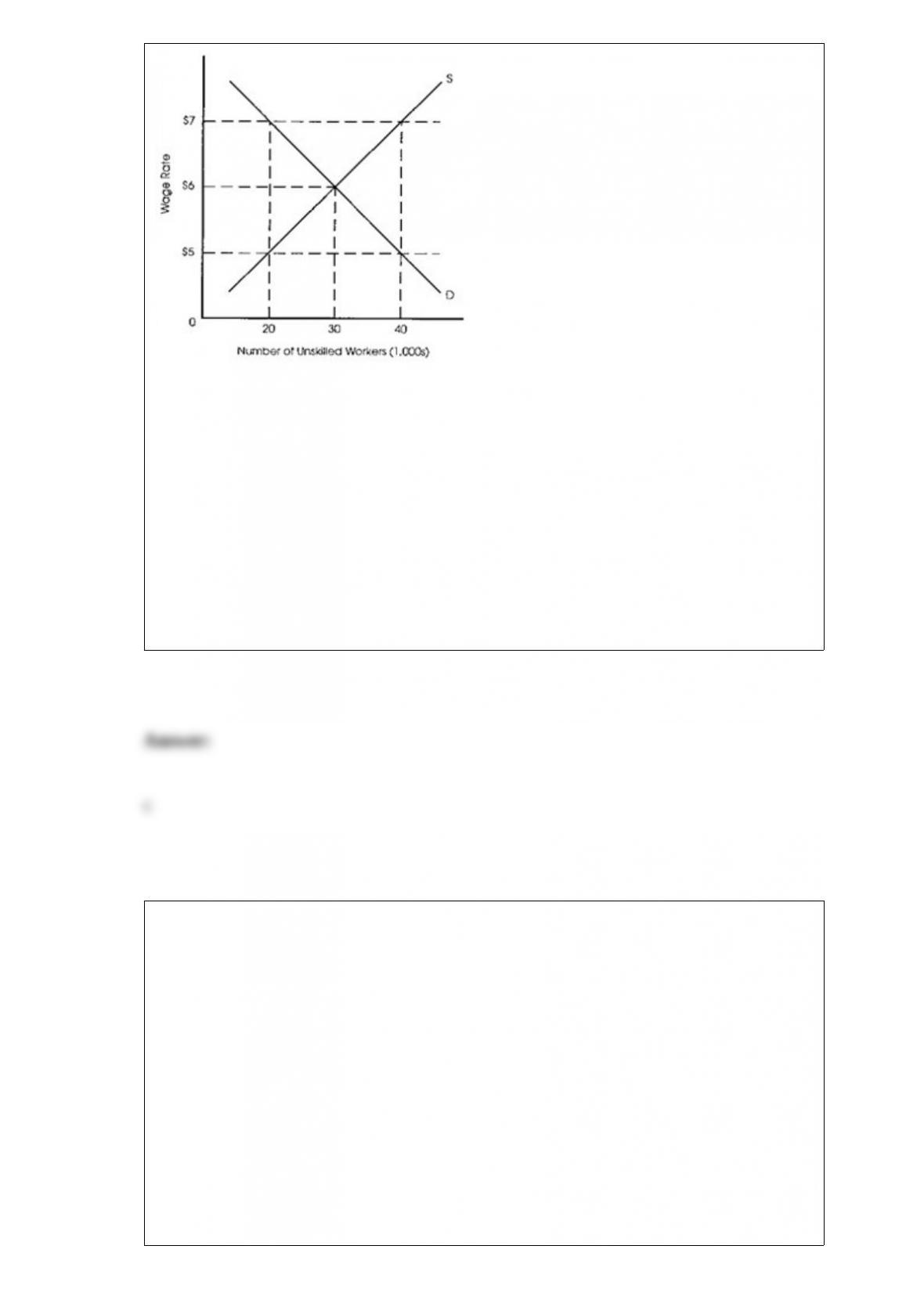
Suppose the minimum wage is set at $5. The result will be
a. unemployment.
b. a shortage of unskilled labor.
c. no impact on the unskilled labor market.
d. a prolonged surplus of unskilled labor.
e. none of the above
Countries tend to specialize in the production of goods in which they have a
comparative advantage because
a. government officials calculate opportunity costs and suggest to people what they
ought to produce.
b. people want to make a profit.
c. the Economic Development Office of the United Nations hires economic experts to
calculate the opportunity costs of different goods in different countries and then
suggests to countries what they ought to produce.
d. the United Nations hires economic experts to calculate the opportunity costs of
different goods in different countries and then suggests to countries what they ought to

produce.
e. none of the above
Which of the following statements is true?
a. Bad weather isn’t always that bad for farmers’ incomes.
b. An individual farmer would probably increase his revenues if he experienced good
weather and other farmers experienced bad weather.
c. Price elasticity of demand is a relevant factor to a farmer’s income.
d. a and b
e. a, b, and c
Exhibit 27-3
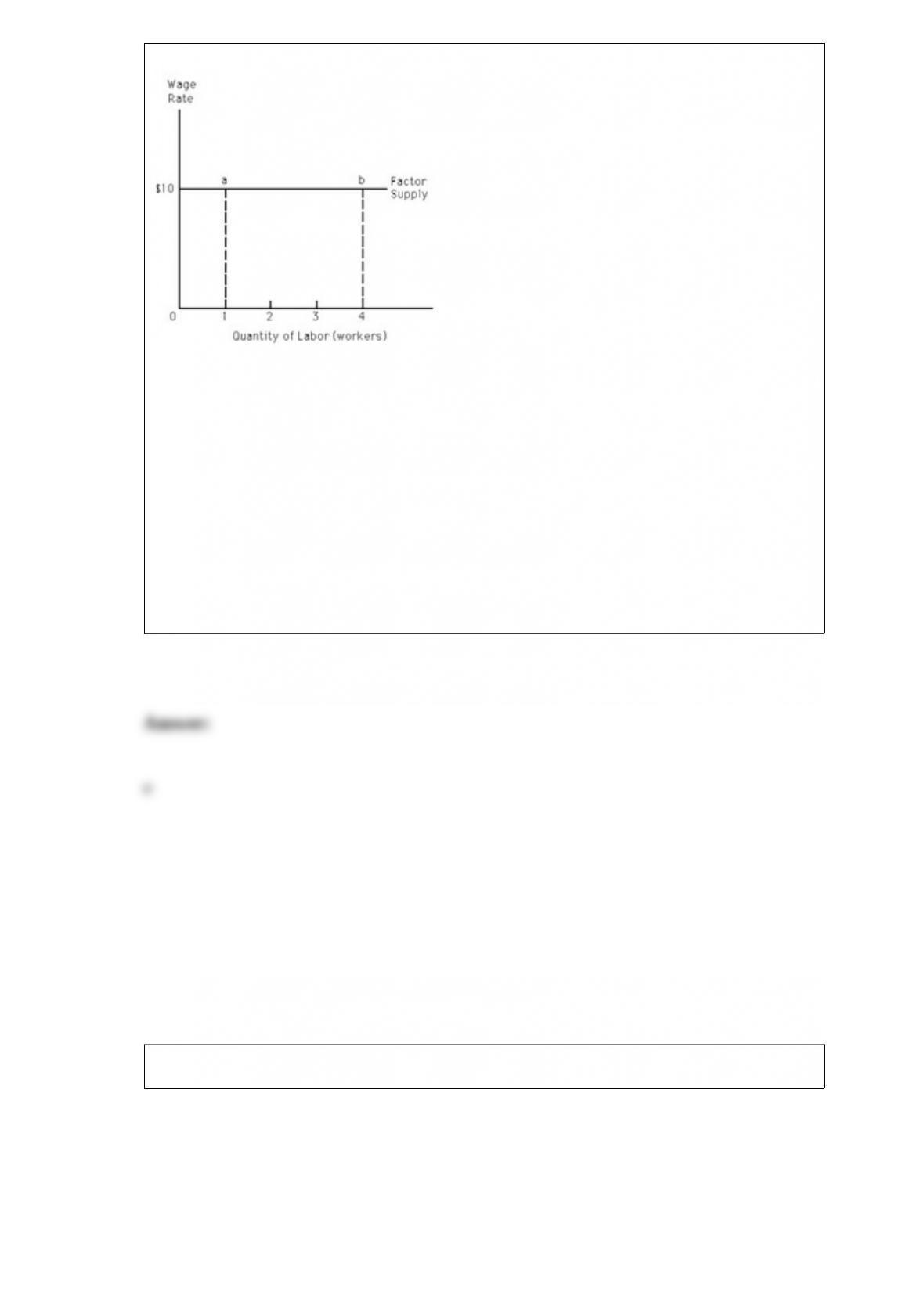
The marginal factor cost (MFC) of the fourth unit of labor is
a. greater than $10 if the firm expects to hire the fourth worker.
b. the same as the MFC of the first unit.
c. less than the wage rate.
d. equal to the wage rate.
e. b and d
Exhibit 32-2
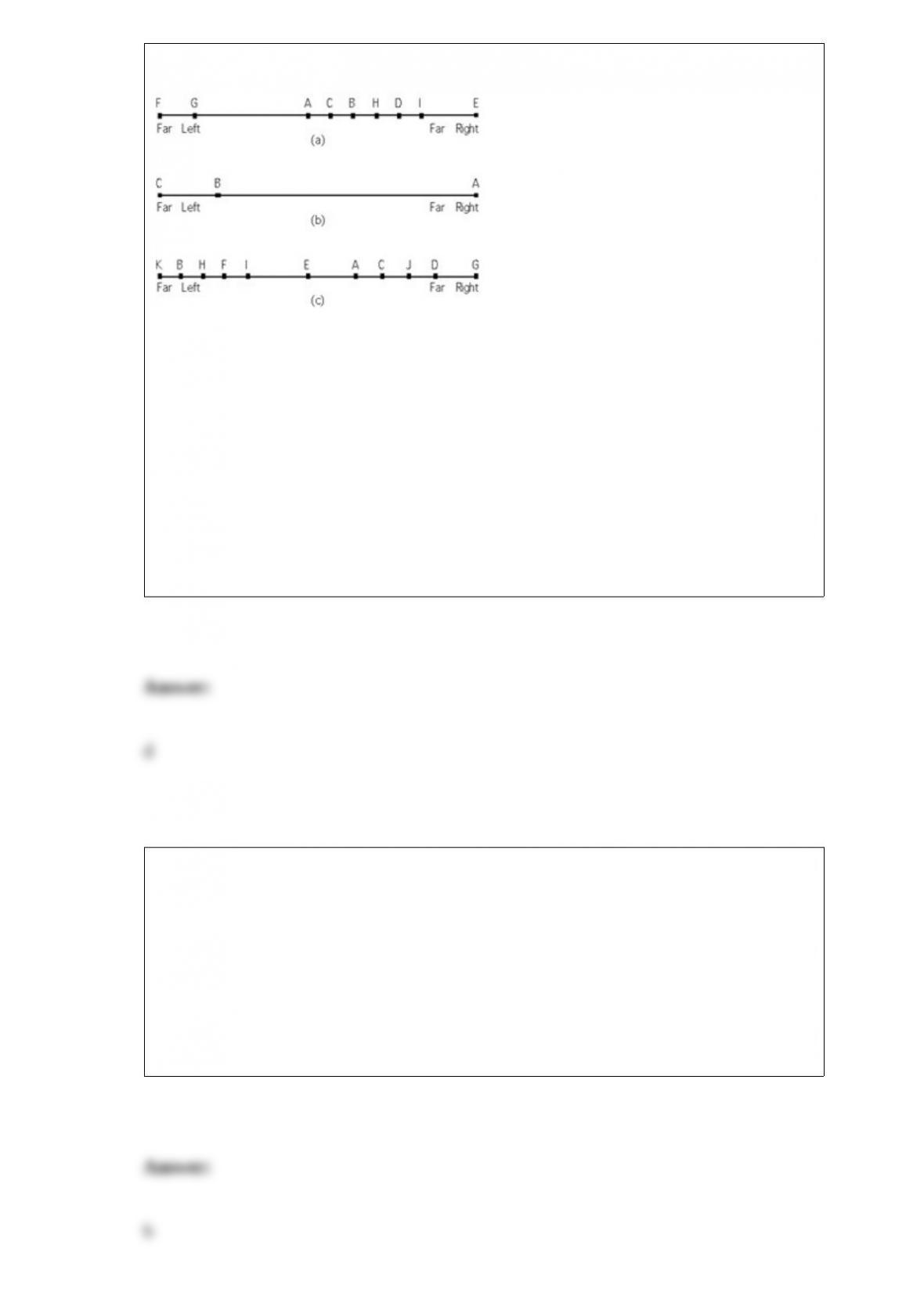
Two candidates are competing for an electorate consisting of 11 voters labeled A-K
shown positioned with respect to their ideological stands on issues. The median voter
theory would predict that candidates will assume the ideological position(s)
a. of voters K and G, respectively.
b. of voters H and J, respectively.
c. of voters I and A, respectively.
d. of voter E.
If private property rights were established in the air, there would probably be
a. more air pollution.
b. less air pollution.
c. the same amount of air pollution that exists without private property rights in the air.
d. better weather.

If variable X goes up as result of variable Y going down, then X and Y are
a. directly related.
b. inversely related.
c. independent.
d. positively related.
Which of the following is a microeconomics topic?
a. the study of how prices are determined in the computer industry
b. the study of unemployment in the economy
c. the study of how changes in the nation’s money supply affect the nation’s output
d. a and c
e. b and c
Good Y is an inferior good. If the average income of those who buy good Y rises, the
_____________ curve for good Y will shift ____________ resulting in a(n)
_____________ in the equilibrium price of Y and a(n) ____________ in the

equilibrium quantity of Y.
a. supply; rightward; decrease; increase.
b. demand; leftward; decrease; decrease
c. demand; rightward; increase; increase
d. supply; leftward; increase; decrease
e. supply; leftward; increase; increase
The law of diminishing marginal utility
a. allows us to make interpersonal utility comparisons.
b. tells us that an additional dollar is worth less to a millionaire than to a poor person.
c. tells us the worth of an additional dollar of income.
d. tells us that an additional dollar of income is worth less than the preceding dollar of
income.
e. a, b, and d
Which of the following statements is true?
a. All persons have a high rate of time preference.
b. People with a high rate of time preference are more likely to be borrowers than

people with a low rate of time preference.
c. People with a high rate of time preference are more likely to be lenders than people
with a low rate of time preference.
d. A high interest rate is the cause of a high rate of time preference.
e. none of the above