The exchange rate is $1 = 110 yen. If the price of a Japanese good is 37,500 yen, what
is the approximate price of the good in dollars?
a. $29.45
b. $4,125,000
c. $294.49
d. $340.91
e. none of the above
A call option is a contract
a. that gives the owner the right, but not the obligation, to buy shares of a stock at a
specified price within the time limits of the contract.
b. that gives the owner the right, but not the obligation, to sell shares of a stock at a
specified price within the time limits of the contract.
c. in which the seller agrees to provide a particular good to the buyer on a specified
future date at an agreed-upon price.
d. that gives the owner the right, but not the obligation, to buy or sell shares of a stock
at a specified price within the time limits of the contract.
Which of the following statements is false?
a. There are more poor white persons than there are poor African-American persons.
b. People are more likely to be poor when they are young than at any other time.
c. Families headed by females are more likely to be poor than families headed by males.
d. The uneducated and poorly educated are more likely to be poor than the educated.
e. none of the above
A negative externality is internalized when __________ until the socially optimum
level of production is obtained.
a. supply shifts to the left
b. supply shifts to the right
c. demand shifts to the right
d. b and c
e. none of the above
If the long-run industry supply curve is downward-sloping, it follows that there are
__________ costs in the industry.
a. increasing
b. constant
c. decreasing
d. a or b
e. There is not enough information to answer the question.
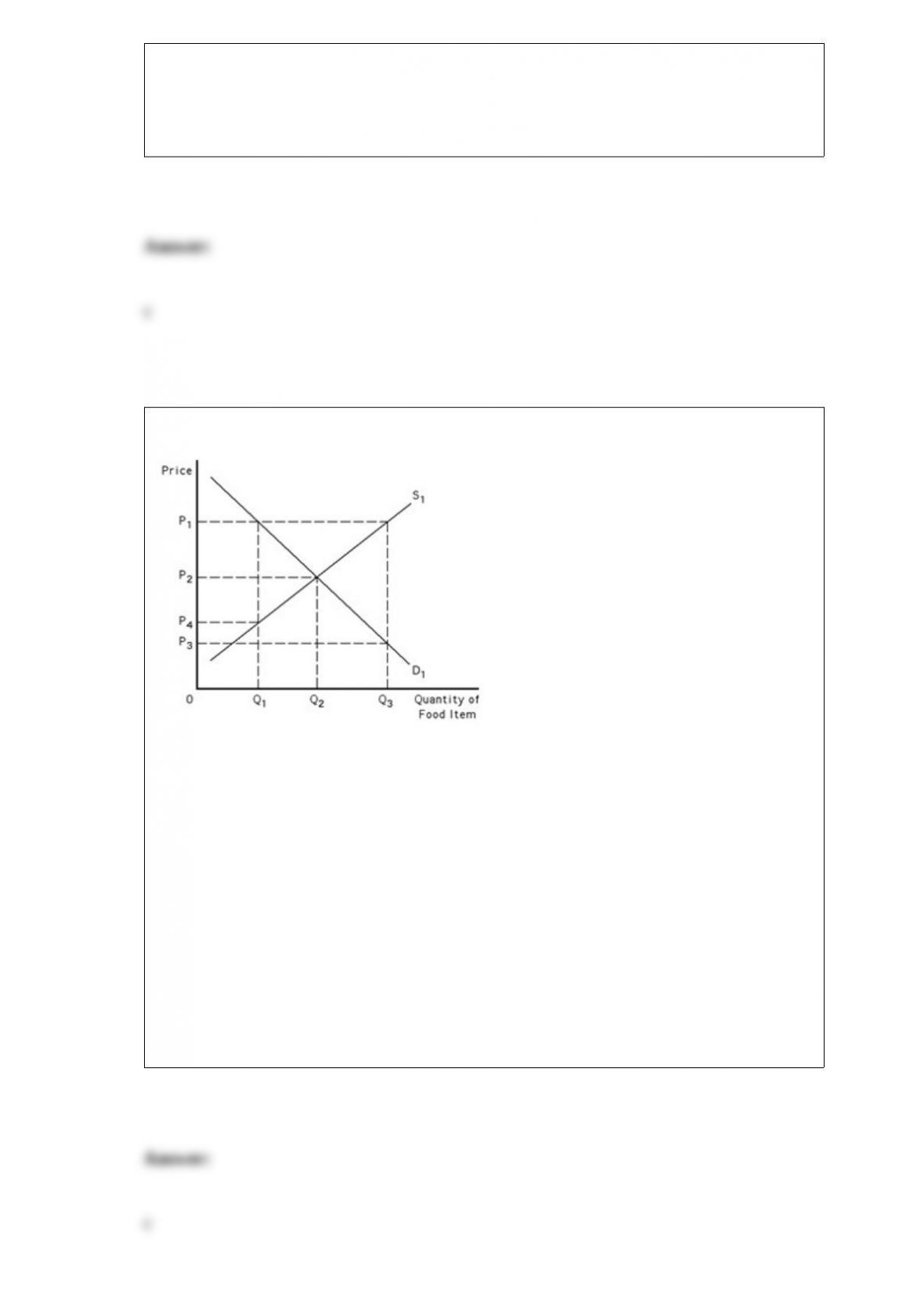
Exhibit 39-9
Under a target price system, with the target price set at P1, the price at which consumers
will buy the food item is
a. P1.
b. P2.
c. P3.
d. P4.
e. There is not enough information to answer the question.
In the market for a given product, when a price floor is set above the equilibrium price
the result will be
a. more exchanges made in the market.
b. an increase in the supply of the product.
c. a decrease in the demand for the product.
d. a deadweight loss.
The concept of an optimal currency area arose from the debate over whether fixed or
flexible exchange rates are better.
a. True
b. False
A monopolist maximizes profits at the output at which
a. total revenue is at its greatest, assuming that the firm has both fixed and variable
costs.
b. price equals marginal cost.
c. price exceeds marginal cost by the greatest amount.
d. none of the above
Average variable cost equals
a. average total cost minus average fixed cost.
b. total variable cost divided by the change in output.
c. total variable cost divided by output.
d. price of the variable input times the quantity of the variable input.
e. a and c
Special interest group K receives a 1/100th slice of the economic pie.Its net benefit from
either an economic growth policy or a transfer policy is $200,000.In order for group K
to be indifferent between the two policies, the economic growth policy would have to
make the size of the economic pie (Real GDP) grow by_________________.This type
of analysis is used to show that special interest groups tend to press government for
______________ instead of ________________.
a. $20,000,000; economic growth; transfers
b. $2,000,000; transfers; economic growth
c. $20,000,000; transfers; economic growth
d. $20,000,000; transfers; economic growth
e. none of the above
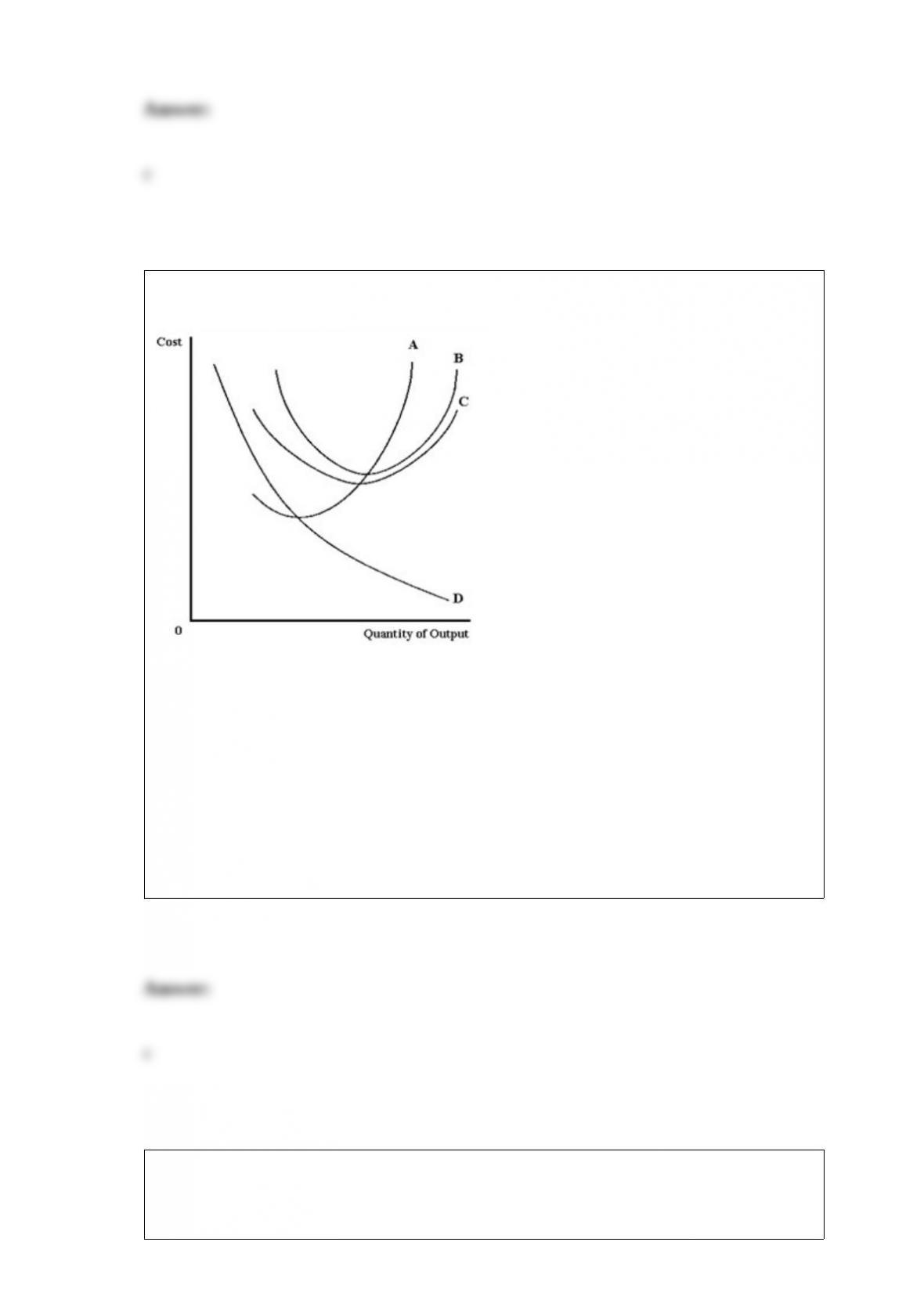
Exhibit 22-4
Curve B is a(n) __________ cost curve.
a. marginal
b. average variable
c. average total
d. average fixed
The Celler-Kefauver Antimerger Act of 1950
a. made interlocking directorates illegal.
b. banned anticompetitive mergers that occurred as a result of one company acquiring
the physical assets of another company.
c. attempted to decrease the failure rate of small businesses by protecting them from the
competition of large and growing chain stores.
d. both a and b
e. all of the above
To an economist, freeway congestion is a sign that the price to drive on the freeway is
a. below its equilibrium level.
b. at its equilibrium level.
c. above its equilibrium level.
d. either a or c
e. none of the above