What is the United States government’s formal definition of the poverty line?
A) It is a level of annual income equal to total income in society divided by the
population, adjusted for a family of four.
B) It is a level of annual income equal to the amount of money necessary to purchase
the minimal quantity of food required for adequate nutrition.
C) It is the annual income level below which a household is exempt from taxes.
D) It is a level of annual income equal to three times the amount of money necessary to
purchase the minimal quantity of food required for adequate nutrition.
Until recently, many developing countries
A) were quite open to foreign investment.
B) encouraged foreign direct investment but discouraged foreign portfolio investment.
C) sealed themselves off from foreign investment.
D) encouraged foreign portfolio investment but discouraged foreign direct investment.
Which of the following statements about economic resources is false?
A) Economic resources include financial capital and money.
B) Economic resources are also called factors of production.
C) Economic resources are used to produce goods and services.
D) Some economic resources are human-made while others are found in nature.
A monetary policy target is a variable that
A) the Fed can affect directly.
B) equals one of the Fed’s main policy goals.
C) the Fed has no ability to change.
D) the Fed cannot affect directly.
Which of the following could be evidence of a market failure?
A) Resources in an economy are not fully utilized.
B) The market price of a product is above the average cost of production.
C) There are only a handful of firms competing against each other in an industry.
D) Market prices do not reflect true production costs.
Suppose President Obama is successful in passing a $5 billion tax increase. Assume that
taxes are fixed, the economy is closed, and the marginal propensity to consume is 0.75.
What happens to equilibrium GDP?
A) There is a $20 billion increase in equilibrium GDP.
B) There is a $20 billion decrease in equilibrium GDP.
C) There is a $15 billion increase in equilibrium GDP.
D) There is a $15 billion decrease in equilibrium GDP.
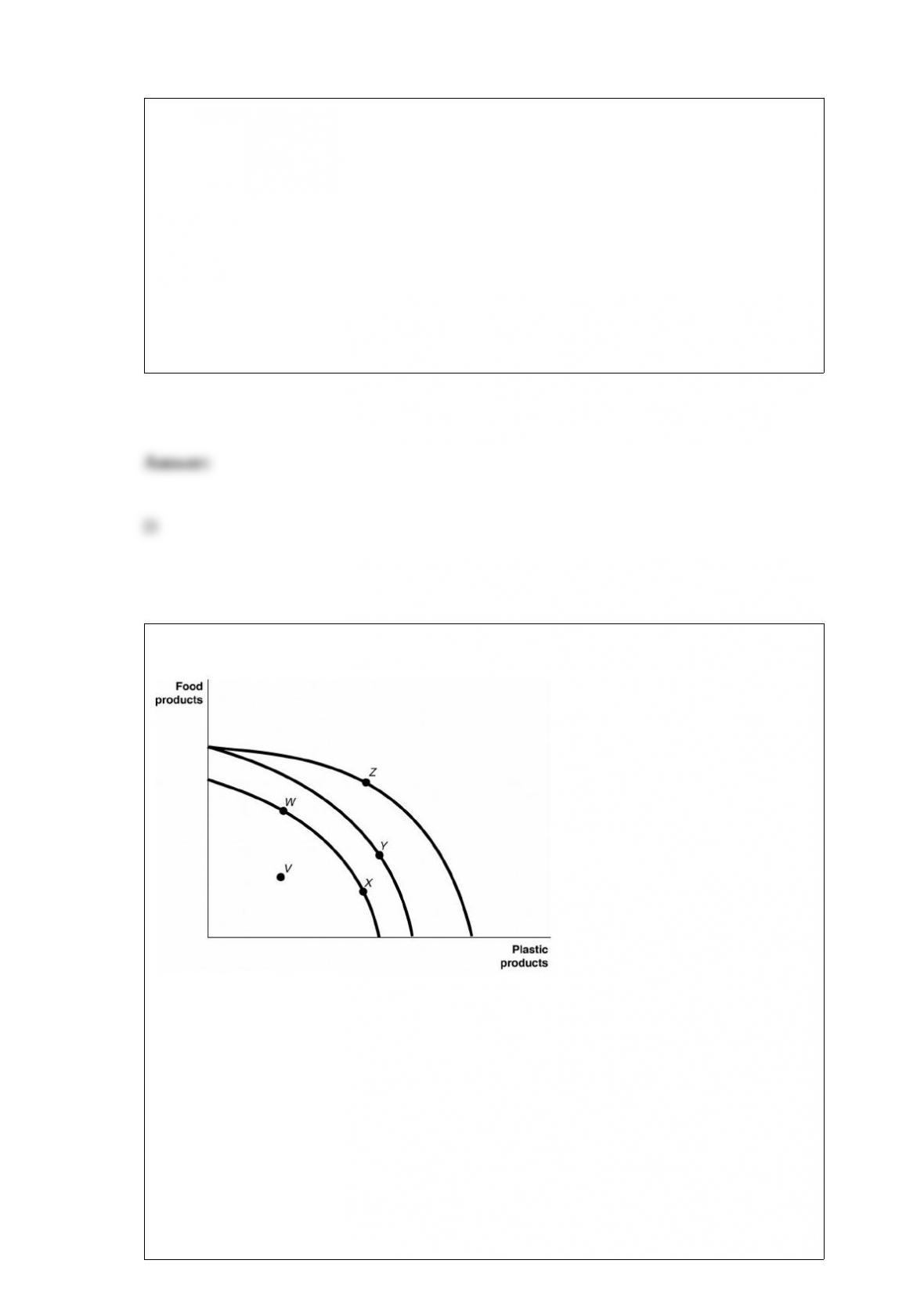
Figure 2-4
Figure 2-4 shows various points on three different production possibilities frontiers for
a nation. Consider the following movements:
a. from point V to point W
b. from point W to point Y
c. from point Y to point Z Which of the movements listed above represents
advancements in technology with respect to only plastic production?
A) a, b, and c

B) b and c only
C) b only
D) c only
Inflation tends to ________ during the expansion phase of the business cycle and
________ during the recession phase of the business cycle.
A) increase; decrease
B) decrease; increase
C) decrease; decrease further
D) increase; increase further
Which of the following is an example of a common resource?
A) the Sumatran tiger population in the world
B) rabbit fur
C) the stock of knowledge in the public domain
D) taxicab services

Health problems prevent people from working harder, which can lower a country’s total
income. This indicates that in effect, health problems
A) are a primary cause of price decreases.
B) increase the incentive to work.
C) shift country’s production possibilities frontier inward.
D) decrease consumer surplus.
Farah has $100 to spend each month on bread and chicken. Suppose the price of bread
is $4 a loaf and the price of chicken is $5 per pound.
a. Draw her budget constraint and label it BC0. Put bread on the horizontal axis and
chicken on the vertical axis. Be sure to identify the intercept values.
b. Suppose Farah is a utility maximizer and she consumes 10 loaves of bread and 12
pounds of chicken. On the same graph you drew in part (a), draw an indifference curve
to identify her optimal bundle. Label this bundle “E.”
c. Is her budget exhausted? Verify your answer.
d. Now suppose Farah’s income falls to so that she can now devote $80 to the two
goods. Prices however remain unchanged. In the same diagram, graph her new budget
constraint and label it BC1. Be sure to identify any new intercept values.
e. Following the change in income, can Farah consume the same bundle “E“? Explain
your answer.
f. What must happen to her total utility following the decrease in her income?
A decrease in consumer confidence can put your job at risk if
A) aggregate expenditures fall.
B) consumers expect their incomes to rise in the future.
C) aggregate expenditures rise.
D) consumers expect firms to increase investment in the future.
Odd pricing became common in the late 19th century. Although the origins of odd
pricing are uncertain, several explanations for the practice have been given. Which of
the following is one of these explanations?
A) Odd pricing forced employees to give customers change. This made it more likely
that employees would record sales rather than pocketing their customers’ money.
B) Odd pricing began in an era when it was difficult for owners and managers of firms
to determine the marginal cost of the goods and services they sold. Odd prices were
rough estimates designed to cover costs plus earn firms a profit.
C) Odd pricing was begun in England in the 1700s when America was part of the
British Empire. Members of the British Royal Court were given the task of pricing
products. After independence, merchants in the United States carried on the practice of
odd pricing.
D) After the passage of the Sherman Act in 1890, merchants used odd pricing as a
means of avoiding prosecution for antitrust violations.
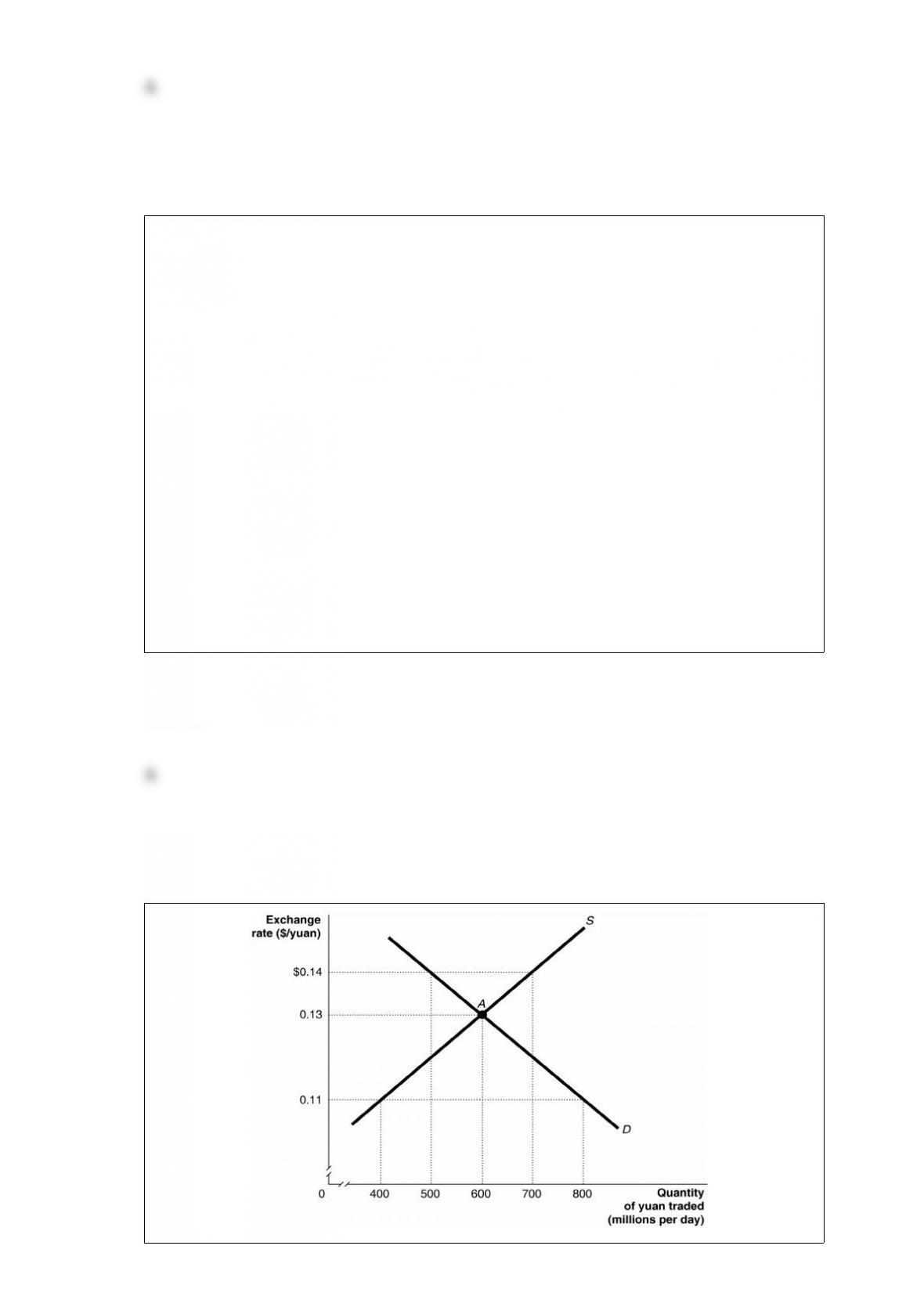
Figure 30-5

Suppose the pegged exchange rate is $0.14/yuan and U.S. consumers increase their
demand for Chinese products. Using the figure above, this would
A) increase the surplus of Chinese yuan.
B) decrease the surplus of Chinese yuan.
C) decrease the shortage of Chinese yuan.
D) increase the shortage of Chinese yuan.
Suppose the government imposes an 8 percent sales tax on clothing items and the tax is
levied on sellers. Who pays for the tax in this situation? (Assume that the demand curve
is downward-sloping and that the supply curve is upward-sloping.)
A) The tax is borne entirely by the sellers.
B) The sellers will pass on the entire sales tax to consumers and therefore the
consumers bear the tax.
C) The tax will be borne partly by consumers and partly by sellers.
D) It is not possible to answer the question without information on price elasticities.