
According to the Keynesian view, the rapid increase in government spending and large
budget deficits in response to the recession of 2008-2009 would
a. slow the recovery process and result in weak long-term growth of real GDP.
b. speed the recovery process and provide the foundation for strong long-term growth
of real GDP.
c. stimulate a more rapid recovery, but cause the economy to fall back into a recession
in the near future.
d. slow the recovery process, but provide the foundation for rapid long-term growth of
real GDP.
The unemployment rate equals the number of persons
a. unemployed divided by the number employed.
b. unemployed divided by the number in the labor force.
c. unemployed divided by the population age 16 and over.
d. not working divided by the population age 16 and over.
Other things constant, if the demand for computer scientists rises,
a. the wages of computer scientists will tend to fall.

b. employment of computer scientists will tend to rise.
c. there will be a surplus of computer scientists.
d. there will be a shortage of computer scientists.
If the Fed sells bonds and, thereby, unexpectedly shifts to a more restrictive monetary
policy, in the short run, the primary impact of this policy will tend to
a. increase inflation.
b. reduce unemployment.
c. increase real output.
d. increase real interest rates.
Which of the following will increase interest rates in the short run?
a. an decrease in reserve requirements
b. the sale of bonds by the Federal Reserve in the open market
c. a decrease in real GDP
d. an decrease in the price level

During 1929-1933, monetary policy was
a. highly expansionary and this led to an increase in the general level of prices.
b. characterized by steady monetary growth, which resulted in price stability.
c. characterized by a sharp reduction in the supply of money, which led to downward
pressure on prices and a decline in output.
d. highly expansionary and this led to a reduction in the general level of prices.
Assume that supply decreases greatly and demand decreases slightly. Which of the
following will happen?
a. Equilibrium price will fall and equilibrium quantity will rise.
b. Equilibrium price will rise and equilibrium quantity will fall.
c. Equilibrium price will rise and equilibrium quantity will rise.
d. Equilibrium price will fall and equilibrium quantity will fall.
e. Neither equilibrium price nor equilibrium quantity will change.
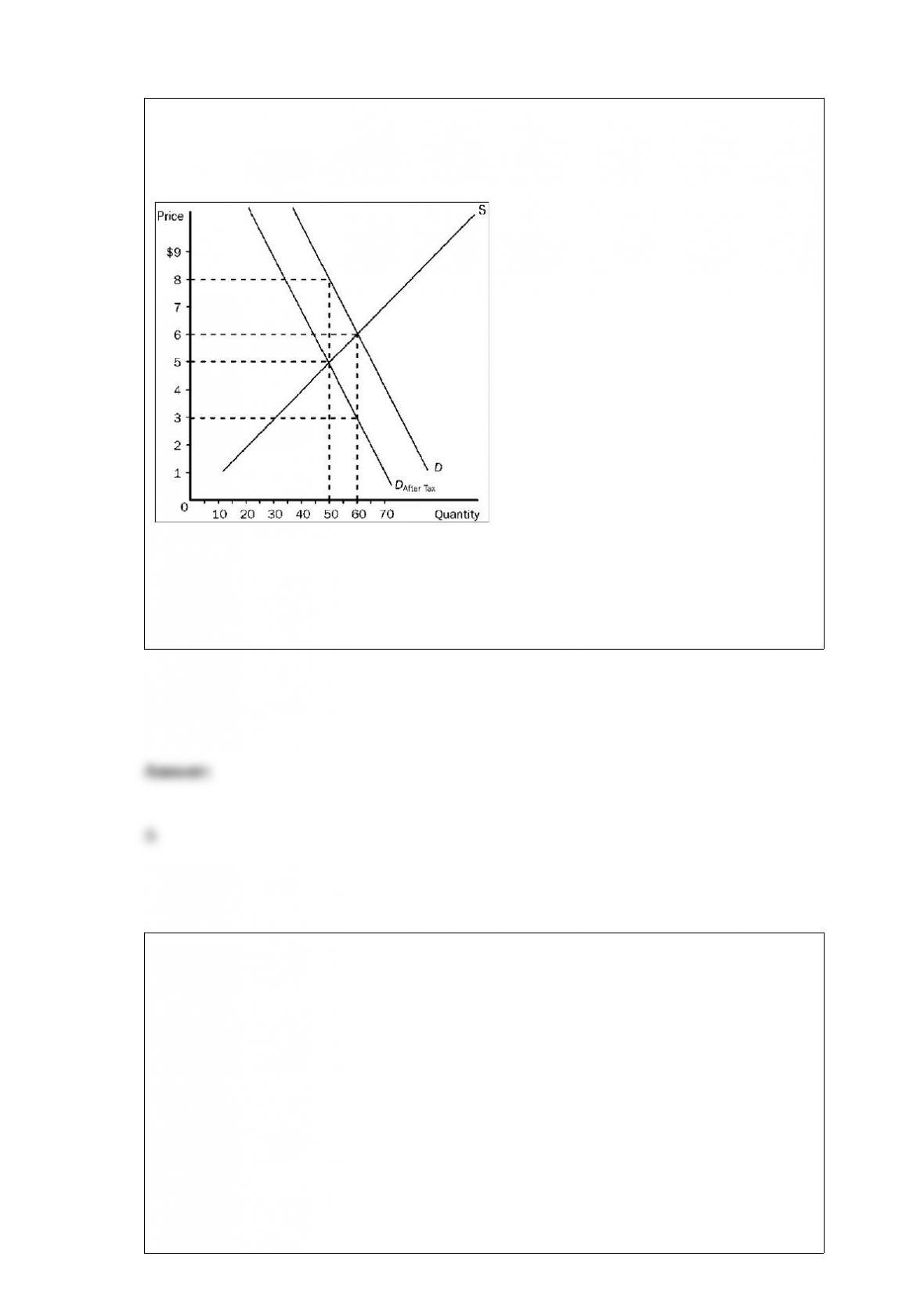
Figure 4-20
Refer to Figure 4-20. The burden of the tax on sellers is
a. $1.00 per unit.
b. $1.50 per unit.
c. $2.00 per unit.
d. $3.00 per unit.
When the federal government owns land resources, such as parks, that are funded by
tax dollars,
a. park mangers receive full information about visitor desires simply by asking visitors.
b. public park managers have the same incentives as private park managers, where
visitors pay at least the actual costs of use.
c. park managers devote much time and effort to satisfying congressional desires
instead of visitor desires.
d. park managers will be well-informed of visitor demands regardless of the funding
mechanism.
The cost of holding money balances increases when
a. the inflation rate decreases.
b. the nominal interest rate increases.
c. the nominal interest rate decreases.
d. nominal GDP is far from full employment.
Use the figure below to answer the following question(s).
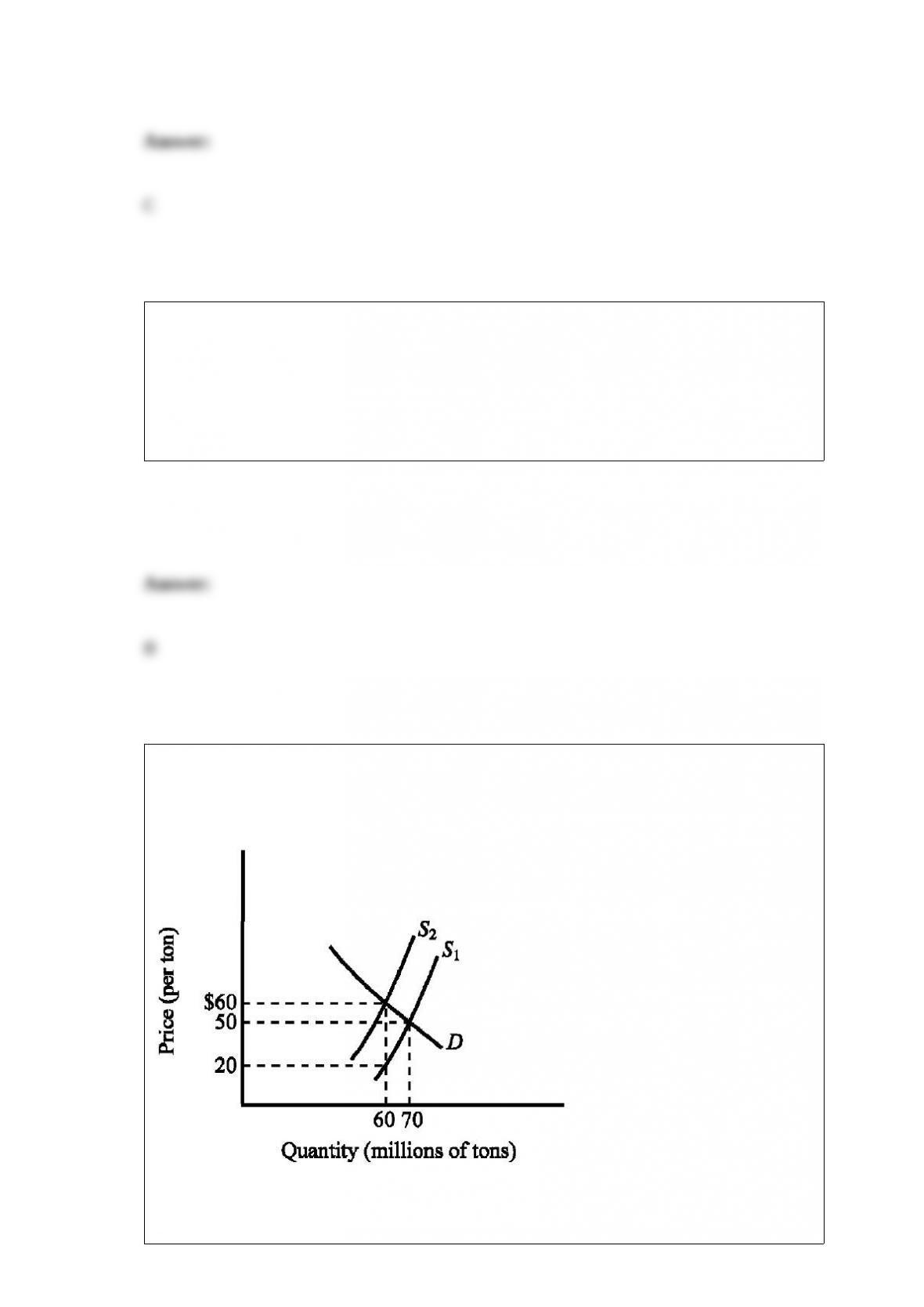
Figure 4-8
Refer to Figure 4-8. Which of the following is true?

a. The tax increases the price of soft coal by $40 per ton.
b. Since the demand for soft coal is more inelastic than the supply, consumers bear most
of the burden of the tax.
c. Since the demand for soft coal is more elastic than the supply, suppliers of soft coal
bear most of the burden of the tax.
d. Since the supply of soft coal is highly inelastic, the primary burden of the tax is
imposed on the consumers of soft coal.
Land used to grow corn could also be used to grow soybeans. Which of the following is
true when the farmer plants soybeans and the market price of corn rises?
a. The opportunity cost of producing soybeans decreases.
b. The opportunity cost of producing soybeans increases.
c. There will be no change in the opportunity cost of producing soybeans.
d. The opportunity cost of producing corn increases.
Keynes rejected the view that lower wages would direct a recessionary economy back
to full employment because
a. lower wages would cause the central bank to reduce the money supply and thereby
prolong the recession.

b. lower wages would stimulate inflation and thereby prolong the recession.
c. market forces would quickly direct an economy back to full employment.
d. powerful trade unions and large corporations made wages highly inflexible.
Because of a late night out with friends, Ayana decided to sleep in rather than attend her
8 a.m. economics class. According to economic analysis, her choice was
a. irrational, because economic analysis suggests you should always attend classes that
you have already paid for.
b. irrational, because oversleeping is not in Ayana’s self-interest.
c. rational only if Ayana has not missed any other classes.
d. rational if Ayana values sleep more highly than the benefit she expects to receive
from attending the class.
Figure 8-5
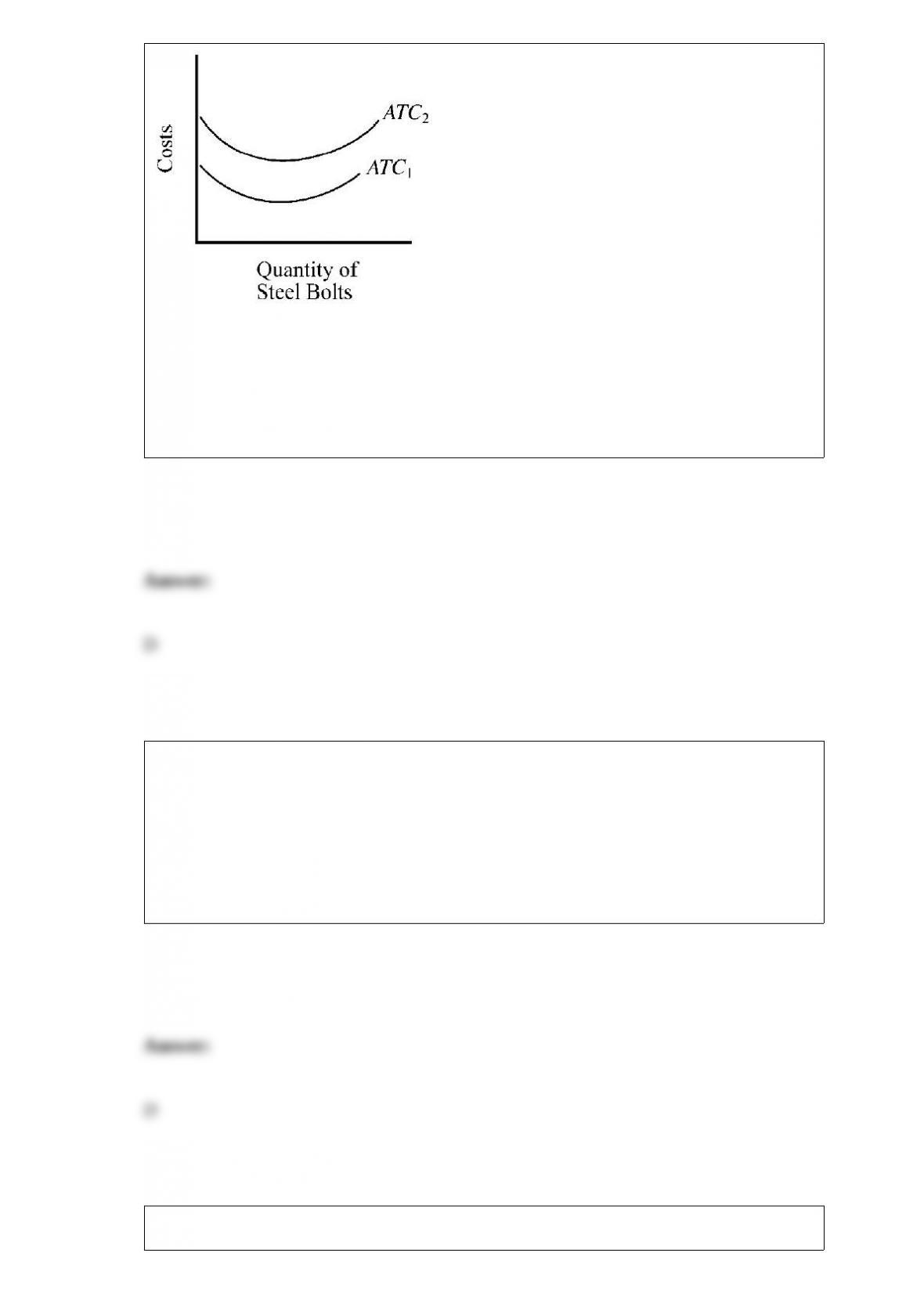
Refer to Figure 8-5. Which of the following would most likely cause the average total
cost curve of a firm producing steel bolts to shift from ATC1to ATC2?
a. an increase in demand for steel bolts
b. an increase in the market price of steel bolts
c. diminishing returns for the variable factors used to produce steel bolts
d. an increase in the price of steel
When an economy operates at its long-run potential output level,
a. aggregate demand will exceed aggregate supply in the goods and services market.
b. unemployment will decline to an abnormally low rate that cannot be sustained in the
long run.
c. the actual rate of unemployment will exceed the natural rate of unemployment.
d. the natural and actual rates of unemployment will be equal.
The 25 years prior to the crisis of 2008-2009 were

a. characterized by more instability than the first 50 years of the twentieth century.
b. the most stable economic quarter of a century in American history.
c. characterized by more monetary and price instability than any era other than the
1970s.
d. a period of historically slow growth and high unemployment.
Which of the following will reduce the likelihood of effective collusion among
oligopolistic producers?
a. low entry barriers into the market
b. a production of a homogenous product
c. a stable market demand for the product
d. a highly inelastic market demand for the product
Which of the following statements is true?
a. The quality of products sold in black markets tends to be less reliable than the quality
of products in legal markets.
b. For otherwise identical products, the price of products in black markets tends to be
higher than in legal markets.
c. The rate of violence is higher in black markets than in legal markets.

d. All of the above are true.
Economic profit provides an incentive for persons investing in human and physical
capital to
a. undertake investment projects yielding an uncertain return.
b. discover and develop beneficial (productive) investment opportunities.
c. produce products that increase the value of resources.
d. do all of the above.
If tariffs are decreased, the long-run effect is most likely to be
a. a decrease in both U.S. imports and exports.
b. an increase in both U.S. imports and exports.
c. a decrease in U.S. imports and an increase in U.S. exports.
d. an increase in U.S. imports and a decrease in U.S. exports.

Entrepreneurs have a strong incentive to
a. discover new production techniques that reduce costs.
b. introduce new products that are highly valued relative to their cost.
c. produce goods that are valued more highly than the resources required for their
production.
d. do all of the above.
If one subtracts the amount of bonds held by agencies of the federal government and the
Federal Reserve from the national debt, what remains is known as the
a. external debt.
b. privately held government debt.
c. trade deficit.
d. budget deficit.
When equilibrium is present, if market conditions do not change,
a. the current price will tend to rise in the future, and the current quantity will tend to
fall.
b. the current price will tend to fall in the future, and the current quantity will tend to
rise.
c. the current price and quantity will tend to persist in the future.
d. the current price will tend to persist in the future, but the current quantity will tend to
rise.
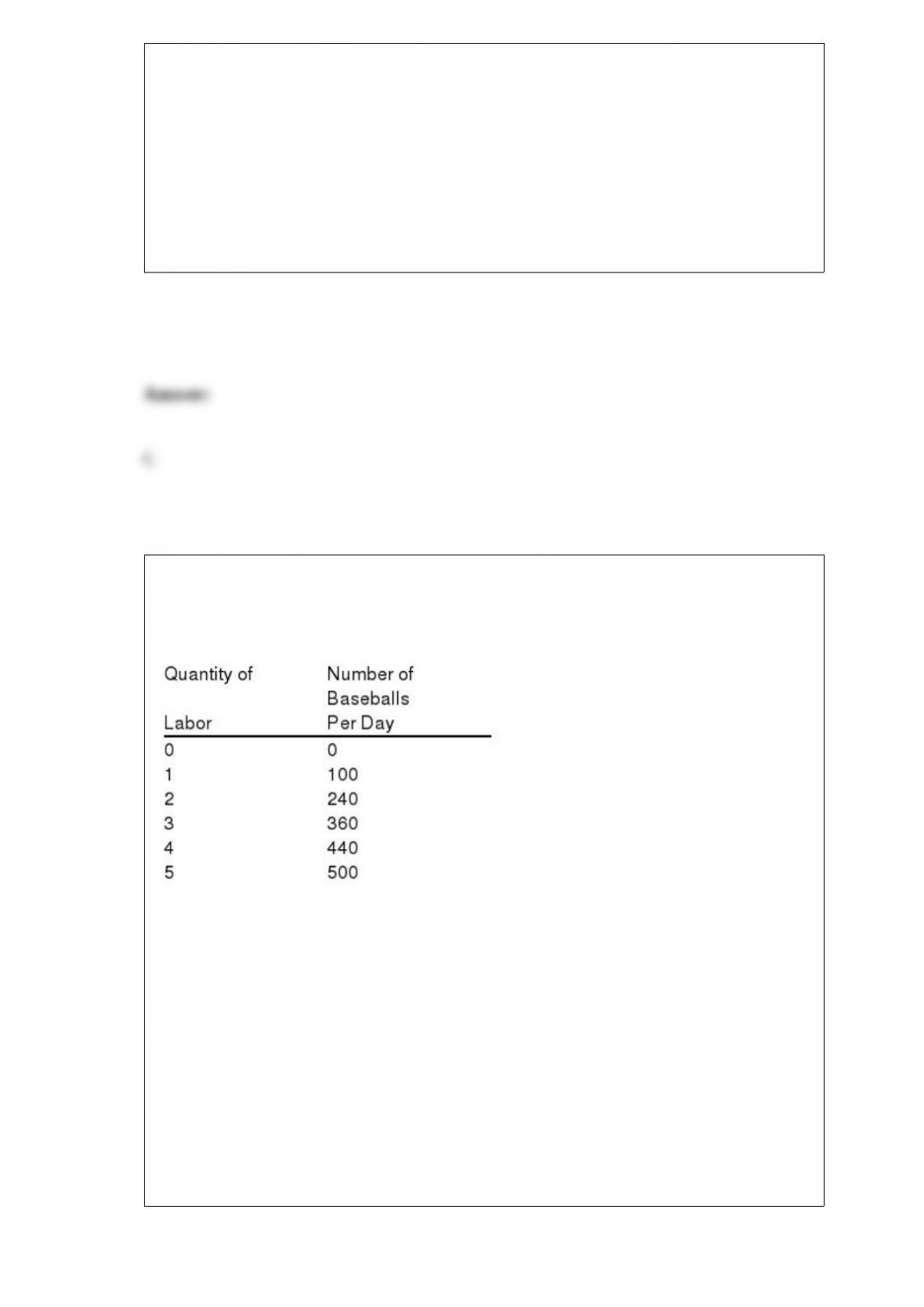
Table 12-2
Refer to Table 12-2. This table describes the number of baseballs a manufacturer can
produce per day with different quantities of labor. Each baseball sells for $5 in a
competitive market. For which level of employment is the marginal product of labor
greatest?
a. 1 worker
b. 2 workers
c. 3 workers
d. 4 workers

Consider two goods – one that generates external benefits and another that generates
external costs. The actual market outcome would
a. result in a price that is lower than the efficient price for both goods.
b. result in a price that is higher than the efficient price for both goods.
c. result in a price that is lower than the efficient price for the good with an external
benefit and a price that is higher than the efficient price for the good with an external
cost.
d. result in a price that is higher than the efficient price for the good with an external
benefit and a price that is lower than the efficient price for the good with an external
cost.
If a Pizza Hut restaurant near campus reduces its pizza prices by 15 percent, and as a
result, its total revenue from pizza sales increases, this indicates that the price elasticity
of demand was
a. elastic.
b. of unitary elasticity.
c. inelastic.
d. equal to 0.15.
An investment in human capital will be financially profitable if the present discounted
value of the future earnings generated by the investment exceeds the
a. present discounted value of both the direct and indirect costs of the investment.
b. dollar amount of the direct and indirect costs of the investment.
c. present discounted value of only the direct costs of the investment.
d. present discounted value of only the indirect costs of the investment.
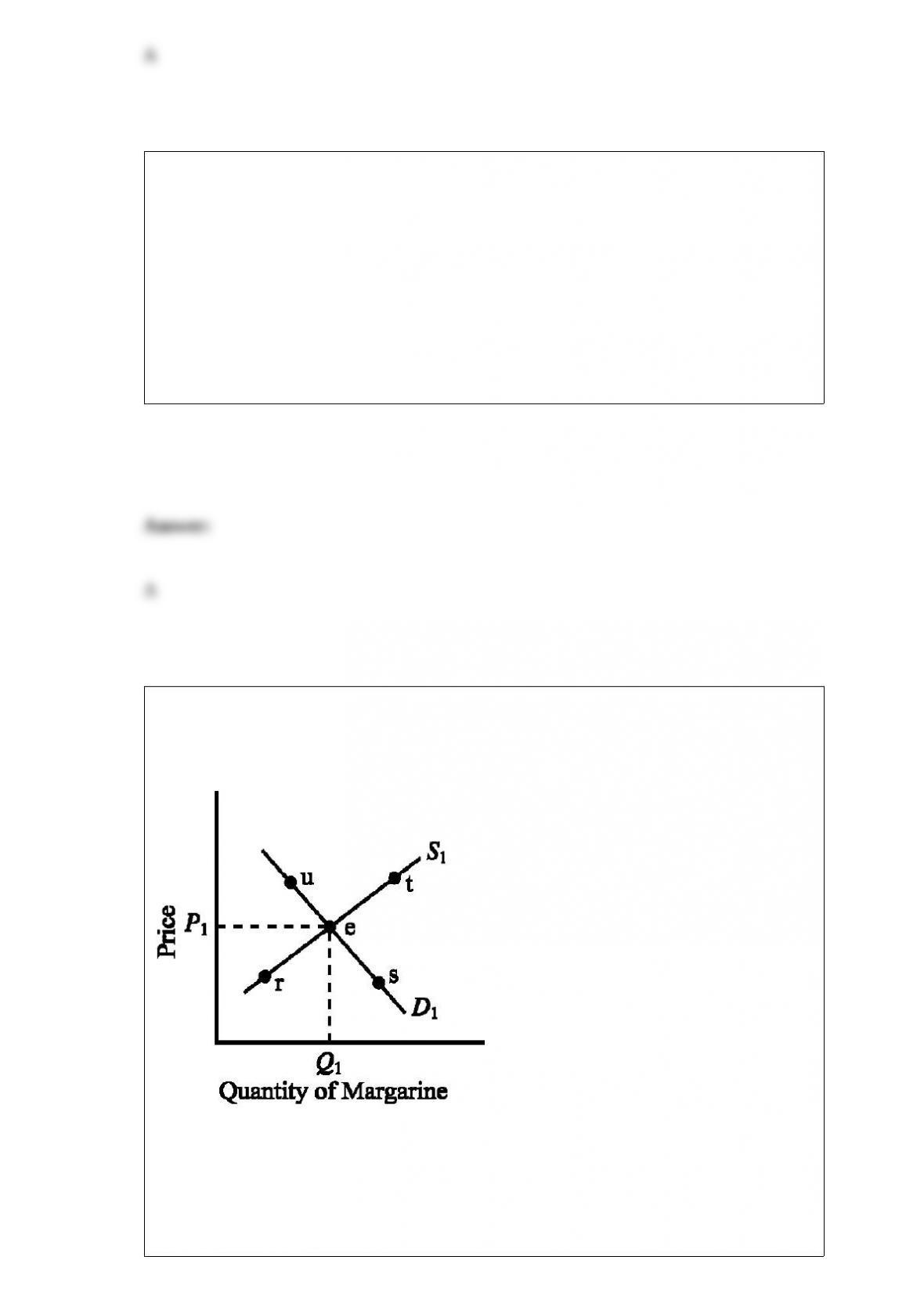
Use the figure below to answer the following question(s).
Figure 3-13
Refer to Figure 3-13. The market for margarine was initially in equilibrium at point e.
Other things constant, an increase in the price of soybean oil, an important ingredient
used to produce margarine, would likely move the equilibrium in this market toward
point

a. r.
b. s.
c. t.
d. u.
The opportunity costs associated with the use of resources owned by a firm are usually
a. externalities.
b. implicit costs.
c. explicit costs.
d. sunk costs.