
Some economists argue that the short-run Phillips curve is not vertical, and that
monetary policy can be effective in the short run. Which one of the following is not one
of the reasons for this skepticism?
A) Empirical evidence shows workers and firms have rational expectations.
B) Contracts with workers and suppliers may hinder firms’ abilities to adjust to price
changes.
C) Wages and prices may not adjust rapidly enough to keep the short-run Phillips curve
vertical.
D) Individuals may not be able to use information of Fed Policy to make a reliable
forecast of inflation.
If the United States is a “net lender” abroad, ________. (Assume that the capital
account is zero and net transfers are zero.)
A) the United States must be exporting less than it is importing
B) net capital flows must be positive
C) domestic saving is greater than domestic investment
D) net foreign investment must be negative
Select the phrase that correctly completes the following statement. “A decrease in the
number of manufacturers caused a decrease in the supply of sailboats. As a result,
A) the price of sailboats increased and the demand for sailboats decreased.”

B) the equilibrium quantity of sailboats increased.”
C) the price of sailboats increased and the quantity demanded of sailboats decreased.”
D) the price of sailboats increased. The higher price caused the supply of sailboats to
increase.”
A monopoly firm’s demand curve
A) is the same as the market demand curve.
B) is perfectly inelastic.
C) is more inelastic than the demand curve for the product.
D) is inelastic at high prices and elastic at lower prices.
Suppose the economy is at full employment and firms become more pessimistic about
the future profitability of new investment. Which of the following will happen in the
short run?
A) Output will rise.
B) Prices will rise.
C) Unemployment will rise.
D) The aggregate demand curve will shift to the right.

After having a monopoly in the diamond market for many years, by 2000 the De Beers
company faced competition from other companies. To maintain its market share, De
Beers
A) began buying so-called “blood diamonds” in order to keep these diamonds out of the
control of other diamond companies.
B) adopted a strategy of differentiating its diamonds. Each of its diamonds is now
marked with a microscopic brand.
C) bought diamond mines in Canada and Russia that had been its competitors.
D) lowered the prices of its diamonds to make the market appear less profitable to
potential competitors.
When actual inflation is less than expected inflation,
A) borrowers lose and lenders gain.
B) borrowers gain and lenders lose.
C) borrowers and lenders both gain.
D) borrowers and lenders both lose.

Selling tickets to graduation ceremonies has long been a tradition among students at
institutions that limit the number of guests. Suppose your classmate, Heidi purchased
two tickets for $40 each. Is this transaction economically efficient?
A) No, people should never be allowed to sell items they received for free.
B) Yes, it was a voluntary exchange that benefited both parties.
C) No, Heidi paid too much for the tickets.
D) Yes, it is efficient only from the perspective of the seller and not from the
perspective of the buyer.
The Industrial Revolution began in
A) England around 1750.
B) the United States around 1820.
C) France around 1680.
D) Germany around 1780.
The largest source of revenue for the federal government of the United States is from
A) tariffs collected on imported goods.

B) property taxes imposed on private property.
C) sales taxes on items purchased for consumption.
D) individual income taxes.
An organization of employees that has the legal right to bargain with employers about
wages and working conditions is called a
A) closed shop.
B) guild.
C) labor union.
D) monopsony.
When housing prices fall, as they did beginning in 2006 following the housing market
bubble, consumption spending on furniture, appliances, and home improvements
________ as many households found it ________ to borrow against the value of their
homes.
A) declined; easier
B) declined; harder
C) increased; easier
D) increased; harder
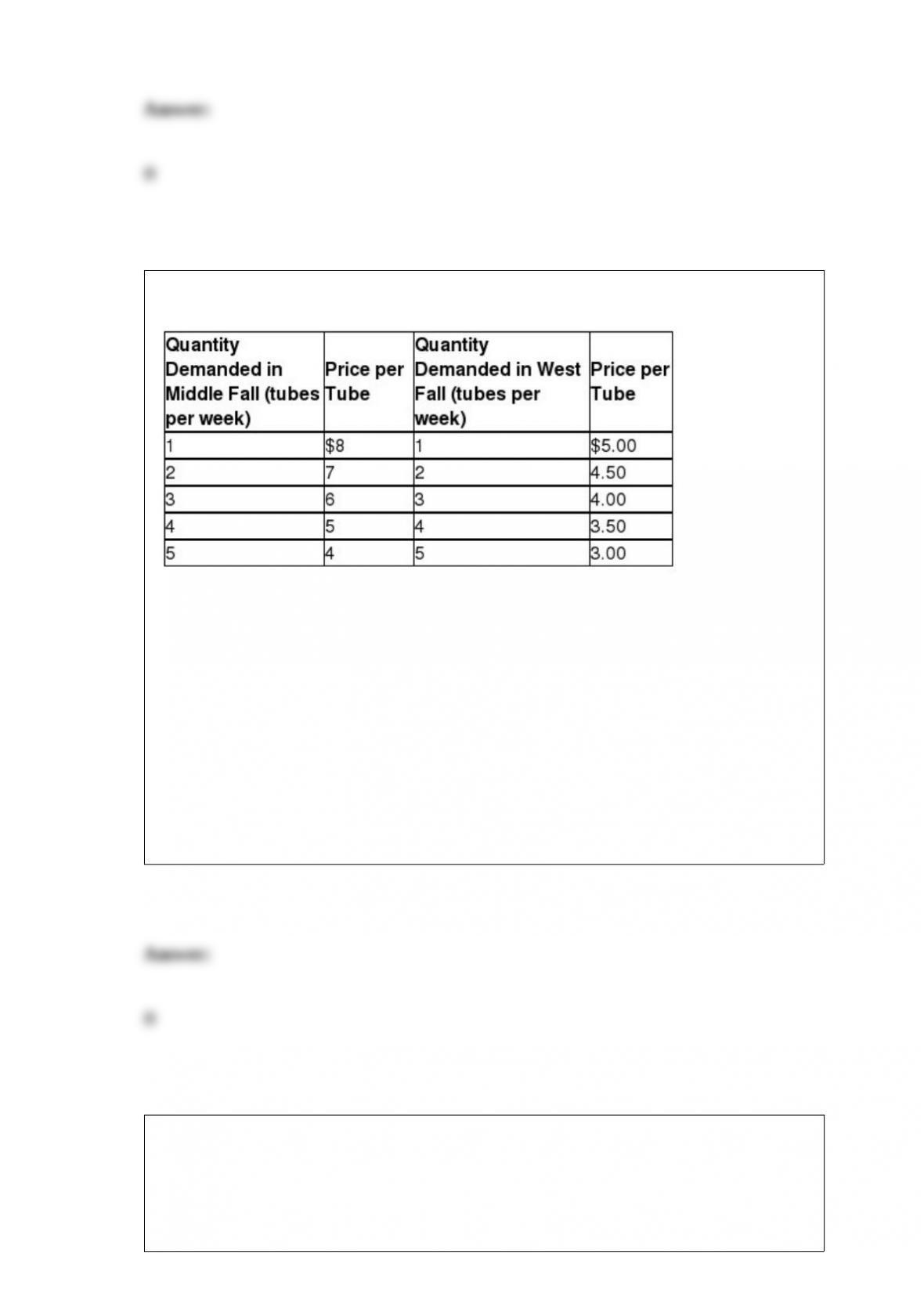
Table 16-2
Neem Products sells its Ayurvedic Neem toothpaste in two completely isolated markets
with demand schedules as shown in Table 16-2. The average cost of production is
constant at $2 per tube. Which of the following statements is trueabout the two
markets?
A) The demand in Middle Fall is more price elastic than the demand in West Fall.
B) The demand in Middle Fall is less price elastic than the demand in West Fall.
C) The demand in Middle Fall is more income elastic than the demand in West Fall.
D) The demand in Middle Fall is less income elastic than the demand in West Fall.
For people who live near a bus route, a subway station, or a commuter rail line, public
transportation provides a substitute to driving their own cars. So, for these people, the
cross-price elasticity of demand between gasoline and public transportation is
A) positive.

B) negative.
C) zero.
D) infinity.
In the 1980s Japan agreed to limit the quantity of automobiles it would export to the
United States. Why did the Japanese government agree to this trade restriction?
A) Japanese automobile producers lobbied for the restrictions in order to increase the
price of their exports to the United States.
B) The Japanese government wanted to limit sales to the United States in order to make
more automobiles available for Japanese consumers.
C) The Japanese government feared that the alternative would be a tariff or quota on
imports of Japanese automobiles imposed by the U.S. government.
D) The Japanese government wanted more automobiles to be available for export to
countries other than the United States.
Which of the following is not a source of technological advancement for a producer?
A) better trained workers
B) more efficient physical capital
C) higher skill level of managers

D) outsourcing some aspect of production