
Sole proprietorships are ________ type of business.
A) the most profitable
B) the least common
C) the most common
D) the least risky
Golda Rush quit her job as a manager for Home Depot to start her own hair dressing
salon, Goldilocks. She gave up a salary of $40,000 per year, invested her savings of
$30,000 (which was earning 5 percent interest) and borrowed $10,000 from a close
friend, agreeing to pay 5 percent interest per year. In her first year, Golda spent $18,000
to rent a salon, hired a part-time assistant for $12,000 and incurred another $15,000 on
equipment and hairdressing material. Based on this information, what is the amount of
her explicit costs?
A) $45,000
B) $45,500
C) $47,000
D) $87,000
If one U.S. dollar could be exchanged for one Australian dollar in 1970, and one U.S.
dollar can now be exchanged for 0.98 Australian dollars, which of the following is true?
A) The U.S. dollar gained value against the Australian dollar.

B) The Australian dollar lost value against the U.S. dollar.
C) The Australian dollar gained value against the U.S. dollar.
D) Both A and C are true.
Presently, GDP is ________ to compensate for the costs of environmental damage.
A) fully adjusted
B) partially adjusted
C) adjusted on a chain-weight basis
D) not adjusted
Explain how each of the following events would affect the long-run aggregate supply
curve.
a. A lower price level
b. A decrease in the labor force
c. A decrease in the quantity of capital goods
d. Technological change
The demand for gasoline in the short run is
A) elastic because people can easily switch to public transportation.
B) perfectly inelastic because people have no choice but to buy gasoline.
C) unit-elastic because people tend to consume a stable amount of gasoline per period.
D) inelastic because there are no good substitutes for gasoline.
If a 6 percent increase in income leads to a 4 percent increase in quantity demanded for
audio books, the income elasticity of demand is
A) -0.67.
B) 0.67.
C) 1.5.
D) 2.

Although some economists believe network externalities are important barriers to entry,
other economists disagree because
A) they believe that the dominant positions of firms that are supposedly due to network
externalities are to a greater extent the result of the efficiency of firms in offering
products that satisfy consumer preferences.
B) they believe that most examples of network externalities are really barriers to entry
caused by the control of a key resource.
C) network externalities are really negative externalities.
D) they believe that the dominant positions of firms that are supposedly due to network
externalities are to a greater extent the result of economies of scale.
Consider the following data for a closed economy:
a. Y = $12 trillion
b. C = $8 trillion
c. I= $3 trillion
d. TR = $2 trillion
e. T = $3 trillion Use the data provided to calculate the level of private saving and the
level of public saving and demonstrate their relationship to investment.
Stan owns a software design business. He obtained a bank loan to buy computer
equipment for his business. He pays $1,000 per month for interest on the loan. He has
10 employees, each of whom is paid $4,000 per month. Because his business has been
successful, next month he will increase employee wages to $5,000. If the revenue from
his business remains at its current level, Stan is considering an addition to his office.
Which of the following statements regarding Stan’s business is false?
A) The payments Stan makes to his employees are variable costs and explicit costs.
B) The monthly payment Stan makes for his bank loan is an implicit cost.
C) The monthly payment Stan makes for his bank loan is a fixed cost.
D) The time and effort Stan spends on his software design business is an implicit cost.
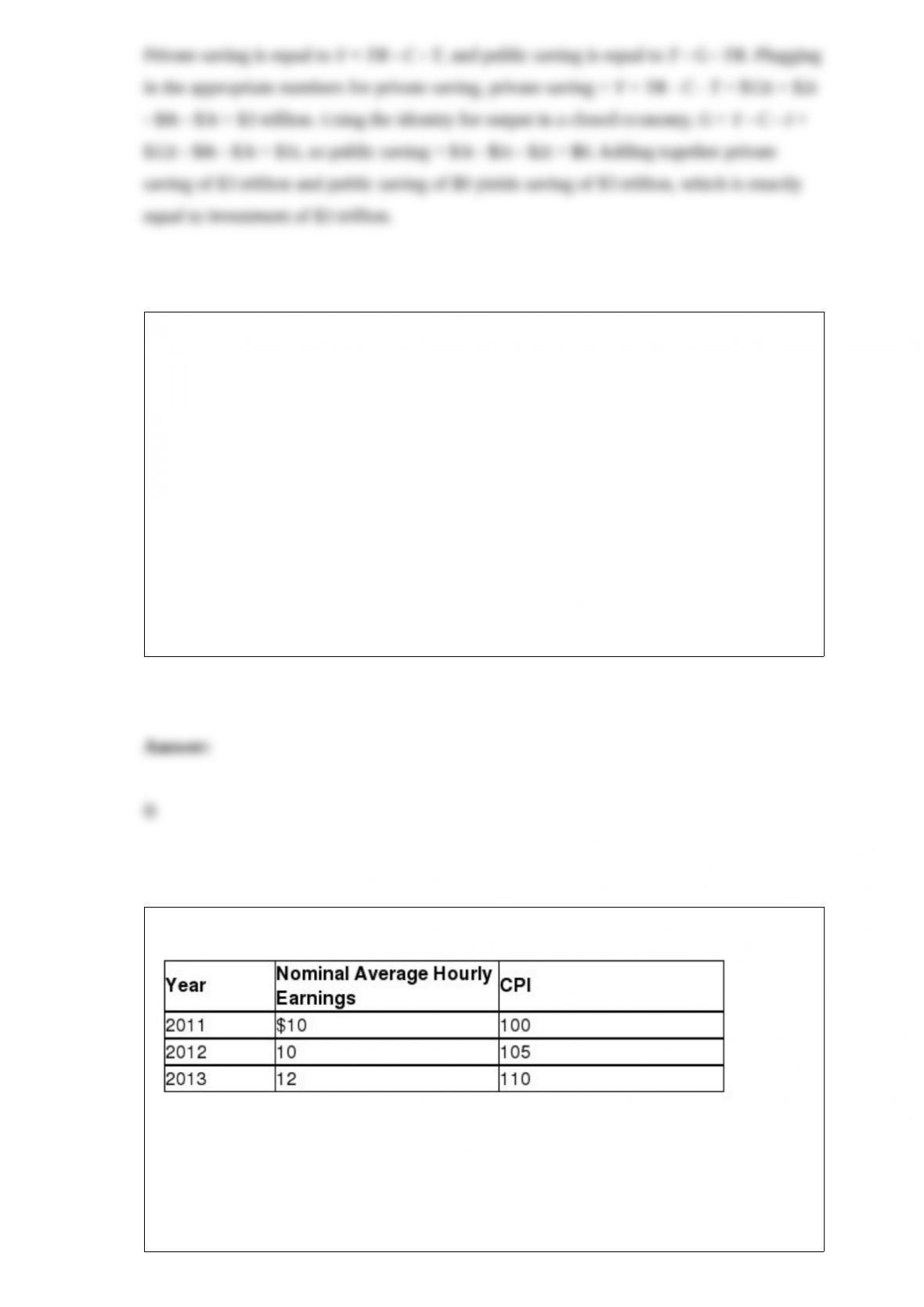
Table 9-15
Looking at the table above, real average hourly earnings in 2011 were
A) $9.
B) $9.52.

C) $10.
D) $12.63.
When the value of a currency is determined ________, the exchange rate system is
defined as a floating exchange rate system.
A) only by supply and demand
B) by its issuing government
C) mostly by supply and demand, but with occasional government intervention
D) by its issuing government, with occasional readjustments in value
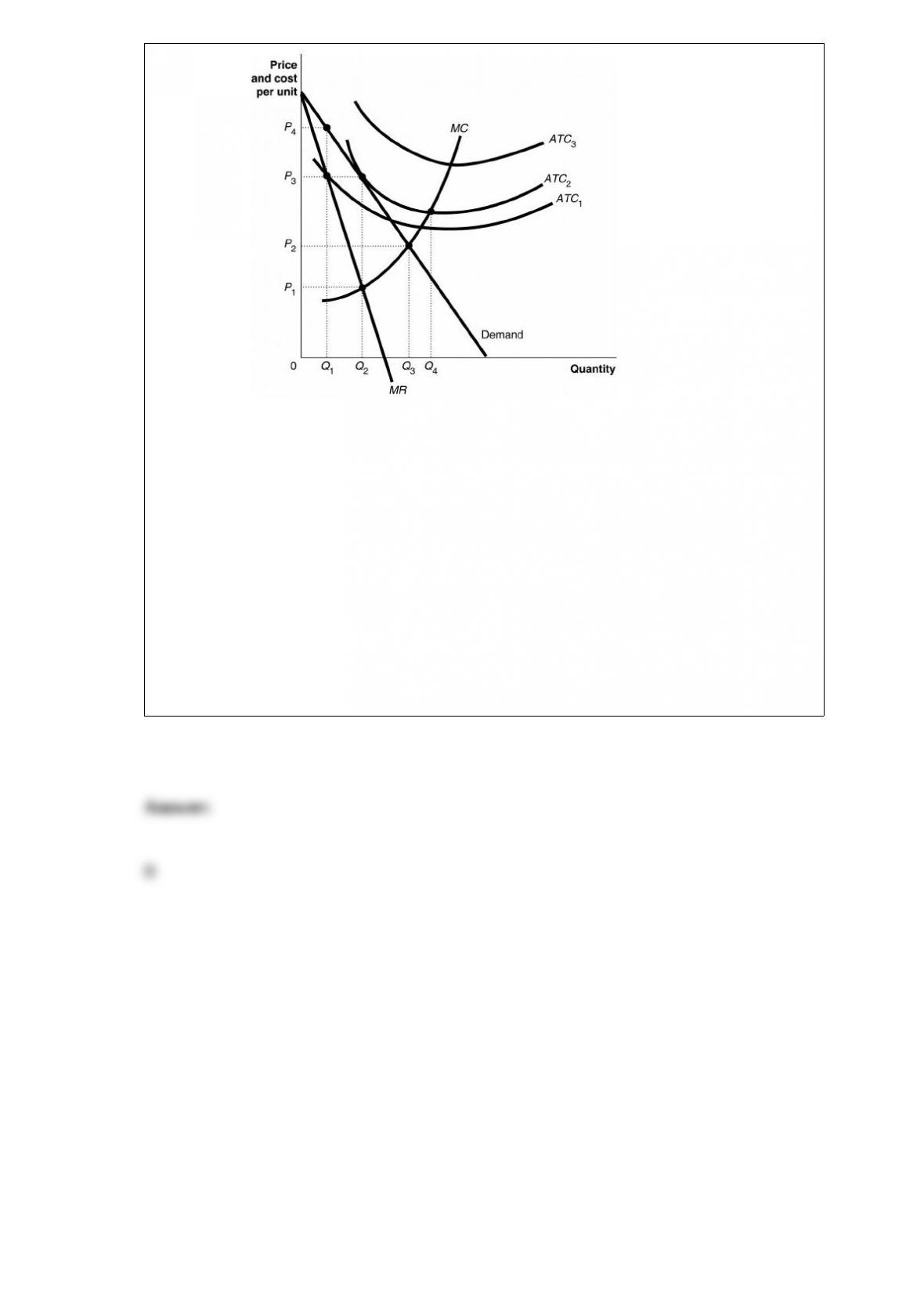
Figure 15-2
Figure 15-2 above shows the demand and cost curves facing a monopolist.
To maximize profit, the firm will produce
A) Q1.
B) Q2.
C) Q3.
D) Q4.