
A three-word synonym for the term ceteris paribus is
a. “nothing else changes.”
b. “in my opinion.”
c. “it is proved.”
d. “under this assumption.”
There is a flexible exchange rate system and only two countries in the world, the United
States and Mexico. The real interest rate in the United States rises relative to the real
interest rate in Mexico. It follows that
a. the dollar will depreciate and the peso will appreciate.
b. the peso will depreciate and the dollar will appreciate.
c. both the peso and the dollar are likely to appreciate.
d. both the peso and the dollar are likely to depreciate.
Universities A and B are substitutes in the minds of many college students.Initially the
student tuition at each university is the same and far below the equilibrium tuition.Then,
the tuition at A is raised and B is not.As a result of a rising tuition at A, some students
who would have applied and enrolled in A, apply to B instead.Based on the logic
presented in one of the theories discussed in the textbook, we would expect that
a. instructors at B will begin to be less nearly punctual for office hours than they were
previously.

b. instructors at A will begin to be more nearly punctualfor office hours than they were
previously.
c. instructors at B will be more nearly punctual for office hours than they were
previously.
d. a and b
e. b and c
Which of the following is false?
a. Special interest legislation is necessarily bad legislation in the sense that it does not
(because it cannot) ever benefit the general public.
b. A special interest group is a subset of the general population that holds usually
intense preferences for or against a particular government service, activity, or policy.
c. Congressional districts can be thought of as special interest groups for certain
purposes.
d. Special interest groups are likely to argue for their specific policies or programs by
claiming they serve the best interests of the general public.
If the government legalizes the purchase and sale of marijuana, the equilibrium quantity
would then _________ and the price would then ________ if the supply of marijuana
increased by _______ than the demand for marijuana increased.
a. fall; fall; more

b. fall; rise; more
c. rise; fall; more
d. rise; fall; less
e. fall; fall; less
The answer is, “Because of the free rider problem.” The question is:
a. Why can’t the government produce nonexcludable public goods?
b. Why can’t the market produce nonexcludable public goods?
c. Why do negative externalities exist?
d. Why do positive externalities exist?
e. b and d
If demand for a product is perfectly inelastic, a tax of $1 per unit imposed on sellers
will
a. not affect the market price of the product.
b. cause the market price to rise by $1 per unit.
c. cause the market price to decline by $1 per unit.
d. cause the market price to rise by less than $1 per unit.
e. none of the above
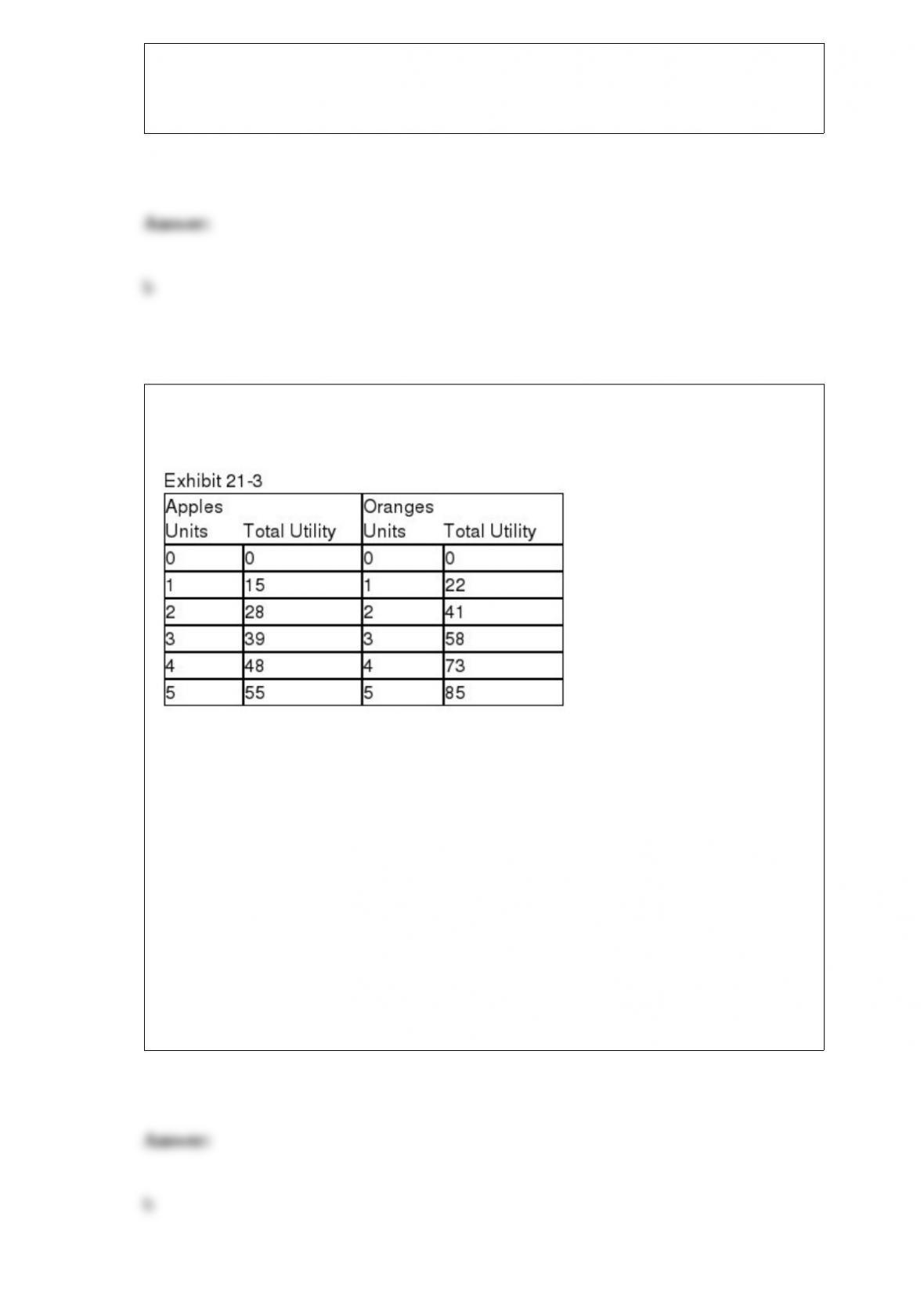
Linda spends $5 a week on apples and oranges. If the price of both goods is $1 per unit,
how many apples and oranges, respectively, does she purchase per week if she wants to
maximize her utility?
a. 0 and 5
b. 1 and 4
c. 2 and 3
d. 3 and 2
e. none of the above

An agricultural price support
a. will create a surplus in the relevant market, assuming the price support is above
equilibrium price.
b. will create a shortage in the relevant market, assuming the price support is above
equilibrium price.
c. is an example of a price floor.
d. will lead to greater total revenue for farmers if demand (for the product) farmers sell
is inelastic between the equilibrium price and the price support (and assuming the price
support is above equilibrium price).
e. a, c, and d
“My opponent in this election says she wants a balanced federal budget, but won’t say
how it would be achieved.” This candidate is trying to
a. challenge his or her opponent’s commitment to balancing the budget.
b. get his or her opponent to say something that will allow a label of “left-wing” or
“right-wing” to be attached on her.
c. accuse the opponent of going exclusively after the median voter, who is never
interested in ends, only means.
d. accuse the opponent of going after the votes of the rationally ignorant.

Which of the following is not correct about contestable markets?
a. There is easy entry into and costless exit from the market.
b. New firms entering the market can produce the product at the same cost as current
firms.
c. Firms exiting the market can easily dispose of their fixed assets by selling them
elsewhere.
d. Firms already in the market have technological advantages.
e. b and c
Most states have instituted mandatory seatbelt laws to reduce traffic fatalities. An
economist may point out that an unintended effect of these laws is
a. an increase in the price of automobiles, further reducing fatalities.
b. an increase in driving speed, reducing the number of accidents.
c. a decrease in driving speed, further reducing fatalities.
d. an increase in risky driving behavior, increasing fatalities.
Exhibit 4-3
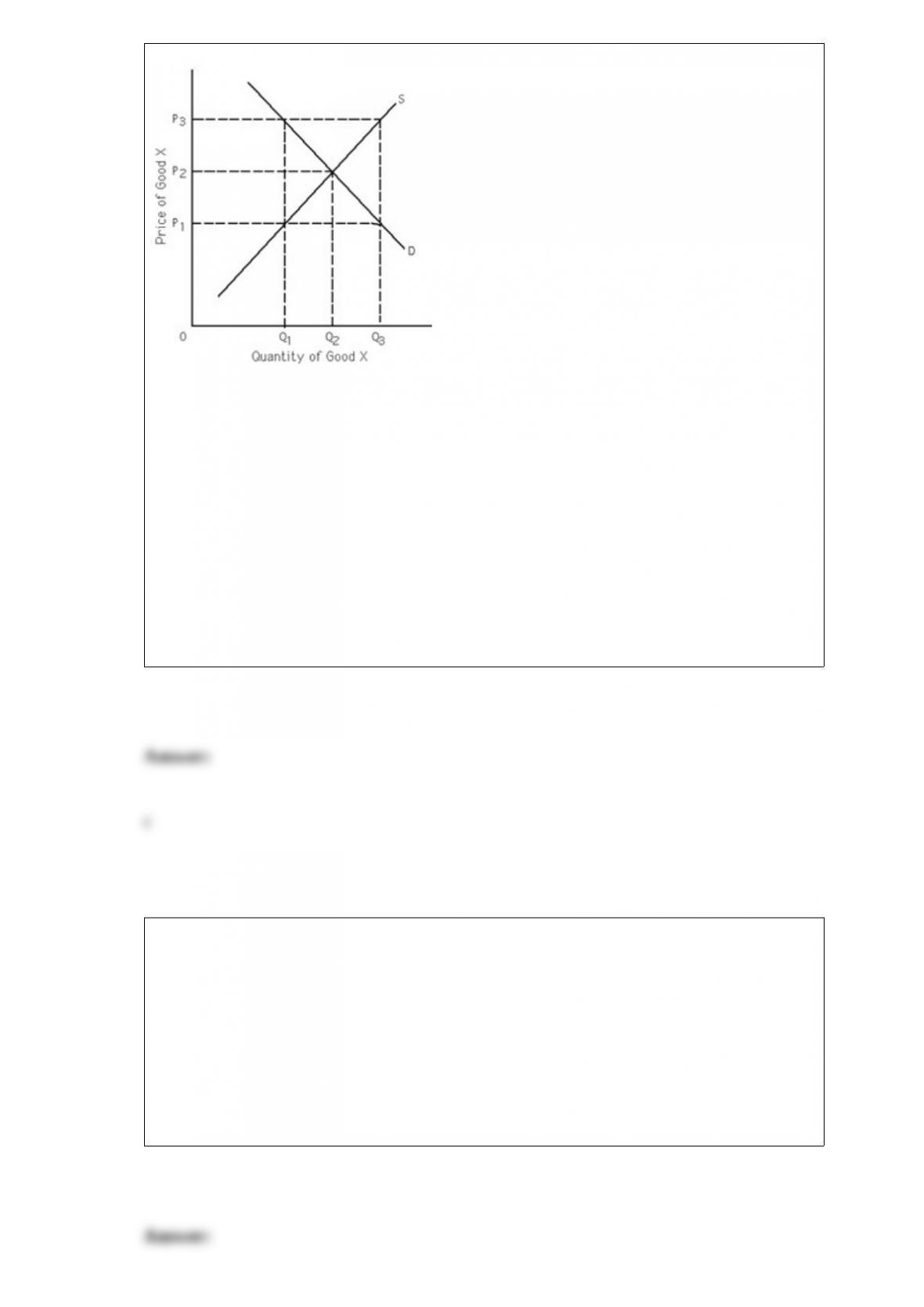
If price P1 is a price floor, then
a. the quantity exchanged is Q1.
b. there is a surplus in the market for good X.
c. it is the lowest price that can legally be charged in the market for good X.
d. both b and c
e. all of the above
A price ceiling is a government-mandated
a. minimum price below which legal trades cannot be made.
b. maximum price above which legal trades cannot be made.
c. minimum price above which legal trades cannot be made.
d. maximum price below which legal trades cannot be made.
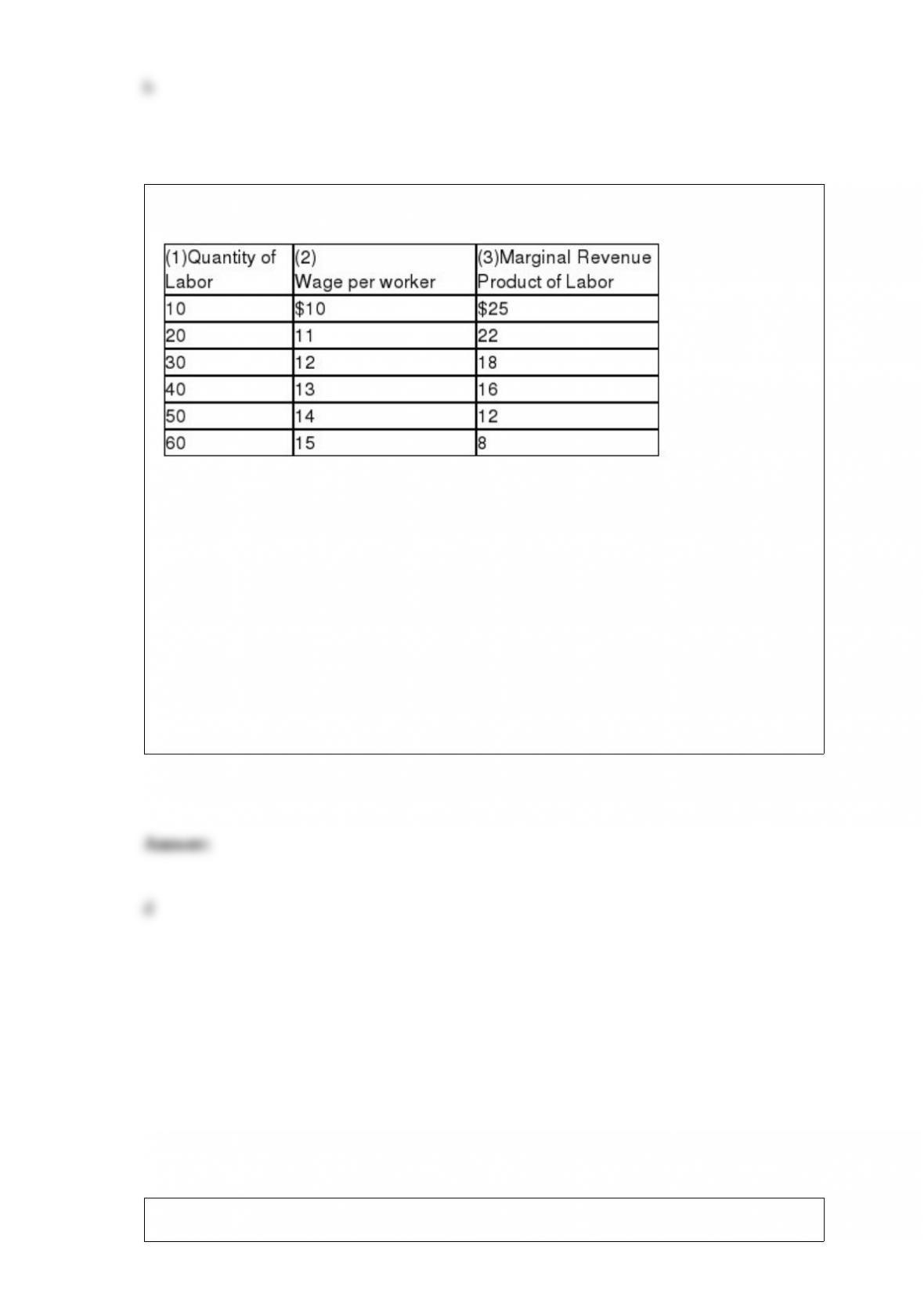
Exhibit 28-7
For technological reasons, this monopsonist can hire labor only in increments of 10
workers. The profit-maximizing number of workers is
a. 10.
b. 20.
c. 30.
d. 40.
e. 50.
Negative externalities arising from the production of a good
a. cause an increase in the demand for the good.
b. cause a decrease in the demand for the good.
c. impose costs on third parties.
d. bring private costs into equality with social costs.