
The market demand curve for labor is the horizontal summation of the firms’ demand
curves (MRP curves) for labor.
a. True
b. False
The term outsourcing is used to describe work done for a company by individuals
working for another company in a different country.
a. True
b. False
Refer to Exhibit 1-1.If the student whose study habits are illustrated here is currently
studying for the 8th hour, she should
Exhibit 1-1
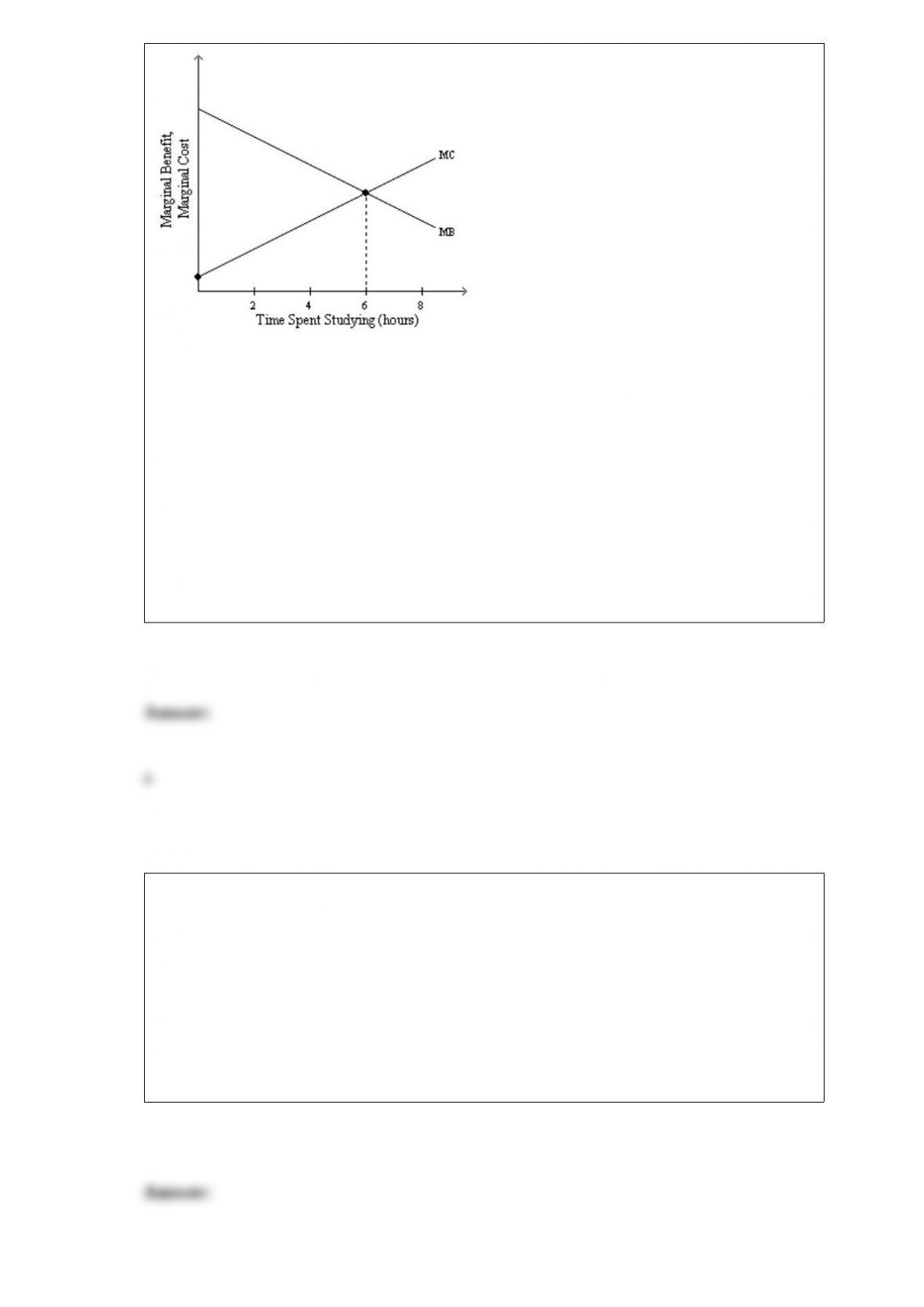
a. cut back on the number of hours she is studying because the marginal benefit of
studying for the 8th hour is less than the marginal cost of doing so.
b. cut back on the number of hours she is studying because the marginal benefit of
studying for the 8th is greater than the marginal cost of doing so.
c. increase the number of hours she is studying because the marginal benefit of studying
for the 8th hour is less than the marginal cost of doing so.
d. increase the number of hours she is studying because the marginal benefit of studying
for the 8th hour is greater than the marginal cost of doing so.
An unintended effect of a new tax placed on the producers of good A may include
a. a higher price paid by the consumers of good A.
b. less consumers’ surplus for the buyers of good A.
c. fewer workers employed in the production of good A.
d. all of the above

The Robinson-Patman Act of 1936
a. made conspiracy in the restraint of trade illegal.
b. made price discrimination, exclusive dealing, tying contracts, and the acquisition of
competing companies’ stock illegal when they ‘substantially lessen competition or tend
to create a monopoly.”
c. declared “unfair methods of competition in commerce” illegal.
d. attempted to decrease the failure rate of small businesses by protecting them from the
competition of large and growing chain stores.
e. banned anticompetitive mergers that occurred as a result of one company acquiring
the physical assets of another company.
Refer to Exhibit 1-2.Based on the data provided in this table,what type of relationship
exists between variables X and Y?
a. inverse
b. direct
c. independent
d. There is no relationship between variables X and Y.

If the owners of a firm earn accounting profit, it follows that
a. they will earn economic profit, too.
b. their explicit costs are greater than their implicit costs.
c. their implicit costs are greater than their explicit costs.
d. they will not earn economic profit.
e. none of the above
In long-run competitive equilibrium, the market equilibrium price equals
a. marginal cost.
b. short-run average total cost.
c. long-run average total cost.
d. a and c
e. a, b, and c

According to the substitution effect, as the wage rate rises the monetary reward from
working increases and workers will want to work more.
a. True
b. False
Alexander Hamilton used the infant-industry argument to support trade restrictions.
a. True
b. False
Refer to Exhibit 3-17.At a price of $20, the quantity demanded of good X is
____________ than the quantity supplied of good X, and economists would use this
information to predict that the price of good X would soon ______________.This
would push the price __________ the equilibrium price.
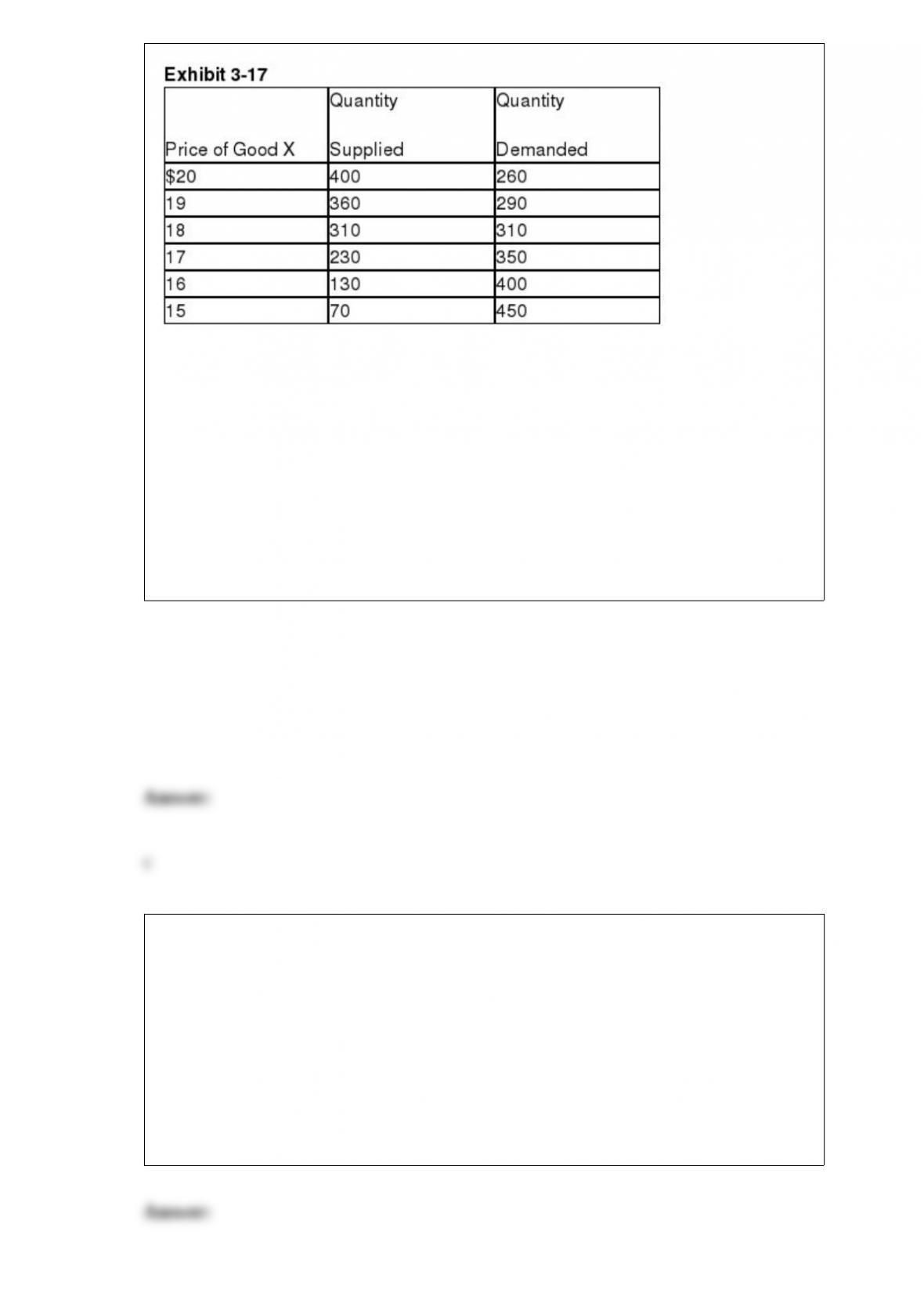
a. greater; fall; toward
b. greater; rise; toward
c. less; fall; toward
d. less; rise; away from
e. less; fall; away from
Does the monopolistic competitive firm exhibit resource-allocative efficiency?
a. No, because at its chosen quantity of output, price does not equal the lowest possible
average total cost.
b. Yes, because at its chosen quantity of output, price equals marginal cost.
c. No, because at its chosen quantity of output, price is greater than marginal cost.
d. Yes, because at its chosen quantity of output, price is less than marginal cost.
Bad weather is likely to
a. raise the total revenue farmers receive for their foodstuffs, assuming that demand for
their products is inelastic.
b. lower the total revenue farmers receive for their foodstuffs, assuming that demand for
their products is elastic.
c. leave the total revenue farmers receive for their foodstuffs unchanged.
d. change the income elasticity of demand for food.
e. c and d
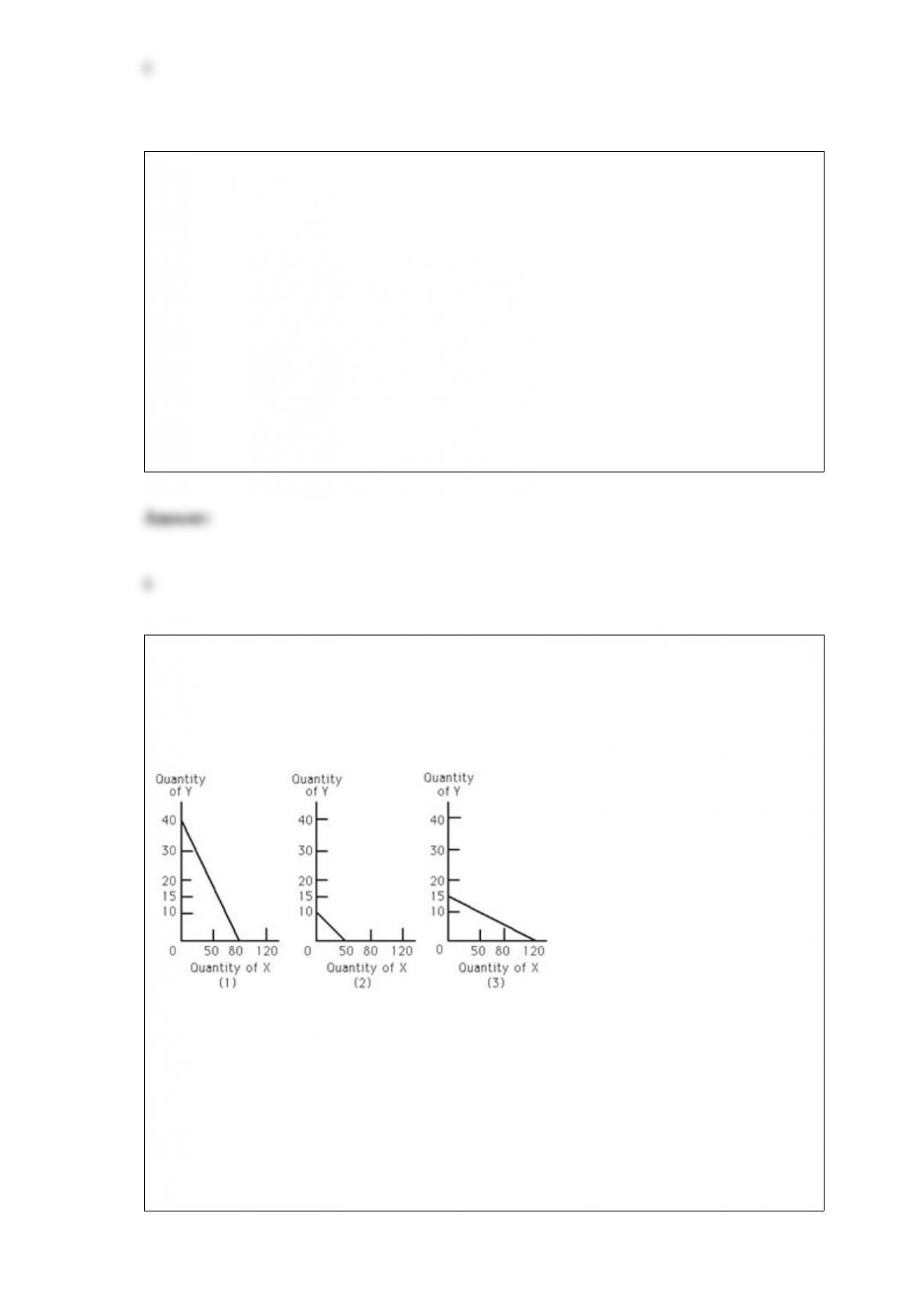
Refer to Exhibit 21-7. Which of the following graphs represents a budget constraint of a
consumer whose income is $120?
Exhibit 21-7
a. (1)
b. (2)
c. (3)
d. (1) and (2)
e. This cannot be determined from the information provided.
Suppose a producer decides that if the price of his or her product is $10, the quantity
supplied will be 1,000 units, and if the price is $11, the quantity supplied will be 1,100.
The supply of the good is
a. elastic.
b. inelastic.
c. perfectly elastic.
d. unit elastic.
e. perfectly inelastic.
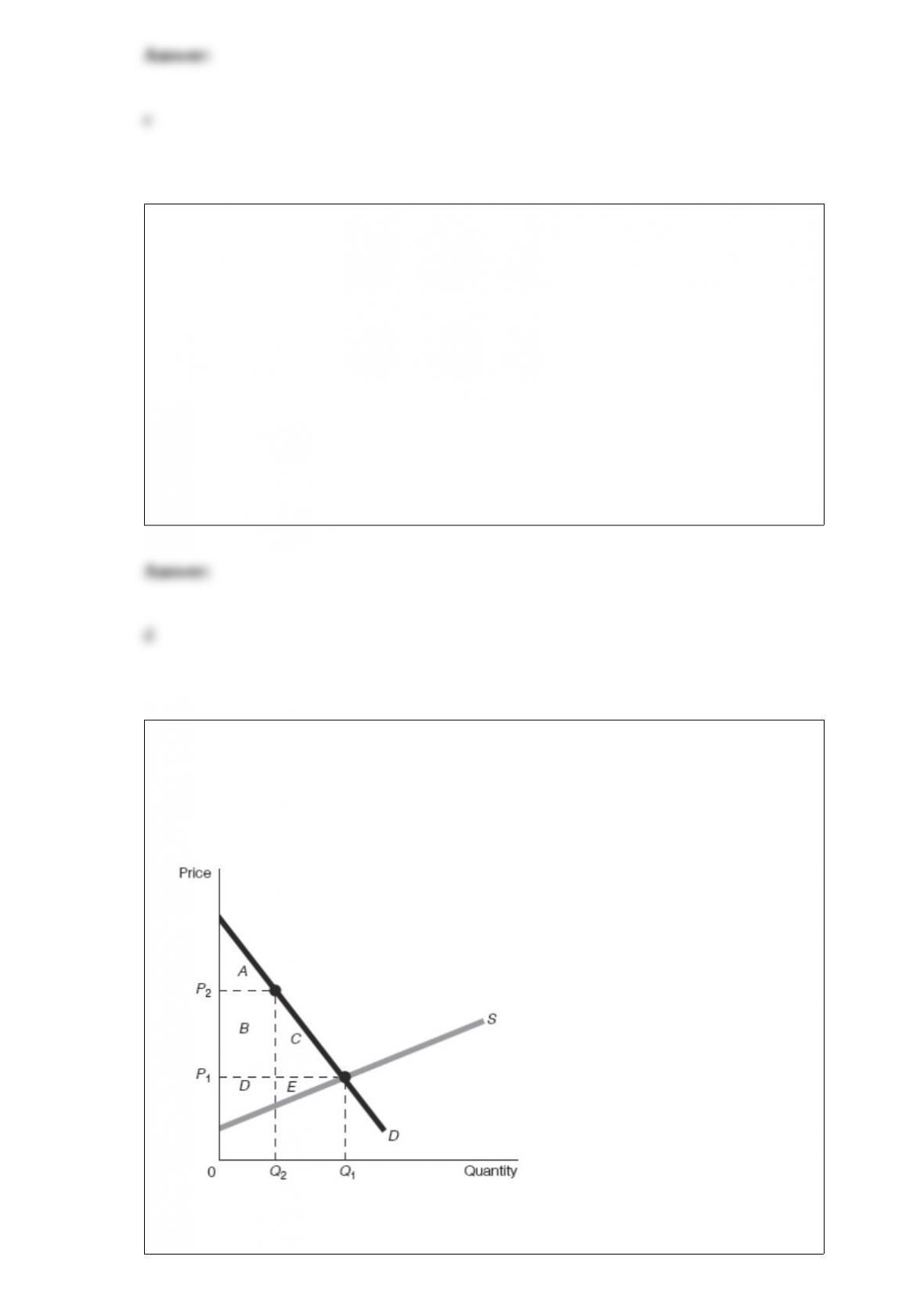
Refer to Exhibit 32-4.Suppose that producers of this good engage in rent seeking which
results in the government imposing a price floor of P2.The loss of consumers’ surplus
that occurs due to the price floor is
Exhibit 32-4
a. B + C

b. A + B + C + D + E
c. A + B + C
d. C + E
e. A
The marginal factor cost of labor for a monopsonist is
a. equal to the wage rate because if the monopsonist wants to hire another worker, it can
do so at the old wage rate.
b. less than the wage rate because if the monopsonist wants to hire another worker, it
has to raise the wage rate paid to all workers.
c. less than the wage rate because if the monopsonist wants to hire another worker, it
has to lower the wage rate paid to all workers.
d. greater than the wage rate because if the monopsonist wants to hire another worker, it
has to raise the wage rate paid to all workers.
Consider a setting in which there is a negative externality, but no positive externality.It
follows that
a. the market outcome is inefficient.
b. the market outcome is efficient.
c.MSC > MPC
d. MPC >MSC
e. a and c
In a PPF graph of goods X and Y, points that lie beyond (to the right of) the PPF
represent combinations of the two goods that are currently unattainable.
a. True
b. False
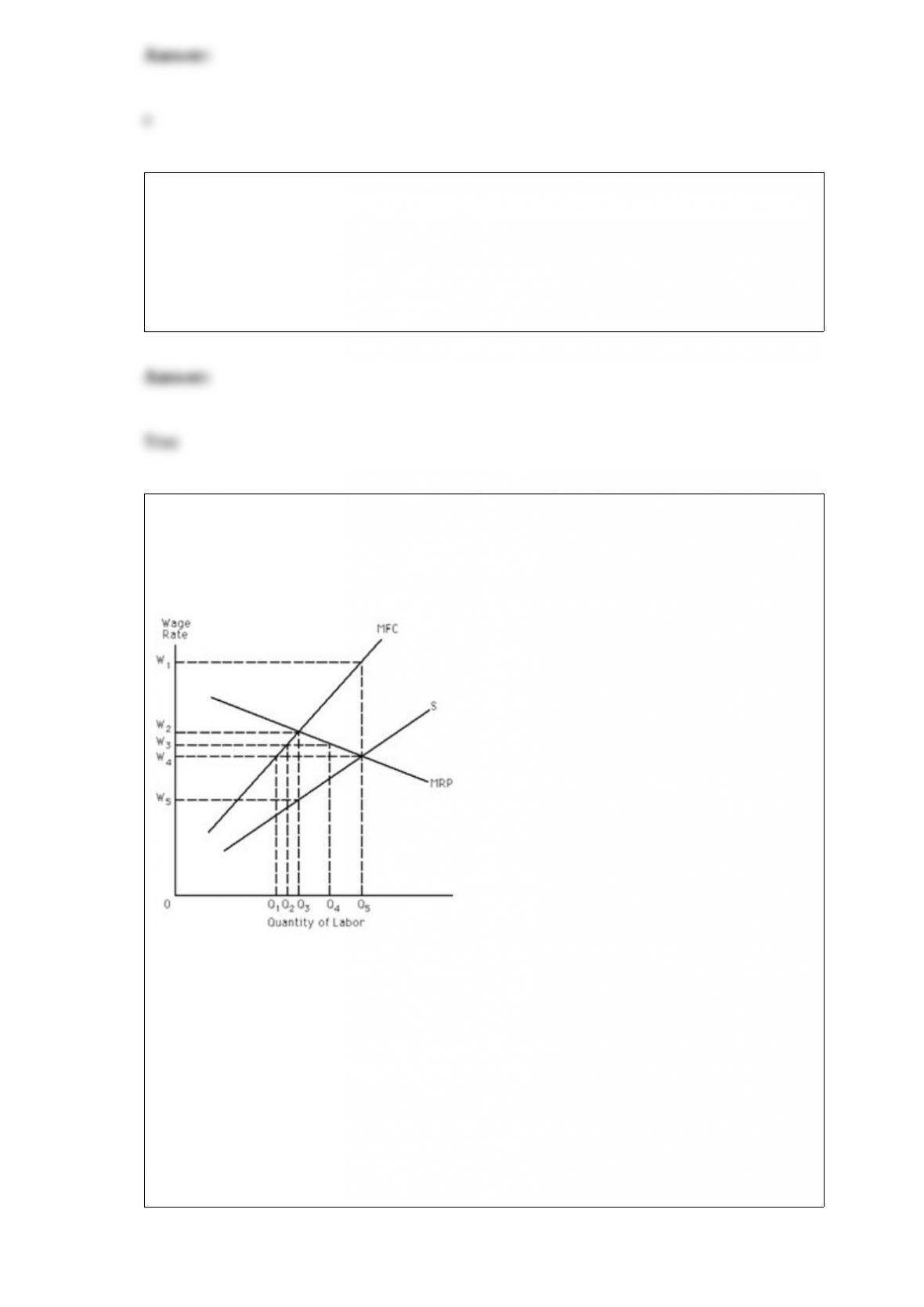
Refer to Exhibit 28-8. If the monopsonist could perfectly discriminate by paying each
worker a different wage rate, the number of workers employed would be
Exhibit 28-8
a. Q1.
b. Q2.
c. Q3.
d. Q4.
e. Q5.

Suppose Will receives 350 utils from consuming one banana and 490 utils from
consuming two bananas. What is the marginal utility of the second banana?
a. 840 utils
b. 75 utils
c. 140 utils
d. 425 utils
e. none of the above
A government agricultural policy that sets a limit on the quantity of a product that a
farmer is allowed to bring to market is the
a. marketing quota system.
b. acreage allotment program.
c. price support program.
d. target price system.
e. paying farmers not to produce system.