
If wages are below the wage level that causes supply to equal demand, then there is
a. excess supply for labor.
b. excess demand for labor.
c. a market equilibrium.
d. unemployment.
e. inflation.
Which of the following groups are not considered to be out of the labor force?
a. students
b. stay-at-home parents
c. discouraged workers
d. marginally attached workers
e. unemployed workers
Suppose that the facts are as follows:

Which city pays the highest real wage?
a. I
b. II
c. III
d. IV
e. V
The hold up problem arises
a. if firms invest in specific capital and so have incurred a sunk cost which is vulnerable
to expropriation.
b. if firms invest in general capital and so have incurred a sunk cost which is vulnerable
to expropriation.
c. if firms invest in specific capital and so workers have an incentive to leave the firm
and waste the investment.
d. if firms invest in general capital and so workers have an incentive to leave the firm
and waste the investment.
e. if specific investments made by the firm will create inefficiencies.

What is the unemployment rate?
a. 1.8%
b. 2.0%
c. 2.2%
d. 2.4%
e. 97.6%
What are the firm’s total costs?
a. $30
b. $50
c. $60
d. $80
e. $90

If leisure is a normal good, then a decrease in non-labor income will cause the desired
number of hours worked to
a. increase.
b. decrease.
c. remain the same.
d. increase for skilled workers only.
e. increase for unskilled workers only.
The marginal rate of substitution
a. represents the amount of money an individual has to be paid to work another hour.
b. is constant along an individual’s entire indifference curve.
c. is the reason why indifference curves are convex.
d. is always negative.
e. helps determine how to increase a person’s utility.

If two inputs are gross substitutes, their substitution elasticity will be
a. zero.
b. positive.
c. negative.
d. ?2-
e. 1.
If one seller can set the price in the market,
a. the seller has monopolist power.
b. the seller has monopsony power.
c. the seller is a price taker.
d. the seller is operating in a perfectly competitive market.
e. the seller is operating in an oligopoly.

If worker ability differs along a single dimension, their earnings are usually:
a. unrelated to ability.
b. homogeneous.
c. heterogeneous.
d. proportional to their ability-unadjusted productivities.
e. proportional to their ability-adjusted productivities.
Which of the following is not a true statement about the Consumer Price Index (CPI)?
a. The CPI is based on a fixed bundle of goods.
b. The CPI is not adjusted spatially and has the same value for all urban areas.
c. The CPI is used to calculate cost of living adjustments.
d. The CPI overstates true changes in the cost of living, because it does not allow for
substitution among goods.
e. The CPI does not allow for the inclusion of new goods.
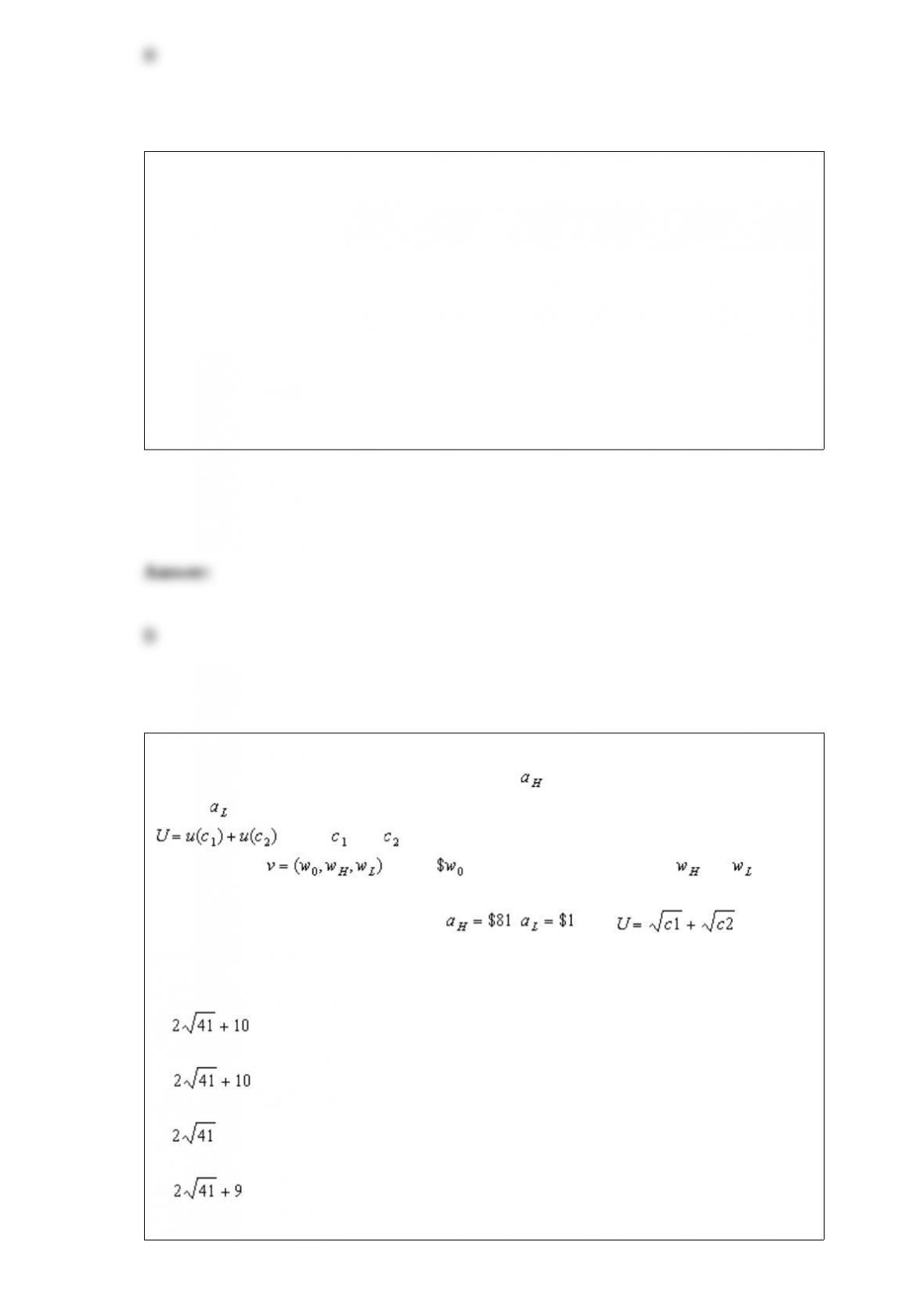
In 2007, the incidence of poverty was ______ among nonwhites than among Whites.
The majority of people in poverty were ______ 18 years old.
a. higher; over
b. higher; under
c. lower; over
d. lower; under
e. the same; under
Suppose a risk-neutral firm hires many risk-averse workers for two periodsex ante and
ex post. Half of the workers possess high ability, , and the other half possess low
ability, . Worker ability is revealed ex post. A worker’s lifetime utility is given by
where and are consumption in each of the periods. The firm
offers contract where is the first period wage and and are the
respective second period wage offers made to high- and low-ability workers. The labor
market is competitive ex ante. Assume , , and . What is
each worker’s expected lifetime utility if the firm is completely insulated from the
external labor market?
a.
b.
c.
d.

e.
The owner of an asset enjoys _______ , which are the rights to all uses of an asset in a
way not consistent with a prior contract.
a. residual control rights
b. formal authority
c. real authority
d. the buy decision
e. the make-or-buy decision
After the $4 tax is imposed, how many individuals work in the steel industry?
a. 19
b. 20
c. 23
d. 25
e. 27
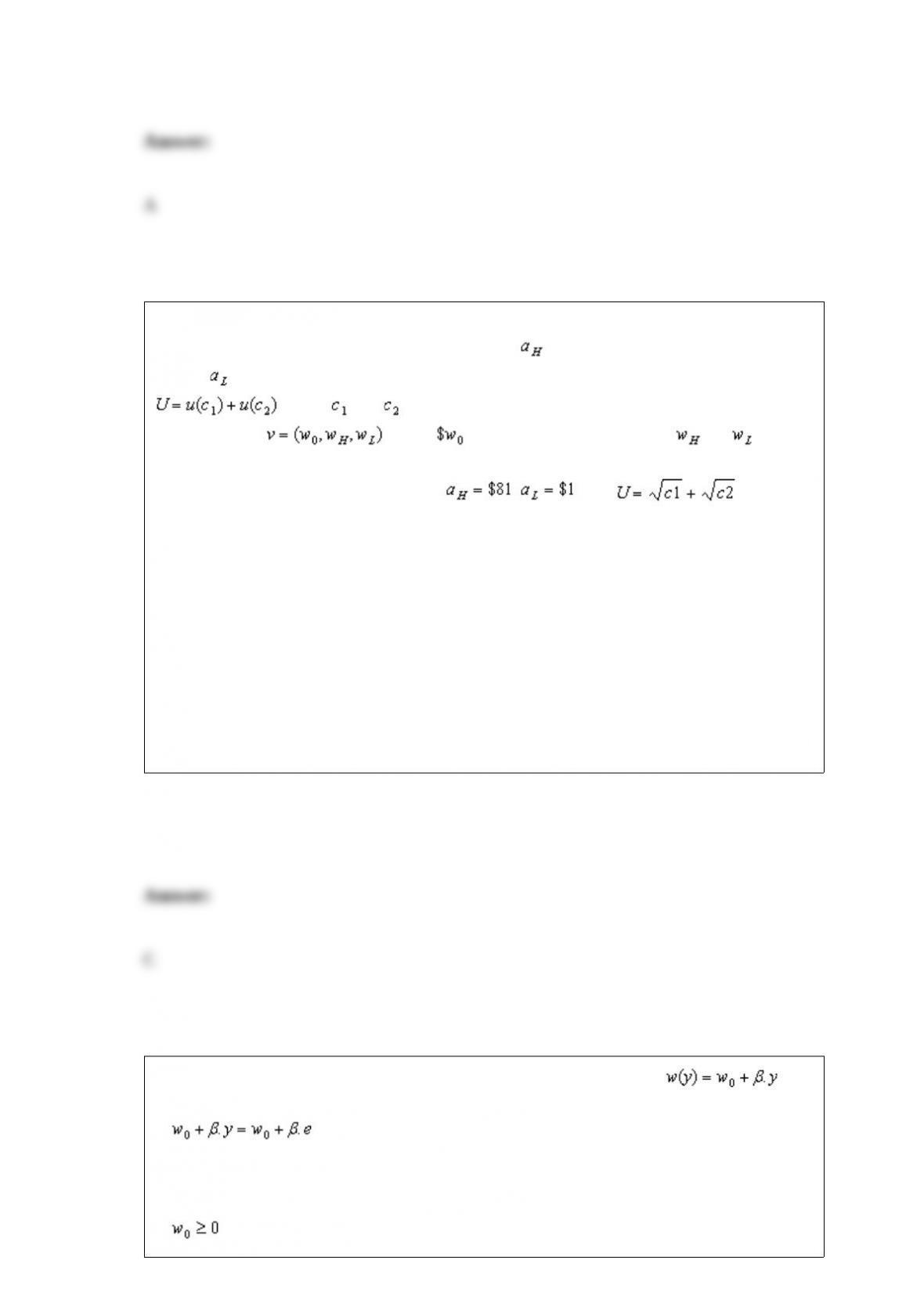
Suppose a risk-neutral firm hires many risk-averse workers for two periodsex ante and
ex post. Half of the workers possess high ability, , and the other half possess low
ability, . Worker ability is revealed ex post. A worker’s lifetime utility is given by
where and are consumption in each of the periods. The firm
offers contract where is the first period wage and and are the
respective second period wage offers made to high- and low-ability workers. The labor
market is competitive ex ante. Assume , , and . What is
the average worker’s productivity?
a. $1
b. $40
c. $41
d. $81
e. $82
Which of the following is necessarily true of the piece-rate contract, ?
a. , where e is a worker’s effort.
b. Work incentives are increasing in β.
c. .

d. is the piece rate.
e. Total output need not be verifiable.
Suppose there is an increase in the supply of labor. This will cause the equilibrium wage
to , hours worked to , and quantity of labor demanded to .
a. decrease, decrease, increase
b. decrease, increase, increase
c. decrease, increase, decrease
d. increase, decrease, increase
e. increase, increase, decrease

Today, the federal minimum wage is set at $5.25, the minimum wage in California is set
at $8.00, and the minimum wage in Ohio is $5. A worker covered by the minimum
wage in California must be paid at least and a worker covered by the minimum wage in
Ohio must be paid at least ______.
a. $8.00; $8.00
b. $8.00; $5.25
c. $8.00; $5.15
d. $5.25; $5.25
e. $5.25; $8.00
Assume that there are three occupations indexed i = 1,2,3. The fractions of men and
women employed in each of these occupations are, respectively, , , and
; and , , and . What is the Duncan index of dissimilarity?
a. 0
b. 0.1
c. 0.35
d. 0.5
e. 0.6

The value of a worker’s output ______ a simple function of the units of output produced
and can be measured ______.
a. is; by subjective measures
b. is; by both objective and subjective measures
c. is not; by objective measures
d. is not; by both objective and subjective measures
e. is not; by subjective measures
The Occupational Health and Safety Act is charged with:
a. reducing workplace injuries and fatalities.
b. inspecting workplaces to ensure that firms provide workers with complete
information about workplace safety.
c. ensuring an efficient level of workplace safety in the U.S. labor market.
d. ensuring American consumers are informed about workplace safety practices.
e. documenting workplace injuries and fatalities.
What is the equilibrium compensating wage differential for the farmer?

a. $5K
b. $10K
c. $20K
d. $25K
e. $40K
Which of the following is an industry-specific skill?
a. Carl takes a course on using Microsoft Office, a commonly used operating system.
b. Sam trains Craig on how to use a new machine in the factory.
c. Mike obtains an engineering degree to become an engineer.
d. Kara talks with her boss about the possible uses of a new word processor.
e. Shelly exercises to stay healthy.
Normative economics is
a. the prescriptive part of economics.

b. the branch of economics that describes and objectively explains economic
phenomena.
c. the scientific branch of economics.
d. used to shed light on positive debates.
e. both A and D
When introduced in the United States, the minimum wage was set at ______ and
covered about ______ of all workers. Today the federal minimum wage is ______ and
it covers almost ______ of workers.
a. $0.25; 50 percent; $4.25; 50 percent
b. $1.00; 75 percent; $10.25; 50 percent
c. $0.50; 100 percent; $7.25; 90 percent
d. $0.50; 75 percent; $7.25; 90 percent
e. $0.25; 50 percent; $5.25; 90 percent
If a firm is producing at the level of output where the marginal product of labor is
greater than the marginal cost of labor (the wage), then
a. profits will increase if the firm hires more workers.

b. profits will increase if the firm fires some workers.
c. the firm always has negative economic rent.
d. the accounting profits are always greater than the economic profits.
e. the firm is maximizing profits.
What problem does turnover create for firm specific training?
a. Human capital is destroyed if the worker quits the firm.
b. The worker pays more for human capital than is efficient.
c. The workers are underpaid to correct a market inefficiency.
d. Firms underinvest in human capital.
e. Turnover does not cause a problem because of contracts.
According to Doeringer and Piore (1971), the supplants the price and wage system of
the as the primary means .
a. internal labor market; external labor market; by which scarce resources are allocated
b. internal labor market; external labor market; by which workers are recruited

c. internal labor market; external labor market; by which the market is organized
d. external labor market; internal labor market; by which scarce resources are allocated
e. external labor market; internal labor market; by which workers are recruited
Suppose there is a perfectly competitive firm that has hired 200 workers. Suppose
wages equal $15 per hour and the marginal revenue product of labor is $20. What
should the firm do in order to reach the profit-maximizing level of production?
a. Hire more workers till MRP = MC.
b. Keep the same number of workers.
c. Fire workers until MRP = MC.
d. Lay off the less efficient workers.
e. C and D