Which of the following would be classified as fiscal policy?
A) The federal government passes tax cuts to encourage firms to reduce air pollution.
B) The Federal Reserve cuts interest rates to stimulate the economy.
C) A state government cuts taxes to help the economy of the state.
D) The federal government cuts taxes to stimulate the economy.
E) States increase taxes to fund education.
In 1930, the U.S. government attempted to help domestic firms that were harmed by the
Great Depression by
A) establishing the General Agreement on Tariffs and Trade (GATT).
B) passing the Smoot-Hawley Tariff.
C) establishing the World Trade Organization (WTO).
D) passing the North American Free Trade Agreement (NAFTA).
A dominant strategy
A) is one that is the best for a firm, no matter what strategies other firms use.
B) is one that a firm is forced into following by government policy.
C) involves colluding with rivals to maximize joint profits.
D) involves deciding what to do after all rivals have chosen their own strategies.
The Federal Reserve’s two main ________ are the money supply and the interest rate.
A) monetary policy targets
B) policy tools
C) fiscal policy targets
D) fiscal tools
In the desire to have a celebrity’s image protected to prevent it from being used in ways
he would not approve, a celebrity’s estate
A) will probably not be successful, since there are no laws regulating this kind of use in
the United States.
B) will have to be granted a patent declaring the celebrity’s image a new product, and
this will give the estate protection for 7 years.
C) can rely on U.S. laws that protect intellectual property rights to prevent the
unauthorized use of his image.
D) will most likely be more successful in developing countries than in high-income
countries, since property regulations are better enforced in developing countries.
Which of the following has a tendency to raise the unemployment rate?
A) implementing a minimum wage in an economy
B) reducing unemployment insurance in an economy
C) offering wages at the market-clearing rate
D) reducing labor unions membership in an economy
If strong aggregate demand is pushing the economy beyond potential real GDP, which
of the following must be true?
A) The economy is at an equilibrium that is on the long-run aggregate supply curve.
B) The economy is at an equilibrium that is on the long-run Phillips curve.
C) The economy is at an equilibrium that is not on the long-run Phillips curve.
D) Expansionary monetary policies will push the economy back to the long-run Phillips
curve.
The Athenian Theatre sells play tickets for the same play at different prices: a lower
price to those who opt for the seats at the back of the theatre and a higher price for those
who purchase seats in the front, around the stage. Which of the following statements is
true?
A) This is an example of product differentiation but not price discrimination.
B) The theatre practices first-degree price discrimination by setting prices based on
willingness to pay.
C) Since the cost of producing the play does not change with the seating configuration,
this is evidence of price discrimination based on market segmentation.
D) Charging two different prices is an effective way to avoid an excess demand for play
tickets; the higher price lowers quantity demanded to some extent.
Depreciation is
A) the value of worn-out equipment, machinery, and buildings.
B) the value of the decrease in business inventory stocks.
C) the value of the addition to the capital stock.
D) the decline in the value of the stock market, net of dividends.
In August 2011, Standard & Poor’s (S&P) changed its rating on U.S. Treasury bonds
from ________ based on the state of the federal government’s budget deficit.
A) “A” to “D”
B) “A” to “AAA”
C) “A+” to “B+”
D) “AAA” to “AA+”
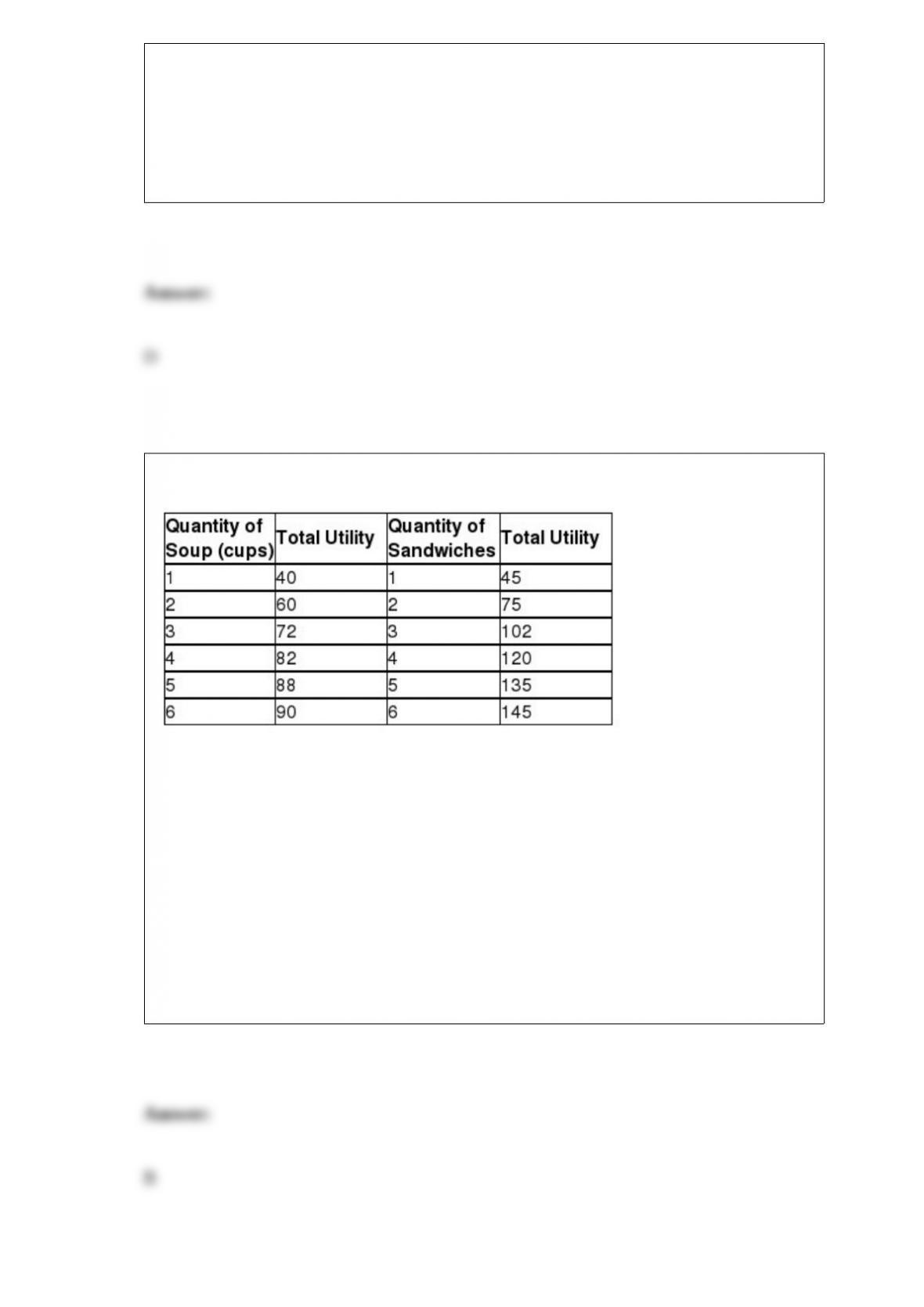
Table 10-2
Table 10-2 above shows Keira’s utility from soup and sandwiches. The price of soup is
$2 per cup and the price of a sandwich is $3. Keira has $18 to spend on these two
goods. Suppose Keira’s income increases from $18 to $23 but prices have not changed.
What is her utility maximizing bundle now?
A) 6 cups of soup and 5 sandwiches
B) 4 cups of soup and 5 sandwiches
C) 5 cups of soup and 4 sandwiches
D) 5 cups of soup and 5 sandwiches
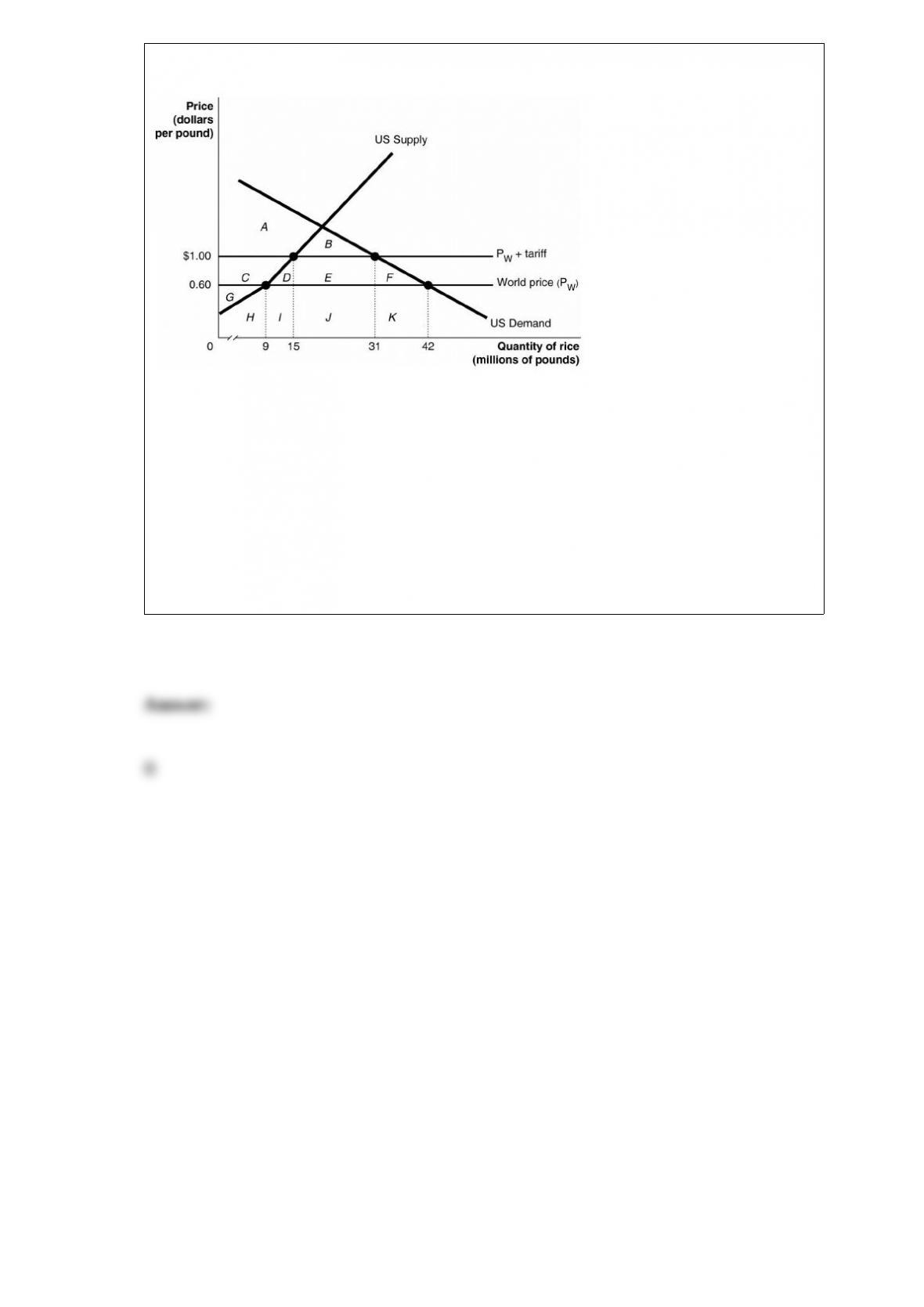
Figure 9-2
Suppose the U.S. government
imposes a $0.40 per pound tariff on rice imports. Figure 9-2 shows the impact of this
tariff. With the tariff in place, the United States produces
A) 9 million pounds of rice.
B) 15 million pounds of rice.
C) 31 million pounds of rice.
D) 42 million pounds of rice.