If you thought the share price of a stock was going to fall, would you be more likely to
buy a call option or a put option?
a. a call option
b. a put option
c. a call option and a put option
d. There is not enough information given to answer this question.
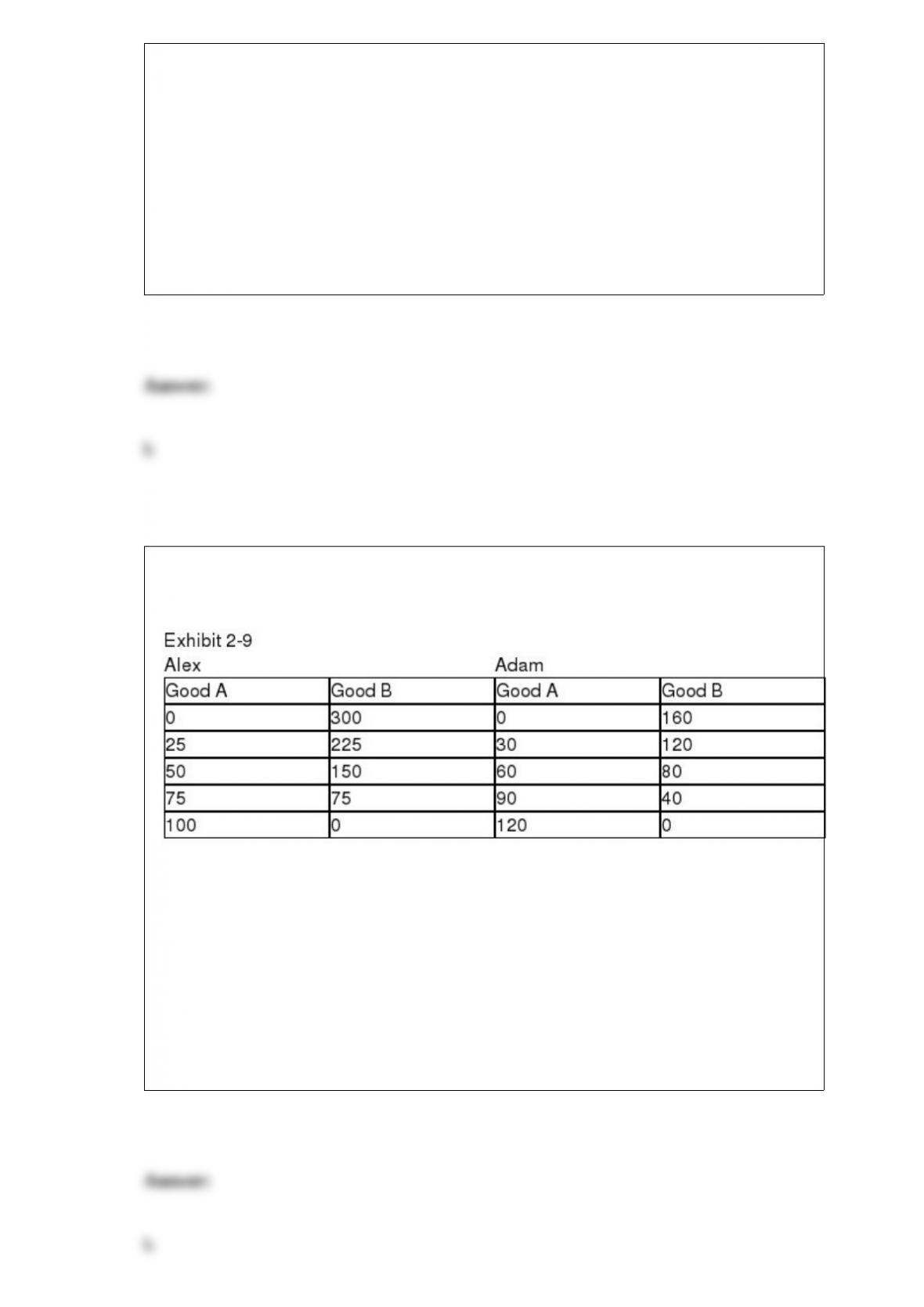
Who has the comparative advantage in the production of good A?
a. Alex
b. Adam
c. Both Alex and Adam
d. Neither Alex nor Adam

Which of the following statements is false?
a. If Mexican restaurant owners provide free chips and salsa to their customers, the
quantity demanded of chips and salsa will be greater than if customers had to pay for
them.
b. If the price of a good falls, then the demand for its complements will increase.
c. If the price of a good rises, then the price of its complements will rise.
d. If chips and salsa are offered for free to Mexican restaurant customers, then
restaurants can charge a higher price for products that are complements to chips and
salsa (such as beer).
Rational ignorance refers to voter-citizens choosing to be uninformed about politics
and government on an individual basis because
a. of apathy.
b. of ignorance.
c. of laziness.
d. they believe the benefits of becoming informed are greater than the costs.
e. they believe the benefits of becoming informed are less than the costs.

A price ceiling set below the equilibrium price will
a. clear the market for the good.
b. result in a shortage of the good.
c. result in a surplus of the good.
d. induce new firms to enter the industry.
With a constant opportunity cost between goods A and B, the PPF for goods A and B
would
a. be a straight line.
b. be a bowed-outward line.
c. be a bowed-inward line.
d. not exist.
Company Z is a U.S. company that has just entered the market for a given good and is
the first in this country to produce that good. The good is already being produced in
many foreign countries is exported to the United States. If company Z wants to restrict
this foreign competition, it will most likely use which of the following arguments?
a. anti-dumping
b. national-defense

c. job-creation
d. infant-industry
e. low-foreign-wages
Which of the following best describes an interpersonal utility comparison?
a. Jones likes computers produced by Dell Computer Corporation and Smith likes
computers produced by Apple Computer Inc.
b. Smith gets more utility from working on his computer than Jones gets from working
on his computer.
c. Smith got less utility from eating the 30th cookie than eating the 29th cookie, and the
same holds for Jones.
d. Usually, Smith seems a lot happier than Jones.
e. Smith usually eats more in a day than Jones eats in a day.
A person is in consumer equilibrium, and then the price rises for one of the goods she
purchases. If she wants to restore herself to consumer equilibrium, she will (most
likely)
a. buy less of the good whose price has risen and more of the relatively lower priced
goods.
b. try to increase the marginal utility she receives from the good whose price has risen.
c. try to decrease the marginal utility she receives from the goods whose prices did not
rise.
d. buy more of both the good whose price has risen and of the goods whose prices have
not risen.
e. There is not enough information to answer the question.
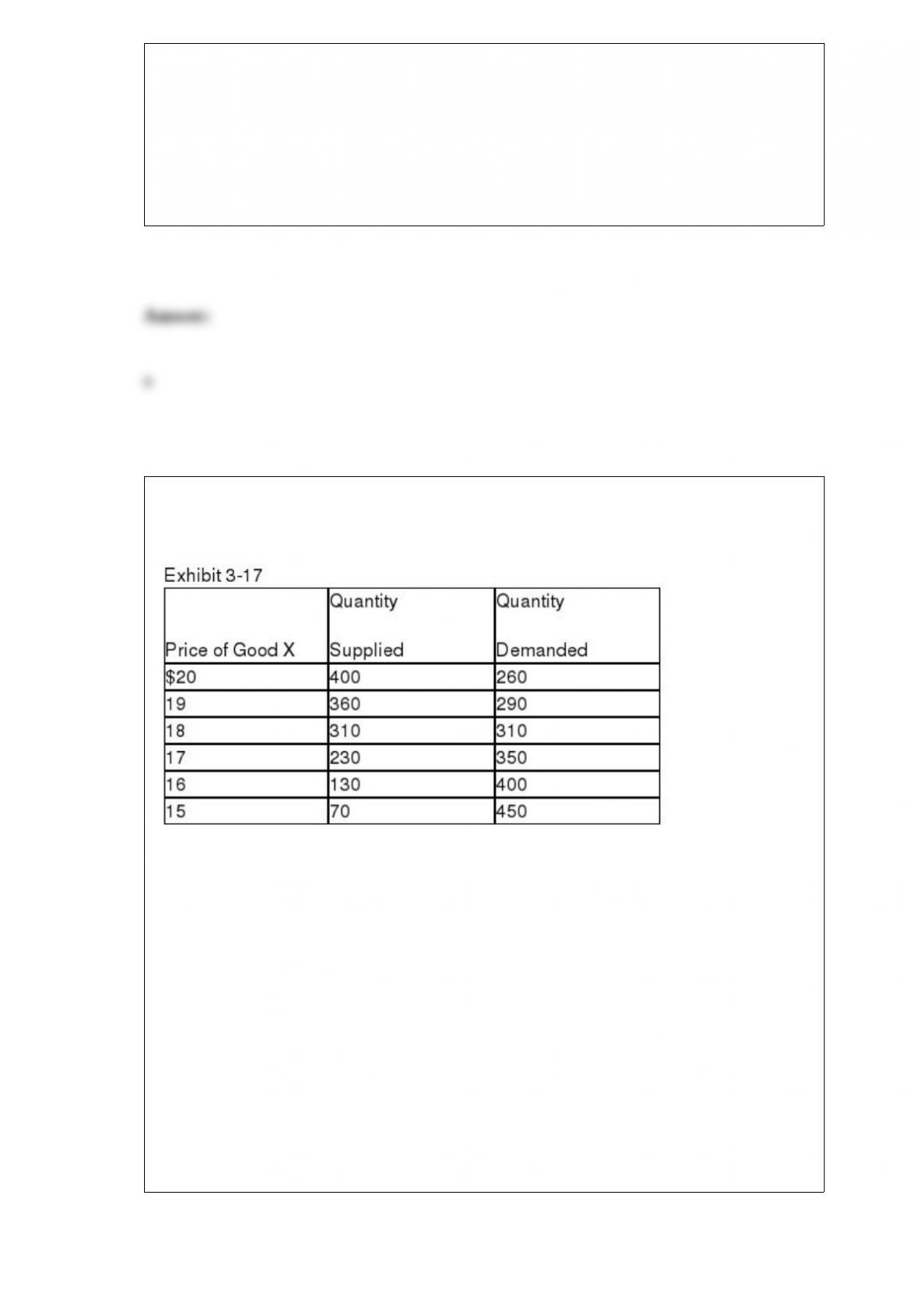
At a price of $16, the quantity demanded of good X is ____________ than the quantity
supplied of good X, and economists would use this information to predict that the price
of good X would soon ______________.This would push the price __________ the
equilibrium price.
a. greater; fall; toward
b. greater; rise; toward
c. less; fall; toward
d. less; rise; away from
e. greater; rise; away from

Suppose the government imposes a price ceiling above the equilibrium price of a given
good. Which of the following is the most likely result?
a. Some other rationing device will emerge to allocate the good among buyers.
b. Some buyers and sellers will be willing to risk breaking the law in order to exchange
the good at a price above the equilibrium price since there would be a shortage of the
good at the price ceiling.
c. No change will occur in the market.
d. Brute force will be used to allocate the good among buyers.
e. a, b, and d
Which of the following is most likely to be an unintended effect of placing safety caps
on medicines?
a. It is now harder for people to open their medicine containers.
b. People leave their medicine containers open more often, which ends up making it
easier for children to get into the medicine.
c. Fewer people get sick and need medicine.
d. Medicine prices fall sharply.

The higher the cost of talking on a cell phone in public (in terms of being perceived by
others as rude) the less likely one is to do so.
a. True
b. False
A bond is
a. a claim on the assets of a corporation such that the purchaser has an ownership right
in the corporation.
b. anything of value to which the firm has a legal claim.
c. a means of assuring that the business firm will pay its debts or fulfill other legal
obligations.
d. a promise to pay for the use of someone else’s money.
Which of the following statements is false?
a. Another term for a Treasury bill is a T-bill.
b. Treasury notes mature in 2 to 10 years.
c. Treasury bonds are considered very safe investments, but Treasury bills are
considered to be a more risky investment.

d. It is unlikely the federal government will default on its bond obligations.
The number of unskilled workers employed before and after a change in the minimum
wage is found to be the same. This means
a. the minimum wage change did not affect the unskilled labor market.
b. nothing, unless we also know that the number of hours worked by each worker has
not changed.
c. the minimum wage could be below the equilibrium wage for unskilled labor.
d. either b or c
e. none of the above
Exhibit 24-1
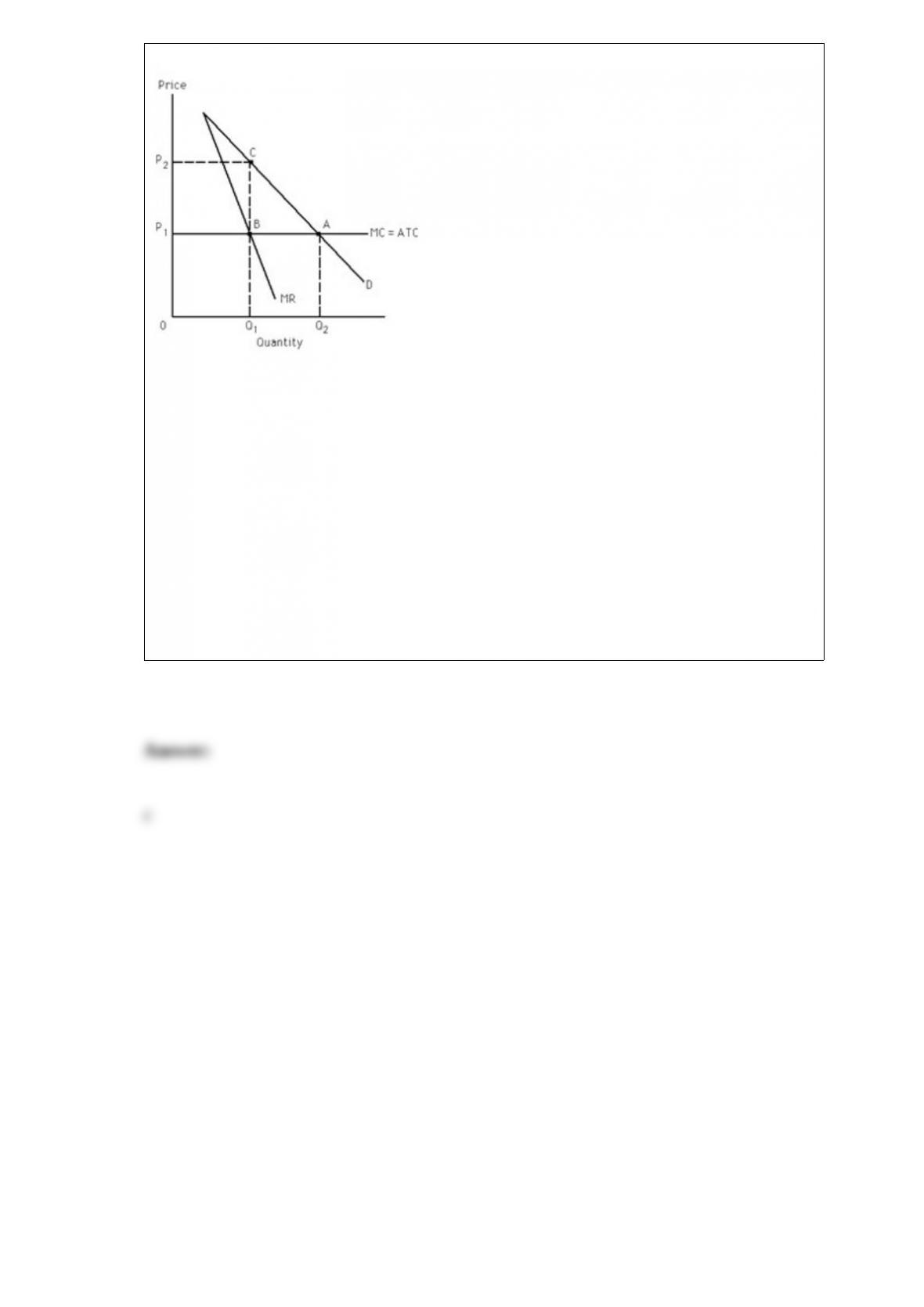
According to economist Gordon Tullock, what area is subject to rent seeking activity?
a. area Q1BAQ2
b. area BCA
c. area P1P2CB
d. area 0P1BQ1
e. none of the above