1) Approximately how much of the income in the United States is earned by workers in
the form of wages and fringe benefits?
a.25 percent
b.50 percent
c.67 percent
d.90 percent
2) Suppose demand is perfectly elastic, and the supply of the good in question
decreases. As a result,
a.the equilibrium quantity decreases, and the equilibrium price is unchanged.
b.the equilibrium price increases, and the equilibrium quantity is unchanged.
c.the equilibrium quantity and the equilibrium price both are unchanged.
d.buyers’ total expenditure on the good is unchanged.
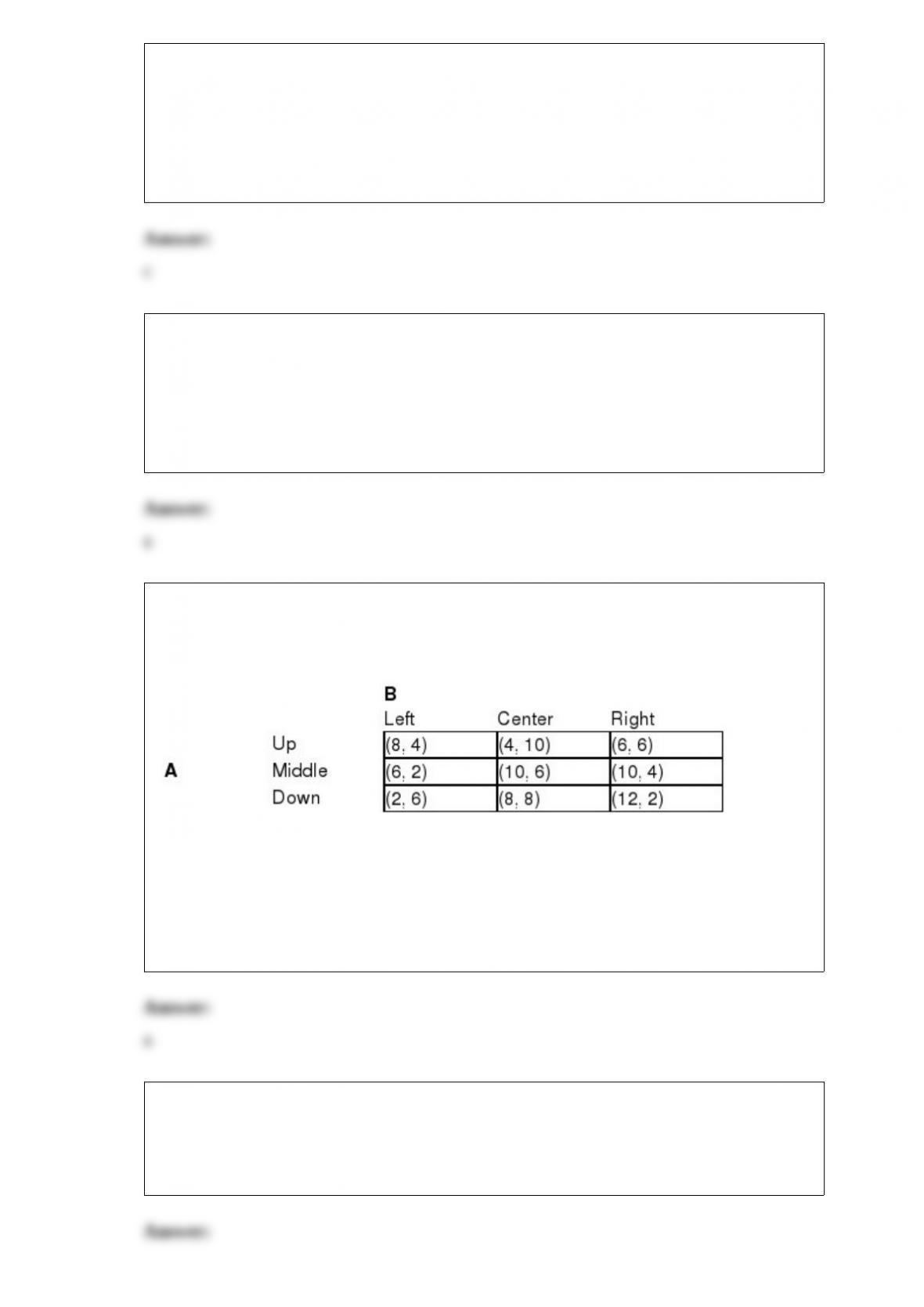
3) Table 17-16
This table shows a game played between two players, A and B. The payoffs are given in
the table as (Payoff to A, Payoff to B).
Refer to Table 17-16. Which of the following outcomes represents a Nash equilibrium
in the game?
a.Middle-Center
b.Down-Center
c.Up-Left
d.More than one of the above is a Nash equilibrium in this game.
4) Standard measurements of the degree of income inequality take both money income
and in-kind transfers into account.
a.True
b.False
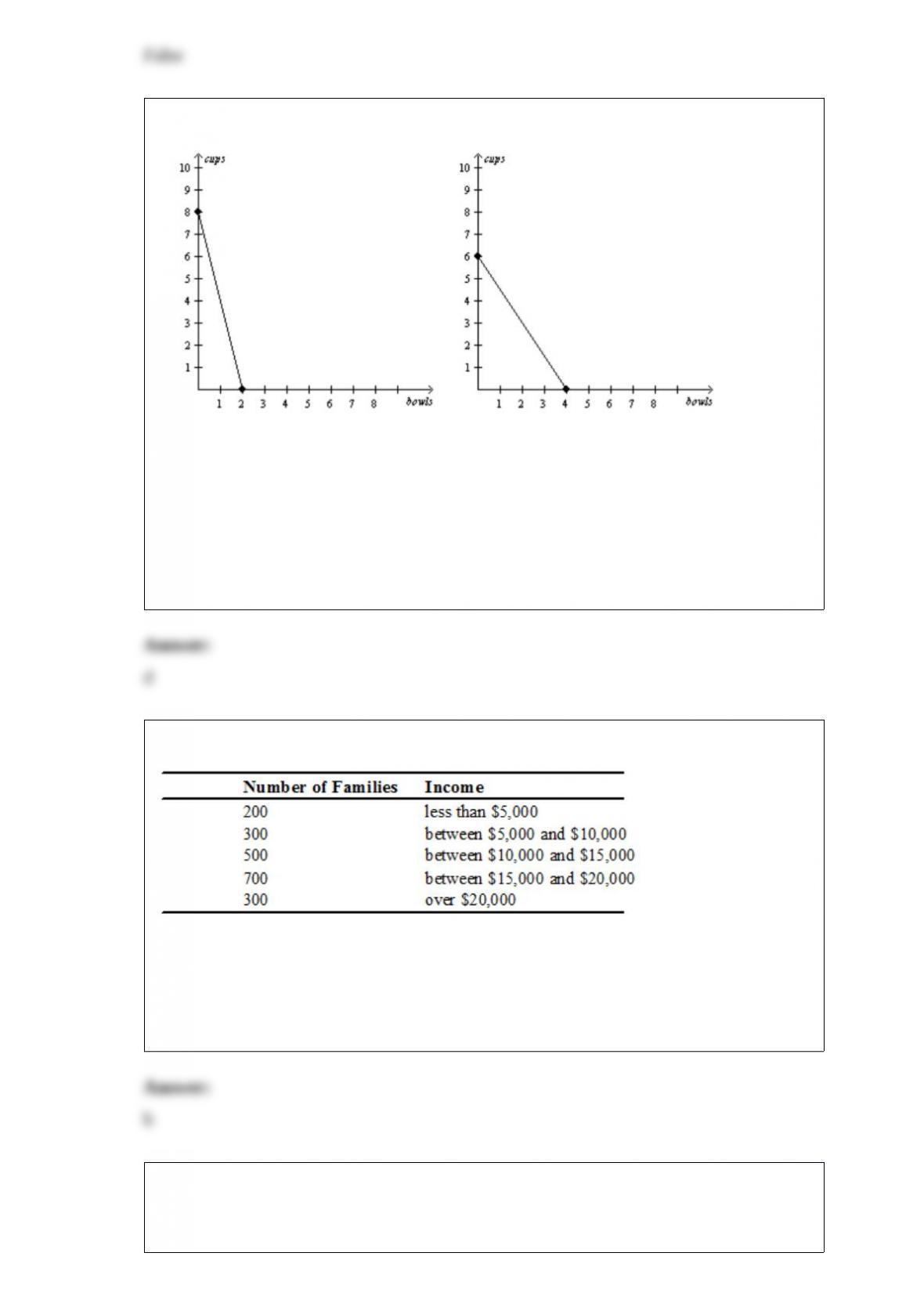
5) Bintu’s Production Possibilities FrontierJuba’s Production Possibilities Frontier
If the
production possibilities frontiers shown are each for 4 hours of work, then which of the
following combinations of bowls and cups could Bintu and Juba together not make in a
given 4-hour production period?
a.3 bowls and 9.5 cups
b.4.5 bowls and 6 cups
c.5 bowls and 4 cups
d.6 bowls and 1 cups
6) The distribution of income for Inequalia is as follows:
If the poverty rate in Inequalia is 25 percent, what is the poverty line in Inequalia?
a.$5,000
b.$10,000
c.$15,000
d.$20,000
7) The best government policy to reduce poverty is
a.a minimum wage law because the resulting unemployment is small in comparison to
the benefits to people it helps.

b.an expanded welfare program because people must have an additional “need” such as
small children or a disability.
c.an in-kind transfer because it ensures that the poor receive what they need most such
as food or shelter.
d.not obvious. Government programs to reduce poverty have many advantages but also
many disadvantages.
8) The short-run tradeoff between inflation and unemployment implies that, in the short
run,
a.a decrease in the growth rate of the quantity of money will be accompanied by an
increase in the unemployment rate.
b.an increase in the growth rate of the quantity of money will be accompanied by an
increase in the unemployment rate.
c.policymakers are able to reduce the inflation rate and, at the same time, reduce the
unemployment rate.
d.policymakers can influence the inflation rate, but not the unemployment rate.
9) A profit-maximizing firm operating in a monopolistically competitive market that is
in a long-run equilibrium has
a.minimized average total cost.
b.chosen to produce where demand is unitary elastic.
c.produced the efficient scale of output.
d.chosen a quantity of output where average revenue equals average total cost.
10) Since a firm in a monopolistically competitive market faces a
a.downward-sloping demand curve, it will always operate with excess capacity.
b.downward-sloping demand curve, it will always operate at its efficient scale.
c.perfectly elastic demand curve, it will always operate with excess capacity.
d.perfectly inelastic demand curve, it will always operate at its efficient scale.
11) Opportunity cost refers to how many inputs a producer requires to produce a good.
a.True
b.False

12) To obtain the market demand curve for a product, sum the individual demand
curves
a.vertically.
b.diagonally.
c.horizontally.
d.and then average them.