
1) For competitive firms, the curve that represents the value of marginal product of
labor is the same as the demand for labor curve.
a.True
b.False
2) If one producer has the absolute advantage in the production of all goods, then that
same producer will have the comparative advantage in the production of all goods as
well.
a.True
b.False
3) A natural correction to employer discrimination in market economies is the
a.threat of judicial review.
b.profit motive.
c.political process.
d.union movement.
4) When studying the effects of public policy changes, economists
a.always refrain from making assumptions.
b.sometimes make different assumptions about the short run and the long run.
c.consider only the direct effects of those policy changes and not the indirect effects.
d.consider only the short-run effects of those policy changes and not the long-run
effects.
5) Scenario 21-2
Lawrence has recently graduated from college with a degree in journalism and
economics. He has decided to pursue a career as a freelance journalist writing for
business newspapers and magazines. Lawrence is typically awake for 112 hours each
week (he sleeps an average of 8 hours each day). For each hour Lawrence spends
writing, he can earn $75. Lawrence is such a good writer that he can get paid for as
many hours of writing as he chooses to work.
Refer to Scenario 21-2. If Lawrence decides to spend 80 hours a week playing
volleyball on the beach and the rest of his time writing, how much income will he have
available to spend on consumption goods?
a.$900
b.$1,500
c.$2,400
d.$3,000
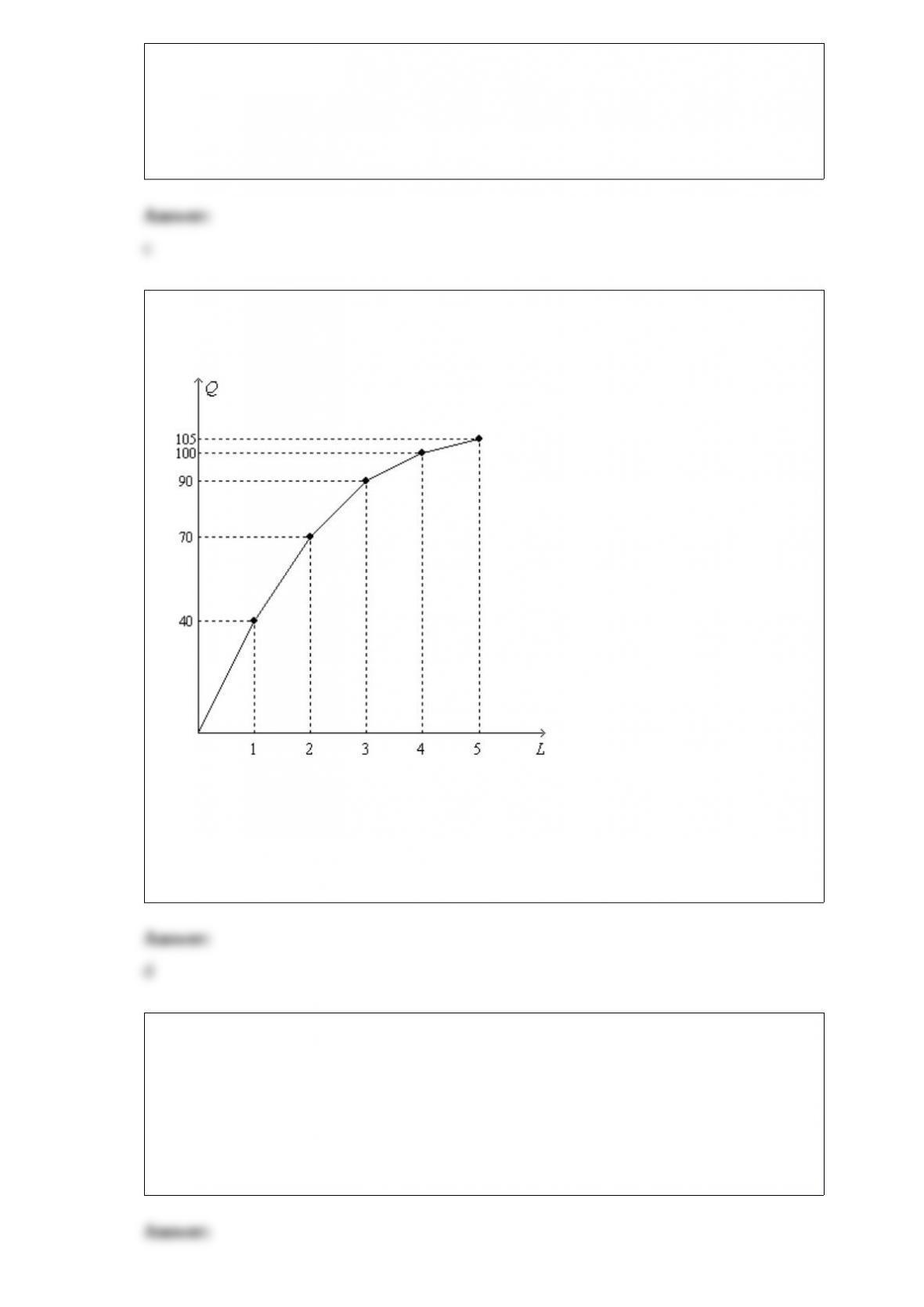
6) Figure 18-2
The figure below shows the production function for a particular firm.
Refer to Figure 18-2. The marginal product of the fourth worker is
a.100 units.
b.25 units.
c.20 units.
d.10 units.
7) Suppose that for Emily, DVDs and trips to the movie theater are perfect substitutes.
Currently, Emily is spending all of her income on trips to the movie theater. If the price
of DVDs doubles, the substitution effect will
a.be two times the income effect.
b.be half the income effect.
c.be zero.
d.always increase the number of trips to the movie theater Emily makes.
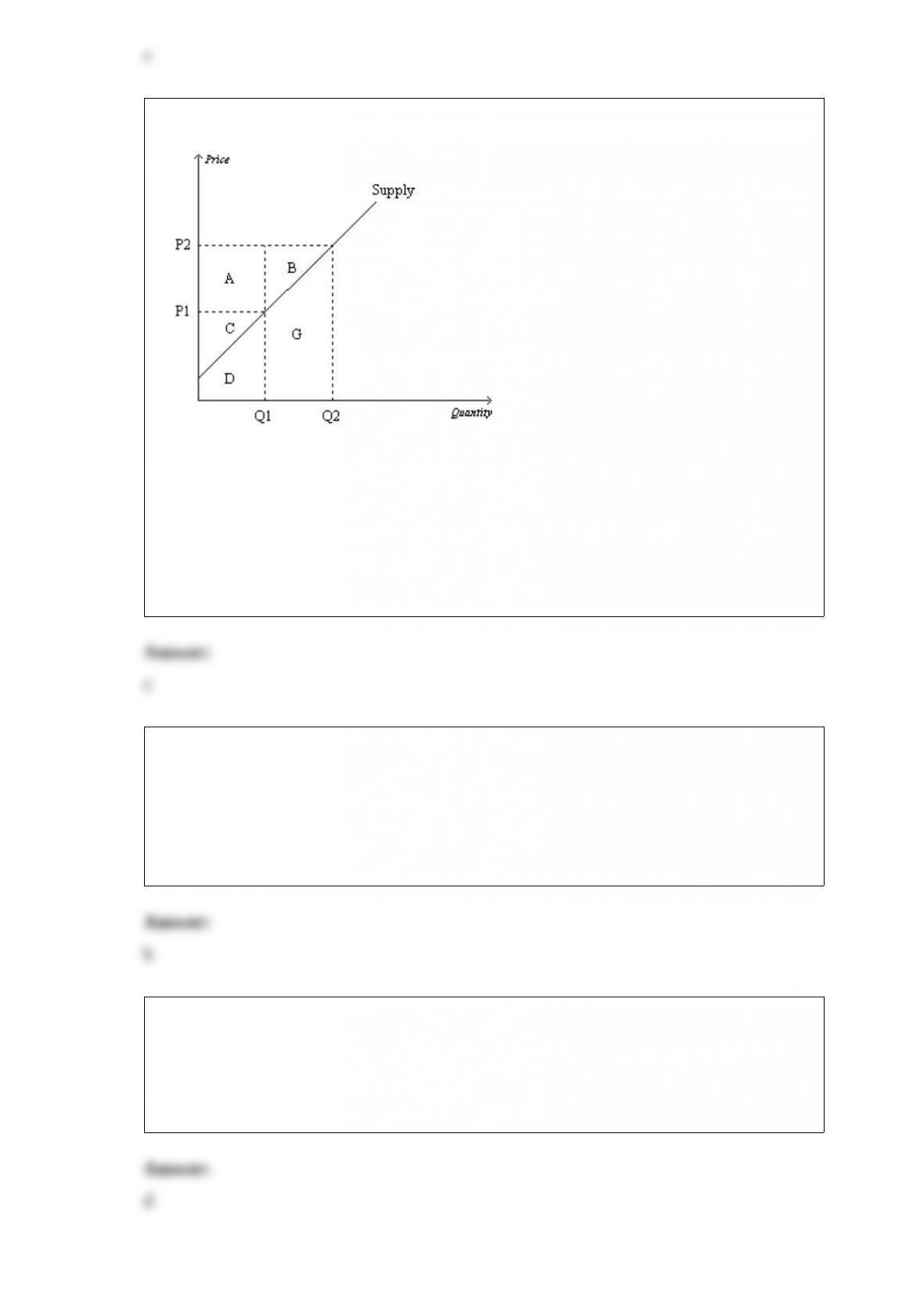
8) Figure 7-15
When the price falls from P2 to P1, which of the following would not be true?
a.The sellers who still sell the good are worse off because they now receive less.
b.Some sellers leave the market because they are not willing to sell the good at the
lower price.
c.The total cost of what is now sold by sellers is actually higher than it was before the
decrease in the price.
d.Producer surplus would fall by area A + B.
9) The labor supply curve may have a backward-bending portion if, at higher wages, the
income effect is
a.smaller than the substitution effect.
b.larger than the substitution effect.
c.negative.
d.Any of the above could result in a backward-bending supply curve.
10) If an externality is present in a market, economic efficiency may be enhanced by
a.increased competition.
b.weakening property rights.
c.better informed market participants.
d.government intervention.

11) Suppose the United States has a comparative advantage over Mexico in producing
pork. The principle of comparative advantage asserts that
a.the United States should produce more pork than what it requires and export some of
it to Mexico.
b.the United States should produce a moderate quantity of pork and import the
remainder of what it requires from Mexico.
c.the United States should refrain altogether from producing pork and import all of
what it requires from Mexico.
d.Mexico has nothing to gain from importing United States pork.
12) The flypaper theory of tax incidence
a.ignores the indirect effects of taxes.
b.assumes that most taxes should be ‘stuck on ” the rich.
c.says that once a tax has been imposed, there is little chance of it changing, so in
essence people are stuck with it.
d.suggests that taxes are like flies because they are everywhere and will never go away.
13) When demand is inelastic, an increase in price will cause
a.an increase in total revenue.
b.a decrease in total revenue.
c.no change in total revenue but an increase in quantity demanded.
d.no change in total revenue but a decrease in quantity demanded.
14) When a tax on a good is enacted,
a.buyers and sellers share the burden of the tax regardless of whether the tax is levied
on buyers or on sellers.
b.buyers always bear the full burden of the tax.
c.sellers always bear the full burden of the tax.
d.sellers bear the full burden of the tax if the tax is levied on them; buyers bear the full
burden of the tax if the tax is levied on them.
15) When a country allows trade and becomes an importer of jet skis,
a.domestic producers of jet skis are worse off, domestic consumers of jet skis are better

off, and the economic well-being of the country rises.
b.domestic producers of jet skis are worse off, domestic consumers of jet skis are better
off, and the economic well-being of the country falls.
c.domestic producers of jet skis are better off, domestic consumers of jet skis are worse
off, and the economic well-being of the country rises.
d.domestic producers of jet skis are better off, domestic consumers of jet skis are worse
off, and the economic well-being of the country falls.