
When firms get together and agree on prices and output, it is called
a. price leadership.
b. the rule of reason.
c. monopolistic competition.
d. collusion.
e. intermediation.
An external diseconomy results in a socially nonoptimal use of a resource because
a. the private costs exceed the social costs.
b. it prohibits economic growth.
c. the resource user does not bear the full cost of his or her actions.
d. firms will not maximize their profits.
e. too little of the resource will be used.
One of the important elements for a successful technological innovation is that it
a. be relatively expensive to adapt to existing needs, creating monopoly profits.

b. reflect a comprehension of market realities and be encouraged by market forces.
c. is derived from technological development taking place outside the country.
d. lead to at least a doubling of an existing capital-output ratio.
e. lower output per person per hour, thus raising labor productivity.
In a closed shop, workers
a. must be union members before they can be hired.
b. need not be union members to work.
c. must become union members within a certain period of time once they have been
hired.
d. are not able to strike under any circumstances.
e. sign yellow dog contracts before they begin work.
A rapid rate of growth in the money supply accompanied by falling interest rates
indicates
a. rapidly falling reserves in the commercial banking system.

b. a deflationary monetary policy.
c. an expansionary fiscal policy.
d. a balanced budget multiplier.
e. monetary policy is easy.
Wartime inflations are generally ________ inflations.
a. cost-overrun
b. sedentary-spending
c. supply-side
d. demand-side
e. parity-price
Fractional-reserve banking means that
a. banks hold less in reserves than the amounts they owe their depositors.
b. all of a bank’s reserves are held by Federal Reserve Banks.
c. some gold is reserved to back paper money but not 100 percent.

d. reserves actually have three components: required, excess, and free.
e. a dangerous situation exists in which bank loans exceed deposits.
If the government goes into the credit market to finance a current budget deficit, the
a. quantity supplied of loanable funds will fall.
b. interest rate will fall.
c. Treasury must print more currency.
d. private sector borrowing will also increase to pay for the bonds.
e. demand curve for loanable funds will shift to the right.
When total revenue for a monopolist reaches its maximum value, marginal revenue is
a. zero.
b. equal to total revenue.
c. negative.
d. rising.

e. equal to the price.
Our money has value because
a. it is backed by gold.
b. its supply is unlimited.
c. it is guaranteed by banks.
d. people accept it in payment for goods and services.
e. it is the result of public and private debt.
In a free market, the price system determines how society’s output is distributed by
a. ensuring that low income people can buy all the necessities for living.
b. providing goods for those willing and able to pay at least the equilibrium price.
c. determining each person’s income in the labor market according to the tax rate
imposed by the state.
d. allowing all those who desire a commodity to buy it.
e. ensuring that each commodity is produced by the most efficient technique.
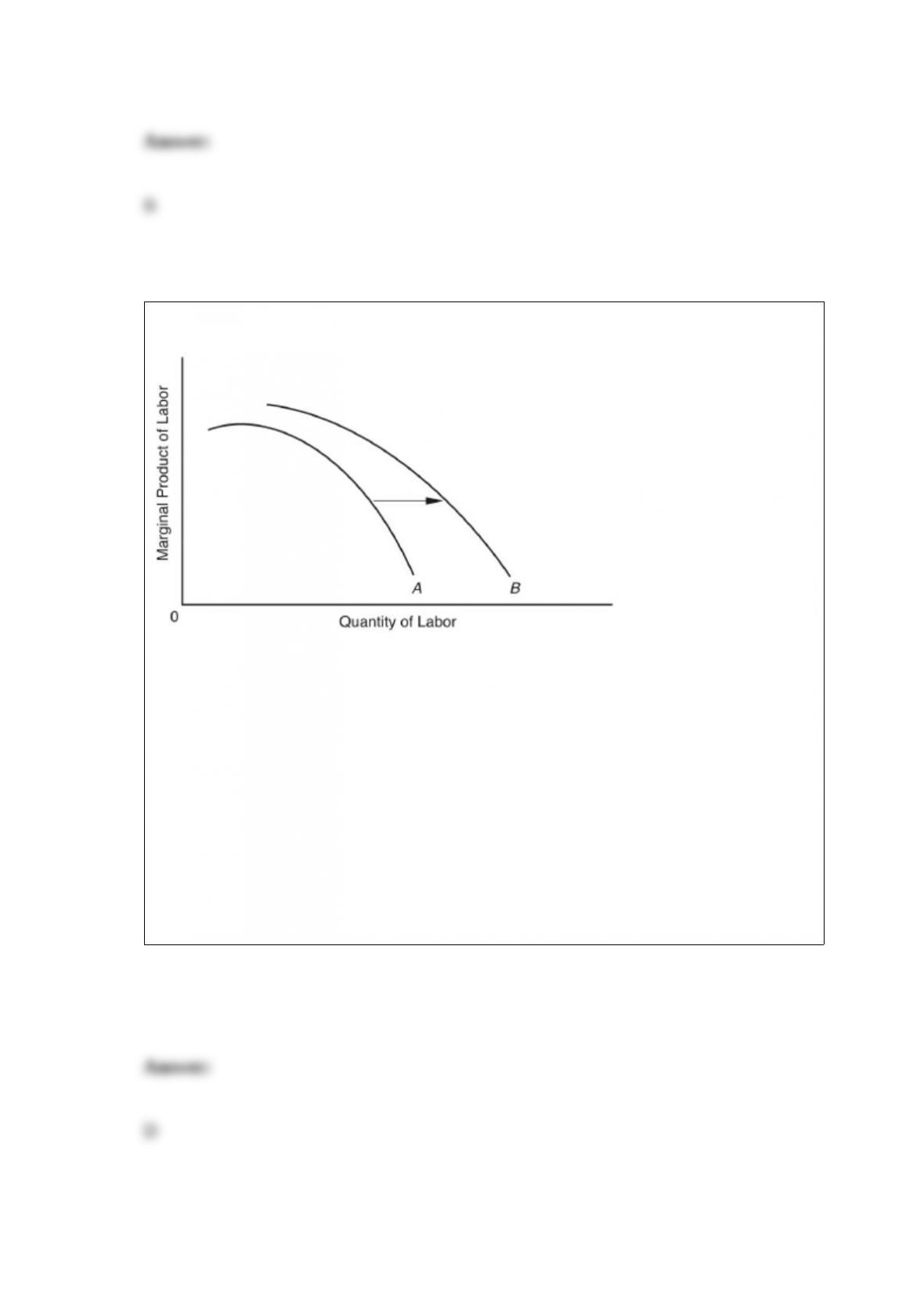
The following questions are based on the following diagram:
The shift in the marginal product of labor curve shown in the diagram might be caused
by
a. population growth.
b. an increase in the price of food.
c. a declining average product of labor.
d. technological change.
e. a decreasing total product of labor.
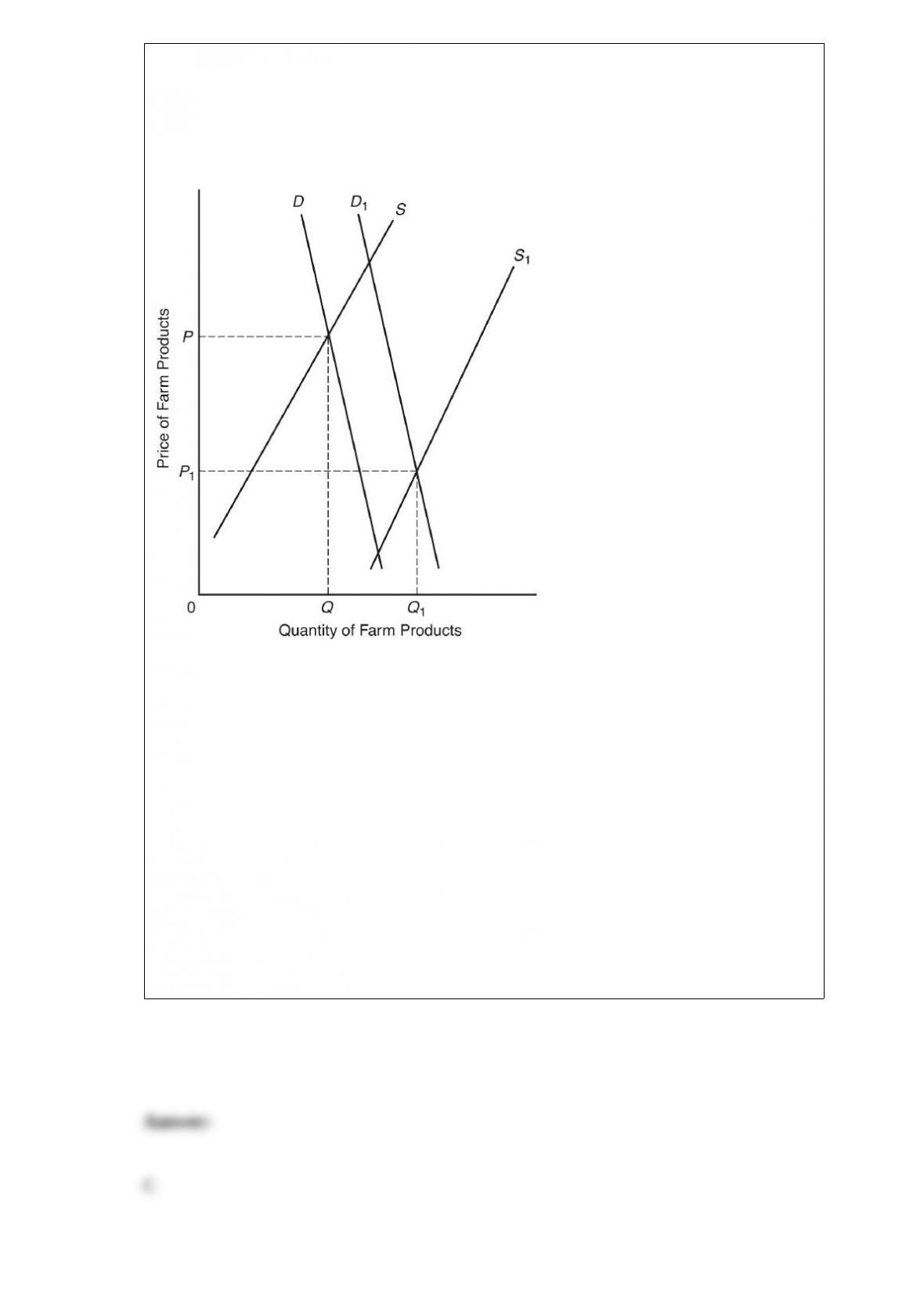
The following questions are based on the following graph. The curves D and S
represent the market demand and supply curves for farm products in 1960. The curves
D1 and S1 represent the market demand and supply curves for farm products in It is
supposed that there were no support programs in either year.
The relative insensitivity of the supply curve to price can best be explained by the fact
that
a. the quantity of food demanded does not vary much with the price of food because
food is a necessity.
b. consumption of food per capita faces natural limits and hence responds by only a
small amount to changes in per capita income.
c. farmers have only limited control over their outputs in the short run.
d. there has been rapid technological change in agriculture.
e. poor climatological conditions led to decreasing harvests.

To measure the value of all final goods produced in a given year, we must include the
value of
a. used goods that are resold.
b. intermediate goods.
c. government and private transfer payments.
d. all financial transactions.
e. changes in total inventories.
The fact that there is NO notation on a $10 bill about what the government will give in
exchange for it is an indication that
a. the note is not legal tender.
b. our paper currency no longer has much value.
c. the Fed has issued more money than the economy can handle.
d. the value of money has little to do with its intrinsic value.
e. the government does not want people to hoard money.
The role of the federal government in helping the poor
a. was virtually nonexistent until about 70 years ago.
b. is currently limited to old-age insurance programs.
c. is now exercised through a negative income tax.
d. began on a large scale in the late 1800s.
e. has declined since the Great Depression.
Changes in the quality of a good
a. are not reflected in GDP unless the price of the good reflects the improvement.
b. increase the national income and lower GDP.
c. are reflected in GDP when GDP is deflated.
d. are one reason the dollar value of output exceeds the dollar value of income.
e. explain why we must avoid double counting.
Which of the following would help to establish a monopoly?
a. possession of patent or copyright privileges
b. sharply increasing average cost at low rates of output
c. minimal industry barriers to entry for new products
d. a perfectly elastic demand curve for the product
e. the need to buy basic inputs in the world market
Which of the following government programs provides goods or services rather than
cash payments to the poor?
a. Aid to Families with Dependent Children
b. unemployment insurance
c. Social Security
d. Medicaid
e. old-age insurance
According to economic analysis, shortages of a good mean
a. supply is too low.
b. demand is too high.

c. the actual price is too low.
d. production is too low.
e. the equilibrium price is too low.
In essence, the Corn Laws
a. lowered the profits of landlords.
b. imposed high tariffs on grain.
c. were designed to benefit industrialists by ensuring low agricultural prices.
d. were written to encourage the substitution of British corn for U.S. and Canadian
wheat.
e. provided poor people in England with free grain.
Tax incidence refers to
a. whether the sales tax is collected by sellers or buyers.
b. who bears the ultimate burden of the tax.
c. the principle of taxation used, either benefit or ability-to-pay.

d. the classification of a particular act as tax evasion or tax avoidance.
e. the separation of taxation from expenditure as in revenue sharing.
A consumer’s demand curve slopes downward because as the
a. price of a commodity rises, the marginal utility per dollar falls relative to other goods
so that less will be purchased to restore equilibrium.
b. average utility of the commodity rises, the price falls; this increases the individual’s
consumption.
c. price of a product rises, its total utility rises, so the consumer will buy less.
d. consumer buys more, total utility falls, so he or she is not willing to pay as much for
the units.
e. price of a commodity falls, demand decreases.
If a firm faces a horizontal demand curve
a. when it increases its price, its revenues will rise.
b. increases in revenues are possible if it increases its price.
c. increases in revenues are possible without reductions in its price.
d. it is the only seller of the product in a given market.
e. industry and product demand curves are identical.
People actively looking for work who CANNOT find jobs because of an insufficiency
of aggregate demand are examples of ________ unemployment.
a. frictional
b. structural
c. cyclical
d. inflationary
e. residual
The biggest financial winners from the passage of Proposition 13 in California were
a. renters.
b. homeowners.
c. business and agriculture.
d. tourists.
e. local governments.

If total intended spending is greater than GDP
a. firms cut production and avoid expansion.
b. inventories fall below desired levels.
c. interest rates decline sharply.
d. business investment will lag.
e. GDP tends to remain unchanged.
Some argue that to determine whether a certain degree of income inequality is unfair,
one must
a. look at the justice of the process leading to the prevailing distribution.
b. assume that perfect equality is the optimal condition.
c. measure the comparable worth of high- and low-income households.
d. determine whether it is correlated with the marginal utility of money.
e. quantify the utility curve for individuals at similar income levels.

Government requirements that food and drug products be pure and properly labeled are
an example of
a. economic stabilization policy.
b. income redistribution.
c. establishing the “rules of the game.”
d. trust busting.
e. providing public goods.
Income generated in the production of this year’s output is measured by summing
transactions in ________ markets.
a. foreign
b. resource
c. commodity
d. stock
e. black
The inverse relationship between inflation and unemployment is a result of the fact that
a. as the unemployment rate decreases, it is easier for labor to get wage increases.
b. as the unemployment rate falls, demand for products and resources decreases.
c. as the unemployment rate increases, bottlenecks occur throughout the economy.
d. at low levels of unemployment, there is a significant amount of excess capacity.
e. as prices rise, unemployment also rises.
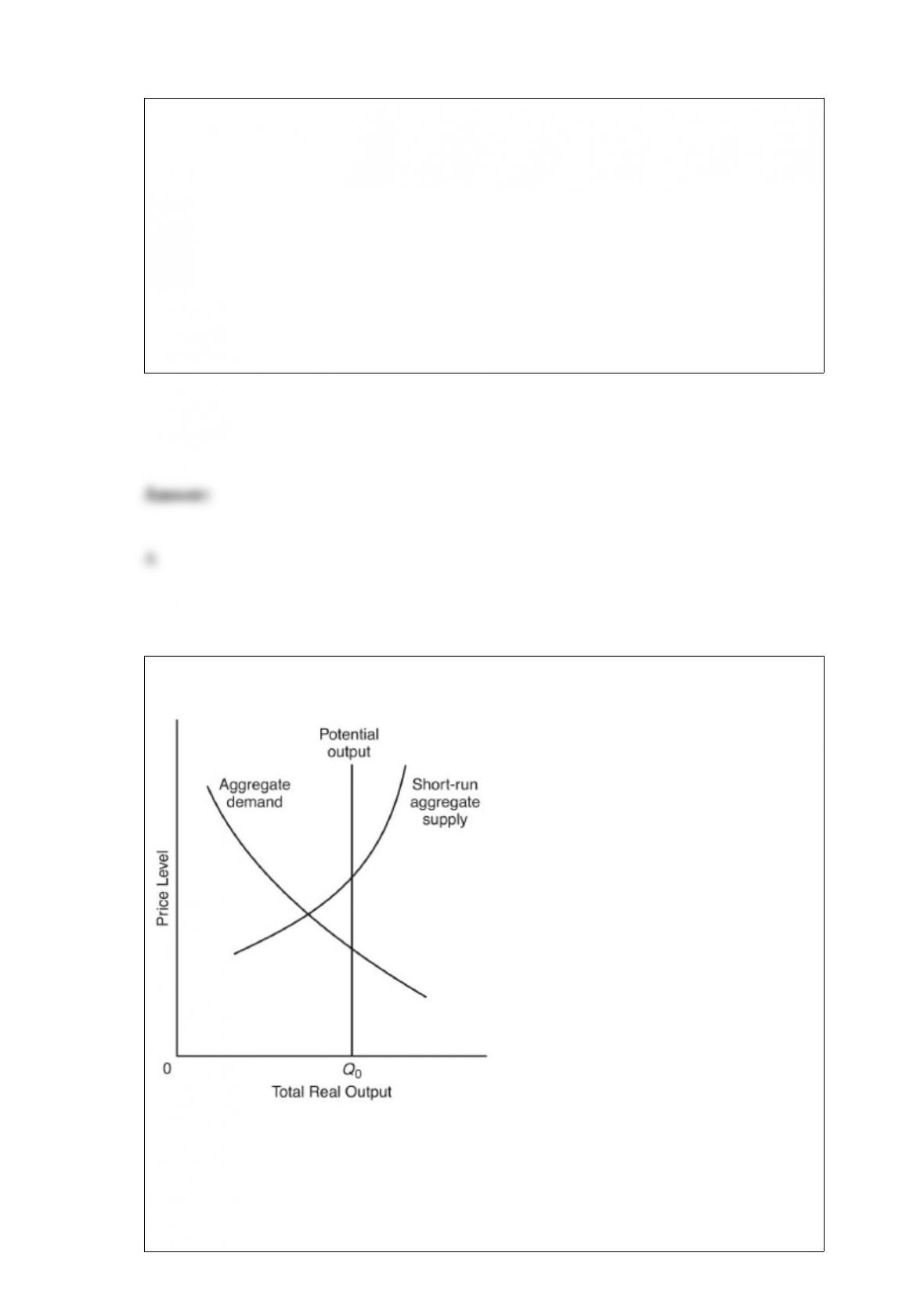
The following questions are based on the following diagram:
Which of the following events would correct the condition shown?
a. a decrease in wages and other input prices
b. a shift to the left in the short-run aggregate supply curve

c. a significant tax increase accompanied by a reduction in government spending
d. a reduction in private sector spending
e. a decrease in the money supply by the government
Proponents of policy activism argue that the time period required for wages and prices
to adjust during a severe recession would be
a. intolerably long and entail great human cost.
b. quite short and promote a quick recovery.
c. unimportant given the relative stability of the components of private spending.
d. shortened by balancing the federal budget.
e. dependent on the ratio of nominal to real GDP.
An antipoverty program structured along the conceptual lines of the negative income
tax proposed by Richard Nixon but NEVER passed by Congress was the
a. Job Corps.
b. Comparable Worth Act.
c. Family Assistance Plan.
d. Equal Pay Act.
e. Federal Workfare Program.
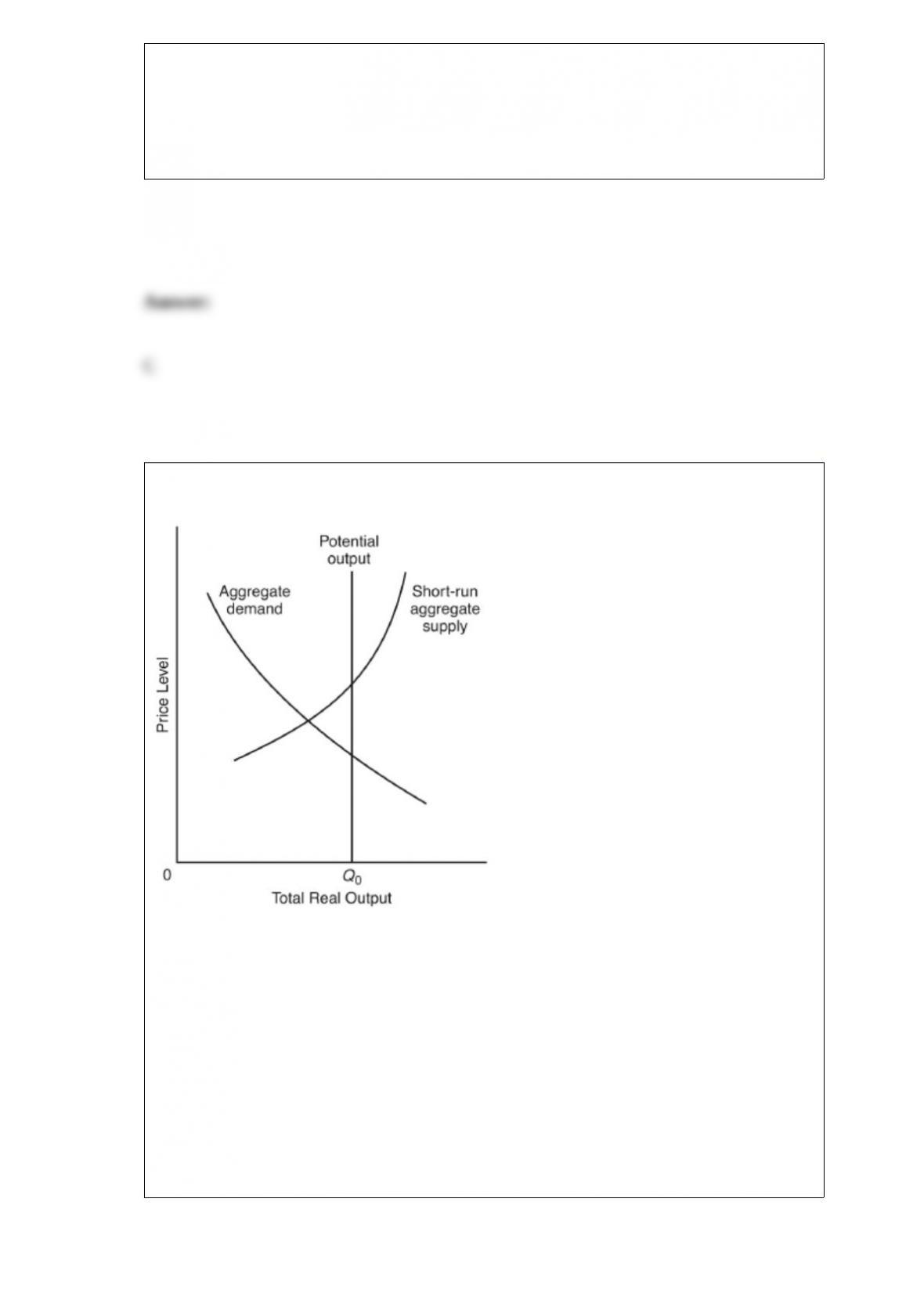
The following questions are based on the following diagram:
Which of the following events would correct the condition shown?
a. a decrease in the money supply by the government
b. a shift to the left in the short-run aggregate supply curve
c. a significant tax increase accompanied by a decrease in government spending
d. an increase in private sector spending
e. an increase in wages and other input prices