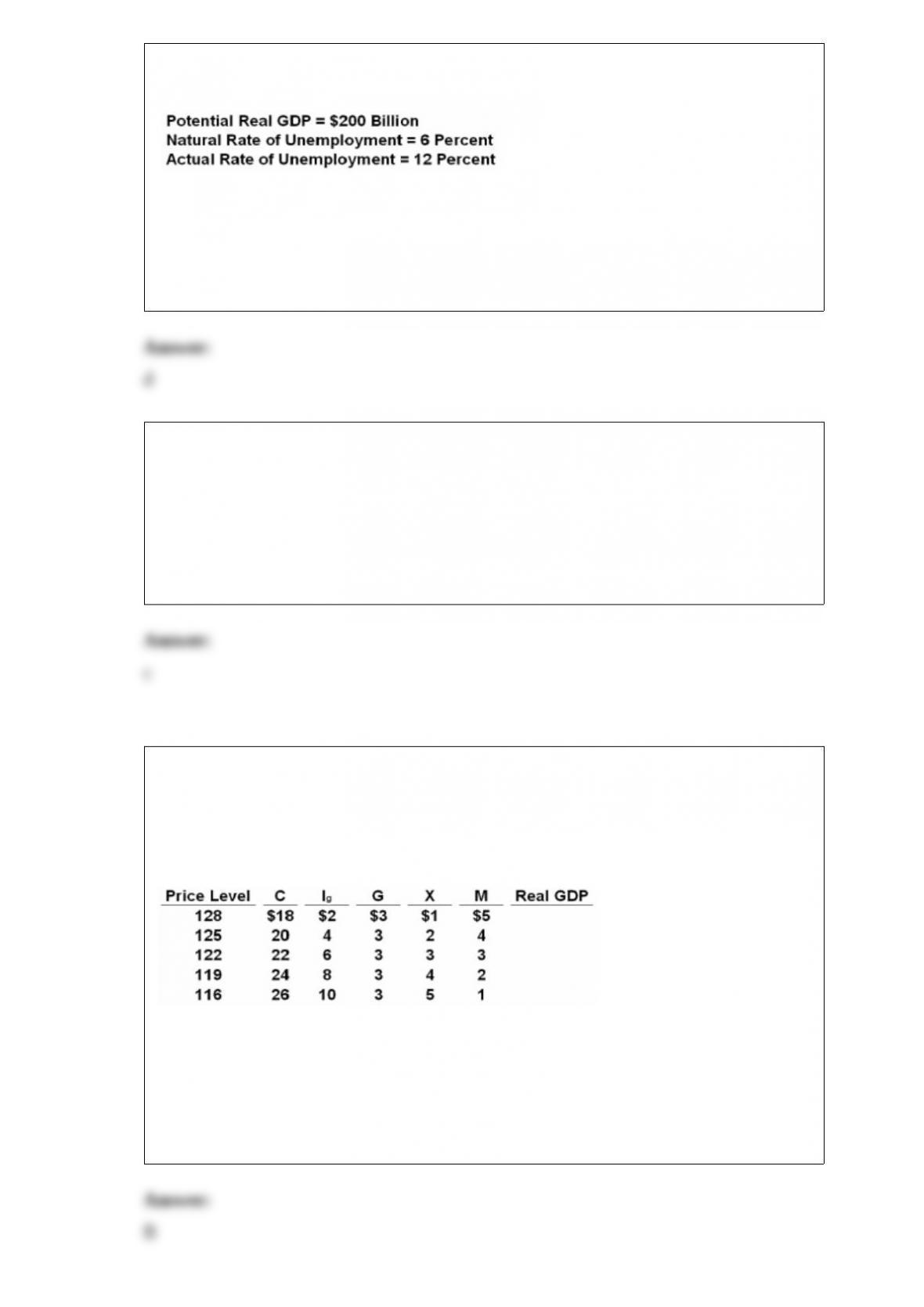
1) answer the next question(s) on the basis of the following information for a specific
year in a hypothetical economy for which okun’s law is applicable:
refer to the above data. the amount of output being forgone by the above economy is:
a.$12 billion.
b.$15 billion.
c.$18 billion.
d.$24 billion.
2) the production possibilities curve:
a.shows all of those levels of production that are consistent with a stable price level.
b.indicates that any combination of goods lying outside the curve is economically
inefficient.
c.is a frontier between all combinations of two goods that can be produced and those
combinations that cannot be produced.
d.shows all of those combinations of two goods that are most preferred by society.
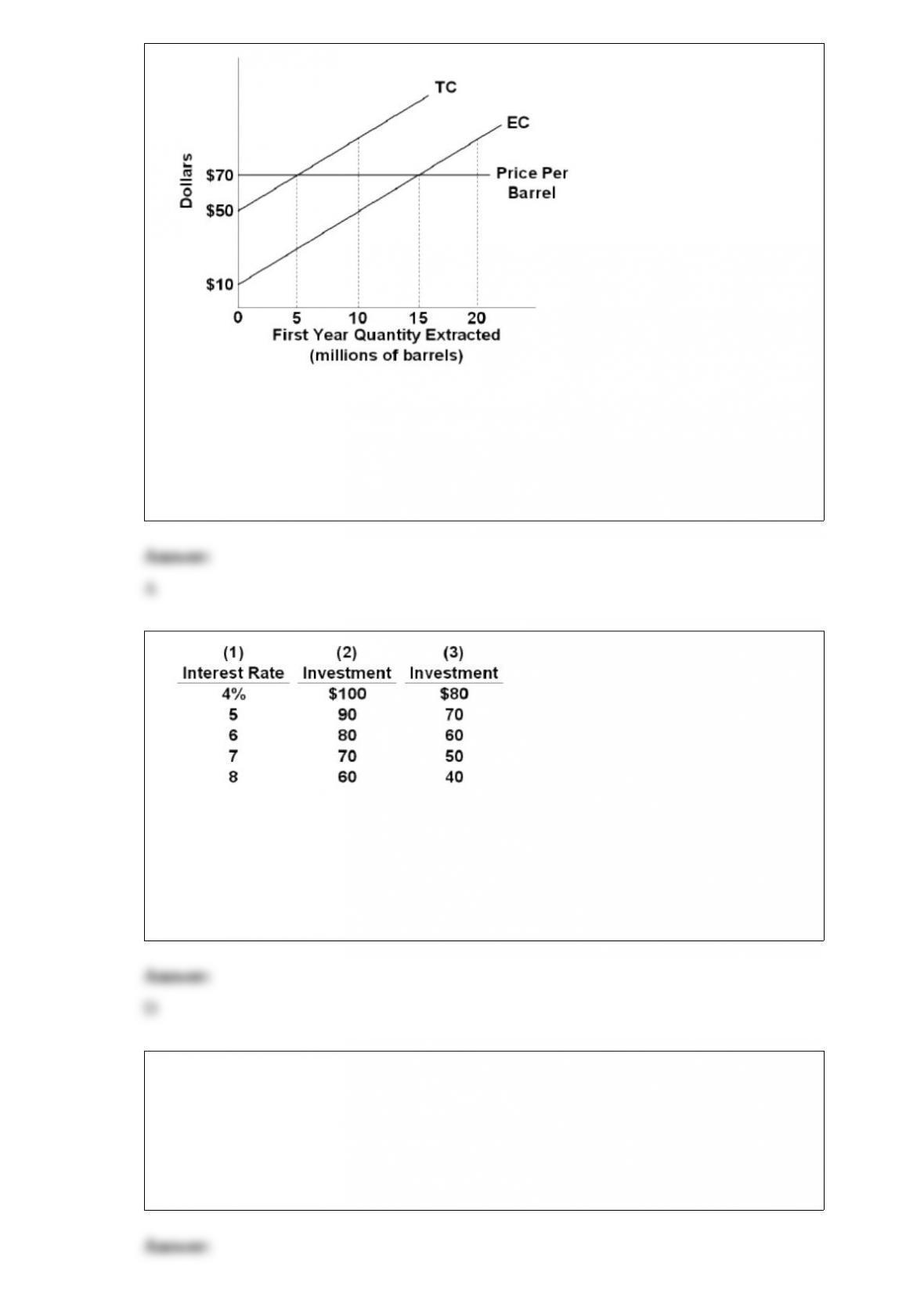
3) Answer the next question(s) on the basis of the following table for a particular
country in which C is consumption expenditures, Ig is gross investment expenditures, G
is government expenditures, X is exports, and M is imports. All figures are in billions of
dollars. Each question is independent of the other questions.
Refer to the above table. If the amounts of GDP supplied at the price levels shown (in
descending order) are $27, $25, $22, $18, and $13, the equilibrium price level will be:
A.128.
B.125.
C.122.
D.119.
4)
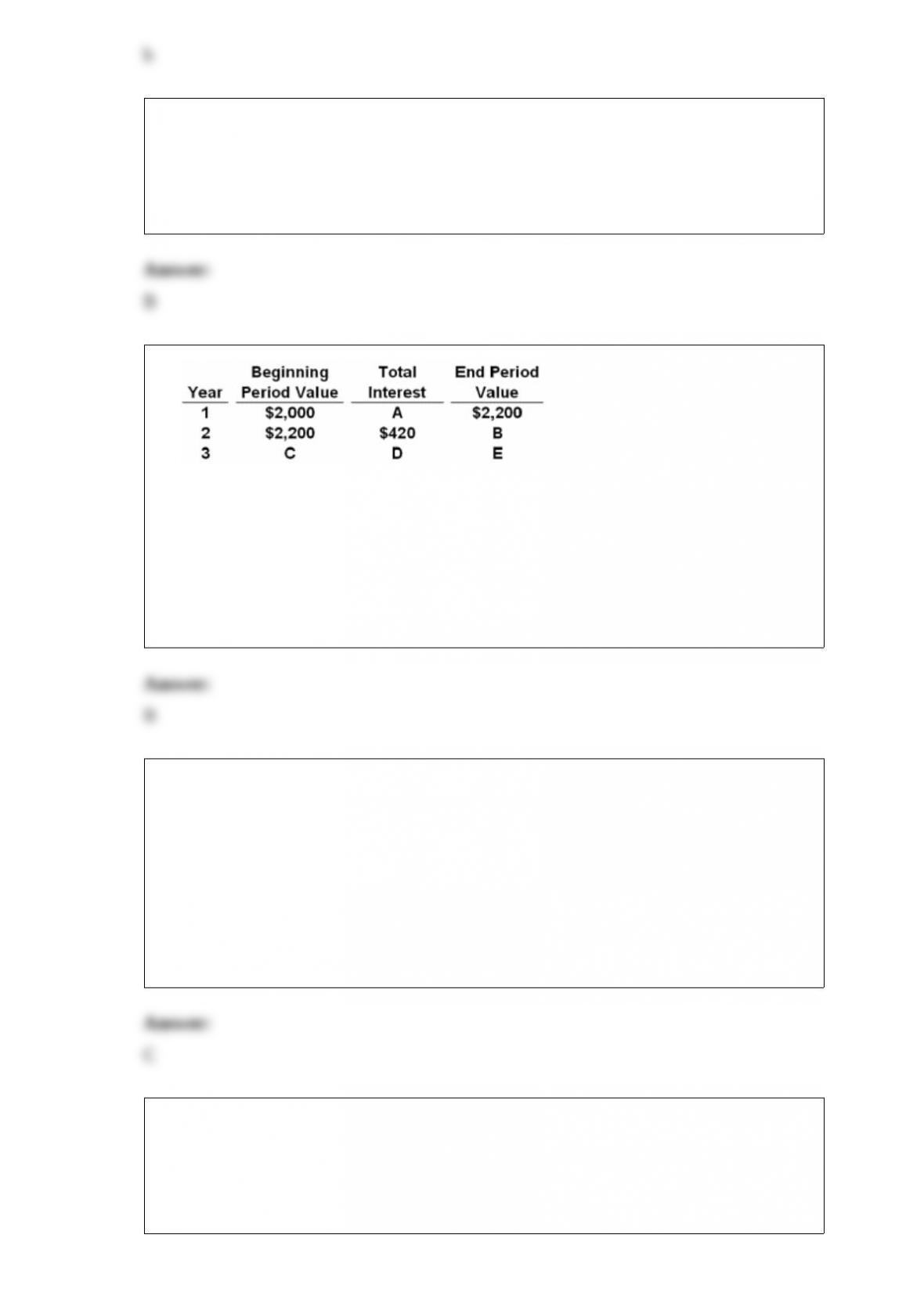
Refer to the diagram above, representing Slippery Slope Oil Company. How many
million barrels should Slippery Slope extract and sell this year?
A.5.
B.10.
C.15.
D.It cannot be determined with the information given.
5)
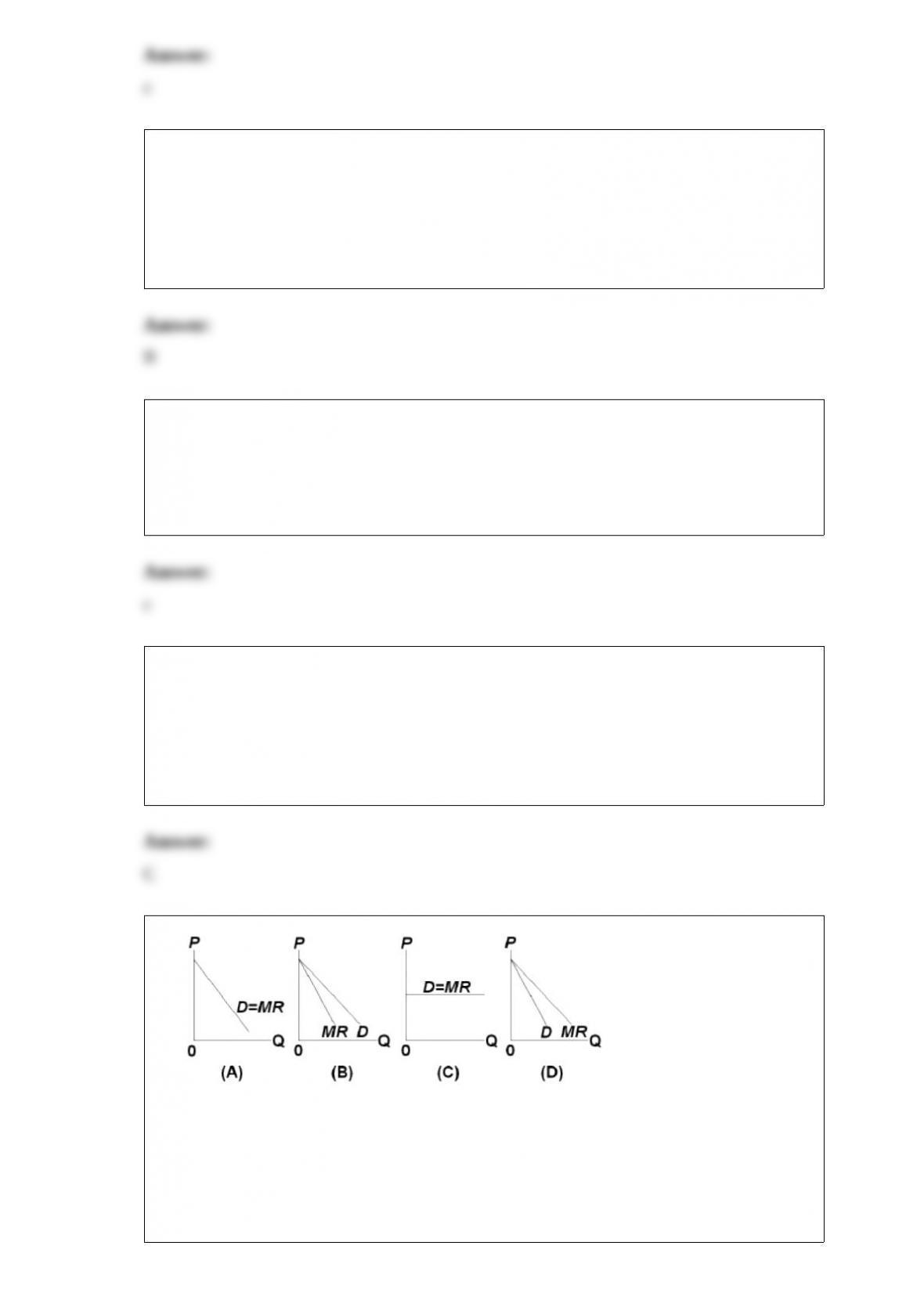
Refer to the above table, in which investment is in billions. Suppose the Fed reduces the
interest rate from 6 percent to 5 percent. Given columns (1) and (2), investment will:
A.decline by $20 billion.
B.increase by $20 billion.
C.decline by $10 billion.
D.increase by $10 billion.
6) approximately what percentage of local government expenditures go to finance
education?
a.36
b.44
c.53
d.69
7) Open-market operations change:
A.the size of the monetary multiplier, but not commercial bank reserves.
B.commercial bank reserves, but not the size of the monetary multiplier.
C.neither commercial bank reserves nor the size of the monetary multiplier.
D.both commercial bank reserves and the size of the monetary multiplier.
8)
Refer to the above table representing Kara’s bank account. Assuming that $2000 was
deposited into her account at the beginning of year 1, and no further deposits or
withdrawals were made, the value for cell E:
A.cannot be determined.
B.is $2,662.
C.is $2,600.
D.is $2,200.
9) Suppose a firm hires both labor (L) and capital (C) under purely competitive
conditions. The price of labor is PL and that of capital is PC. The marginal product of
labor is MPL and that of capital is MPC. The firm sells its product competitively at a
price of PX.
Refer to the above information. If MPC/PC > MPL/PL, the firm:
A.may be maximizing profits, but it is not minimizing costs.
B.may be minimizing costs, but it is not maximizing profits.
C.is neither minimizing costs nor maximizing profits.
D.is minimizing costs and maximizing profits.
10) if z is an inferior good, an increase in money income will shift the:
a.supply curve for z to the left.
b.supply curve for z to the right.
c.demand curve for z to the left.
d.demand curve for z to the right.
11) (Last Word) The use of U.S. dollars in foreign countries:
A.is illegal under international law.
B.actually benefits the United States because each dollar costs less than a dollar to
produce.
C.varies directly (positively) with U.S. interest rates.
D.is less in volume than the use of foreign currencies in the United States.
12) the term “ceteris paribus” means:
a.that if event a precedes event b, a has caused b.
b.that economics deals with facts, not values.
c.other things equal.
d.prosperity inevitably follows recession.
13) Which of the following occupations is not among the ten projected fastest growing
U.S. occupations in terms of percentage increases?
A.medical assistants
B.veterinarians
C.desktop publishers
D.software engineers
14)
which of the above diagrams correctly portray a nondiscriminating pure monopolist’s
demand (d) and marginal revenue (mr) curves?
a.a
b.b
c.c
d.d