
1) The per capita public debt doubled between 1990 and 2000.
2) A nation that imports more goods and services than it exports is necessarily realizing
an international balance of payments deficit.
3) Excess reserves are the amount by which required reserves exceed actual reserves.
4) products and services are scarce because resources are scarce.
5) The short-run aggregate supply curve shifts to the left when nominal wages rise in
response to price level increases.
6) the entrepreneur’s sole function is to combine other resources (land, labor, and
capital) in the production of some good or service.
7) between 1953 and 2007, rising labor productivity contributed more to u.s. economic
growth than did increases in inputs.
8) The following economic data for a hypothetical economy:
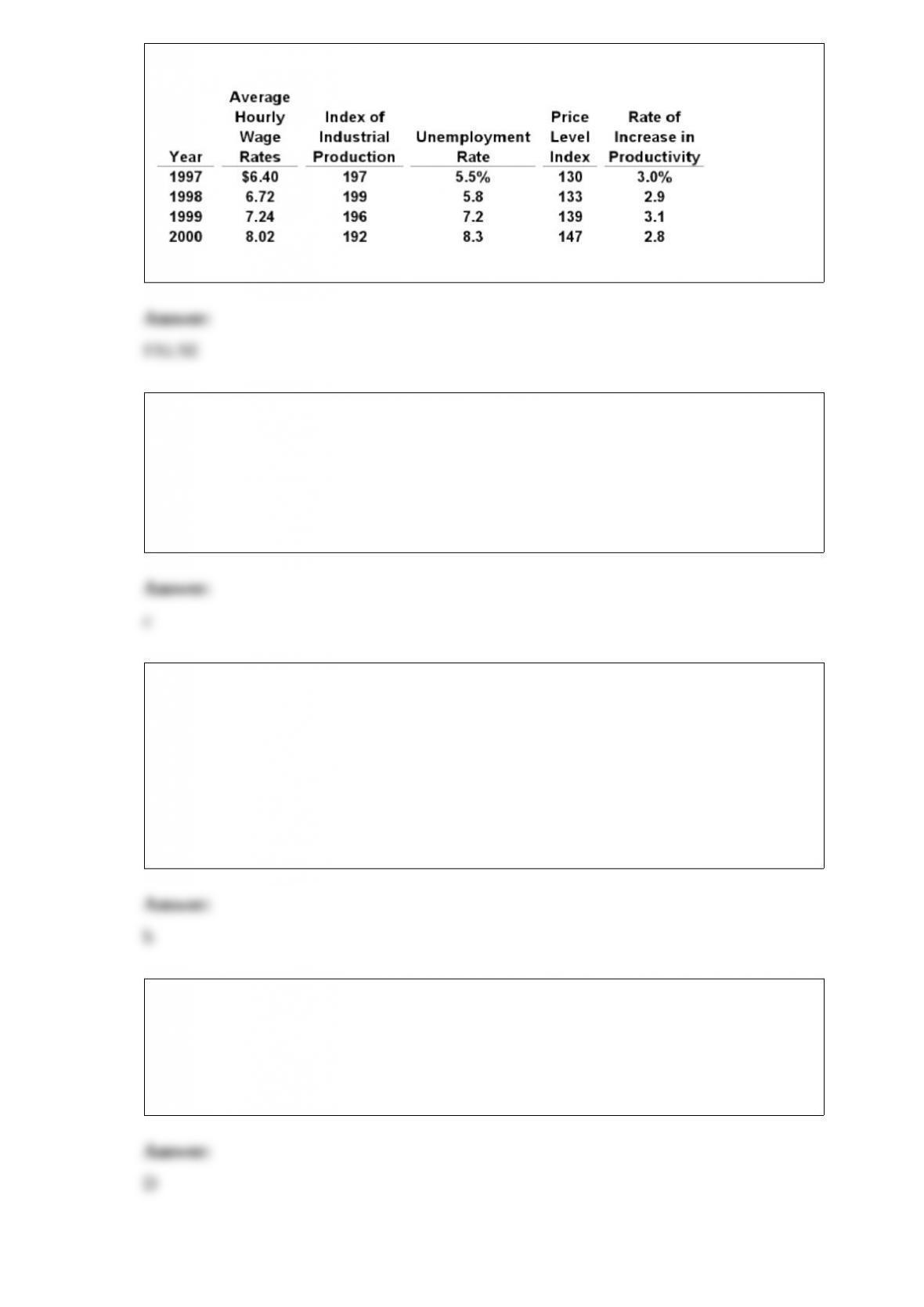
The above data indicate that the economy has entered a period of demand-pull inflation.
9) a major objection to creating a legal market for human organs is that such a market
would:
a.create a substantial surplus of unused organs.
b.increase the present shortage of organs.
c.commercialize human body parts and thus diminish the special nature of human life.
d.encourage healthier lifestyles to maintain saleable organs.
10) (consider this) unlike newspaper dispensing devices, soft drink dispensing machines
do not permit people to take more than one can or bottle with each payment. the reason
is that the:
a.opportunity cost of additional cans or bottles of a soft drink increase very rapidly.
b.marginal utility of extra soft drink cans or bottles declines slowly, particularly because
they are storable and can be consumed later.
c.marginal utility of extra soft drink cans or bottles declines quite rapidly.
d.opportunity cost of additional cans or bottles of soft drink increase very slowly.
11) Collective bargaining agreements usually cover:
A.wages and hours.
B.union status.
C.seniority and job opportunities.
D.all of these.
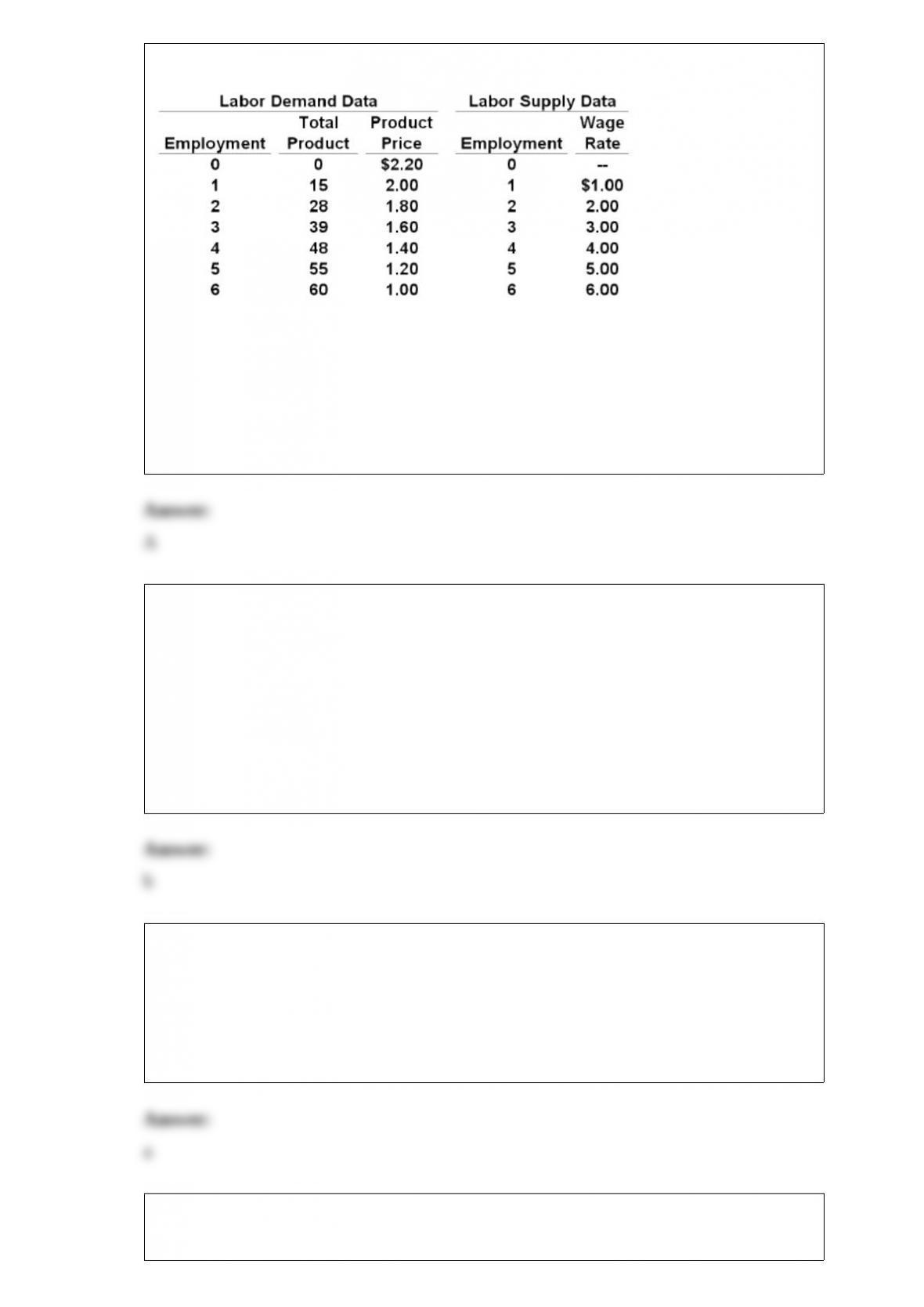
12)
Refer to the above data. We can conclude that:
A.both the product and resource markets are imperfectly competitive.
B.the resource market is imperfectly competitive but the product market is purely
competitive.
C.both the resource and product markets are purely competitive.
D.the resource market is purely competitive but the product market is imperfectly
competitive.
13) determine, other things equal, the effects of a given change in a determinant of
demand or supply for product x upon (1) the demand (d) for, or supply (s) of, x, (2) the
equilibrium price (p) of x and (3) the equilibrium quantity (q) of x.
refer to the above. consumer expectations that the price of x will rise sharply in the
future will:
a.increase s, increase p, and increase q.
b.increase d, increase p, and increase q.
c.decrease s, increase p, and increase q.
d.increase d, decrease p, and increase q.
14) if the supply of a product decreases and the demand for that product simultaneously
increases, then equilibrium:
a.price must rise, but equilibrium quantity may rise, fall, or remain unchanged.
b.price must rise and equilibrium quantity must fall.
c.price and equilibrium quantity must both increase.
d.price and equilibrium quantity must both decline.
15) Assume that an appliance manufacturer is employing variable resources X and Y in
such amounts that the MRPs of the last units of X and Y employed are $100 and $60
respectively. Resource X can be hired at $50 per unit and resource Y at $20 per unit.
The firm:
A.should hire more of both X and Y.
B.should hire more of Y and less of X.
C.is producing with the least-costly combination of X and Y, but could increase its
profits by employing more of X and less of Y.
D.is using the least-cost combination of X and Y, but could increase its profits by
employing less of both X and Y.
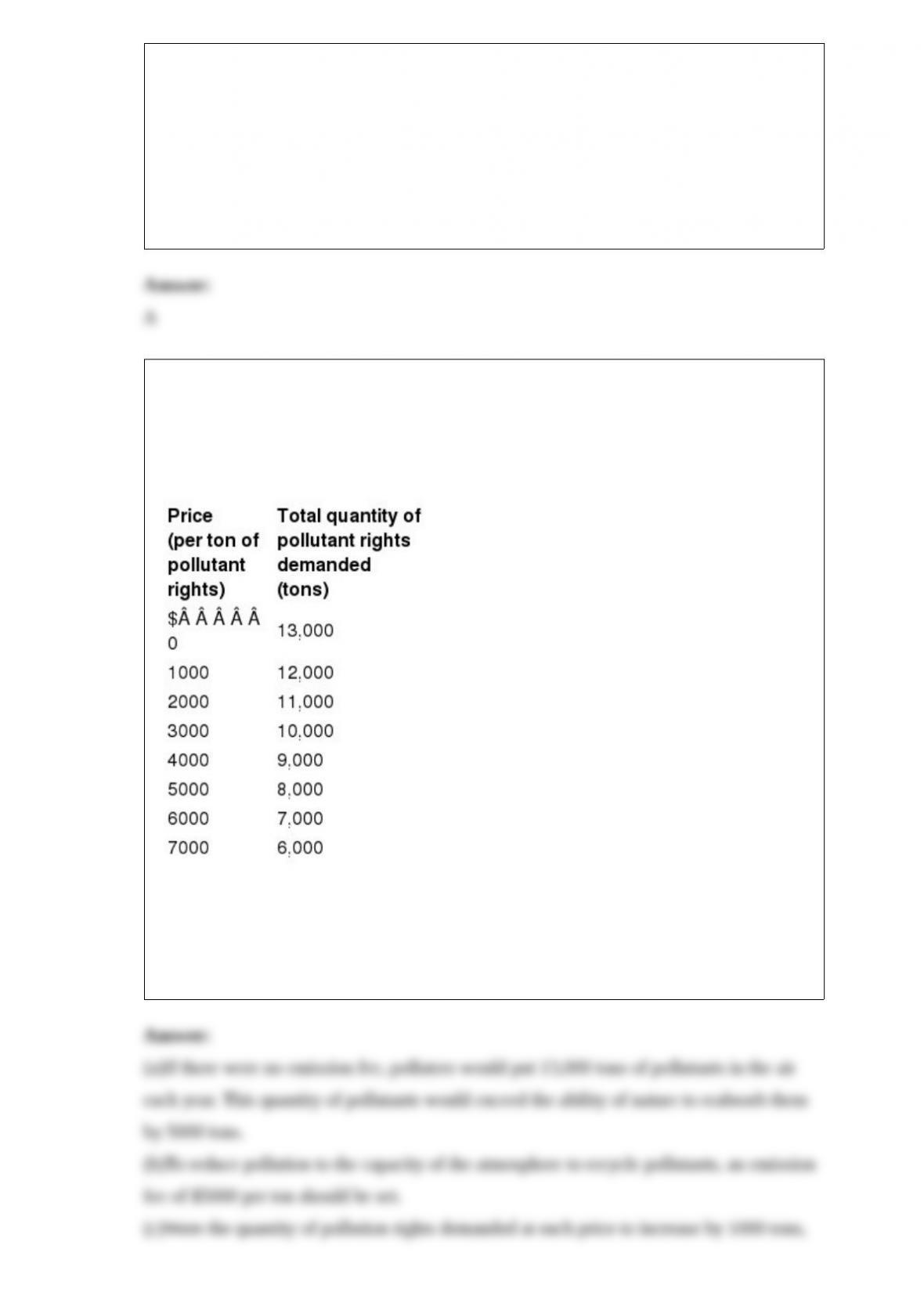
16) Assume the atmosphere of an urban area is able to reabsorb 8000 tons of pollutants
per year. The schedule below shows the price polluters would be willing to pay for the
right to dispose of 1 ton of pollutants per year and the total quantity of pollutants they
would wish to dispose of at each price.
(a)If there were no emission fee, how many tons of pollutants would there be and how
much greater would this amount be than the capacity for reabsorption?
(b)What pollution fee should the urban authorities charge to solve the problem?
(c)What would happen in this market for pollution rights if quantity demanded
increased by 1000 tons at each price?

17) A $70 price tag on a sweater in a department store window is an example of money
functioning as a:
A.unit of account.
B.standard of deferred payments.
C.store of value.
D.medium of exchange.
18) In monopsony:
A.each firm employs a small portion of the total supply of labor.
B.the work force is highly mobile.
C.the wage rate paid by the employer varies directly with the number of workers
employed.
19) since 1975, united states exports and imports have:
a.grown absolutely, but remained a constant proportion of gdp.
b.grown absolutely, but declined as a proportion of gdp.
c.grown both absolutely and as a percentage of gdp.
d.declined both absolutely and as a percentage of gdp.
20) economic profits in an industry suggest the industry:
a.can earn more profits by increasing product price.
b.should be larger to better satisfy consumers’ desire for the product.
c.has excess production capacity.
d.is the size that consumers want it to be.
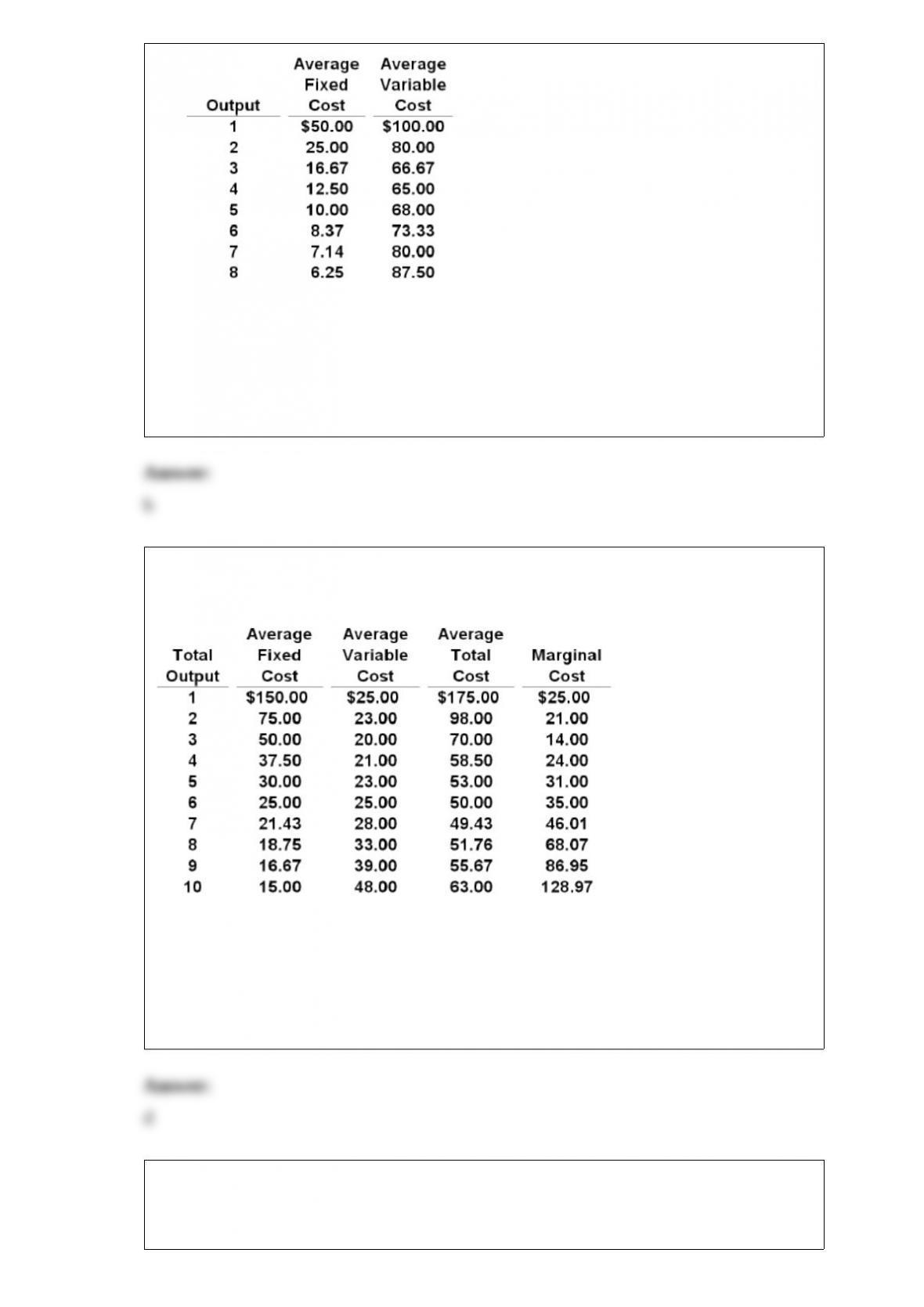
21)
refer to the above data. the marginal cost curve would intersect the average variable
cost curve at about:
a.2 units of output.
b.4 units of output.
c.6 units of output.
d.7 units of output.
22) the following cost data for a firm that is selling in a purely competitive market.
refer to the above data. we can infer that, at zero output, this firm’s total fixed, total
variable, and total costs are:
a.zero, zero, and zero, respectively.
b.zero, $25, and $175, respectively.
c.$150, $25, and $175, respectively.
d.$150, zero, and $150, respectively.
23) The following production possibilities data for Gamma and Sigma. All data are in
tons.
Gamma production possibilities:

Sigma production possibilities:
On the basis of the above information:
A.Gamma should export both tea and pots to Sigma.
B.Sigma should export tea to Gamma and Gamma should export pots to Sigma.
C.Gamma should export tea to Sigma and Sigma should export pots to Gamma.
D.Gamma should export tea to Sigma, but it will not be profitable for the two nations to
exchange pots.
24) a surplus of a product will arise when price is:
a.above equilibrium with the result that quantity demanded exceeds quantity supplied.
b.above equilibrium with the result that quantity supplied exceeds quantity demanded.
c.below equilibrium with the result that quantity demanded exceeds quantity supplied.
25) assume that a consumer purchases products a, b, and c in quantities such that the
last dollar spent on each yields the same marginal utility and the consumer’s income is
totally spent. we can conclude that:
a.total utility is being minimized.
b.production costs are being minimized.
c.marginal utility exceeds total utility.
d.total utility is being maximized.
26) answer the next question(s) on the basis of the following national income data for
the economy. all figures are in billions of dollars.
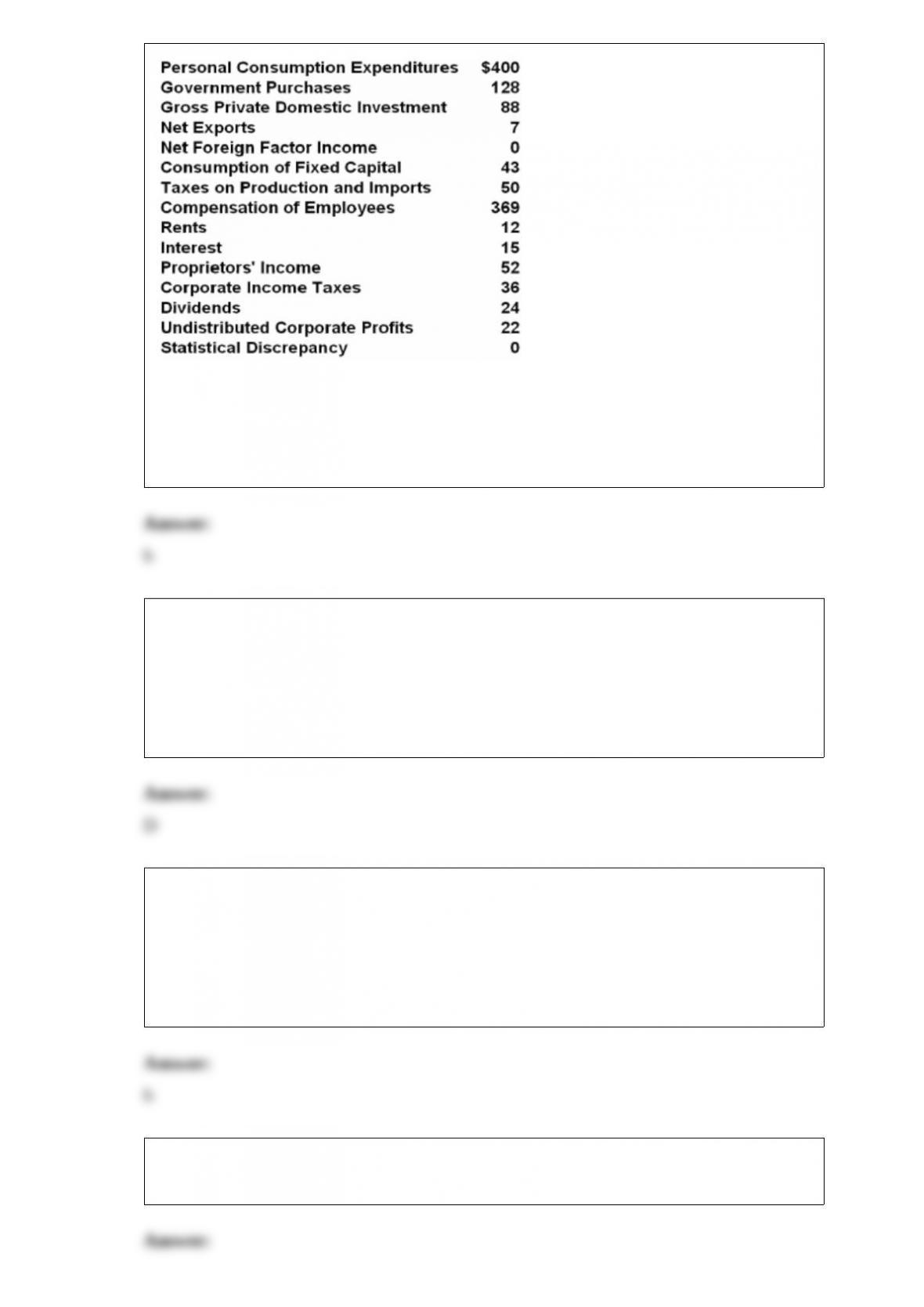
refer to the above data. net domestic product is:
a.$520.
b.$580.
c.$623.
d.$573.
27) Available research suggests that the union wage advantage diminishes the national
output by:
A.10 percent.
B.15 percent.
C.5 percent.
D.less than 1 percent.
28) comparing a pure monopoly and a purely competitive firm with identical costs, we
would find in long-run equilibrium that the pure monopolist’s:
a.price, output, and average total cost would all be higher.
b.price and average total cost would be higher, but output would be lower.
c.price, output, and average total cost would all be lower.
d.price and output would be lower, but average total cost would be higher.
29) What role does the interest rate play in the economy? Is the distinction between real
and nominal interest rates an important one in discussing these roles?

30) Describe bank runs. How can bank runs be avoided?
31) (Consider This) Why was unemployment in Europe so high in recent years?
32) Suppose an economys real GDP is $50,000 in year 1 and $55,000 in year What is
the growth rate of its GDP? Assume that population was 100 in year 1 and 105 in year
What is the growth rate in GDP per capita?
33) Describe the characteristics of the long-run aggregate supply curve. Explain how
changes in the price level affect the short-run aggregate supply curve and the long-run
aggregate supply curve.

34) Under what circumstances might the Coase theorem not be applicable? Apply these
circumstances to an example to illustrate your point.