
In the short run with predetermined prices, when output is less than planned aggregate
expenditure, firms will:
A. reduce production.
B. increase production.
C. increase planned aggregate expenditure.
D. decrease planned aggregate expenditure.
Refer to the figure below. At quantities less than 50 doughnuts per day:
A. marginal cost is declining.
B. the return to the firm’s variable factors of production must be increasing.
C. average cost is declining because marginal cost is increasing.
D. average cost is declining because marginal cost is less than average cost.
It is impossible for total utility to be ______ when marginal utility is ______.
A. increasing; increasing
B. decreasing; positive
C. positive; negative

D. increasing; decreasing
The table below shows how the payoffs to two political candidates depend on whether
the candidates run a positive or negative campaign. The payoffs are given in terms of
the percentage change in the number of votes received.
Running a negative campaign is ______ for the ______ candidate.
A. a dominated strategy; Democratic
B. a dominated strategy; Republican
C. a dominant strategy; Democratic
D. neither a dominant nor dominated strategy; Republican
In the short-run, if the Federal Reserve increases interest rates, then consumption and

investment ______, planned aggregate expenditure ______, and short-run equilibrium
output _______.
A. increase; increases; increases
B. increase; increases decreases
C. increase; decreases; decreases
D. decrease; decreases; decreases
It is difficult to engage in long-term financial planning when inflation is:
A. high and erratic.
B. low and stable.
C. accounted for through indexing.
D. predictable.
If average labor productivity increases, real GDP per person:
A. increases.
B. decreases.

C. remains constant.
D. may increase or decrease depending on the change in the share of population
employed.
For an economy starting at potential output, an increase in planned investment in the
short run results in a(n):
A. expansionary output gap.
B. recessionary output gap.
C. increase in potential output.
D. decrease in potential output.
For all firms, the additional revenue collected from the sale of one additional unit of
output is termed:
A. price.
B. average revenue.
C. marginal profit.
D. marginal revenue.

A prisoner’s dilemma illustrates situations in which:
A. resources with the lowest opportunity cost should be used first.
B. everyone does best when each person specializes in the activities in which he or she
has a comparative advantage.
C. efficiency is an important social goal.
D. there is a conflict between the narrow self-interest of individuals and the broader
interests of a group.
The practice of spreading one’s wealth over a variety of different financial investments
in order to reduce overall risk is called:
A. allocation.

B. following the risk premium.
C. diversification.
D. risk reservation.
Most cartels cease to be effective because:
A. of strict enforcement of antitrust legislation.
B. of the incentive to cheat on the cartel agreement.
C. the dominant firm buys out the other firms.
D. consumers discover the cartel and buy from other firms instead.
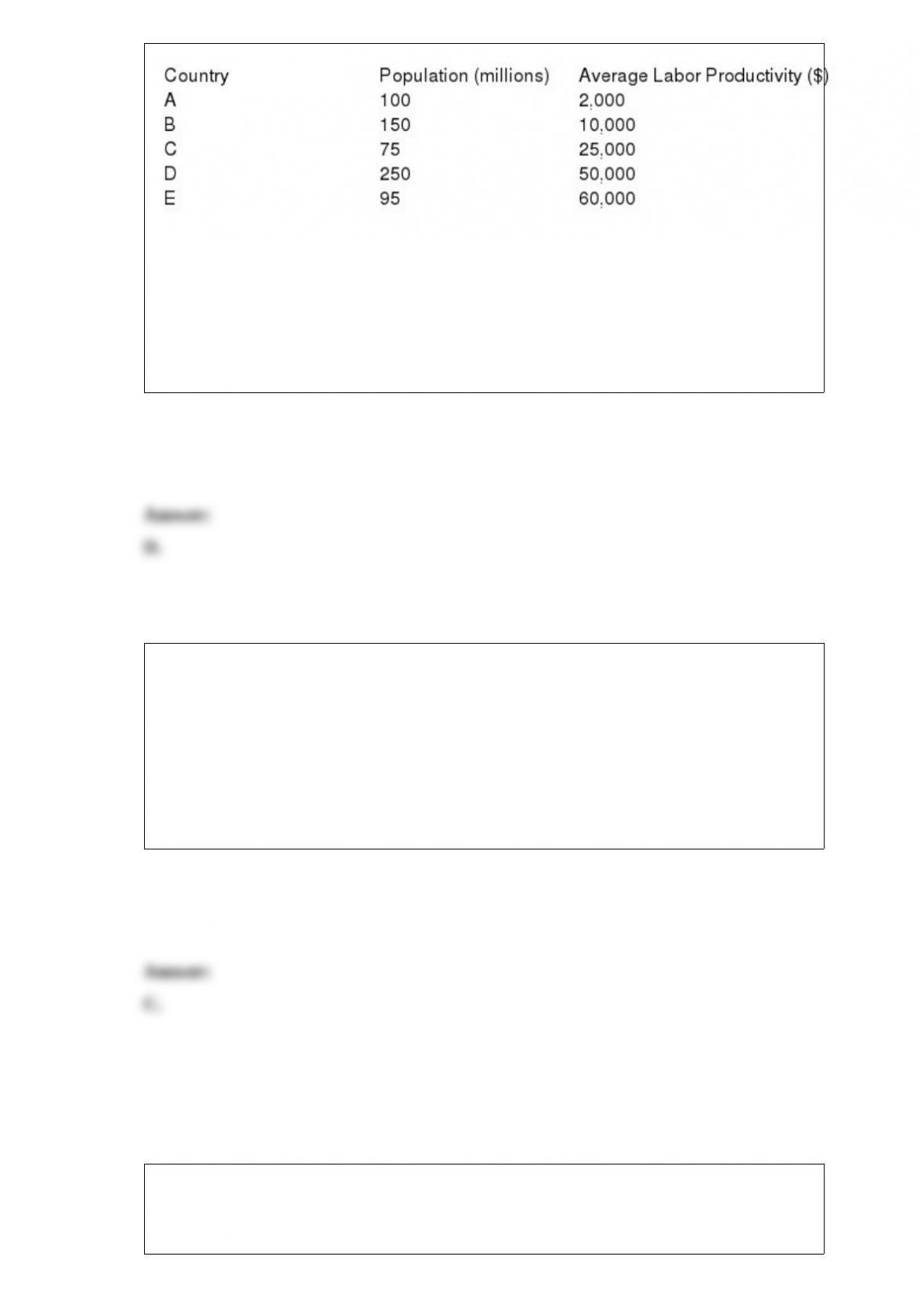
Assume that the share of population employed in all countries is 50 percent. Based on
the information in the table, which country has the highest real GDP per capita?
A. Country A
B. Country B
C. Country D
D. Country E
The U.S. trade deficit has been mainly caused by:
A. production of inferior goods in the U.S.
B. unfair trade restrictions imposed by other countries on imports.
C. a low rate of national saving.
D. cheap labor in other countries.
The price elasticity of demand equals 1:
A. whenever the slope of a straight-line demand curve is greater than 1 in absolute
value.
B. at the midpoint of a straight-line demand curve.
C. whenever the slope of a straight-line demand curve is less than 1 in absolute value.
D. whenever the slope of a straight-line demand curve equals zero.
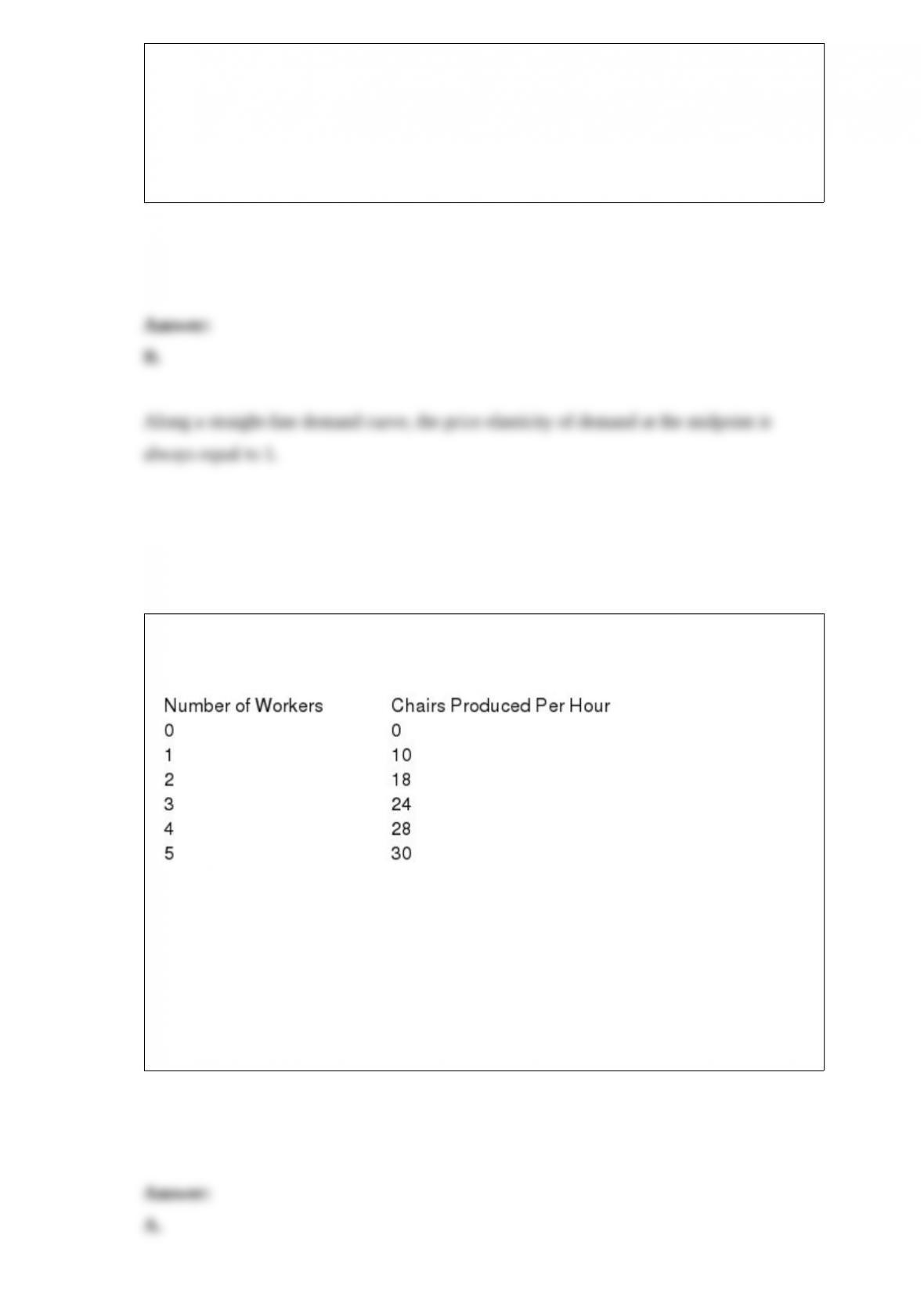
High Tech, Inc. produces plastic chairs that sell for $10 each. The following table
provides information about how many plastic chairs can be produced per hour.
How many workers will be hired if the hourly wage for workers is $120?
A. 0
B. 3
C. 5
D. More than 5

Which of the following events will increase the domestic real interest rate in an open
economy?
A. An increase in domestic saving
B. A decrease in the domestic saving
C. A decrease in the perceived riskiness of investing in the domestic economy
D. An increase in net capital inflow
Two firms, Industrio and Capitalista, have access to five production processes, each of
which has a different cost and gives off a different amount of pollution. The daily costs
of the processes and the corresponding number of tons of smoke emitted are shown in
the table below. Both firms currently use process A, and each emits 4 tons of smoke per
day. The government is considering two plans to reduce pollution: requiring both firms
to reduce pollution by 25 percent or auctioning pollution permits. Each permit would
entitle the owner to emit one ton of smoke per day. Without a permit, no smoke can be
emitted.
process
Suppose the government decides to sell 6 permits allowing a total of 6 tons of pollution.
The government starts the bidding with an opening price of $30. What happens next?
A. A total of five permits will be demanded, forcing the government to lower the price.
B. Industrio will purchase all available permits at $30.

C. Industrio will demand 3 permits and Capitalista will demand 3 permits.
D. A total of seven permits will be demanded, forcing the government to raise the price.
Explanations for the high saving rate in Japan consistent with the bequest reason for
saving include:
A. long life expectancies and large down payments required for home purchases.
B. lifetime employment.
C. the desire to leave resources to children who provide support and attention to parents
in their old age.
D. low unemployment rates in Japan.
Relative to a world in which some people are motivated by nonmaterial incentives, if all
people were motivated solely by financial incentives, then:
A. transactions in the business world would be the same, but personal interactions
would not.
B. economic efficiency would be achieved more often.
C. there would be no commitment problems.
D. both business transactions and personal interactions would be different.

If the marginal cost of reducing pollution is positive, then:
A. pollution should be reduced as much as technically feasible.
B. the marginal benefit of reducing pollution is zero.
C. the optimal amount of pollution is zero.
D. the optimal amount of pollution is greater than zero.
Refer to the figure below. What is the price elasticity of supply at point A?

A. 4
B. 2
C. 1
D. 1/2
The figure below shows Ava’s demand curve for days in the hospital. The marginal cost
of an additional day in the hospital is $200.
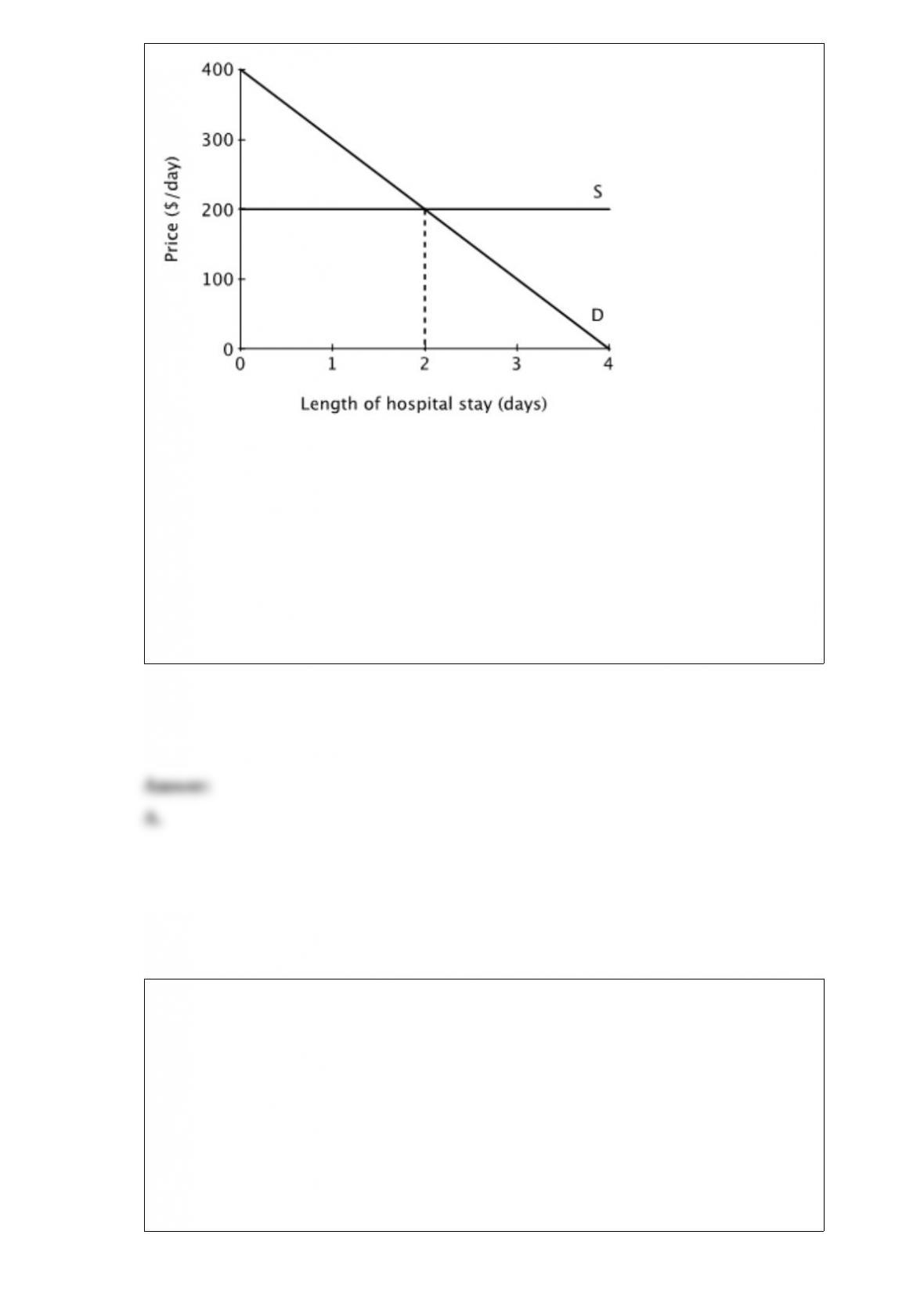
If Ava had first-dollar medical insurance, then she would choose to stay ______ day(s)
in the hospital.
A. 4
B. 1
C. 2
D. 3
Which of the following is NOT a commitment device?
A. A non-refundable advance payment to reserve a room at a resort.
B. A manufacturer’s 2-year agreement to fix, at no cost to you, anything that breaks on
your computer.
C. A pre-nuptial agreement that provides for a large penalty in the event a spouse has an
affair.
D. High fines for illegal parking on campus.

An increase in the interest rate directly affects ______, but also has an indirect effect on
______ because of its effect on exchange rates.
A. planned consumption and investment; government spending
B. planned consumption and investment; net exports
C. net exports; planned consumption and investment
D. net exports; government spending
There are 20 residents in the village of Towneburg. The size of the village’s annual
fireworks display depends upon the number of shells that are fired off. Each resident’s
demand for fireworks is shown below. The total cost of the fireworks display is $1,000
plus $10 per shell.

What is the vertical intercept of the village’s demand curve for fireworks?
A. 25
B. 50
C. 10
D. 1,000
If the absolute value of slope of the demand curve is 2.5, price is $6 per unit, and the
quantity demanded is 8 units, then the price elasticity of demand is:
A. 0.3.
B. 0.533.
C. 1.6.
D. 1.875.

Structural unemployment will decrease when:
A. the minimum wage is increased.
B. the minimum wage is decreased.
C. unemployment insurance benefits are increased.
D. union wages are increased.
It is socially optimal to hire an additional police officer if:
A. the marginal benefit of doing so is positive.
B. hiring an additional police officer reduces crime.
C. the marginal benefit of doing so is greater than the marginal cost.
D. the marginal benefit of hiring a police officer is decreasing.

A good is characterized by network economies if it:
A. can be used by more than one person at a time.
B. becomes cheaper to produce as more people buy it.
C. becomes more valuable as more people own it.
D. is widely advertised on television.
Suppose that a new drug has been approved to treat a life-threatening disease. The
demand for that drug is shown on the graph below. Prior to approval of this drug, the
only treatment for this condition was any one of several non-prescription, or
over-the-counter, pain relievers. The demand for one brand of the several
non-prescription pain relievers is also shown on the graph.
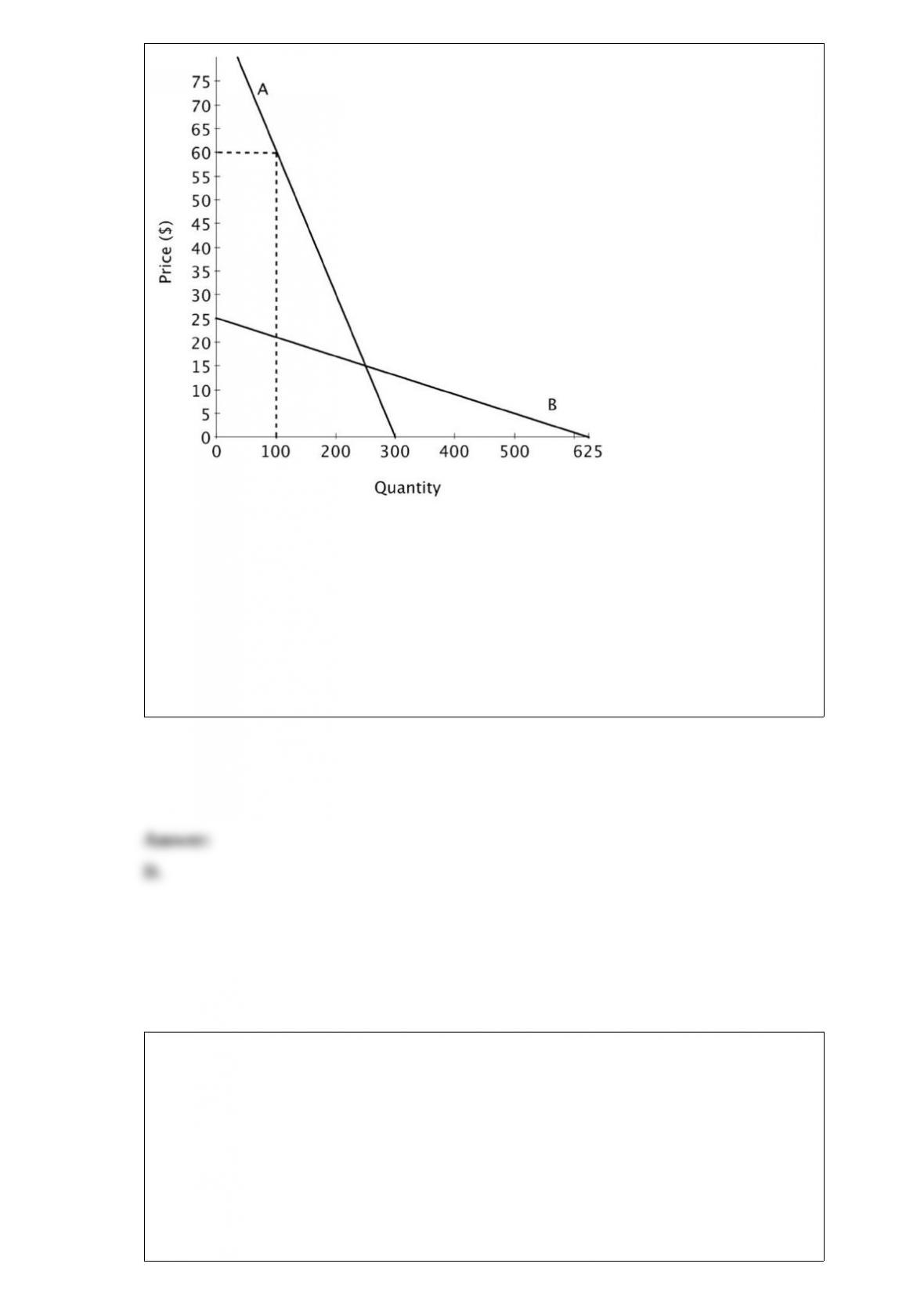
The manufacturer of the over-the-counter pain reliever would _______ total revenue by
increasing the price from $15 to $16.
A. increase
B. decrease
C. experience no change in
D. experience an uncertain change in
When the government transfers resources to the poor in the form of a good or service, it
is called:
A. the Earned Income Tax Credit (EITC).
B. Temporary Assistance to Needy Families (TANF).
C. an in-kind transfer.
D. a regressive tax.
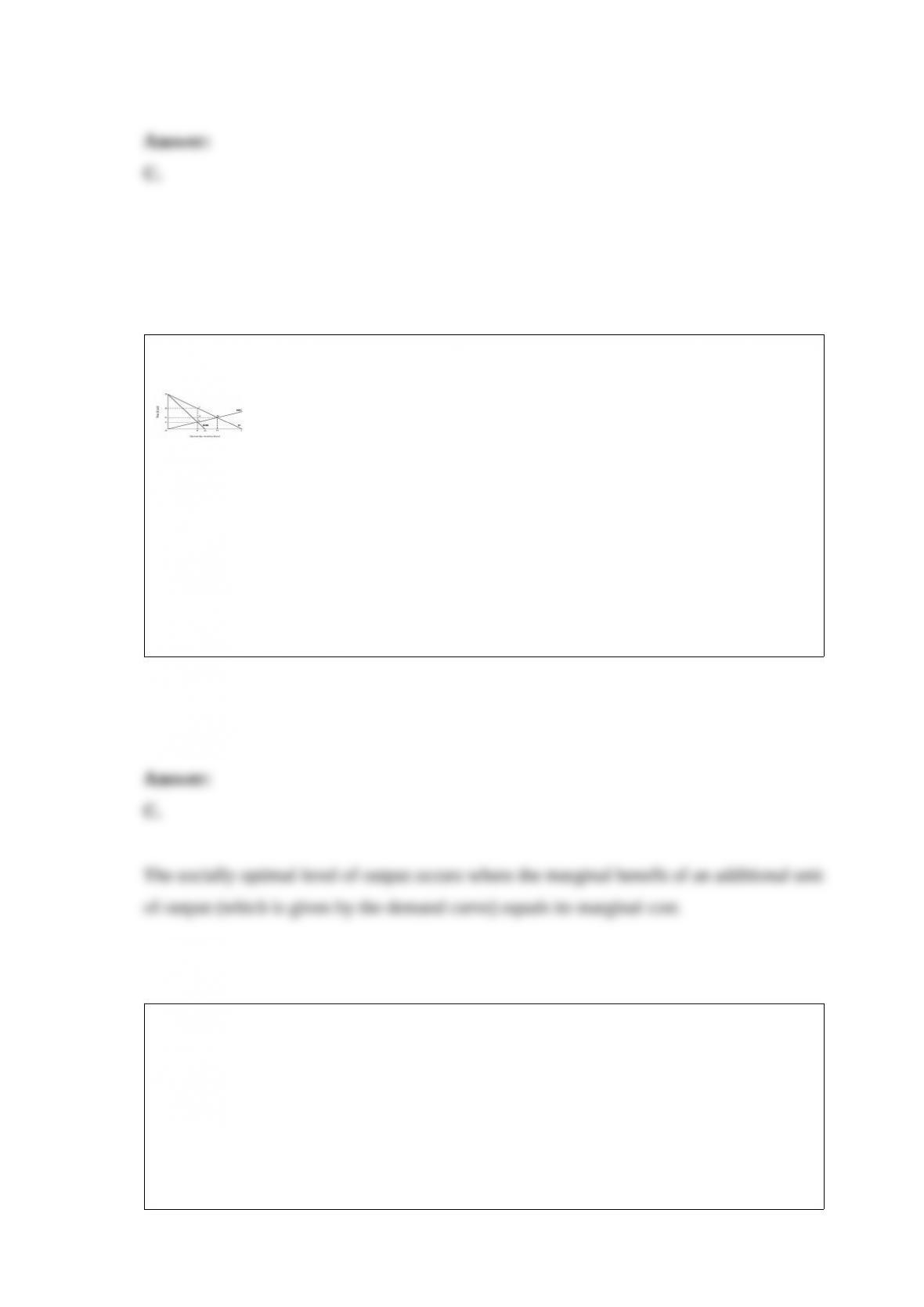
Suppose the figure below shows the demand curve, marginal revenue curve and
marginal cost curve for a monopolist.
The socially optimal level of output is ______ units per day.
A. F
B. G
C. H
D. I
The Cost-Benefit Principle indicates that an action should be taken if:
A. its total benefits exceed its total costs.
B. its average benefits exceed its average costs.
C. its net benefit (benefit minus cost) is zero.
D. its extra benefit is greater than or equal to its extra cost.

Ingrid has been waiting for the show “Mamma Mia!” to come to town. When it finally
does come, tickets cost $60. Ingrid’s reservation price is $75. But when Ingrid tries to
buy a ticket, they are sold out. Ingrid decides to try to buy a ticket from a scalper (a
person who purchased extra tickets at the box office with the intent to resell them at a
higher price). If Ingrid finds someone who is willing to sell her a ticket for $70, she
should:
A. not purchase the ticket because it is overpriced.
B. not purchase the ticket because the cost to the scalper was only $60.
C. purchase the ticket because doing so will make her $5 better off.
D. purchase the ticket even though doing reduce total economic surplus.