
Which of the following would occur if the United States switched from income taxes to
consumption taxes?
A) Consumption would increase.
B) The supply of loanable funds would decrease.
C) Saving would increase.
D) Tax revenues would rise.
Dollar bills in the modern economy serve as money because
A) they are backed by the gold stored in Fort Knox.
B) they can be redeemed for gold by the central bank.
C) they have value as a commodity independent of their use as money.
D) people have confidence that others will accept them as money.
Which of the following is true about the occurrence of the twin deficits?
A) They always occur together.
B) They only occur when exchange rates are fixed.
C) They did not occur after 1990 in the United States.
D) They occur consistently in all the economies of the world except the United States.

Which of the following is an example of discretionary fiscal policy?
A) an increase in unemployment insurance payments during a recession
B) an increase in income tax receipts with rising income during an expansion
C) the tax cuts passed by Congress in 2001 to combat the recession
D) a decrease in food stamps issued during an expansion or boom
Cassie’s Quilts alters, reconstructs and restores heirloom quilts. Cassie has just spent
$800 purchasing, cleaning and reconstructing an antique quilt which she expects to sell
for $1,500 once she is finished. After having spent $800, Cassie discovers that she
would need some special period fabric that would cost her $200 in material and time in
order to complete the task. Alternatively, she can sell the quilt “as is” now for $900.
What should she do?
A) She should cut her losses and sell the quilt now.
B) It does not matter what she does; she is going to take a loss on her project.
C) She should purchase the period fabric, complete the task and then sell the quilt.
D) She should not do anymore work on the quilt because she has already spent too
much time on it and has not been paid for that time.

Investment spending will decrease when
A) the interest rate falls.
B) the corporate income tax decreases.
C) business cash flow decreases.
D) firms become more optimistic about earning future profits.
If government purchases are $400 million, taxes are $700 million, and transfers are
$200 million, which of the following is true?
A) Public saving is $500 million.
B) The budget deficit is $100 million.
C) The budget deficit is $500 million.
D) Public saving is $100 million.
Which of the following would decrease the balance on the current account?
A) a decrease in foreign direct investment
B) a decrease in the amount of aid money the government sends abroad
C) a decrease in imports
D) None of the above will increase the balance on the current account.
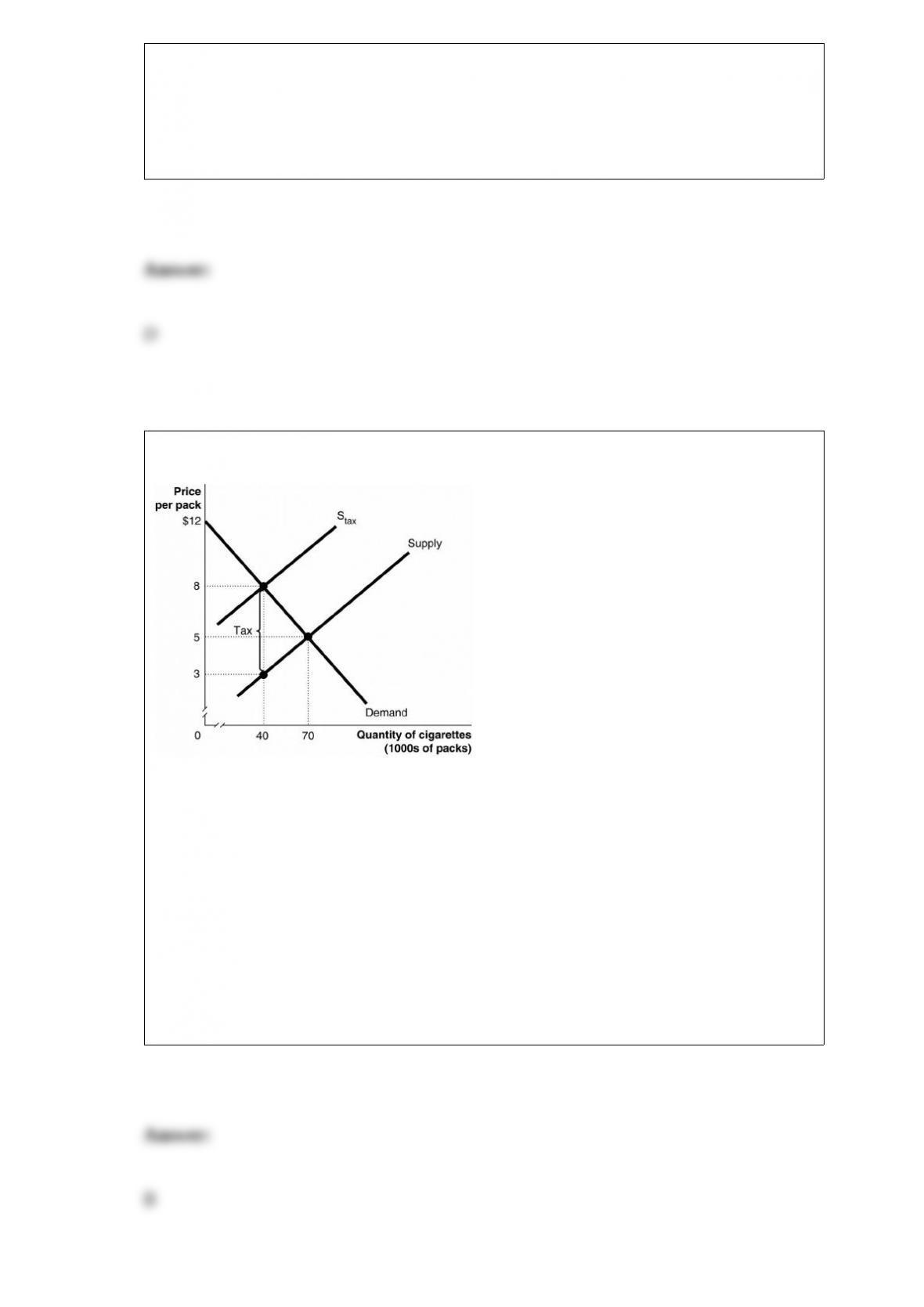
Figure 4-9
Figure 4-9 shows the market for cigarettes. The government plans to impose a unit tax
in this market.
Refer to Figure 4-9. The price buyers pay after the tax is
A) $12.
B) $8.
C) $5.
D) $3.

Which of the following statements is not true?
A) Consumer surplus measures the difference between the highest price a consumer is
willing to pay for a product and the price she actually pays.
B) Marginal benefit is the additional benefit to a consumer from consuming one more
unit of a product.
C) Consumer surplus measures the net benefit from participating in a market.
D) Producer surplus measures the total benefit received by producers from participating
in a market.
Which of the following is motivated by an efficiency concern?
A) In 2009, the Obama administration increased unemployment benefits.
B) As part of an economic stimulus package, each taxpayer received a $3,000 tax rebate
check.
C) Following a six-month drought, a city banned homeowners from watering their
lawns in an effort to conserve water.
D) Some U.S. colleges have cut back on merit scholarships since these programs siphon
money from need-based programs, thus harming lower-income students with greater
financial need.
When the economy enters a recessionary phase of the business cycle, unemployment
tends to
A) decrease.
B) increase.
C) be unchanged.
D) change in the same direction as the rate of inflation.
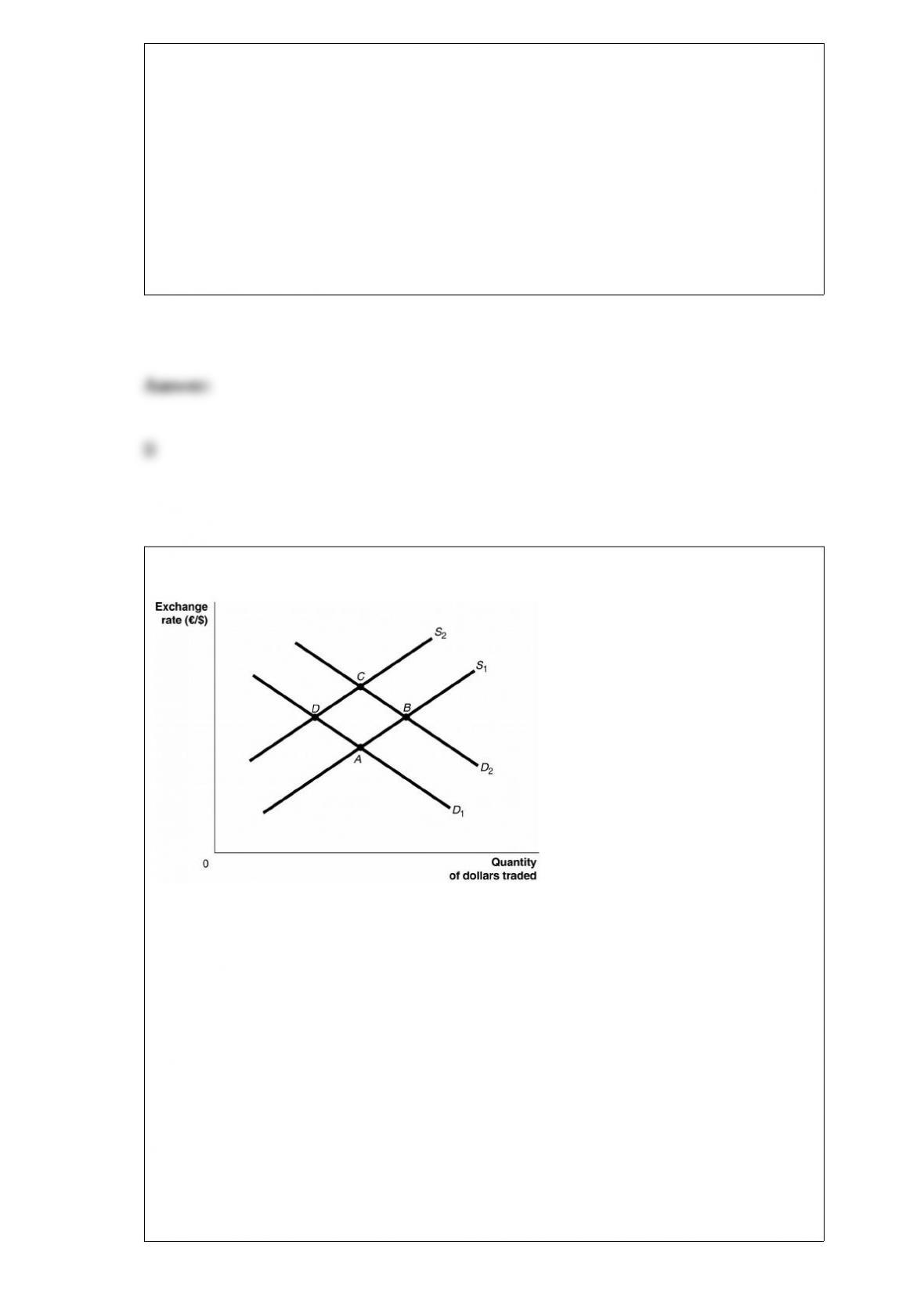
Figure 18-1
Refer to Figure 18-1. Currency speculators believe that the value of the euro will
decrease relative to the dollar. Assuming all else remains constant, how would this be
represented?
A) Supply would decrease, demand would decrease and the economy moves from B to
C to D.
B) Supply would increase, demand would decrease and the economy moves from C to
B to A.
C) Supply would decrease, demand would increase and the economy moves from A to
D to C.
D) Supply would increase, demand would increase and the economy moves from D to
A to B.

A(n) ________ in private expenditures as a result of a(n) ________ in government
purchases is called crowding out.
A) increase; decrease
B) decrease; decrease
C) decrease; increase
D) increase; increase
Which of the following would increase the unemployment rate?
A) a law making it illegal to work more than 35 hours per week
B) a cut in unemployment compensation
C) an increase in unemployment insurance payments
D) a decrease in the minimum wage
An outward shift of a nation’s production possibilities frontier can occur due to
A) a reduction in unemployment.
B) a natural disaster like a hurricane or bad earthquake.
C) a change in the amounts of one good desired.
D) an increase in the labor force.
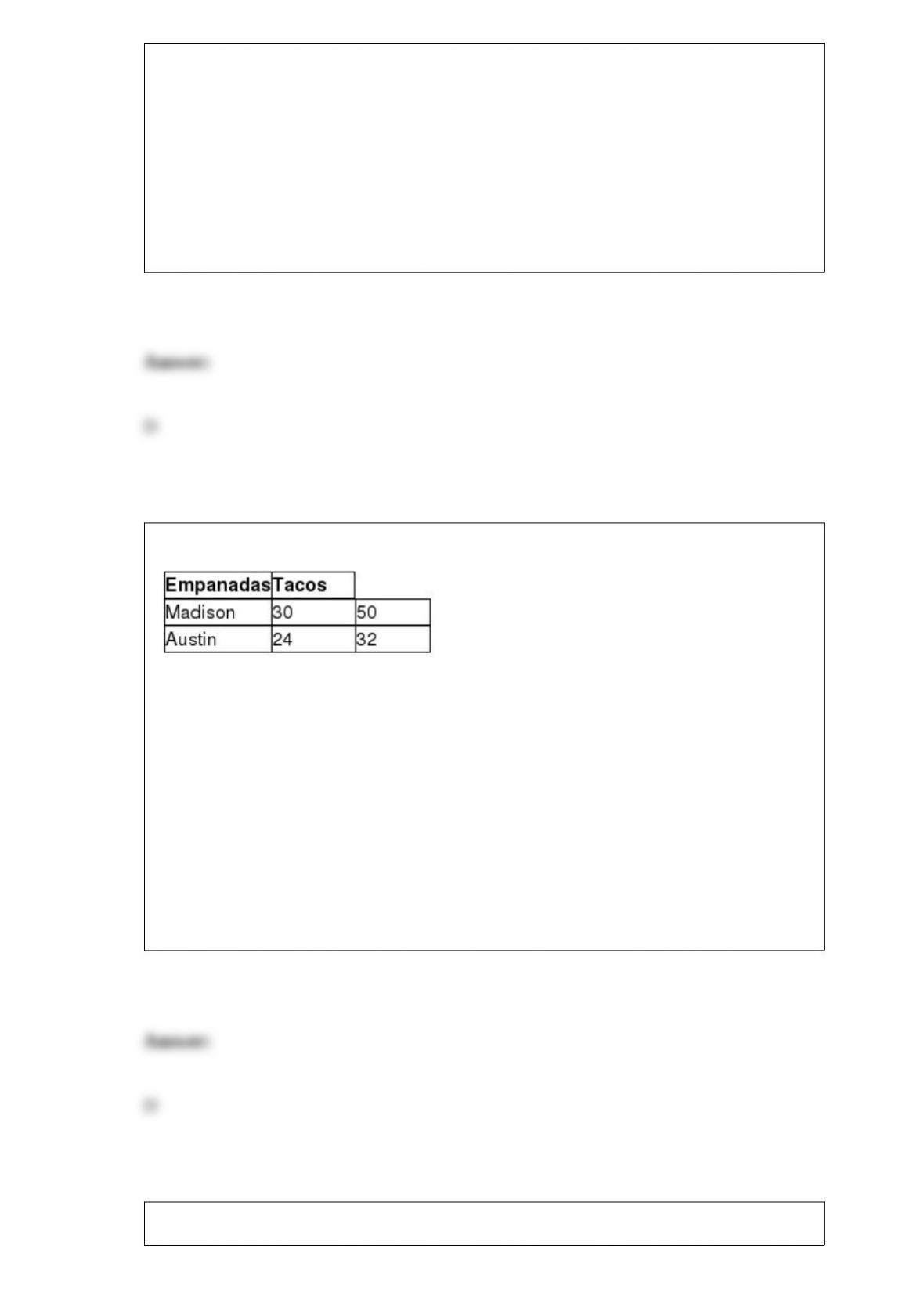
Table 7-2
Madison and Austin own Cafe Ole’. Table 7-2 lists the number of empanadas and tacos
Madison and Austin can each make in one hour.
Refer to Table 7-2. Select the statement that accurately interprets the data in the table.
A) Madison has a comparative advantage in making empanadas.
B) Austin has a comparative advantage in making tacos.
C) Madison has a comparative advantage in making empanadas and making tacos.
D) Madison has a comparative advantage in making tacos.
In response to the destructive bank panics of the Great Depression, future bank panics
are designed to be prevented by
A) the Federal Reserve System acting as a lender of last resort.
B) the Federal Reserve System conducting open market operations.
C) the establishment of the Federal Deposit Insurance Corporation.
D) establishing a fractional reserve system of banking.
E) increasing the required reserve ratio to 100%.