The long-run aggregate supply curve is vertical.
Deadweight loss refers to a loss in revenue resulting from producers having to reduce
their selling price to remain competitive.
For the purchasing power of money to increase, the price level has to fall.
If currency speculators decide that the value of the dollar should rise in the future
relative to the yen, this will increase the demand for dollars and decrease the supply of
dollars.
The Fed has more control over open market operations as compared to discount policy.
The size of the underground economy as a percent of GDP is larger in the United States
as compared to poorer countries such as Zimbabwe.
The dynamic aggregate demand and aggregate supply model assumes that potential
GDP increases over time.
An increase in the money supply is a discretionary fiscal policy which will increase
aggregate demand.

The labor force participation rates of men have gradually increased since 1948.
Holding all else constant, an economic expansion in Mexico should decrease the
demand for U.S. dollars.
Which of the following is an asset for a bank?
A) deposits of its customers
B) short-term borrowing
C) shareholders’ equity
D) loans
According to the quantity theory of money, inflation is caused by
A) the money supply growing slower than real GDP.
B) GDP growing faster than the money supply.
C) GDP growing at the same rate as the money supply.
D) the money supply growing faster than real GDP.
In what ways do economists and policymakers who believe that market-based reforms
are the key to improving the health care system criticize the Patient Protection and
Affordable Care Act (ACA)?
An increase in the interest rate
A) decreases the opportunity cost of holding money.
B) increases the opportunity cost of holding money.
C) decreases the percentage yield of holding money.
D) increases the percentage yield of holding money.
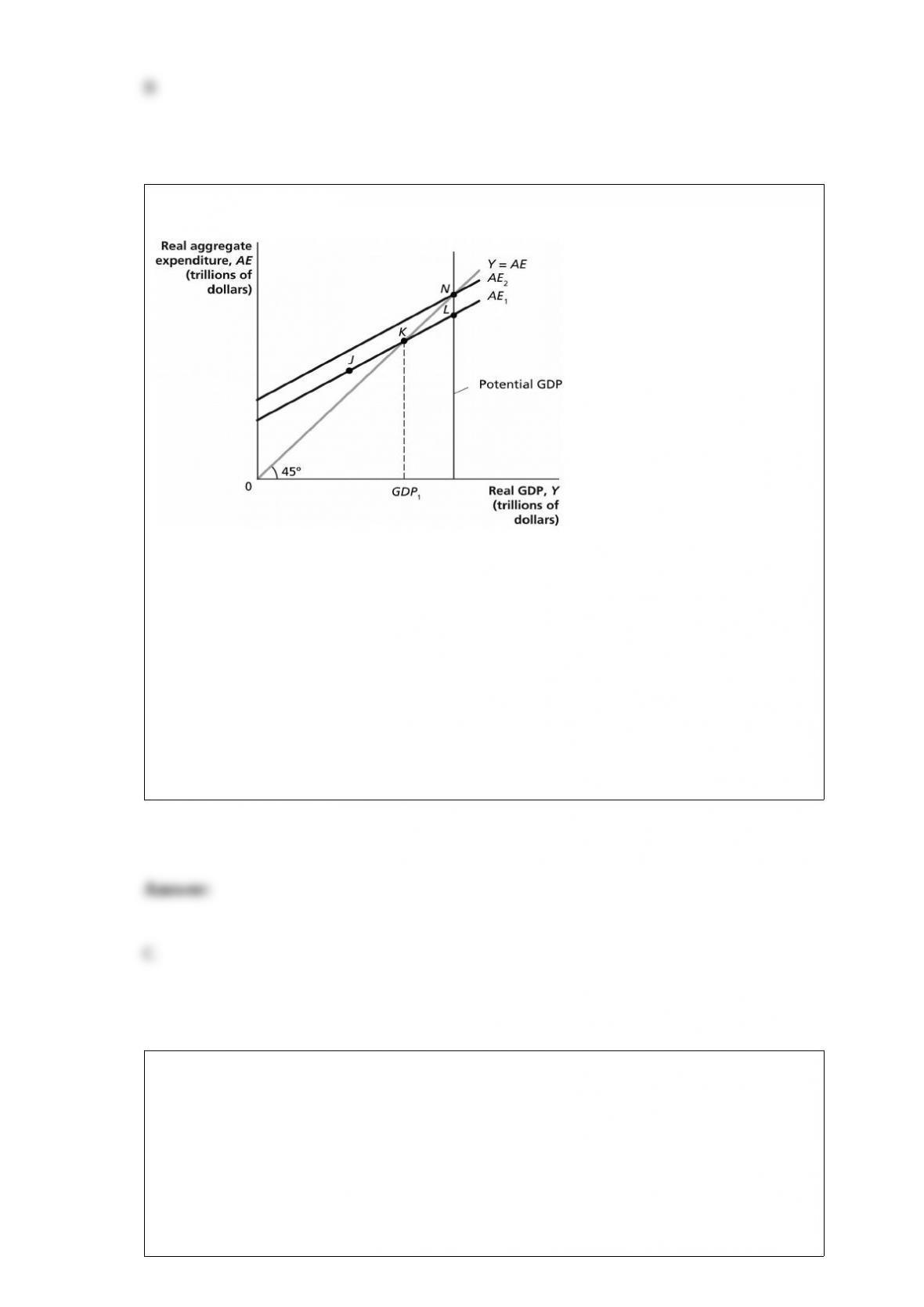
Figure 12-4
Refer to Figure 12-4. Potential GDP equals $500 billion. The economy is currently
producing GDP1 which is equal to $450 billion. If the MPC is 0.8, then how much must
autonomous spending change for the economy to move to potential GDP?
A) -$40 billion
B) -$10 billion
C) $10 billion
D) $40 billion
Suppose the majority of the shares of British Airways stock were sold to a firm in the
United States. Assuming all else remains constant, this will
A) decrease the balance of the U.S. financial account.
B) decrease foreign direct investment in the United States.
C) decrease the balance of the U.S. current account.
D) increase net portfolio investment in the United States.
E) create a capital inflow in the United States.
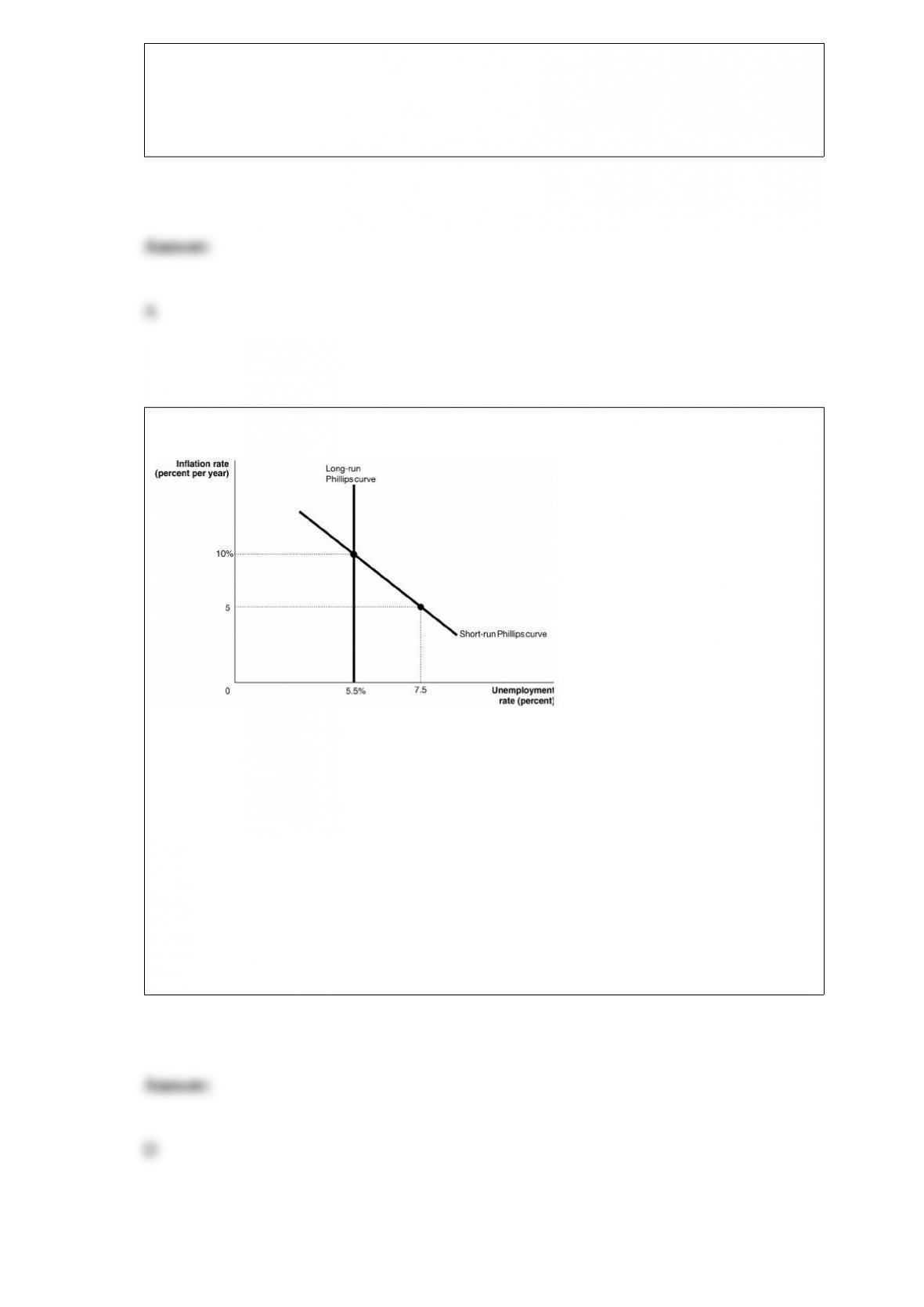
Figure 17-7
Refer to Figure 17-7. Consider the Phillips curves depicted in the graph above. The Fed
announces its intention to decrease inflation from 10 percent to 5 percent per year, and
it succeeds. If expectations of inflation are not altered by the Fed’s announcement, the
rate of unemployment will be ________ in the short run.
A) less than 5.5 percent
B) 5.5 percent
C) between 5.5 and 7.5 percent
D) 7.5 percent

If we take into account transfer payments (TR) when we derive the saving and
investment relationship, the saving and investment equation becomes
A) S = I + NFI.
B) S + TR = I + NFI.
C) S = I + NFI + TR.
D) S = I + NX – TR.
Pricing insurance policies is made difficult because buyers have more information than
sellers. This difficulty is an example of
A) moral hazard.
B) adverse selection.
C) asymmetric information.
D) the free rider problem.
In the decade of the ________, A.W. Phillips plotted data for Great Britain which
revealed a relationship between rates of changes in wages versus unemployment rates.
Economists later discovered other “Phillips Curve” relationships between rates of
inflation versus unemployment rates.
A) 1930s
B) 1940s

C) 1950s
D) 1960s
If the Federal Reserve announces that its target for the federal funds rate is falling from
3 percent to 2.25 percent, how do you expect workers and firms to react?
A) As long as the Fed’s announcement is credible, workers and firms will decrease their
consumption and investment spending, which will decrease aggregate demand and
inflation.
B) As long as the Fed’s announcement is credible, workers and firms will increase their
consumption and investment spending, which will increase aggregate demand and
inflation.
C) If the Fed’s announcement is not credible, workers and firms will not expect inflation
to rise so they will increase their consumption and investment spending, which will
decrease aggregate demand and increase inflation.
D) Workers and firms will incorporate the decrease in interest rates into their
expectations of inflation, and they will expect inflation to fall as a result of Fed’s policy
announcement.
In the United States today, the Federal Reserve will give you ________ in exchange for
$1.
A) 1/35 of an ounce of gold
B) $1 worth of gold (based on the market price of an ounce of gold at the time you

redeem the gold)
C) 1 ounce of gold
D) no gold
A decrease in the price of pork will result in
A) a smaller quantity of pork supplied.
B) a larger quantity of pork supplied.
C) a decrease in the demand for pork.
D) an increase in the supply of pork.
If real GDP in a small country in 2012 is $8 billion and real GDP in the same country in
2013 is $8.3 billion, the growth rate of real GDP between 2012 and 2013
A) is 3.0%
B) is 3.6%
C) is 3.75%
D) cannot be determined from the information given.

If the economy is growing beyond potential real GDP, which of the following would be
an appropriate fiscal policy to bring the economy back to long-run aggregate supply?
An increase in
A) the money supply and a decrease in interest rates.
B) government purchases.
C) oil prices.
D) taxes.
The supporters of a monetary growth rule believe that active monetary policy
A) stabilizes the economy, decreasing the number of recessions and their severity.
B) destabilizes the economy, increasing the number of recessions and their severity.
C) cannot change the inflation rate.
D) cannot change real GDP.
The most widely used measure of inflation is based on which of the following price
indices?

A) the producer price index
B) the consumer price index
C) the GDP deflator
D) the wholesale price index
An increase in cyclical unemployment will result in
A) an increase in the natural rate of unemployment.
B) an increase in the unemployment rate.
C) an increase in structural unemployment.
D) a decrease in frictional unemployment.
Which is not one of the criteria necessary for a commodity to make a suitable medium
of exchange?
A) It should be durable.
B) It should be of standardized quality.
C) It should be valuable relative to its weight.
D) It should have intrinsic value.
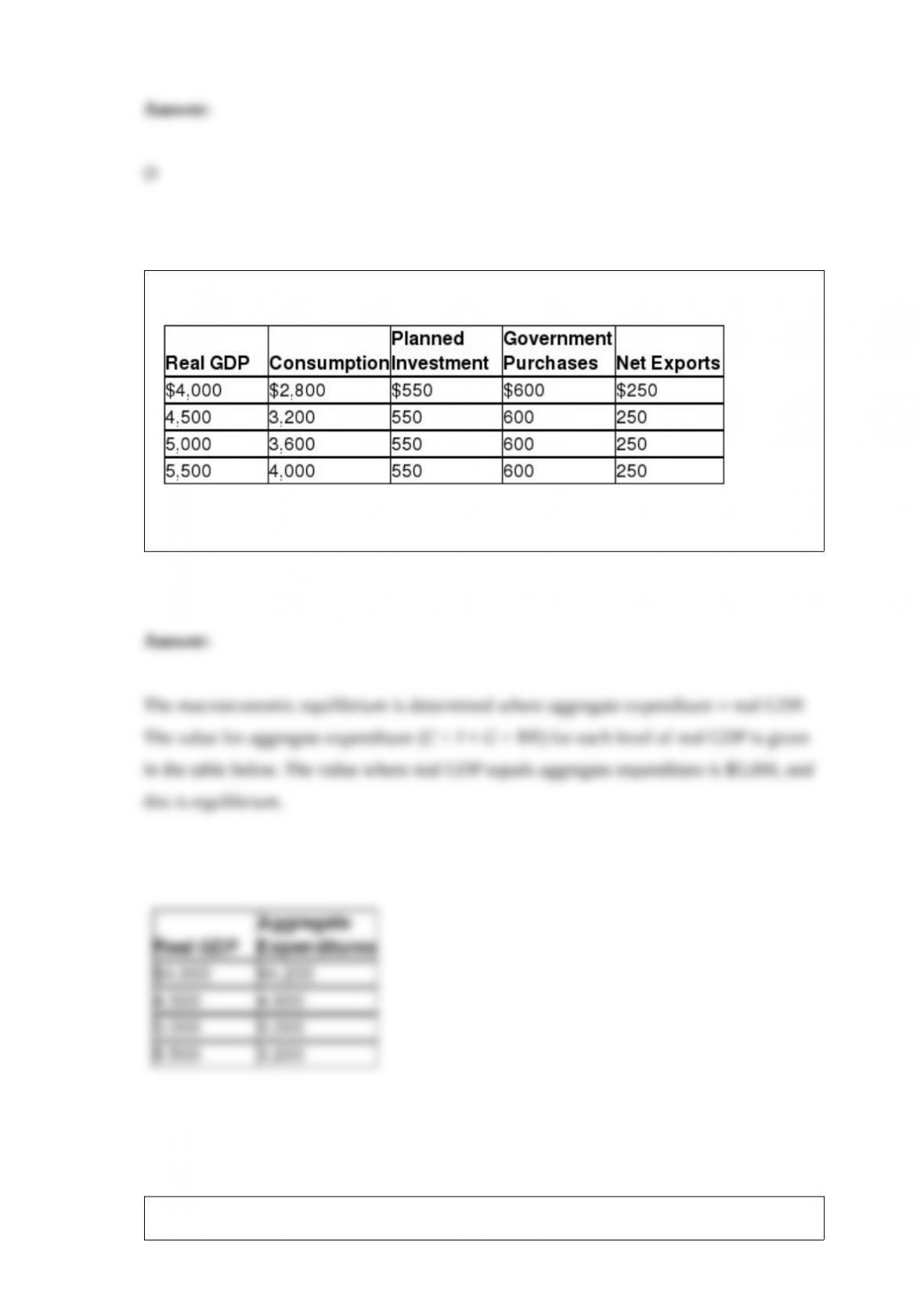
Table 12-1
Refer to Table 12-1. Using the table above, compute aggregate expenditure and identify
the macroeconomic equilibrium.
Give an example of a monetary policy target. Explain why the Fed uses policy targets.
Article Summary
In a letter to Congress, Treasury Secretary Jacob Lew stated that the United States will
run out of borrowed money by Thursday, October 17 unless the $16.7 trillion debt
ceiling was raised. Every Thursday, the Treasury typically rolls over $100 billion in
debt as bonds mature and investors use the proceeds to buy new bonds, and Lew was
concerned that without an increase in the debt ceiling, a crisis could emerge from a
massive bond sell-off. Since the government had reached its current debt limit, it would
only be able to use daily on-hand revenue to pay its bills without the increase in the
ceiling. The Treasury expected the government to have only $30 billion per day in cash
on hand by October 17, while its typical daily expenses were $60 billion. “If we have
insufficient cash on hand, it would be impossible for the United States of America to
meet all of its obligations for the first time in our history,” Lew said.
Source: Gregory Korte, “Treasury will run out of borrowed money by Oct. 17,” USA
Today, September 25, 2013.
Refer to the Article Summary. When does the Treasury Department borrow? Why would
the Treasury have to borrow more than it estimated, as was indicated by its letter to
Congress to raise the debt ceiling? When would the Treasury repay what it borrowed,
and who is it repaying?
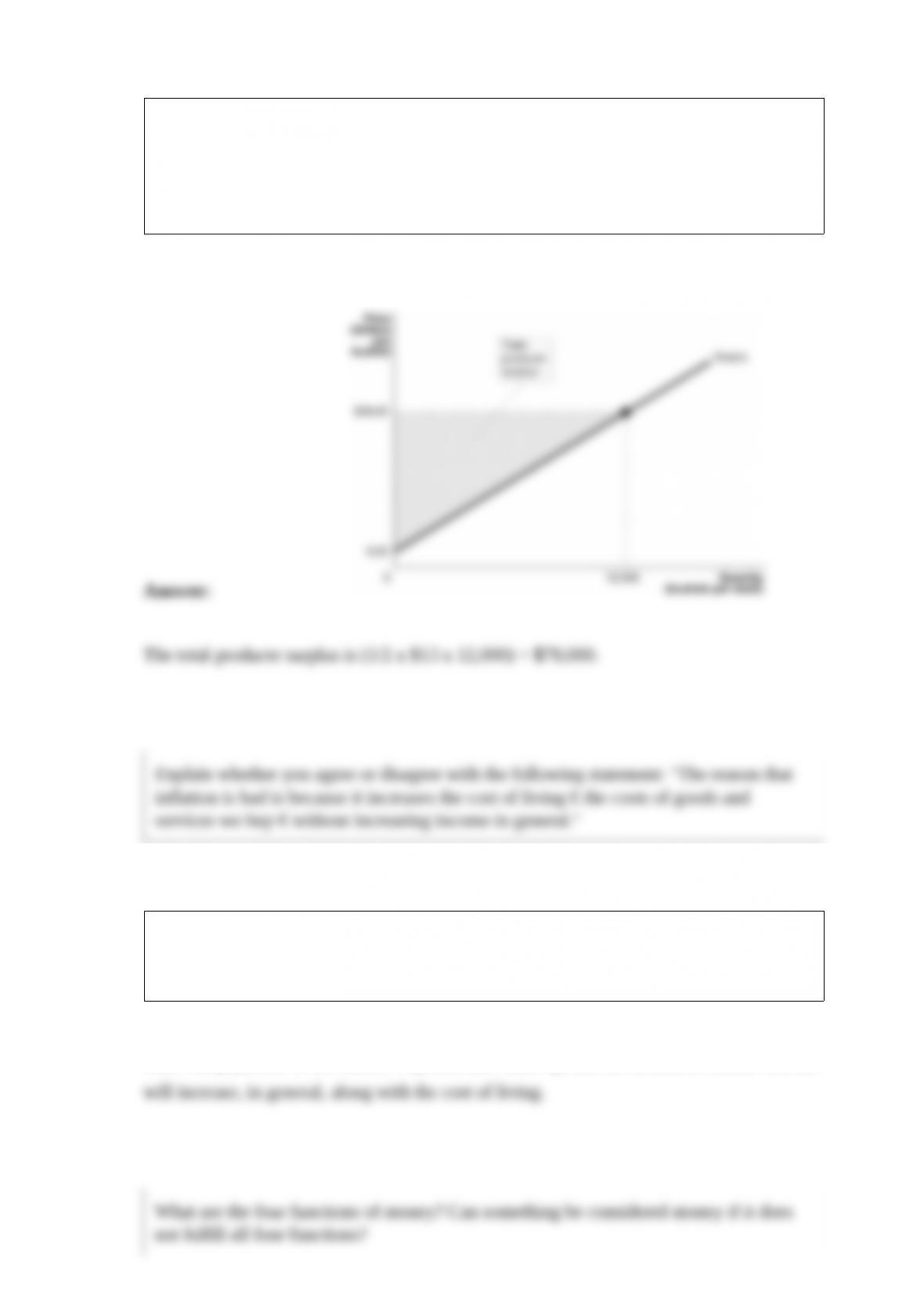
Assume the market price for tangerines is $18.00 per bushel. At the market price,
tangerine growers are willing to supply a quantity of 12,000 bushels per week. The
quantity supplied drops to zero when the price falls to $5.00 per bushel. Construct a
graph showing this data, calculate the total producer surplus in the market for
tangerines, and show the total producer surplus on the graph.
Explain whether you agree or disagree with the following statement: “The reason that
inflation is bad is because it increases the cost of living € the costs of goods and
services we buy € without increasing income in general.”
What are the four functions of money? Can something be considered money if it does
not fulfill all four functions?
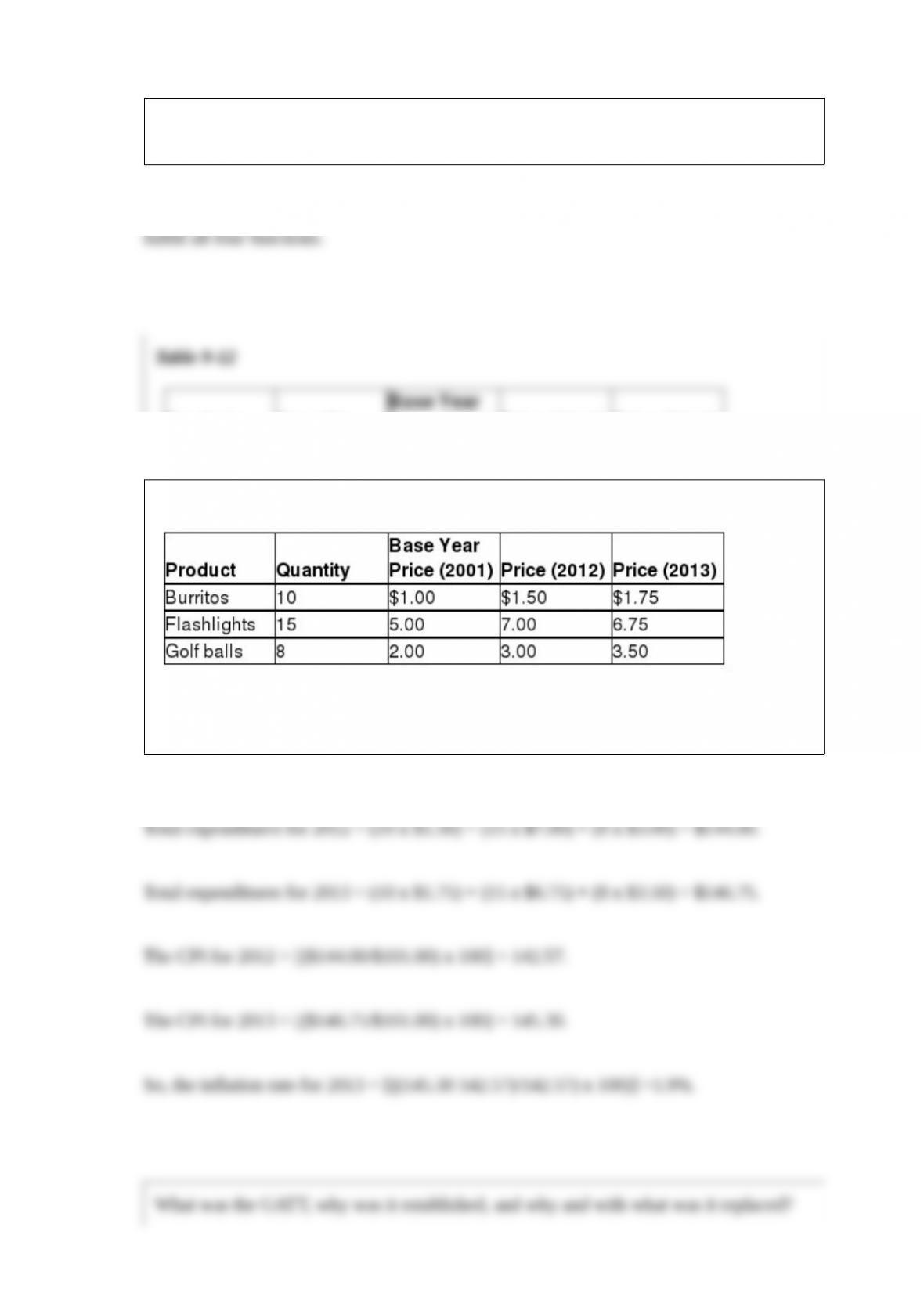
Table 9-12
Refer to Table 9-12. Consider a simple economy that produces only three products:
burritos, flashlights, and golf balls. Use the information in the table to calculate the
inflation rate for 2013, as measured by the consumer price index.
What was the GATT, why was it established, and why and with what was it replaced?