
If production displays increasing marginal returns, then
A) total product rises by a constant amount throughout.
B) each new worker hired adds more to output than previous hires.
C) the firm must be adding new capital to keep boosting productivity.
D) total product reaches a maximum sooner than if production displayed decreasing
returns.
A tariff is a tax imposed by a government on
A) exports.
B) services.
C) imports.
D) luxury items.
Figure 15-10
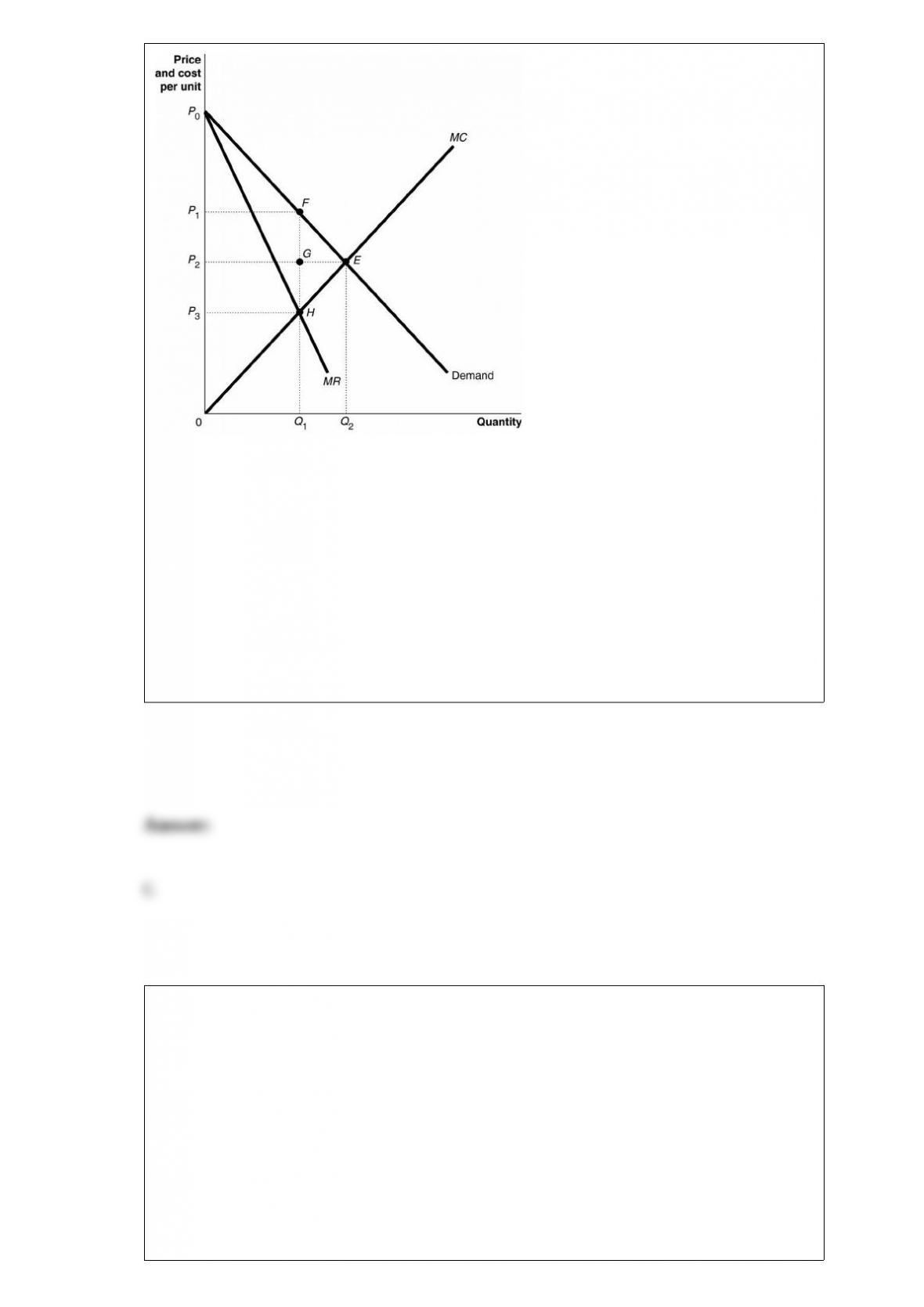
Refer to Figure 15-10. What is the area that represents producer surplus under a
monopoly?
A) the triangle 0P2E
B) the triangle 0P3H
C) the trapezium 0P1FH
D) the rectangle P1P3HF
Ordinarily, governments attempt to promote competition in markets. Why do
governments use patents to block entry into some markets when this prohibits
competition?
A) Patents encourage firms to spend money on research necessary to create new
products.
B) Politicians sometimes succumb to pressure from lobbyists to grant favors to
businesses for political reasons.
C) Patents are an important source of government revenue.
D) Patents are justified because they are an important means for creating network
externalities.
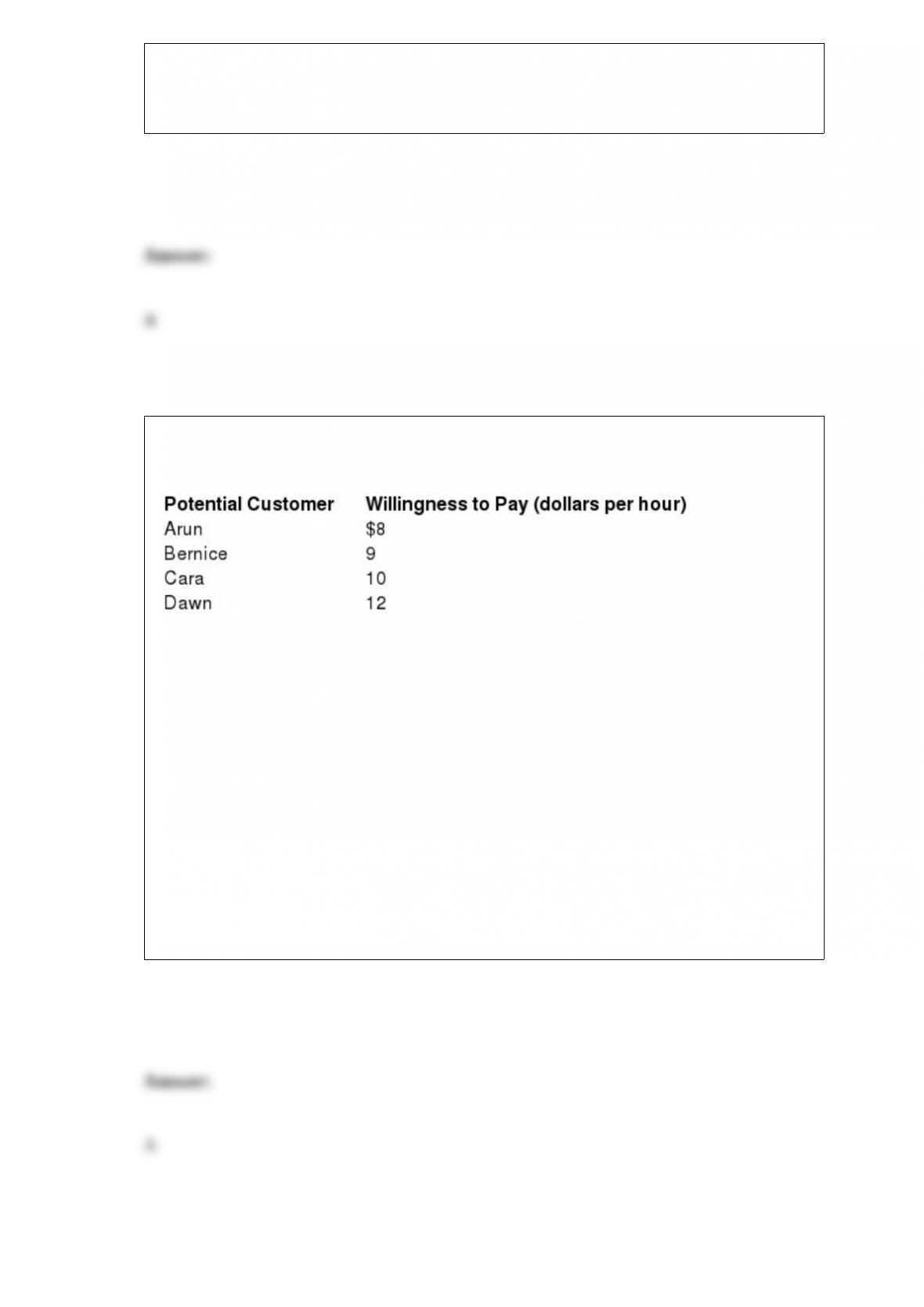
Table 16-3
Julie plans to start a pet-sitting service. She surveyed her neighborhood to determine the
demand for this service. Assume that each person surveyed demands only one hour of
pet sitting services per period. Table 16-3 above shows a portion of her survey results.
Refer to Table 16-3. If Julie charges $10 per hour, how many hours of pet sitting
services will be purchased and by whom?
A) 2 hours (1 hour by Cara and 1 hour by Dawn)
B) 1 hour by Cara only
C) 1 hour by Dawn only
D) 3 hours (1 hour each by Arun, Bernice and Cara)

In a city with rent-controlled apartments, all of the following are true except
A) apartments usually rent for rates lower than the market rate.
B) apartments are often in shorter supply than they would be without rent control.
C) it usually takes more time to find an apartment than it would without rent control.
D) landlords have an incentive to rent more apartments than they would without rent
control.
Table 9-1
Linda and Sandy own The Preppy Puppy, a dog grooming business. Table 9-1 lists the
number of dogs Linda and Sandy can each bathe and groom in one week.
Refer to Table 9-1. Select the statement that accurately interprets the data in the table.
A) Linda has a comparative advantage in dog bathing.
B) Sandy has an absolute advantage in dog bathing.
C) Sandy has a comparative advantage in dog bathing.
D) Linda has a comparative advantage in dog grooming and dog bathing.

Many firms use odd pricing – charging prices such as $.99 instead of $1.00 and $9.99
instead of $10.00. One reason for this pricing strategy is that consumers will somehow
believe that the difference in price appears to be greater than it actually is. Researchers
conducted consumer surveys to determine whether this is actually the case. What was
the result of these surveys?
A) The surveys found that small differences in price cause small differences in quantity
demanded. There is no evidence that odd pricing makes economic sense.
B) Although the results were not conclusive, there is some evidence that odd pricing
makes economic sense.
C) The surveys found indifference regarding this strategy among most consumers, but
hostility among other consumers. The latter group resented what they viewed as an
attempt to fool them into buying products with odd prices. Researchers concluded that
odd pricing is counterproductive.
D) The survey results were inconclusive because most consumers gave unreliable
responses to the survey questions.
Economists estimated that the cross-price elasticity of demand for beer and wine is
-0.83 and the income elasticity of wine is 5.03. This means that
A) beer and wine are substitutes and wine is an inferior good.
B) beer and wine are complements and wine is a luxury good.
C) beer and wine are substitutes and wine is a luxury good.
D) beer and wine are complements and wine is an inferior good.
In the United States in 2012, the percentage of people who received health insurance
through a government program was about
A) 10%.
B) 16%.
C) 36%.
D) 64%.
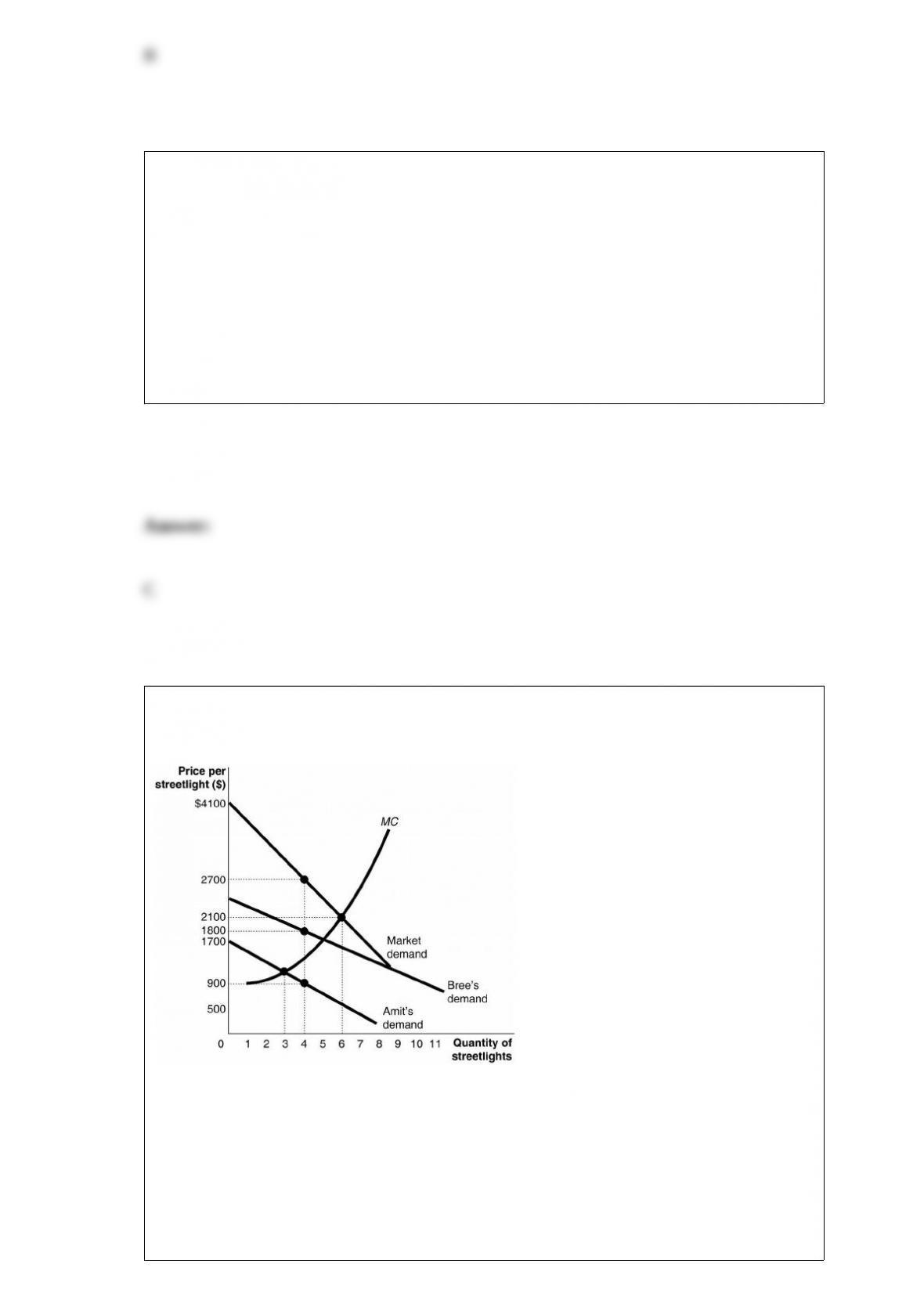
Figure 5-16
Amit and Bree are the only two homeowners on an isolated private road. Both agree
that installing street lights along the road would be beneficial and want to do so. Figure
5-16 shows their willingness to pay for different quantities of street lights, the market
demand for street lights and the marginal cost of installing the street lights.
Refer to Figure 5-16. What is the optimal quantity of street lights to install?
A) 3

B) 4
C) 6
D) 9
If it is difficult for a firm to attribute the output it produces to a particular worker then
A) its employees are likely to form a union.
B) a commission system of compensation will be preferable to a salary system.
C) a salary compensation system will be preferable to a commission system.
D) a piece-rate system of compensation will be preferable to a salary system.
Once a product becomes established, network externalities may create ________ costs
that make consumers reluctant to buy a new product with better technology.
A) external
B) implicit
C) switching
D) marginal

When groups of mortgages are bundled together by financial institutions and sold to
investors, these institutions are said to be ________ mortgage loans.
A) securitizing
B) underwriting
C) liquidating
D) harvesting
Despite being in a market with ________, from the mid-1990s to the mid-2000s
Starbucks was able to significantly differentiate its products from the products of its
competitors.
A) few barriers to entry
B) significant barriers to entry
C) blocked entry
D) no barriers to entry
If a firm lowered the price of the product it sells and found that total revenue did not
change, then the demand for its product is
A) perfectly inelastic.
B) perfectly elastic.
C) unit-elastic.
D) relatively elastic.
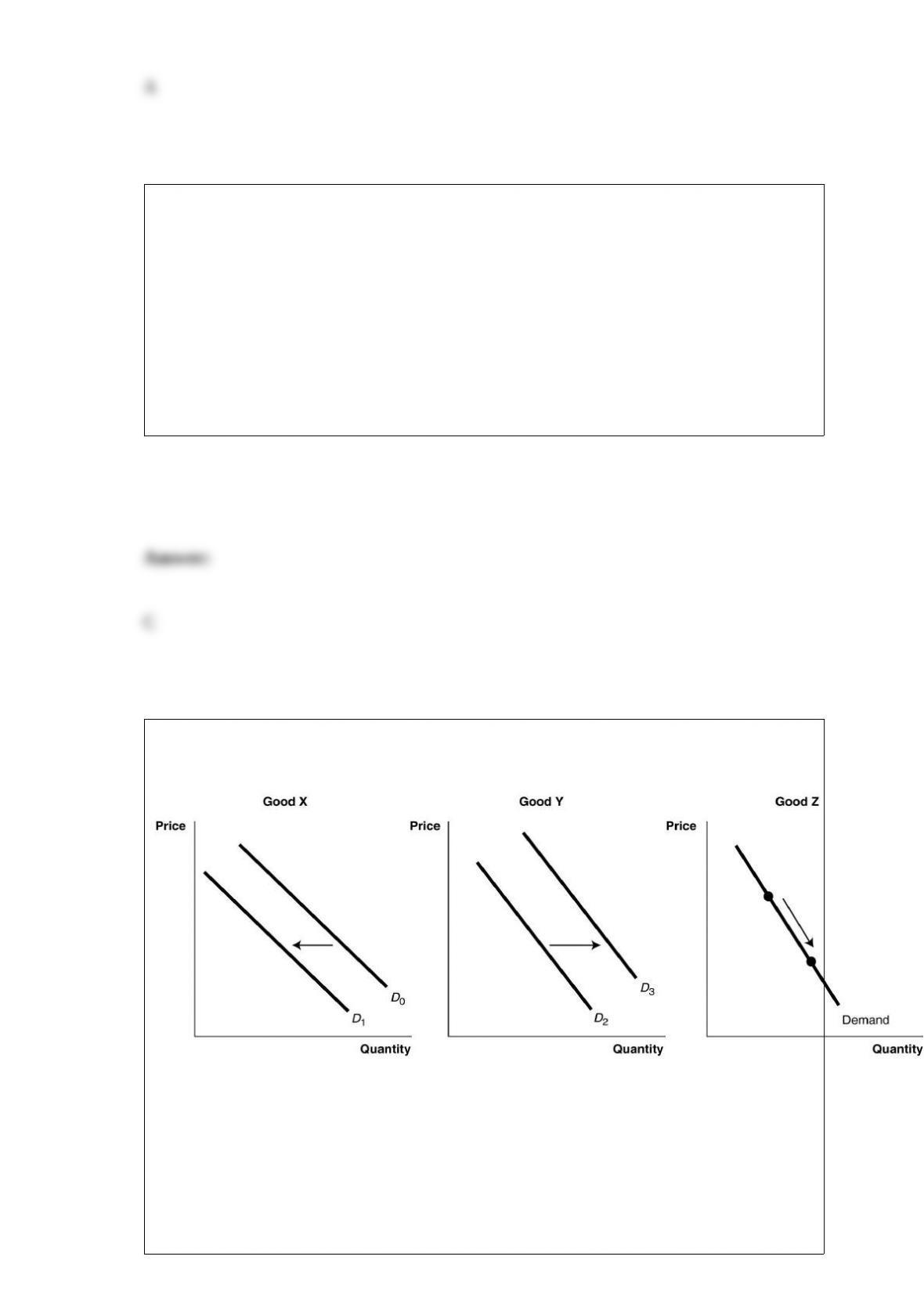
Figure 6-8
Refer to Figure 6-8. Identify the two goods which are complements.
A) Good X and Good Y
B) Good Y and Good Z
C) Good X and Good Z

D) It is not possible to distinguish any relationship among the goods.
The demand curve for corn is downward sloping. If the price of corn, an inferior good,
falls
A) the income effect which causes you to reduce your corn purchases is smaller than
the substitution effect which causes you to increase your corn purchases, resulting in a
net increase in quantity demanded.
B) the income effect which causes you to increase your corn purchases is larger than the
substitution effect which causes you to reduce your corn purchases, resulting in a net
increase in quantity demanded.
C) both the income and substitution effects reinforce each other to increase the quantity
demanded.
D) the income and substitution effects offset each other but the price effect of an
inferior good leads you to buy less corn.
If, for a given percentage decrease in price, quantity supplied decreases by a
proportionately smaller percentage, then supply is
A) unit-elastic.
B) perfectly elastic.
C) relatively inelastic.

D) elastic.
A merger between U.S. Steel and General Motors would be an example of a
A) vertical merger.
B) horizontal merger.
C) conglomerate merger.
D) conspiracy in restraint of trade.
Haiti was once a heavily forested country. Today, 80 percent of Haiti’s forests have been
cut down, primarily to be burned to create charcoal. The reduction in the number of
trees has lead to devastating floods when it rains heavily. This is an example of
A) tragic externalities.
B) the tragedy of the commons.
C) human greed.
D) the consequences of not having a market economic system.

When Disneyland opened in 1955, what prices were charged for admission and rides?
A) Admission was free; customers paid for rides.
B) All customers paid the same price for admission; rides were free.
C) Admission prices varied by your age, home address and occupation; rides were free.
D) All customers paid the same low price for admission; customers were also charged
prices for rides.
If the market for a product is broadly defined, then
A) the good has many complements.
B) there are few substitutes for the product and the demand for the product is relatively
inelastic.
C) there are many substitutes for the product and the demand for the product is
relatively elastic.
D) the expenditure on the good is likely to make up a large share of one’s budget.

Buyers rush to purchase stocks in California vineyards following a forecast of a 30
percent decline in this year’s grape harvest. What happens in the California wine market
as a result of this announcement?
A) The demand curve for California wine shifts to the left in anticipation of higher
prices in the future.
B) The demand curve for California wine shifts to the right in anticipation of higher
prices in the future.
C) The supply curve for California wine shifts to the right in anticipation of higher
prices in the future.
D) The supply curve for California wine shifts to the left in anticipation of lower
quantities in the future.
A perfectly elastic demand curve is
A) vertical.
B) horizontal.
C) curvilinear.
D) upward sloping.

On a two-dimensional graph, ________ allows for the effects of additional variables.
A) moving along a curve
B) shifting curves
C) eliminating a curve
D) adding an additional curve
If the price elasticity of demand for canned soup is estimated at -1.62. What happens to
sales revenue if the price of canned soup rises?
A) It falls by 162 percent.
B) It rises by 1.62 percent.
C) It falls.
D) It rises.
A perfectly competitive market is in long-run equilibrium. At present there are 100
identical firms each producing 5,000 units of output. The prevailing market price is $20.
Assume that each firm faces increasing marginal cost. Now suppose there is a sudden
increase in demand for the industry’s product which causes the price of the good to rise
to $24. Which of the following describes the effect of this increase in demand on a
typical firm in the industry?

A) In the short run, the typical firm increases its output and makes an above normal
profit.
B) In the short run, the typical firm’s output remains the same but because of the higher
price, its profit increases.
C) In the short run, the typical firm increases its output but its total cost also rises,
resulting in no change in profit.
D) In the short run, the typical firm increases its output but its total cost also rises.
Hence, the effect on the firm’s profit cannot be determined without more information.
When a monopolistically competitive firm cuts its price to increase its sales, it
experiences a gain in revenue due to the
A) substitution effect.
B) income effect.
C) price effect.
D) output effect.
Which of the following is a transfer payment?
A) the food stamp program
B) a tax deduction
C) Social Security payments
D) an income tax credit
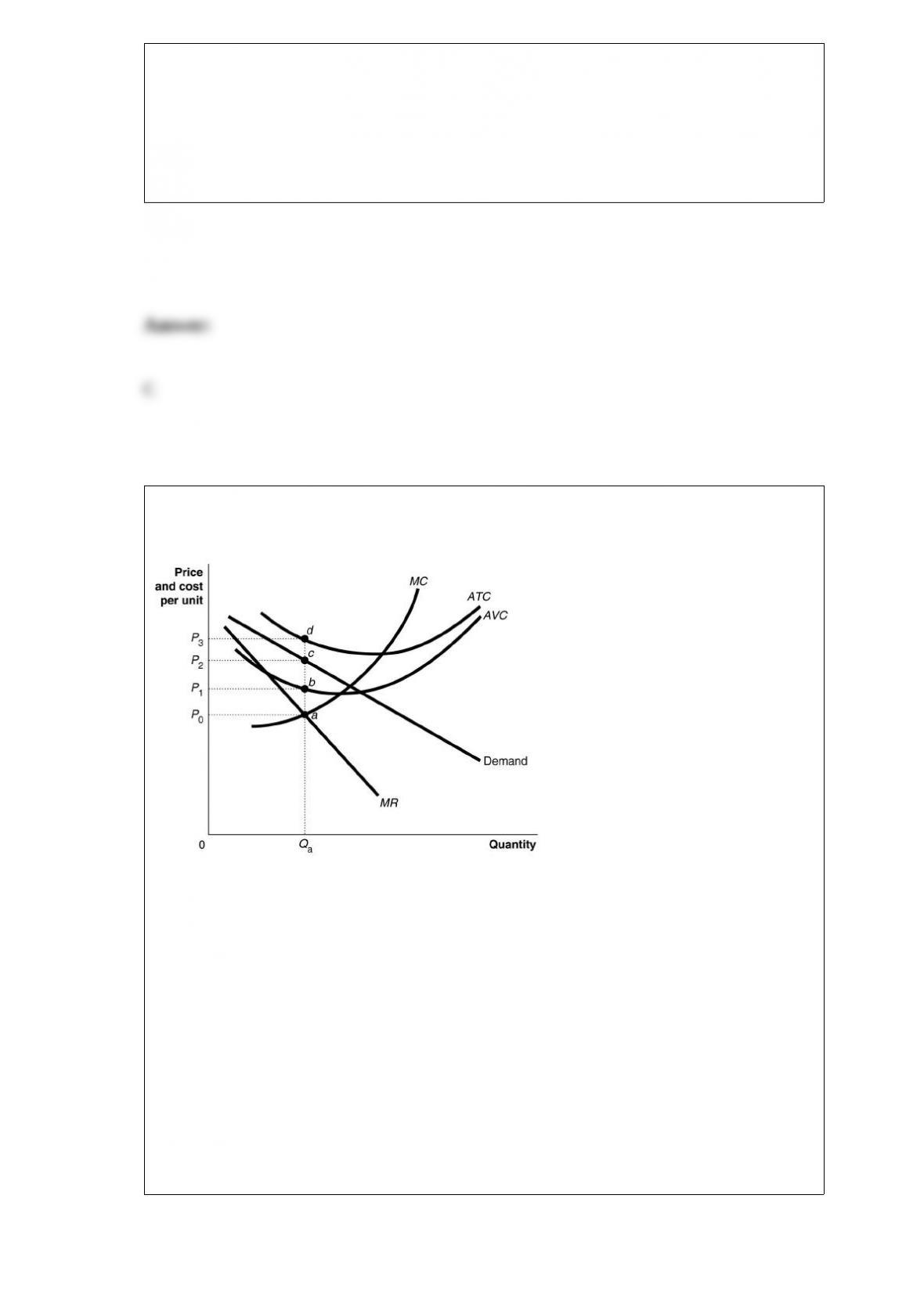
Figure 13-4
Figure 13-4 shows short-run cost and demand curves for a monopolistically competitive
firm in the market for designer watches.
Refer to Figure 13-4.What is the area that represents the total revenue made by the
firm?
A) 0P0aQa
B) 0P1bQa
C) 0P2cQa
D) 0P3dQa
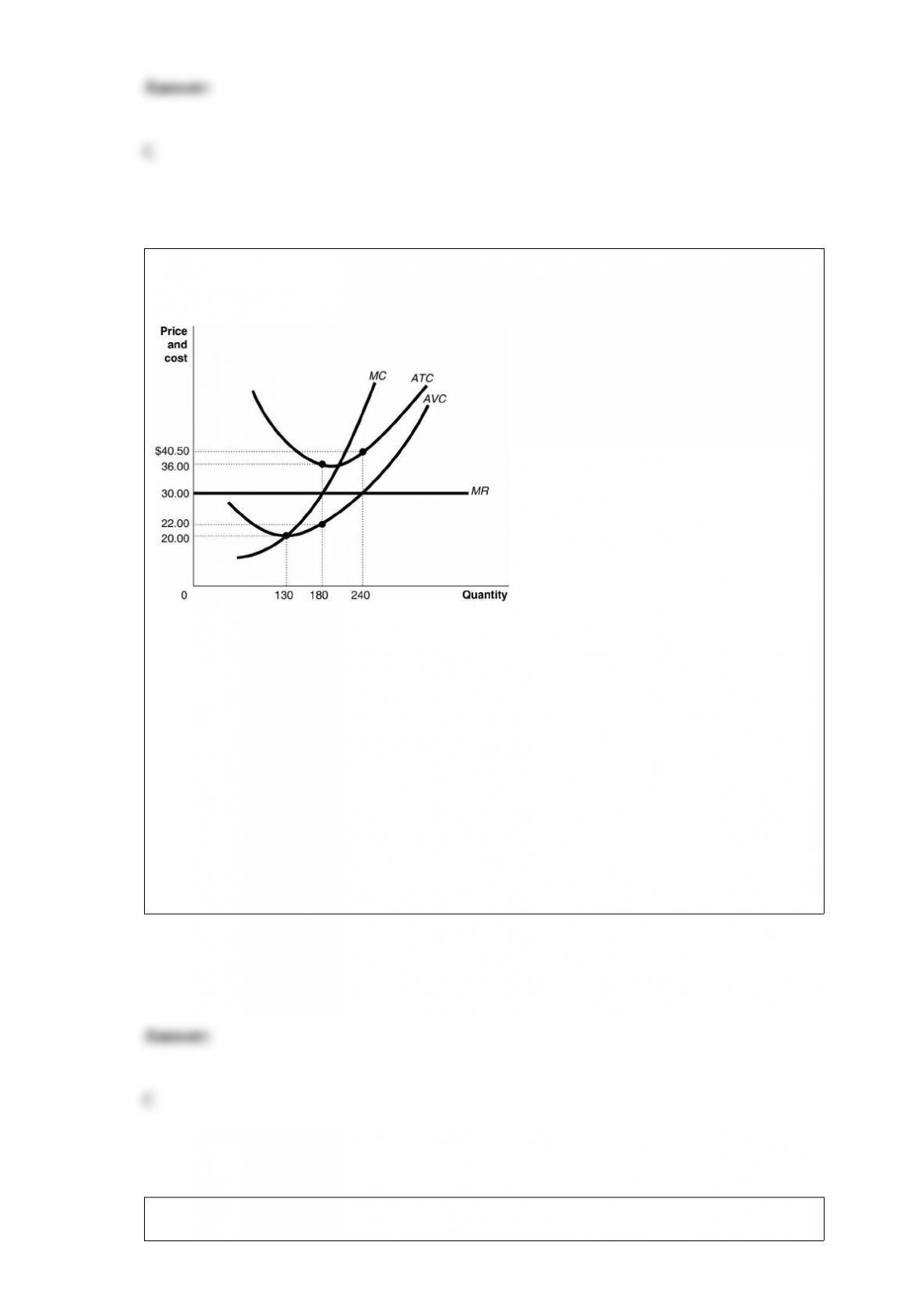
Figure 12-4
Figure 12-4 shows the cost and demand curves for a profit-maximizing firm in a
perfectly competitive market.
Refer to Figure 12-4. If the market price is $30, should the firm represented in the
diagram continue to stay in business?
A) No, it should shut down because it is making a loss.
B) No, it should shut down because it cannot cover its variable cost.
C) Yes, because it is covering part of its fixed cost.
D) Yes, because it is making a profit.
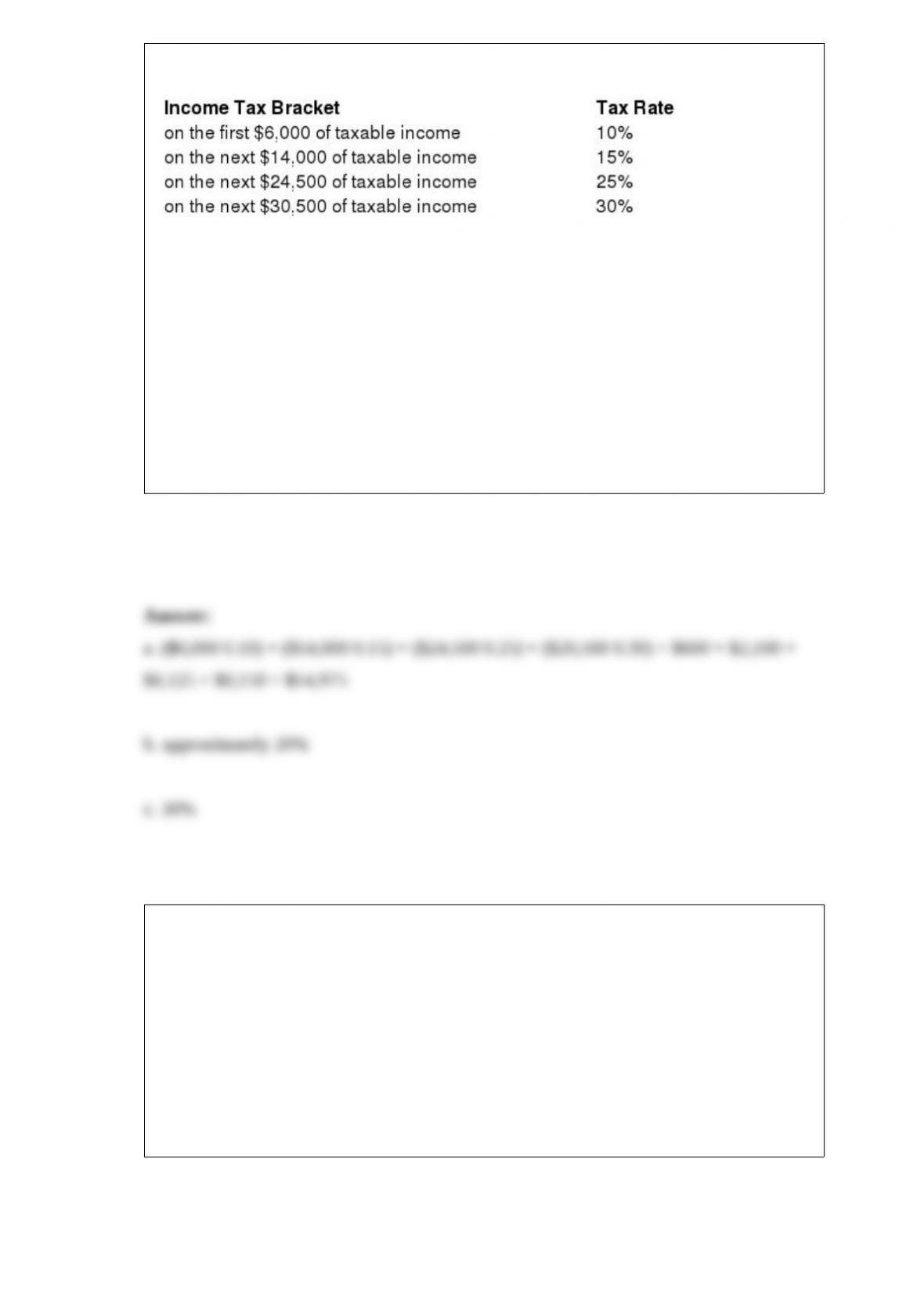
Table 18-10
Table 18-10 shows the income tax brackets and tax rates for single taxpayers in
Bauxhall.
Refer to Table 18-10. A tax exemption is granted for the first $10,000 earned per year.
Suppose you earn $75,000.
a. What is the amount of taxes you will pay?
b. What is your average tax rate?
c. What is your marginal tax rate?
Increasing opportunity cost is represented by a ________ production possibilities
frontier.
A) linear
B) bowed in
C) bowed out
D) vertical