
1) Suppose the domestic price (no-international-trade price) of copper is $1.20 a pound
in the United States while the world price is $1.00 a pound. Assuming no transportation
costs, the United States will:
A.have a domestic surplus of copper.
B.export copper.
C.import copper.
D.neither export nor import copper.
2) Narrow, specifically designated expenditures that are included in more
comprehensive legislation are known as:
A.earmarks.
B.logrolls.
C.benefits-received allocations.
D.progressive expenditures.
3) if there are important external benefits associated with the consumption of a product:
a.government should enact legislation to prohibit the production of the commodity.
b.special excise taxes should be levied on producers of the product.
c.the market demand curve understates the relative importance of the product and
resources are therefore underallocated to its production.
d.the market supply curve for the product lies too far to the right to provide an efficient
allocation of resources.
4) Which of the following occupations is among the ten projected fastest growing U.S.
occupations in terms of percentage increases?
A.personal financial advisors
B.file clerks
C.desktop publishers
D.textbook authors
5) the perceived central economic problem associated with the u.s. health care system
is:
a.too many frivolous malpractice law suits.
b.an overabundance of scanning machines.
c.an overallocation of resources to the system.
d.that workers lose their insurance when they lose their jobs.
6) if a demand for a product is elastic, the value of the price elasticity coefficient is:
a.zero.
b.greater than one.
c.equal to one.
d.less than one.
7) all of the following are sources of increasing returns and economies of scale except:
a.network effects.
b.spreading of development costs.
c.more specialized inputs.
d.coordination problems in large organizations.
8)
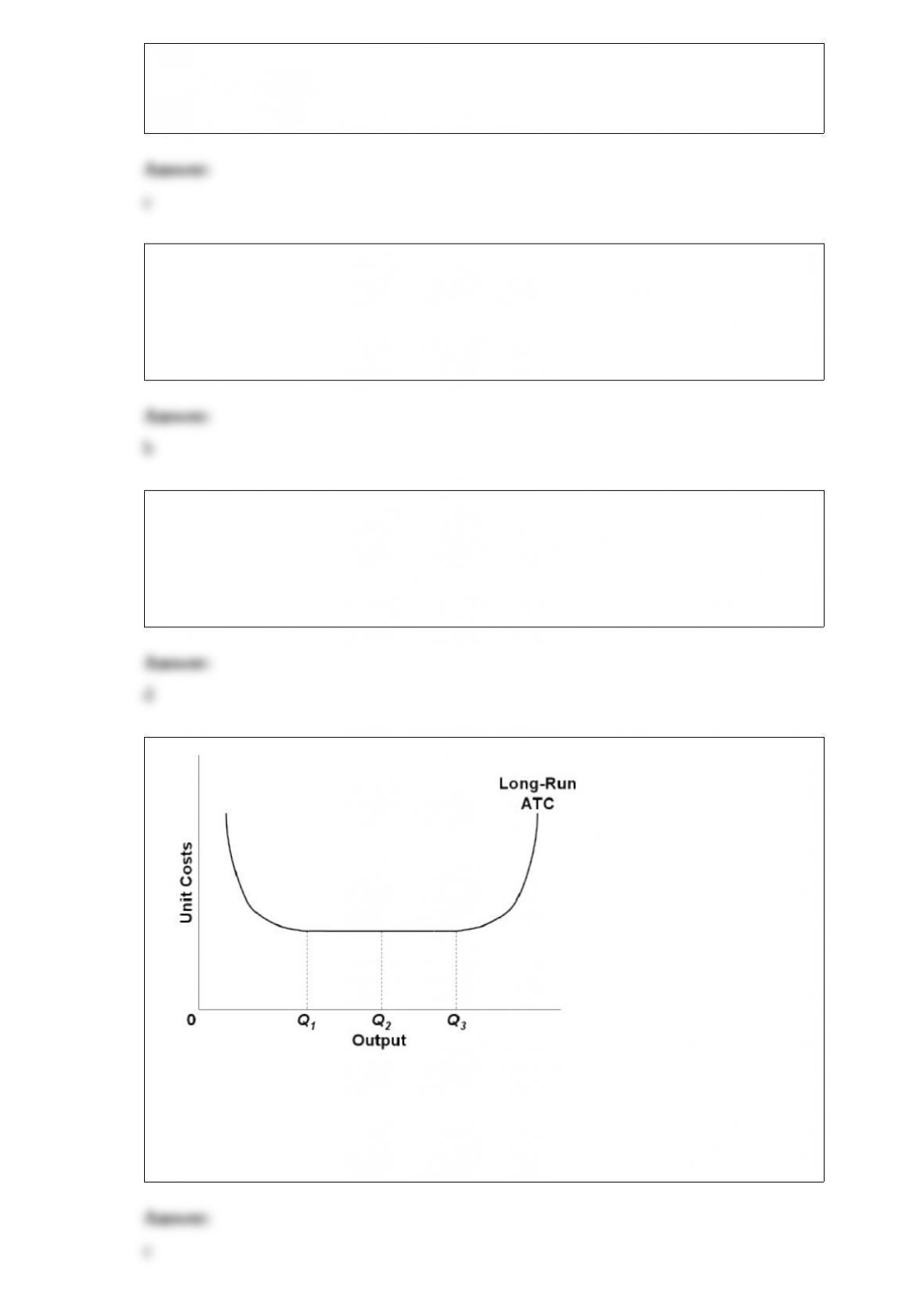
refer to the above diagram. diseconomies of scale:
a.begin at output q1.
b.occur over the q1q3 range of output.
c.begin at output q3.
d.are in evidence at all output levels.
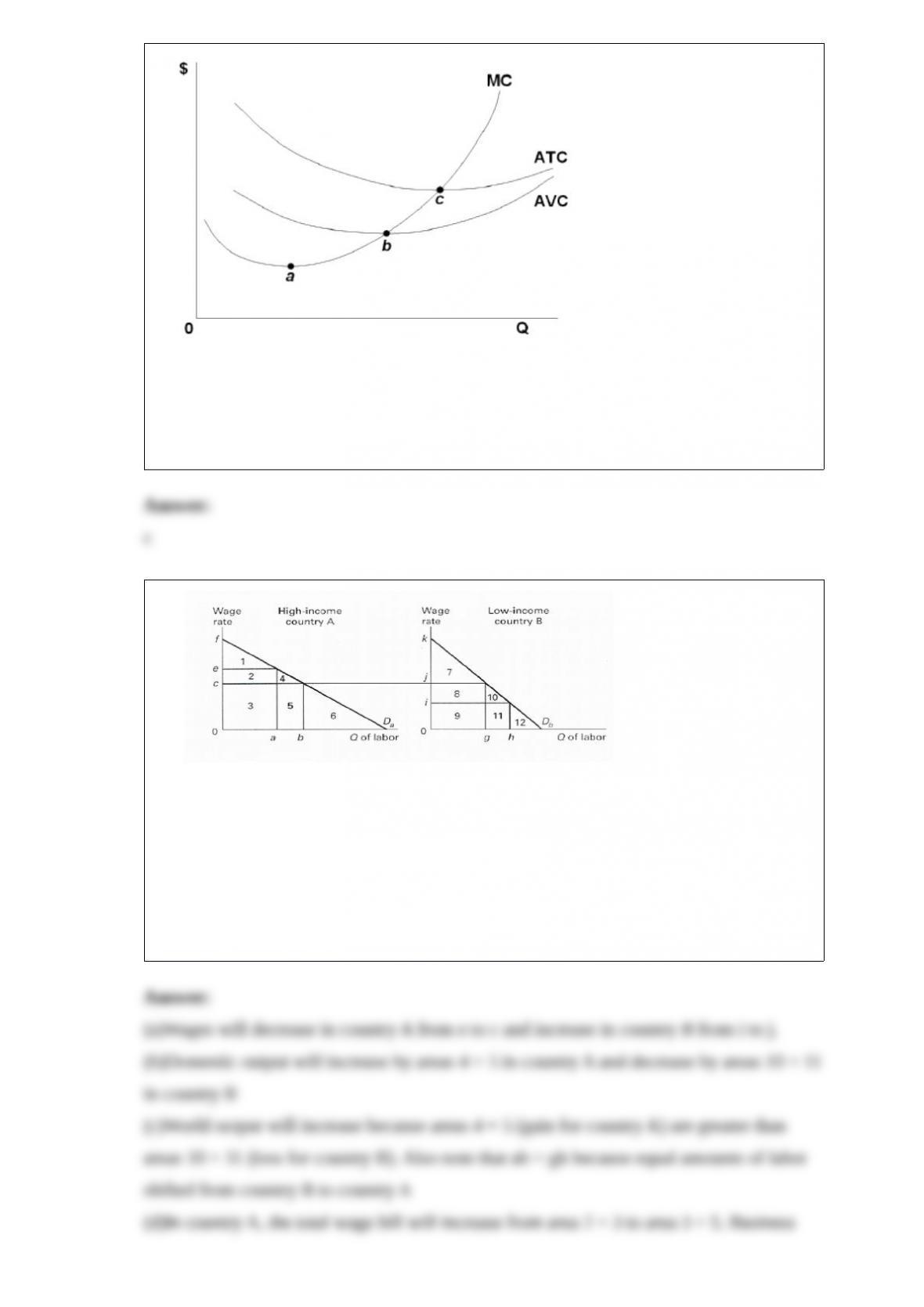
9)
refer to the above diagram. this firm’s average fixed costs are:
a.not shown.
b.the vertical distance between avc and mc.
c.the vertical distance between avc and atc.
d.equal to the per unit change in mc.
10) The next four questions
refer to the graph below. (Assume that the premigration labor force in country A is a
and that it is h in country B.) Explain your answers with reference to areas in the graph
(1, 2, etc.) or to letters (a, b, c, etc.).
(a)What will happen to wage rates in country A and country B because of the migration
of labor from country B to country A?
(b)What will happen to domestic output in country A and country B after immigration?
(c)What will happen to world output given the experience in these two nations?
(d)What will happen to income shares for workers and business in each country?

11) Social Security is financed:
A.by state income tax revenues.
B.by payroll taxes on employees and employers.
C.by Federal excise taxes.
D.out of general tax revenues.
12) In 2006, the highest quintile of households in the U.S. income distribution received
about:
A.35 percent of the income.
B.54 percent of the income.
C.60 percent of the income.
D.50 percent of the income.
13) productive efficiency refers to:
a.the use of the least-cost method of production.
b.the production of the product-mix most wanted by society.
c.the full employment of all available resources.
d.production at some point inside of the production possibilities curve.
14) during a severe recession, we would expect output to fall the most in:
a.the health-care industry.
b.the clothing industry.
c.agriculture.
d.the construction industry.
15) if the secular trend of labor productivity is 3 percent per year, the number of years
that it will take for the standard of living to double will be about:
a.15 years.
b.17 years.
c.20 years.
d.23 years.
16) Small innovative firm X that has developed a new product, accepts an offer to be
acquired by a larger firm. As it relates to new technology, this behavior or outcome is
known as a:
A.fast-second strategy.
B.limit pricing.
C.zero-sum game.
D.a buyout.
17) as applied to the price level, the “rule of 70” indicates that the number of years
required for the price to double can be found by:
a.dividing “70” into the annual rate of inflation.
b.dividing the annual rate of inflation into “70.”
c.subtracting the annual change in nominal incomes from “70.”
d.multiplying the annual rate of inflation by “70.”
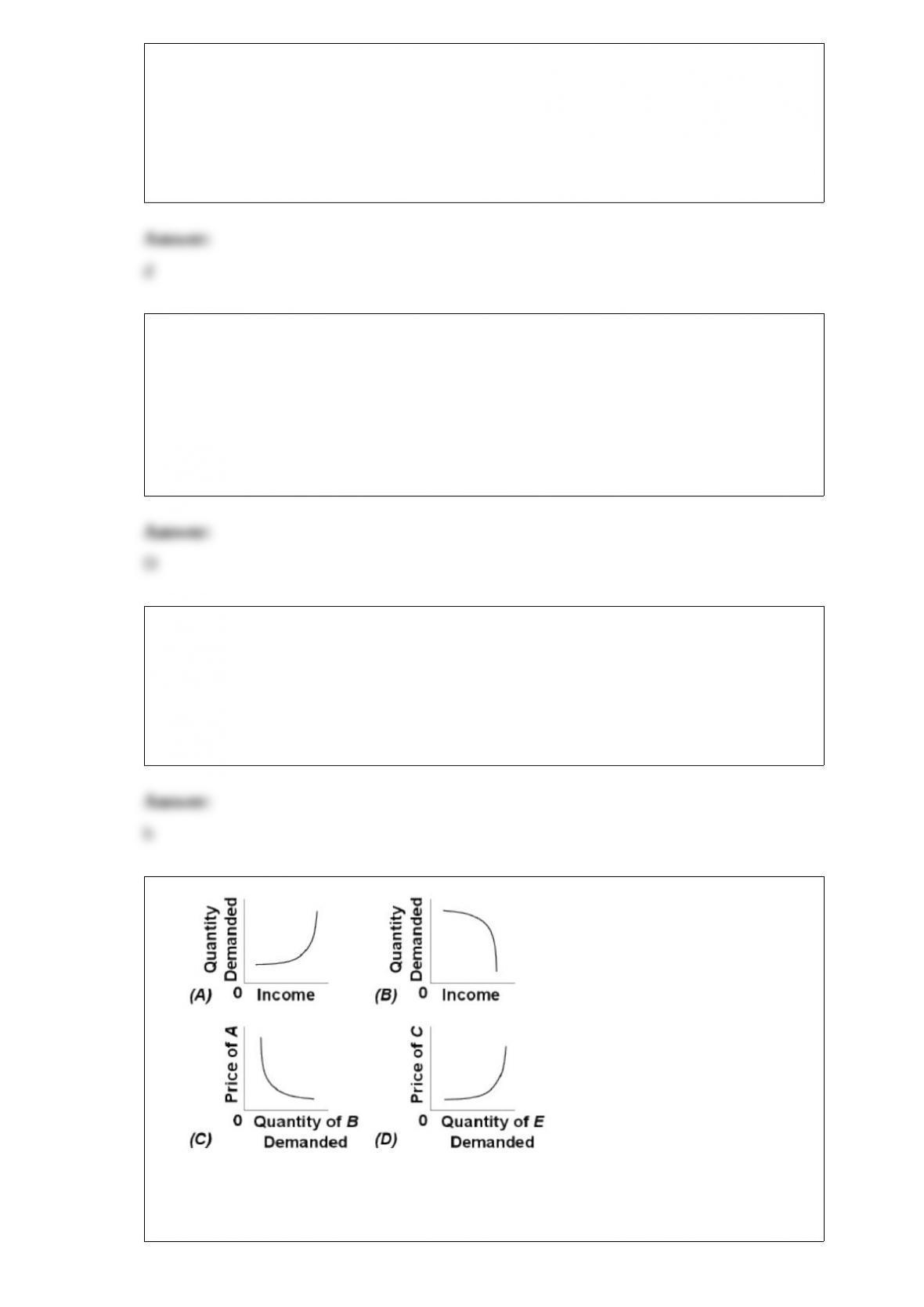
18)
refer to the above diagrams. the case of complementary goods is represented by figure:
a.a
b.b

c.c
d.d
19) In “Slicing the Pizza” the shrinkage of the pizza refers to the:
A.fact that poor people are not helped by the income maintenance system.
B.efficiency losses-the losses of output and income-associated with the tax-transfer
system.
C.tendency of rich people in developing nations to hoard their wealth overseas.
D.failure of the Internal Revenue Service to collect all the tax revenues owed by
taxpayers.
20) listed in descending order of relative size, households divide their total incomes
among:
a.consumption expenditures, saving, and taxes.
b.saving, consumption expenditures, and taxes.
c.consumption expenditures, taxes, and saving.
d.taxes, consumption expenditures, and saving.