1) if x is a normal good, a rise in money income will shift the:
a.supply curve for x to the left.
b.supply curve for x to the right.
c.demand curve for x to the left.
d.demand curve for x to the right.
2)
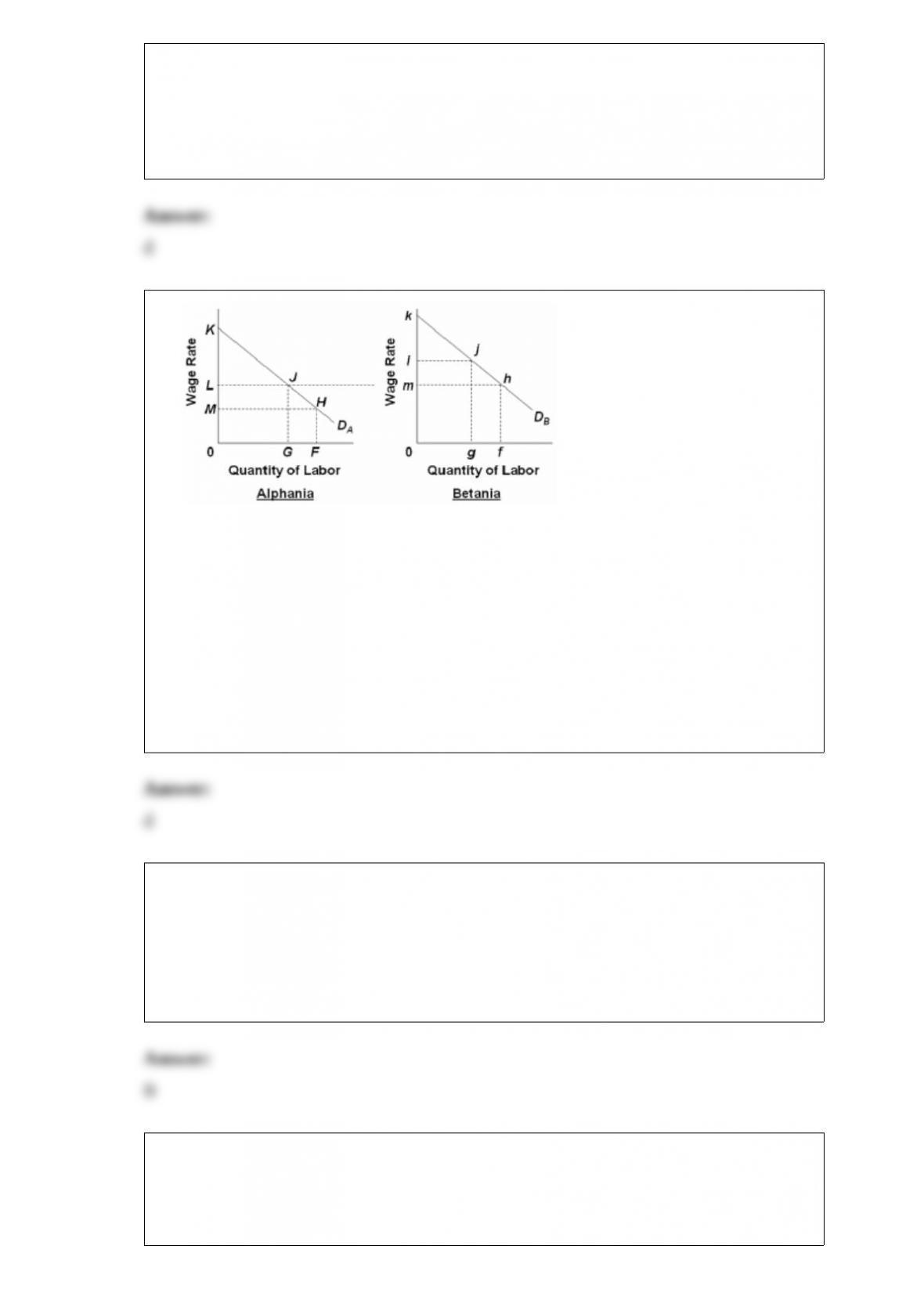
assumptions: (1) the demand for labor in alphania and betania are as shown by da and
db, respectively; (2) alphania’s native labor force is f and that of betania is g; (3) wage l
in alphania is equal to wage m in betania; and (4) full employment exists in both
countries.
refer to the above diagram and assumptions. if migration is costless and unimpeded:
a.migration will cause the average level of wages to fall in alphania.
b.no migration will occur.
c.fg workers will move from betania to alphania.
d.gf workers will move from alphania to betania.
3) Which of the following did not contribute to the large Federal budget deficits in 2002
and 2003?
A.spending on the wars in Afghanistan and Iraq.
B.low interest rates.
C.Federal tax cuts.
D.the recession of 2001 and its aftermath.
4)
Other things equal, the relationship between the relative importance of a given type of
labor in a firm’s total costs and the elasticity of demand for that labor is such that the:
A.demand for labor will be elastic only if labor accounts for less than 50 percent of total

costs.
B.demand for labor will be elastic only if labor accounts for 50 percent or more of total
costs.
C.larger the labor cost-total cost ratio, the smaller will be the elasticity of labor demand.
D.larger the labor cost-total cost ratio, the greater will be the elasticity of labor demand.
5) (Consider This) Which of the following methods is used by farmers to “hedge”
against short-run price and output fluctuations?
A.Securing prices for their output in the futures market.
B.Purchasing crop revenue insurance to prevent against natural disasters.
C.Leasing land to other farmers in return for stable rent payments.
D.All of these risk-management techniques are used.
6) When the actual rate of inflation is less than the expected rate:
A.the unemployment rate will temporarily rise.
B.firms will increase their output to recoup their falling profits.
C.the unemployment rate will temporarily fall.
D.firms will experience rising profits and thus increase their employment.
7) If the Fed were to purchase government securities in the open market, we would
anticipate:
A.lower interest rates, an expanded GDP, and depreciation of the dollar.
B.lower interest rates, an expanded GDP, and appreciation of the dollar.
C.higher interest rates, a contracted GDP, and depreciation of the dollar.
D.lower interest rates, a contracted GDP, and appreciation of the dollar.
8) (Consider This) Which of the following nations has implemented policies that pay
women to have additional children?
A.Italy.
B.United States.

C.China.
D.All of these nations.
9) if the demand for product x is inelastic, a 4 percent increase in the price of x will:
a.decrease the quantity of x demanded by more than 4 percent.
b.decrease the quantity of x demanded by less than 4 percent.
c.increase the quantity of x demanded by more than 4 percent.
d.increase the quantity of x demanded by less than 4 percent.
10) The bank and thrift share of total financial assets has:
A.declined significantly since 1980.
B.increased significantly since 1980.
C.remained quite constant since the Second World War.
D.increased in the United States but declined abroad.
11) In a mixed open economy, if aggregate expenditures exceed GDP:
A.Ig + X + G = Ca.
B.Ca + Ig + Xn + G < domestic output.
C.Ig > S.
D.Ig + X + G > Sa + M + T.
12) as a firm produces successive units of output in the short run we would expect:
a.tvc to increase initially by declining amounts, but eventually increase by increasing
amounts.
b.tvc to increase initially by increasing amounts, but eventually by decreasing amounts.
c.tfc to increase by constant amounts.
d.the sum of tvc and tfc to increase initially by increasing amounts, but eventually by
decreasing amounts.
13) Prices and wages tend to be:
A.flexible both upward and downward.
B.inflexible both upward and downward.
C.flexible downward, but inflexible upward.
D. flexible upward, but inflexible downward.
14) in a market economy the distribution of output will be determined primarily by:
a.consumer needs and preferences.
b.the quantities and prices of the resources that households supply.
c.government regulations that provide a minimum income for all.
d.a social consensus as to what distribution of income is most equitable.
15)
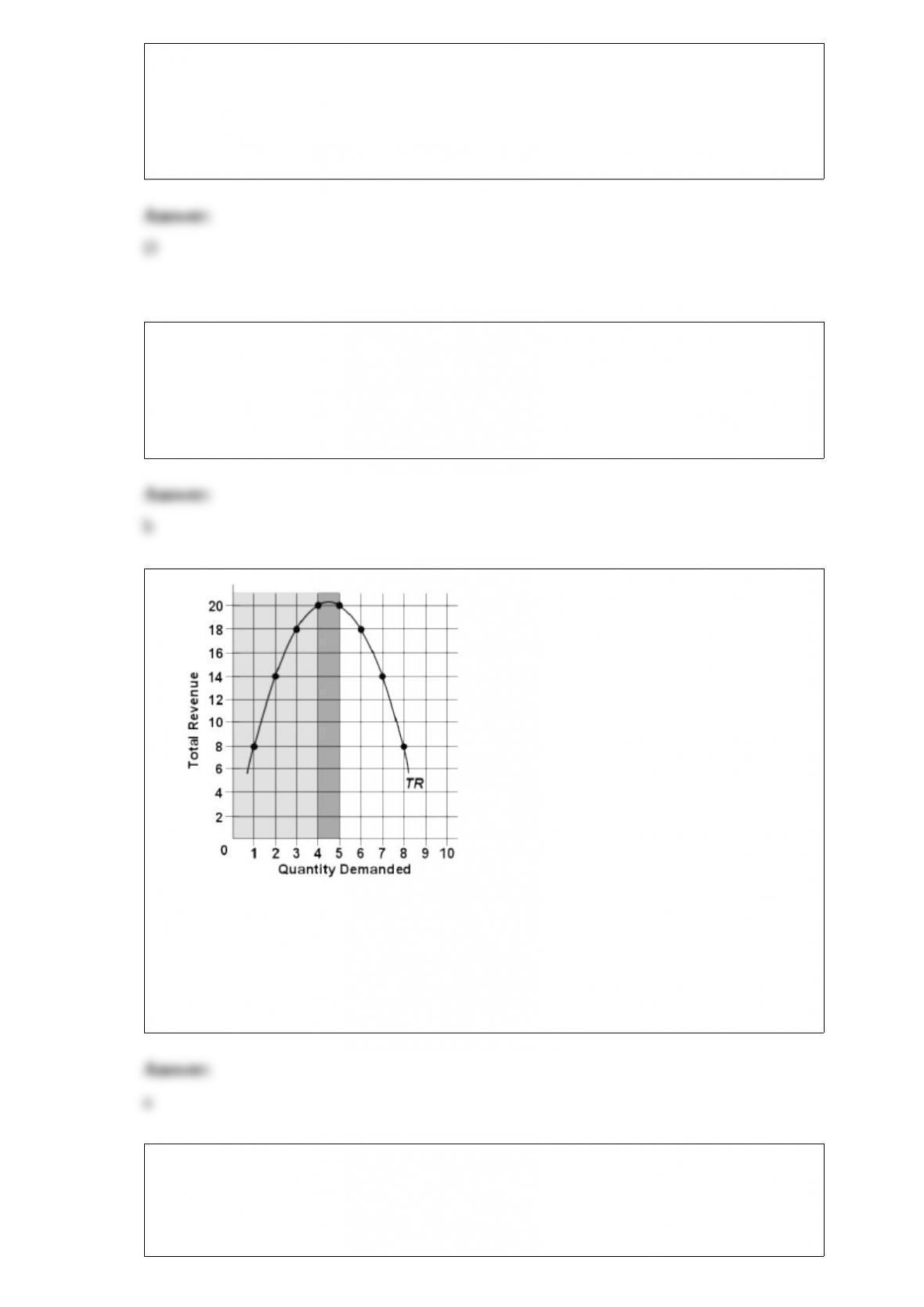
suppose that the above total revenue curve is derived from a particular linear demand
curve. that demand curve must be:
a.inelastic for price declines that increase quantity demanded from 6 units to 7 units.
b.elastic for price declines that increase quantity demanded from 6 units to 7 units.
c.inelastic for price increases that reduce quantity demanded from 4 units to 3 units.
d.elastic for price increases that reduce quantity demanded from 8 units to 7 units.
16) an indifference curve:
a.may be either upsloping or downsloping, depending on whether the two products are
complements or substitutes.
b.is downsloping and convex to the origin.
c.is upsloping and has a constant slope.
d.is downsloping and concave to the origin.
17) in which of the following industry structures is the entry of new firms the most
difficult?
a.pure monopoly
b.oligopoly
c.monopolistic competition
d.pure competition
18)
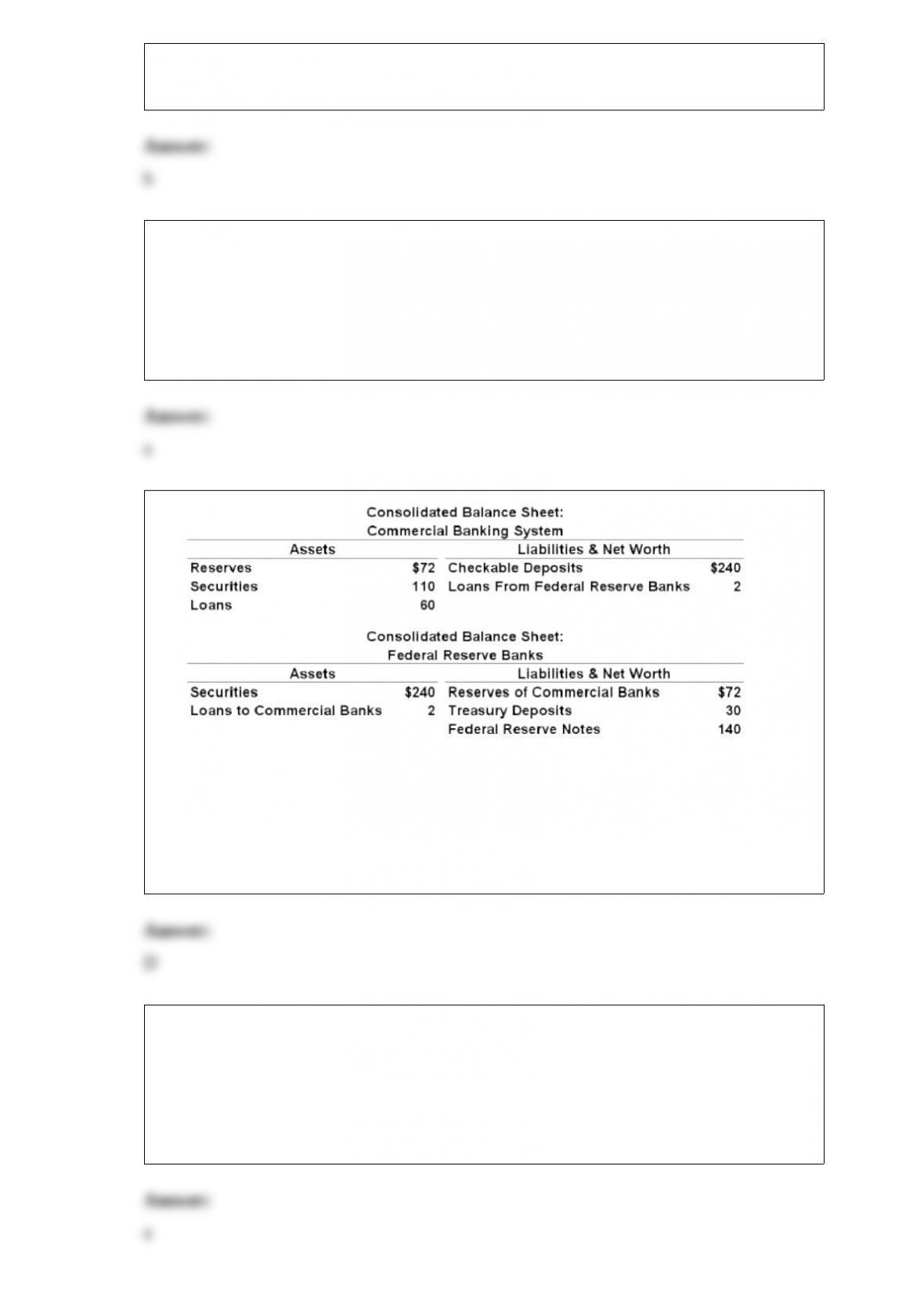
Which of the following will happen when the Federal Reserve buys bonds from the
public in the open market and the amount of cash held by the public does not change?
A.the required reserve ratio will increase
B.the money supply will decrease
C.the deposits of commercial banks will decline
D.commercial bank reserves will increase
19) cross elasticity of demand measures how sensitive purchases of a specific product
are to changes in:
a.the price of some other product.
b.the price of that same product.
c.income.
d.the general price level.
20) Evaluate the statement: Tariffs and quotas are needed to protect American products
from dumping.
21) Describe the cost of discrimination to society. How is the cost of discrimination
illustrated in a production possibilities curve?
22) Describe the characteristics of the long-run aggregate supply curve. Explain how
changes in the price level affect the short-run aggregate supply curve and the long-run
aggregate supply curve.
23) What is the relationship between economies of scale and a natural monopoly?
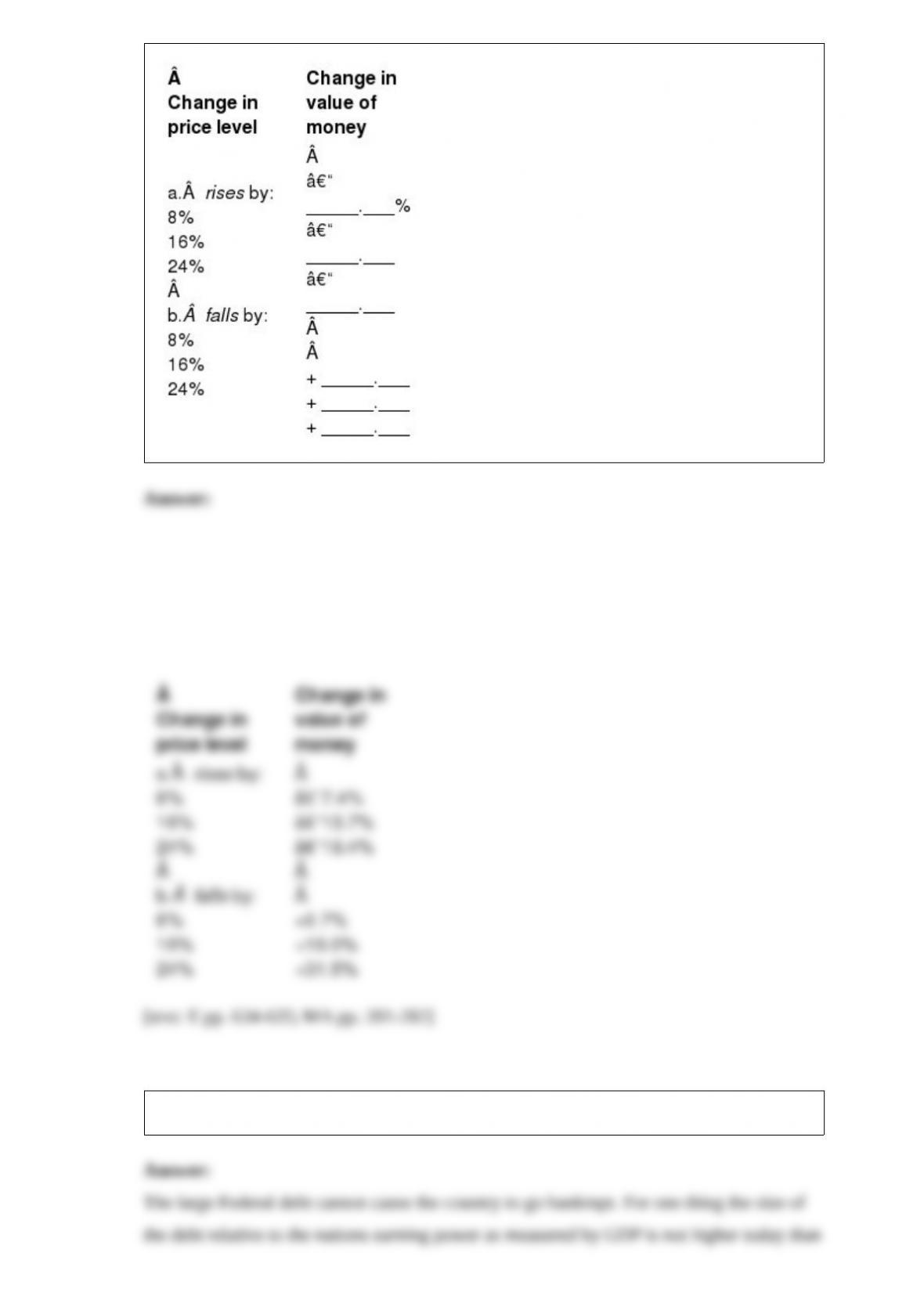
24) Complete the following table showing the relationship between a percentage change
in the price level and the percentage change in the value of money. Calculate the
percentage change in the value of money to one decimal place.
25) Can the large public debt cause the nation to go bankrupt? Explain.
26) What is the difference between the short run, long run and very long run?
27) What are the differences among positive-sum, negative-sum, and zero-sum games?
28) What are the major criticisms of the Laffer Curve and supply-side economics?
29) Explain: Antitrust is basically pro-business, because it is antimonopoly. To believe
that it is antibusiness is to believe that monopoly is pro-business.