
Figure 16-7
The Lizard Lounge is well known for its
exotic cocktails. Figure 16-7 shows its estimated demand curve for cocktails. The
owners of the Lizard Lounge are considering the following four pricing options:
a. A single price scheme where the cocktail price equals the monopoly price.
b. A single price scheme where the cocktail price equals the competitive price.
c. A two-part tariff: a monopoly price for cocktails and a cover charge that will generate
total revenue equal to the area X.
d. A two-part tariff: a competitive price for cocktails and a cover charge that will
generate total revenue equal to the area X + Y + Z. Under which scheme are the Lounge
customers better off?
A) scheme a
B) scheme b
C) scheme c
D) scheme d
Table 4-4
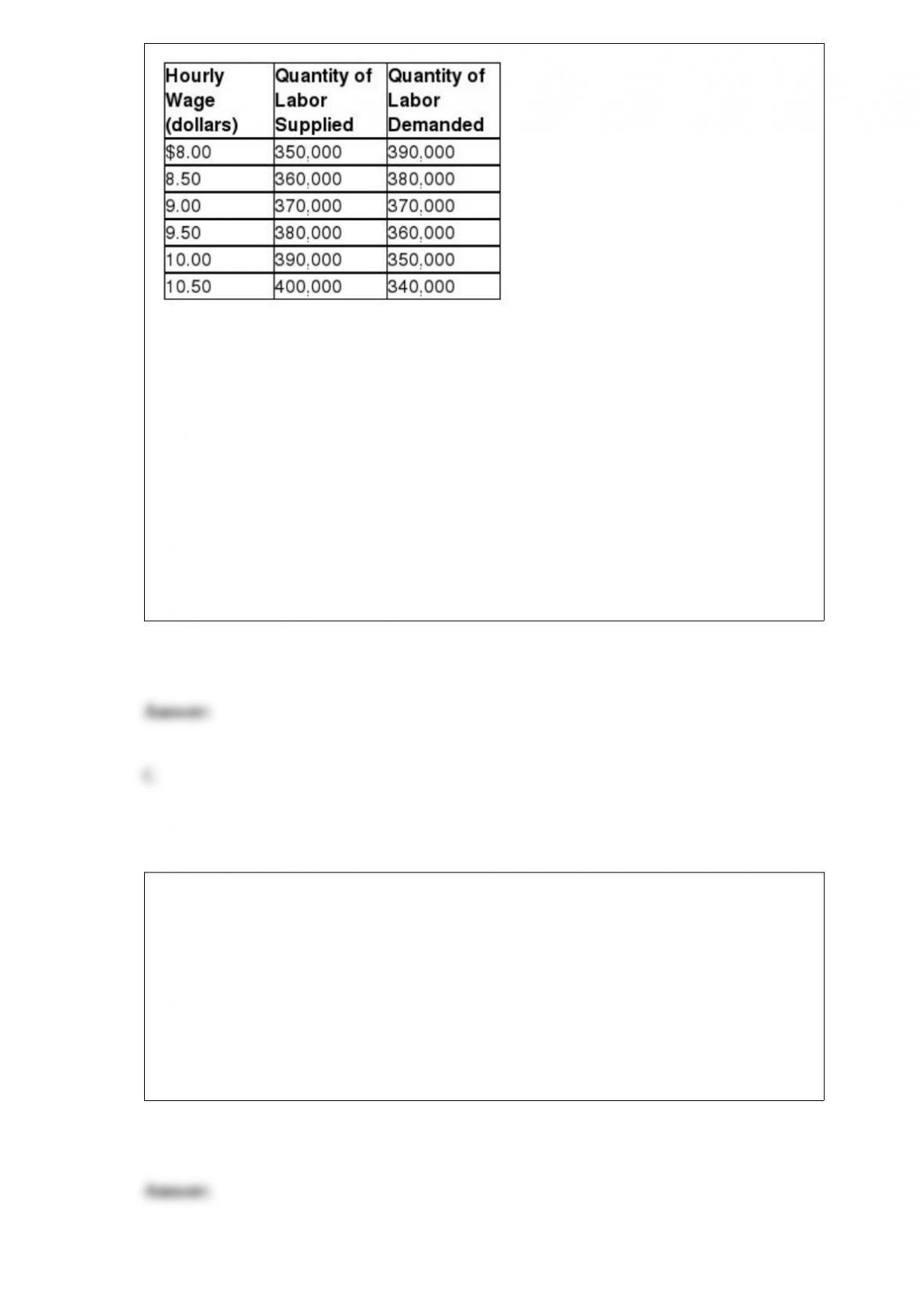
Table 4-4 shows the demand and supply schedules for the low-skilled labor market in
the city of Westover.
If a minimum wage of $10.50 an hour is mandated, what is the quantity of labor
demanded?
A) 400,000
B) 370,000
C) 340,000
D) 60,000
How does the increasing use of MP3 players affect the market for compact discs?
A) The demand curve for compact discs shifts to the right.
B) The supply curve for compact discs shifts to the left.
C) The supply curve for compact discs shifts to the right.
D) The demand curve for compact discs shifts to the left.

Open market operations refer to the purchase or sale of ________ to control the money
supply.
A) corporate bonds and stocks by the Federal Reserve
B) U.S. Treasury securities by the Federal Reserve
C) corporate bonds and stocks by the U.S. Treasury
D) U.S. Treasury securities by the U.S. Treasury
Which of the following factors help to explain the sustained increases in health care
spending in the United States, and which do not?
a. the additional paperwork, duplication, and waste generated in the U.S. health care
system compared to systems in other countries
b. the increasing costs of malpractice insurance and malpractice lawsuit settlements
c. the number of uninsured patients receiving hospital treatment that could have been
performed at a lower cost in doctors’ offices
d. the slow growth in labor productivity in health care compared to that in the economy
as a whole
e. the aging population
f. increases in the cost of providing health care
If a monopolist’s marginal revenue is $35 per unit and its marginal cost is $25, then
A) to maximize profit, the firm should increase output.
B) to maximize profit, the firm should decrease output.
C) to maximize profit, the firm should continue to produce the output it is producing.
D) Not enough information is given to say what the firm should do to maximize profit.
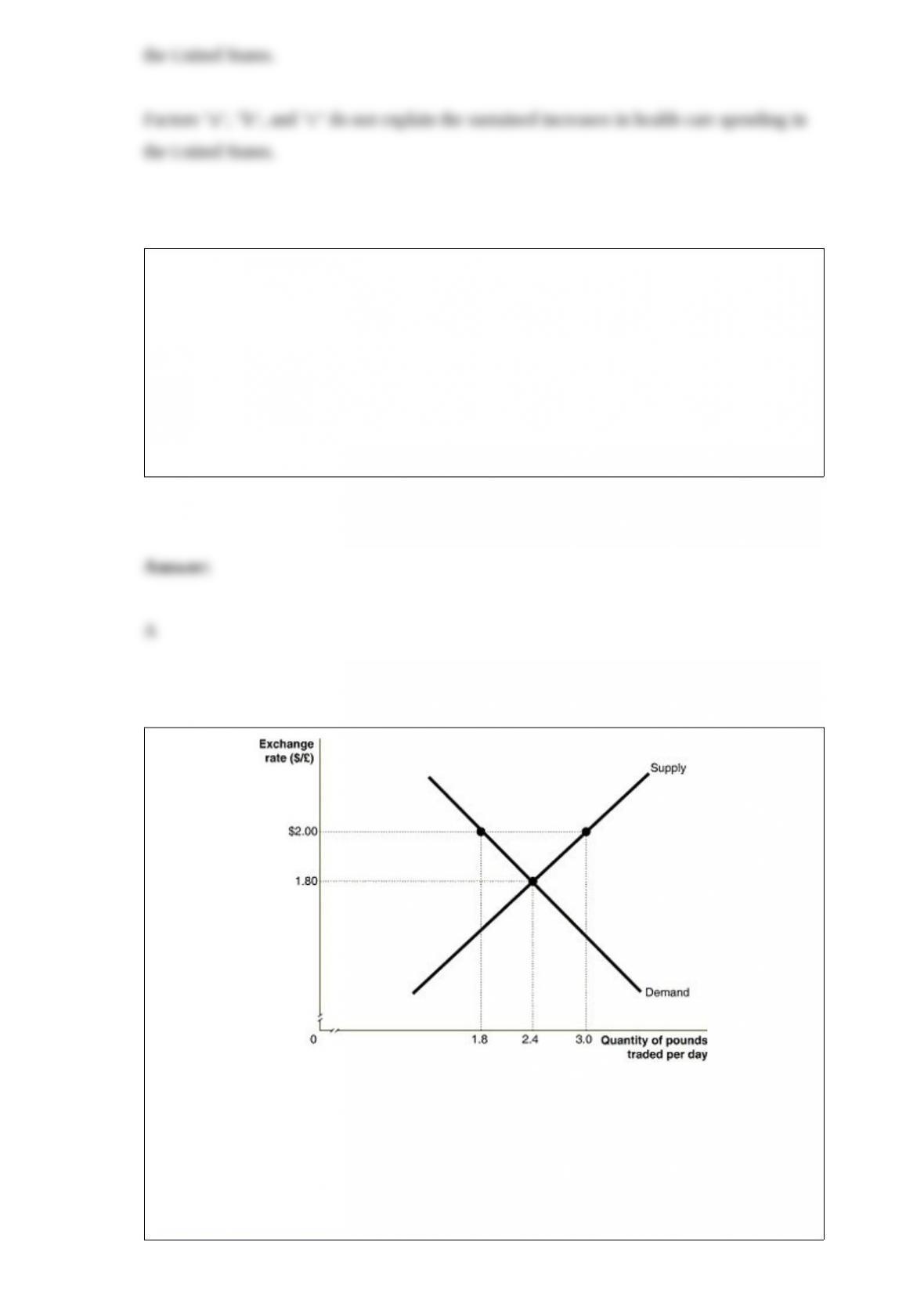
Figure 19-11
The graph above depicts supply and demand for British pounds during a trading day,
where the quantity is millions of pounds. In order to support a fixed exchange rate of
$2.00 per pound, the U.S. central bank must
A) buy 0.6 million pounds per trading day.
B) sell 0.6 million pounds per trading day.
C) buy 1.2 million pounds per trading day.
D) sell 1.2 million pounds per trading day.
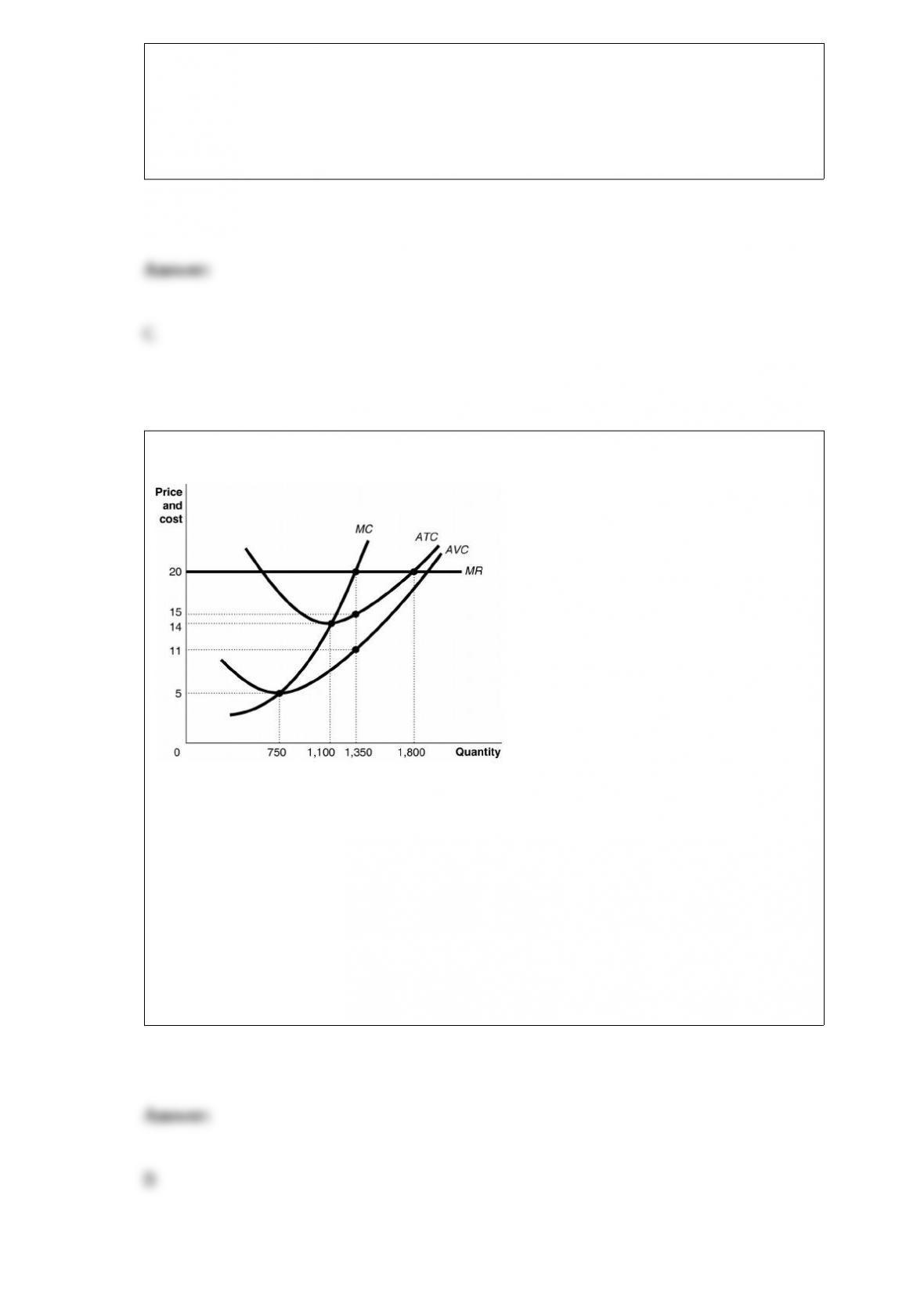
Figure 12-11
Suppose the prevailing price is $20 and the firm is currently producing 1,350 units. In
the long-run equilibrium
A) there will be fewer firms in the industry and total industry output decreases.
B) there will be more firms in the industry and total industry output increases.
C) there will be fewer firms in the industry but total industry output increases.
D) there will be more firms in the industry and total industry output remains constant.
Scenario 17-1. In academia, professors in some disciplines receive higher salaries than
others. For example, professors teaching in business schools receive higher salaries than
professors in the English department. Suppose at Unity College, assistant professors in
the business school earn $80,000 while assistant professors in the English department
earn $50,000. Now suppose the government passes comparable worth legislation that
requires academic institutions to pay all faculty the same salaries.
Following the passage of comparable worth legislation, Unity College responds by
placing salaries for all assistant professors at $80,000. Which of the following is the
result of the legislation?
A) The supply of English professors increases; the market for business professors is not
affected.
B) The demand for English professors decreases; the market for business professors is
not affected.
C) There will be a surplus in the market for English professors and a shortage in the
market for business professors.
D) There will be a surplus in the market for English professors and the market for
business professors will not be affected.
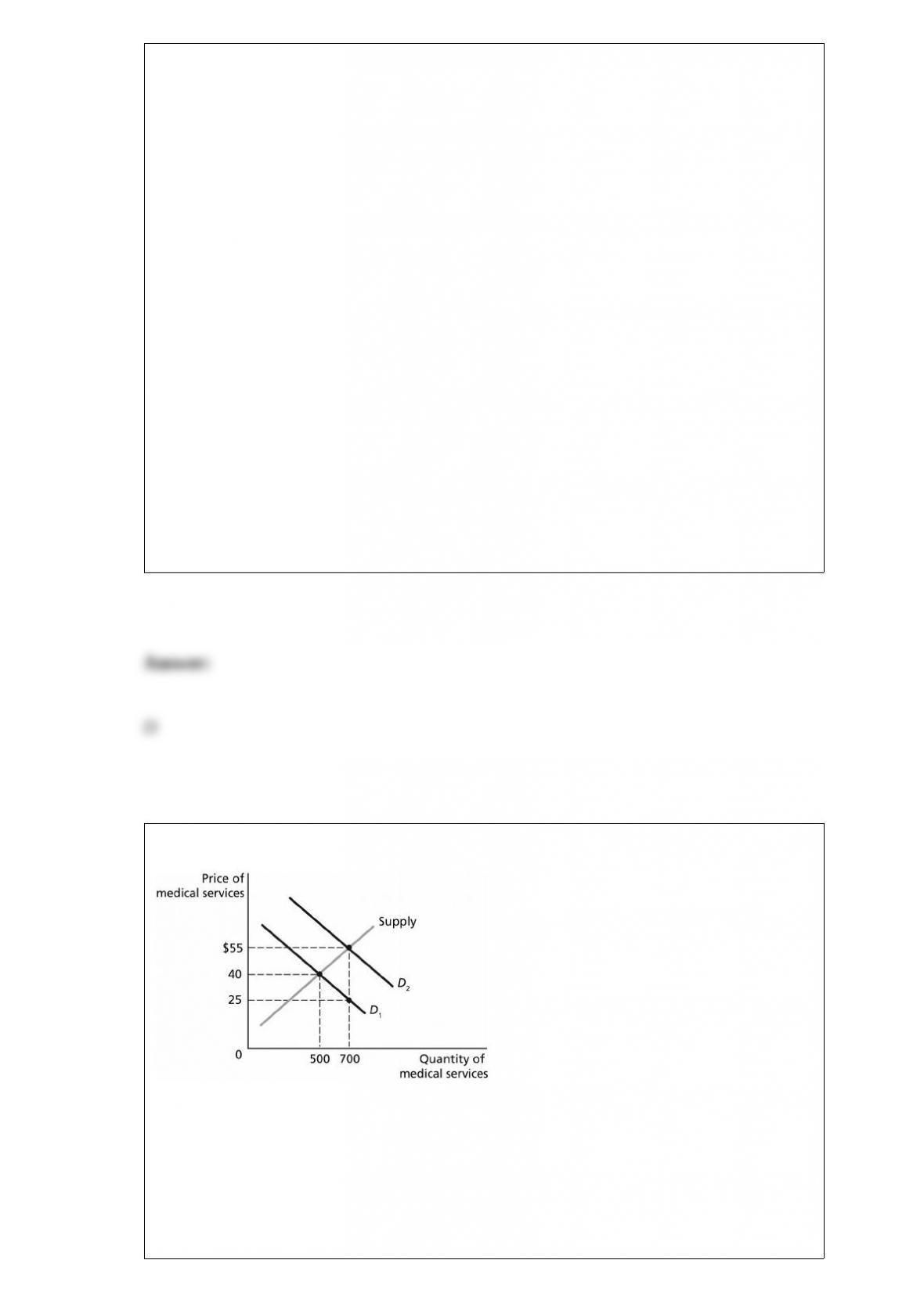
Figure 7-2
Figure 7-2 represents the market for
medical services with and without insurance, and the effect of a third-party payer
system on the demand for medical services.
With insurance and a third-party payer system, what price do consumers pay for
medical services?
A) $25

B) $40
C) $55
D) >$55
A proprietorship or partnership can raise funds for expansion in all of the following
ways except
A) borrowing from someone or an institution willing to lend the funds.
B) reinvesting profit back into the business.
C) taking on a partner or more partners.
D) issuing stock through financial markets.
Between 2007 and 2011 the value of the U.S. dollar fell by more than 60 percent
against the Japanese yen. This fall in the price of the dollar against the yen was
________ for Japanese companies that exported to the United States and ________ for
U.S. companies that exported to Japan.
A) good; good
B) bad; good
C) good; bad
D) bad; bad

Walt Disney began planning for Disneyland in the early 1950s. When he began to
consider how the amusement park would be funded
A) he decided to use the profits earned from his company’s cartoons and motion
pictures.
B) he had trouble raising the required funds. Eventually, he convinced a television
network to fund the amusement park in exchange for providing a weekly television
program.
C) he decided to borrow money from Hollywood banks. The banks quickly agreed to
loan Disney the money because of Disney’s reputation and previous success.
D) he had trouble raising the required funds from banks, so he decided to issue “Disney
bonds.” He had no trouble paying the interest and principal on the bonds with profits
from Disneyland.
What is the NAIRU?
A) the natural accelerating inflation rate of unemployment
B) the nonaccelerating inflation rate of unemployment
C) the nongovernmental agency of inflationary rate unions
D) the new accrual index of real unemployment