
If intended spending is greater than GDP
a. firms will experience unexpected increases in their planned inventory levels.
b. consumption expenditures must be greater than disposable income.
c. firms will attempt to increase production.
d. GDP will fall.
e. the economy is in declining equilibrium.
In 1914, the government gave AT&T the right to set up its long-distance network with
the assurance that the government would not take that network away in exchange for
AT&T’s agreement to refrain from buying up any more independent telephone
companies and for providing existing companies access to that network. This agreement
was called the
a. rule of reason.
b. Kingsbury Commitment.
c. Sherman Act.
d. Spindletop Resolution.
e. Golden Rule of Output Determination.

Marginal revenue
a. generally rises as output increases.
b. exceeds price under conditions of monopoly.
c. is the addition to total revenue from the sale of one more unit.
d. coincides with marginal cost at each level of output.
e. is another name for profit.
The quantity of money demanded varies inversely with
a. the level of real GDP.
b. the interest rate.
c. bond prices.
d. the level of intended spending.
e. the price level.
It is difficult to tell whether the corporate income tax is progressive or regressive
because

a. the income of stockholders is generally not known.
b. dividends are often paid out to pension funds.
c. the corporation may be able to pass on the tax by charging a higher price.
d. dividends are not taxed.
e. it may be offset by the personal income tax.
Among the structural changes that have made recessions less severe in recent years is
the
a. willingness of the federal government to balance the budget each and every year.
b. fact that firms on average now hold much larger inventories, which serve as buffers
to unexpected shocks.
c. fact that the service sector now dominates the U.S. economy, and the demand for
services is typically more stable than that for goods.
d. decision by the Fed to adhere to a strict money growth rate rule.
e. rapid growth in productivity in basic manufacturing industries such as steel and
chemicals.
This is an equilibrium because

a. no worker wishes to work for a lower wage.
b. a higher wage would produce an excess supply; a lower wage would produce an
excess demand.
c. at a wage above this, employers are not willing to hire any workers.
d. this wage is consistent with union ambitions.
e. higher or lower wages generate shifts in the supply and demand curve to restore that
wage.
The government can use fiscal policy to reduce inflation by
a. increasing total spending.
b. modifying the tax laws to induce less personal saving.
c. increasing government expenditures.
d. increasing the budget deficit.
e. increasing the tax rate on personal income.
An aggregate supply curve
a. becomes horizontal at full employment.
b. slopes downward and to the right during periods of unemployment.
c. can be derived by adding up the supply curves for all individual commodities.
d. is constructed on the assumptions that the money supply is fixed and there is full
employment of resources.
e. is constructed by allowing all commodity prices to vary.
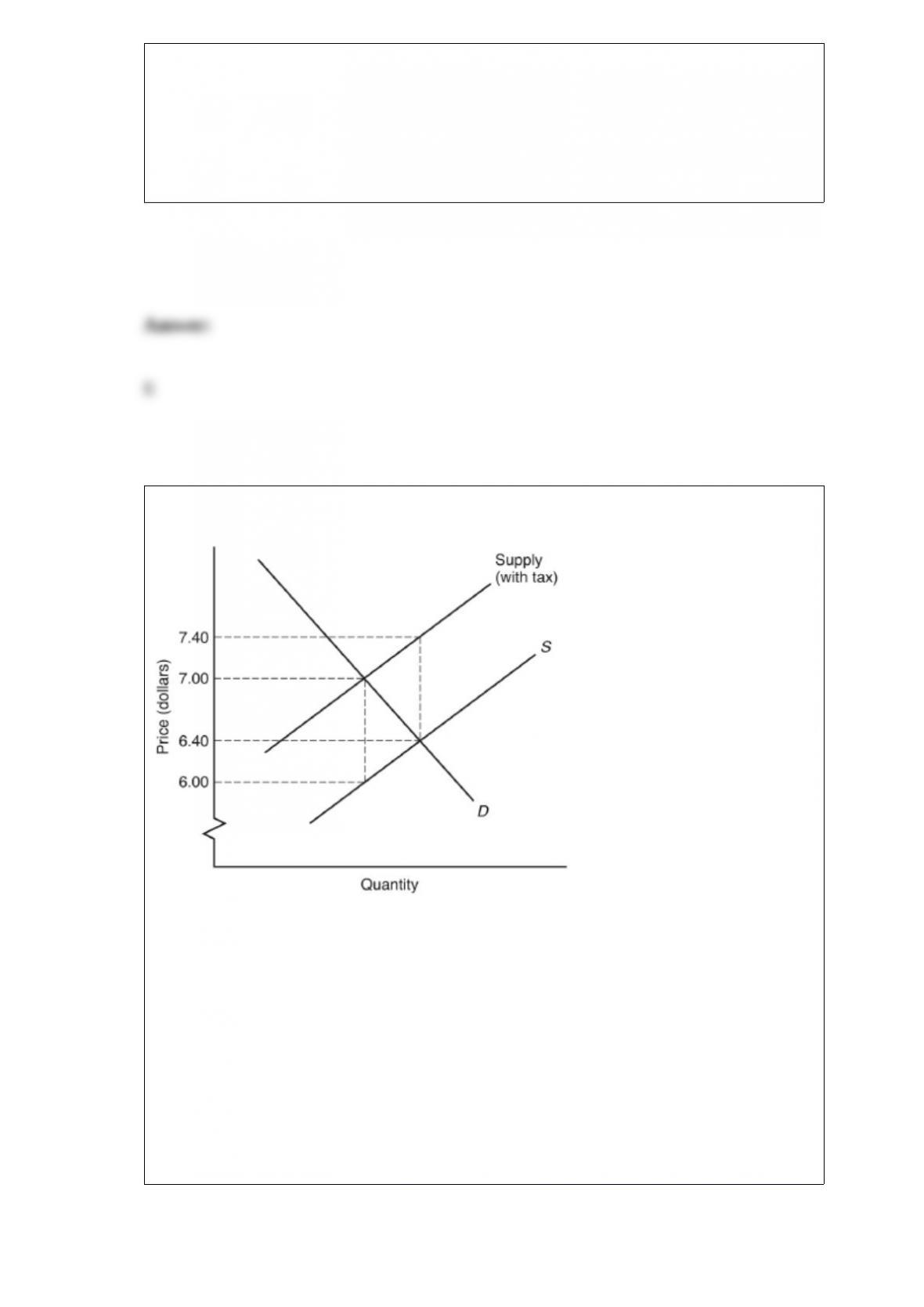
The following questions are based on the following diagram:
The incidence of the tax on the seller is ________ per unit.
a. $1.40
b. $1
c. $0.60
d. $0.50
e. $0.40

The value of the multiplier is
a. negative at low income levels.
b. the reciprocal of the marginal propensity to consume.
c. increased as autonomous investment spending declines.
d. never less than 1.
e. difficult to calculate unless you know the change in equilibrium GDP.
Which of the following conditions would indicate that a perfectly competitive firm
should expand its output to increase its profit?
a. Marginal cost equals average cost.
b. Total cost exceeds marginal cost.
c. Price exceeds marginal cost.
d. Total revenue exceeds total cost.
e. Total revenue equals price.

An example of an ability-to-pay principle tax is the
a. gasoline tax.
b. real estate tax.
c. sales tax.
d. license fee for vehicles and drivers.
e. personal income tax.
To suggest that the United States should take measures to preserve jobs in the steel
industry is an example of ________ economics.
a. positive
b. passive
c. normative
d. mechanical
e. comparative

People unemployed because they lack the necessary qualifications to fill available jobs
are examples of ________ unemployment.
a. frictional
b. structural
c. cyclical
d. inflationary
e. residual
The idea behind the direct market experiment to measure demand is to
a. see the effects on the quantity demanded of actual variations in the price of a product.
b. use statistical methods to estimate demand curves from historical data.
c. measure demand by interviewing consumers about their buying habits and intentions.
d. measure the effect of changes in variables, such as income or taste, on price.
e. measure the effect of changes in price on quantities supplied.
Among the arguments against monopoly is that
a. compared to a perfectly competitive industry, a monopolist produces too much of a
good.

b. a monopolist charges a price that is less than the cost to society of producing the
extra unit.
c. a monopolist redistributes income in its favor by charging a price above marginal
cost.
d. as monopoly profits disappear, a monopolist must raise price to increase sales.
e. the socially optimal output rate is frequently too high for a single firm to produce at
minimum unit costs.
When monetary authorities increase the money supply and push down interest rates,
they are pursuing a(n) ________ money policy.
a. easy
b. tight
c. selective
d. fiscal
e. open
The following questions are based on the following diagram:
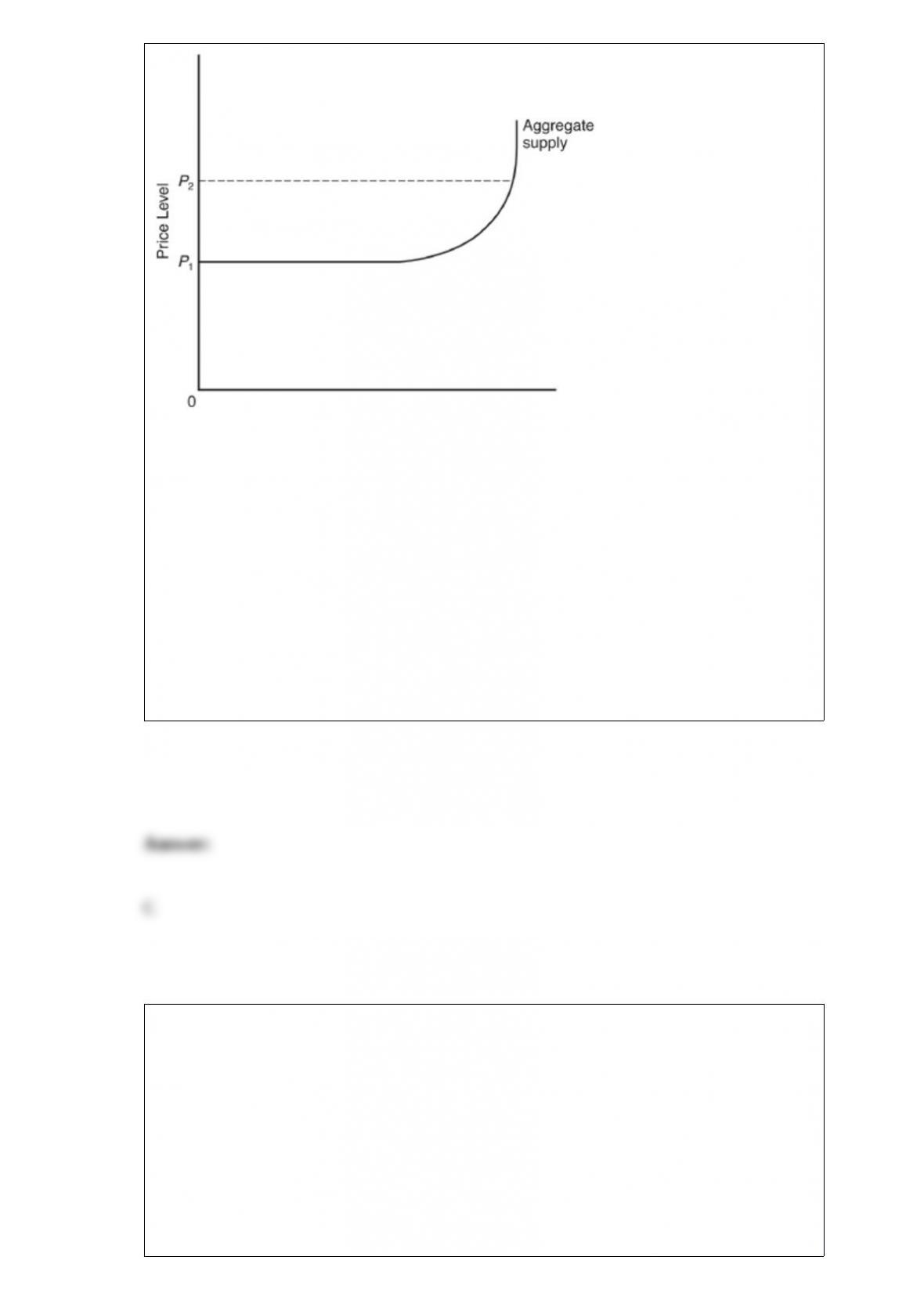
The maximum national output and employment occur when the economy’s aggregate
demand curve intersects the aggregate supply curve in
a. the horizontal range.
b. the upward-sloping range.
c. the vertical range.
d. all three ranges.
e. a manner impossible to determine from the diagram.
In the Keynesian model, supply adjusts passively to demand in the short run because
a. of Say’s law.
b. the equilibrium level of output automatically adjusts to the full-employment level.
c. actual saving equals actual investment at all times.
d. both consumption and investment respond to changes in interest rates when the
aggregate supply curve is vertical.

e. high levels of unemployment keep wages and prices stable.
The costs of unemployment
a. consist solely of potential output forgone by society.
b. may often include despair and damage to an individual’s self-image.
c. pertain solely to frictional unemployment.
d. are permanently high according to the classical theory.
e. are almost impossible to quantify because there is little agreement as to a common
definition of full employment.
In addition to controlling the money supply, the Federal Reserve System also
a. holds deposits for the public.
b. acts as fiscal agents for the federal government.
c. regulates the market for corporate securities.
d. governs the International Monetary Fund.
e. insures most commercial bank accounts through the Federal Deposit Insurance
Corporation.

Price elasticity of demand is defined as the
a. percentage increase in price induced by a decrease in demand.
b. absolute change in quantity demanded divided by the absolute change in price.
c. maximum amount consumers will pay for increased quantity.
d. percentage amount by which price can change without affecting the quantity
demanded.
e. percentage change in quantity demanded induced by a 1 percent change in price.
A shift in a commodity’s demand curve means that there has been a change in the
a. amount currently available for consumption.
b. number of sellers.
c. costs of production.
d. amount demanded at each price level.
e. techniques of production.

A basic characteristic of natural monopoly is
a. that the firm has control over the entire supply of a basic input.
b. that a firm is protected by a government franchise.
c. patent protection of certain basic processes.
d. continuously decreasing average costs as the firm expands output.
e. collusion with other competitors in an attempt to divide up the market.
In the short run, what adjustments take place when a perfectly competitive market in
long-run equilibrium experiences an increase in demand?
a. Price and profits fall, causing new firms to enter and existing firms to expand.
b. Price and output remain fixed.
c. Price rises but output remains unchanged.
d. Price rises and firms expand output by using existing capacity more intensively.
e. New firms enter and existing firms expand capacity, leading to an increase in supply
and a decline in price.

Those who hold that the downward-sloping Phillips curve is a short-run relationship
argue that it is futile for government to try to reduce the unemployment rate below
a. zero.
b. its natural rate.
c. the Phillips curve.
d. the levels mandated by the Kennedy-Johnson guidelines.
e. the rate of labor productivity.
When demand decreases in a competitive market
a. equilibrium price falls.
b. supply rises.
c. shortages emerge.
d. actual price rises.
e. quantities sold increase.

Responsibilities of the Federal Reserve System do NOT include which of the
following?
a. collecting federal taxes
b. supplying the public with currency
c. acting as fiscal agents for the federal government
d. providing facilities for check collection
e. supervising the operation of the member commercial banks
The change in a country’s stock of capital goods is indicated by its net
a. exports.
b. output.
c. profit.
d. income.
e. investment.
In a free market, a price ceiling

a. encourages sellers to produce more.
b. leads to a decrease in the market demand curve.
c. improves the ability of a market to adjust to changes in demand.
d. eliminates the need to ration.
e. creates shortages.