In the Iowa Gambling Task, scientists have found that on average, subjects are able to
articulate why they stopped drawing cards from unfavorable decks after drawing:
A) 5 cards.
B) 10 cards.
C) 50 cards.
D) 60 cards.
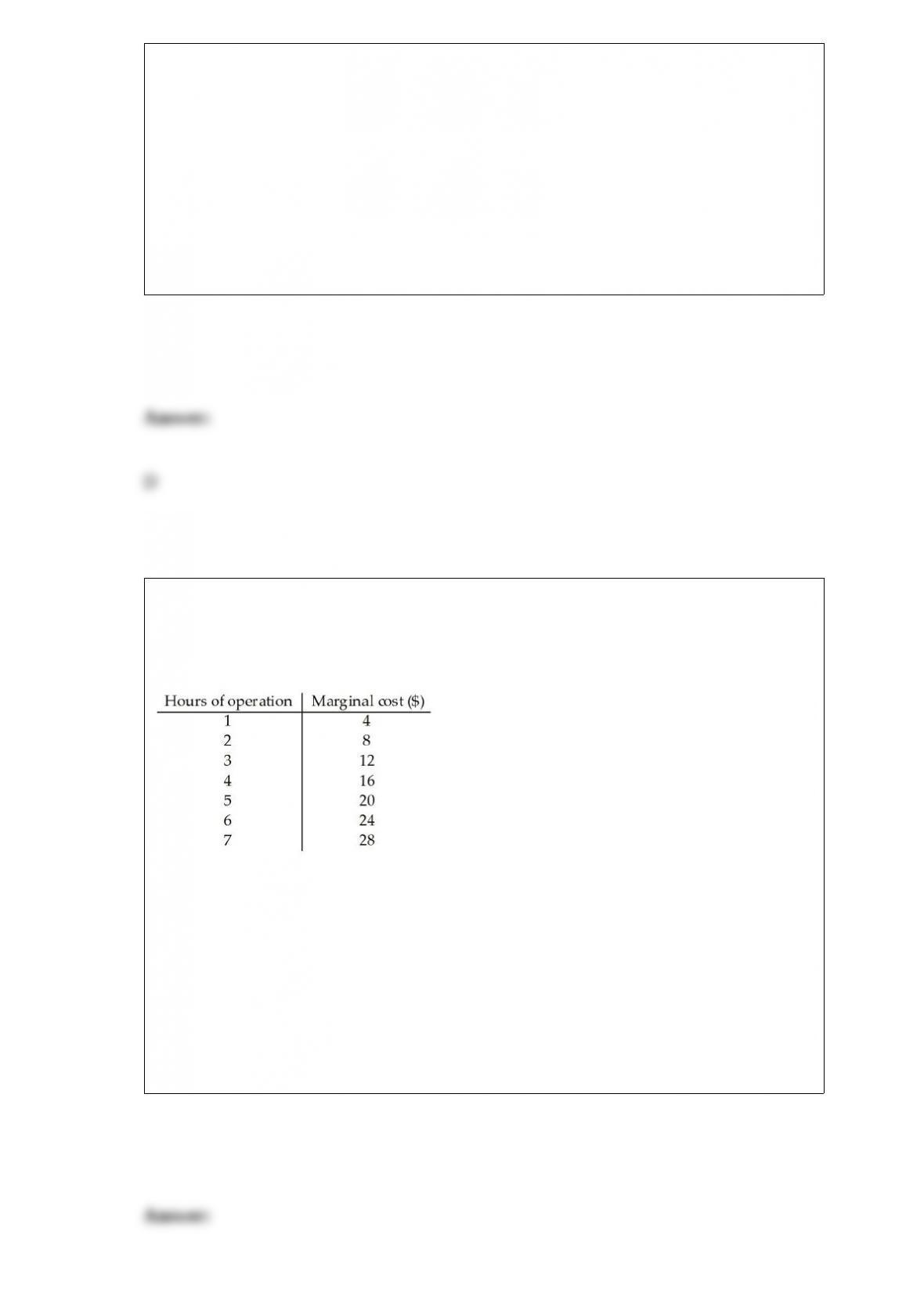
Julianne runs a business and needs to decide how many hours to stay open. Table 2.2
illustrates her marginal costs of staying open for each additional hour. Suppose that we
observe Julianne staying open 5 hours per day. If she is following the marginal
principle, what must her marginal benefit be?
Table 2.2
A) $10
B) $16
C) $20
D) $24
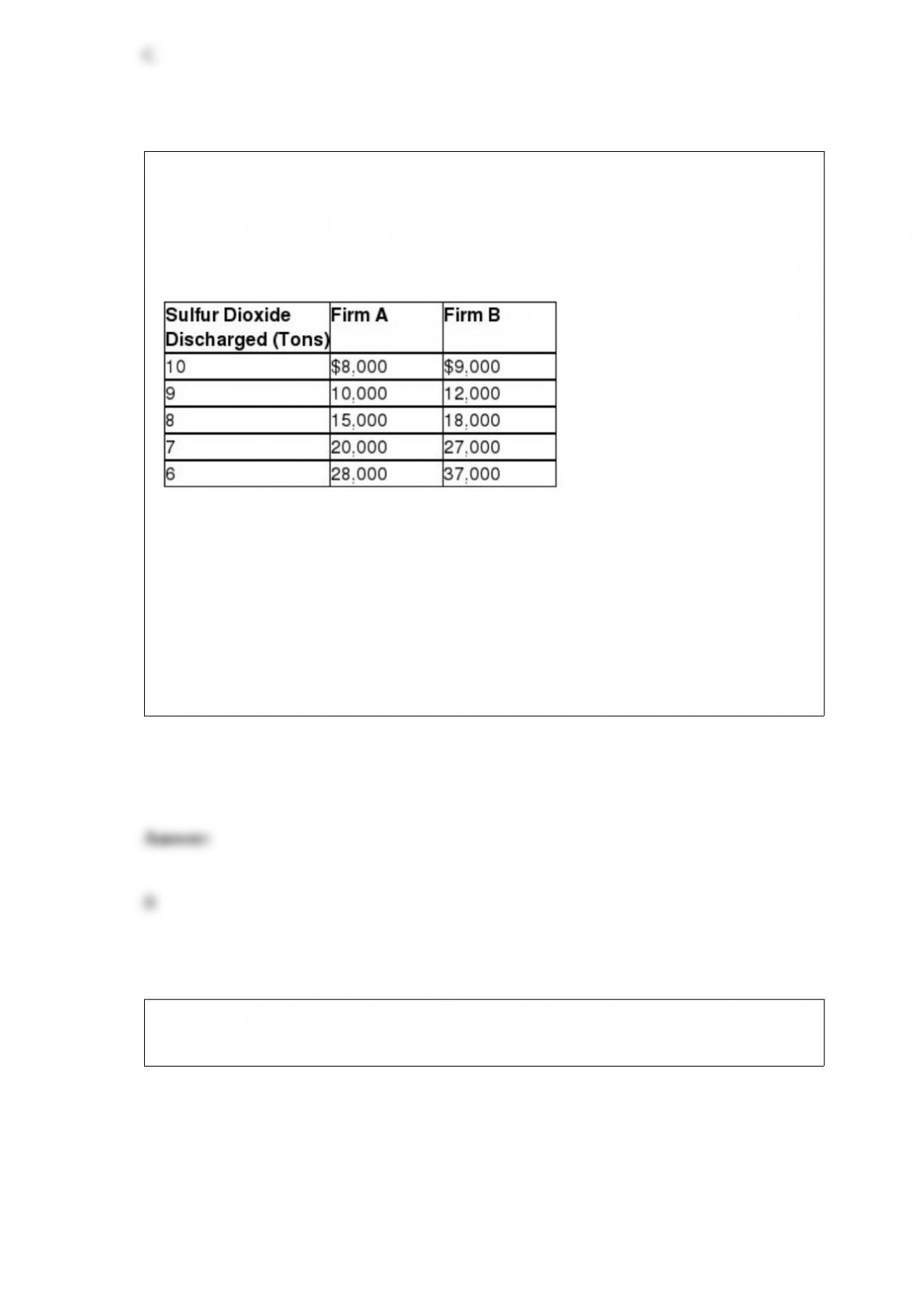
Table 16.3 shows the production cost for two utilities at different levels of sulfur
dioxide emissions. Assume that the government issued 8 marketable pollution permits
to each firm and that Firm A has sold one permit to Firm B. If Firm B wants to purchase
a second permit to be able to discharge 10 tons of sulfur dioxide, what is Firm B’s
willingness to pay?
Table 16.3
A) $2,000
B) $3,000
C) $5,000
D) $9,000
Figure 4.4 illustrates the demand for guitars. An increase in the demand for guitars is
represented by the movement from:
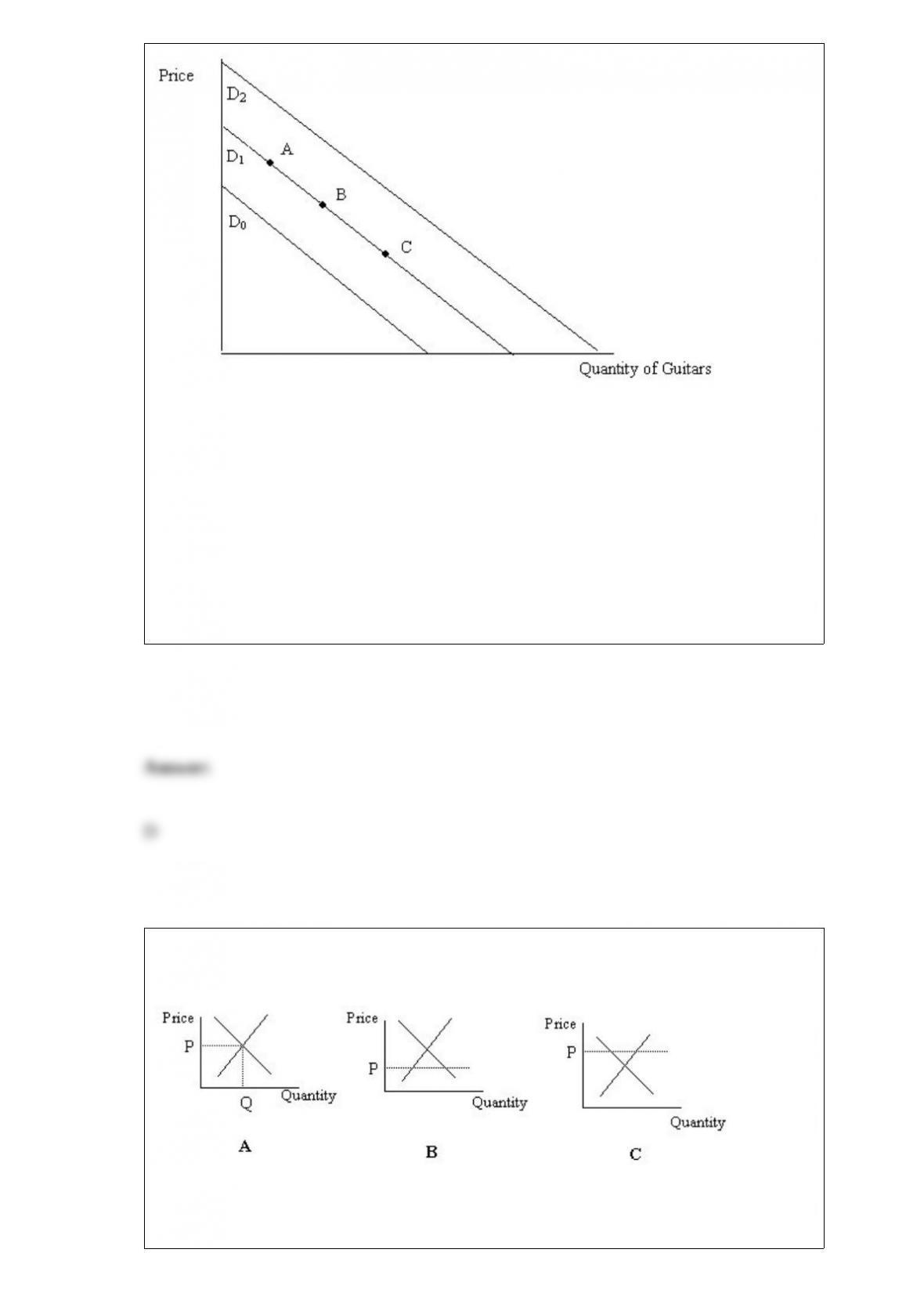
Figure 4.4
A) point B to point C.
B) point B to point A.
C) D1 to D0.
D) D1 to D2.
In Figure 4.2, which of the panels depicts a market in which there is an excess supply of
a product?
Figure 4.2

A) Panel A
B) Panel B
C) Panel C
D) None of the panels depicts a market in which there is an excess supply of a product.
The Act that extended antitrust legislation to proprietorships and partnerships was the:
A) Sherman Act.
B) Hart-Scott-Rodino Act.
C) Robinson-Patman Act.
D) Celler-Kefauver Act.
Which of the following firms have no market power?
A) clothing companies
B) fast food chains such as McDonald’s
C) theme parks
D) gold panners during the gold rush
The Hart-Scott-Rodino Act:
A) created the Federal Trade Commission.
B) was passed by Congress in 1914.
C) extended antitrust legislation to proprietorships and partnerships.
D) outlawed price discrimination.
A firm that has market power has the ability:
A) to affect the price of its own product.
B) to conduct illegal activities without fear of prosecution.
C) to command consumer to buy any quantity from them.
D) to drive its competition out of the market.

When you voluntarily accept a job and exchange your labor for money:
A) you and your employer expect to be better off.
B) you and your employer expect to be worse off.
C) you expect to be better off while your employer expect to be worse off.
D) you expect to be worse off while your employer expect to be better off.
Public goods are:
A) rival in consumption and their benefits are excludable.
B) nonrival in consumption and their benefits are excludable.
C) nonrival in consumption and their benefits are nonexcludable.
D) rival in consumption and their benefits are nonexcludable.
If at a price of $1000, 8 different laptop manufacturers are willing to sell 20 laptops
each. If the 8 manufacturers are the only sellers of laptops in the market, then at a price
of $1000, there are ________ laptops supplied in the market.
A) 160
B) 8
C) 20
D) 820
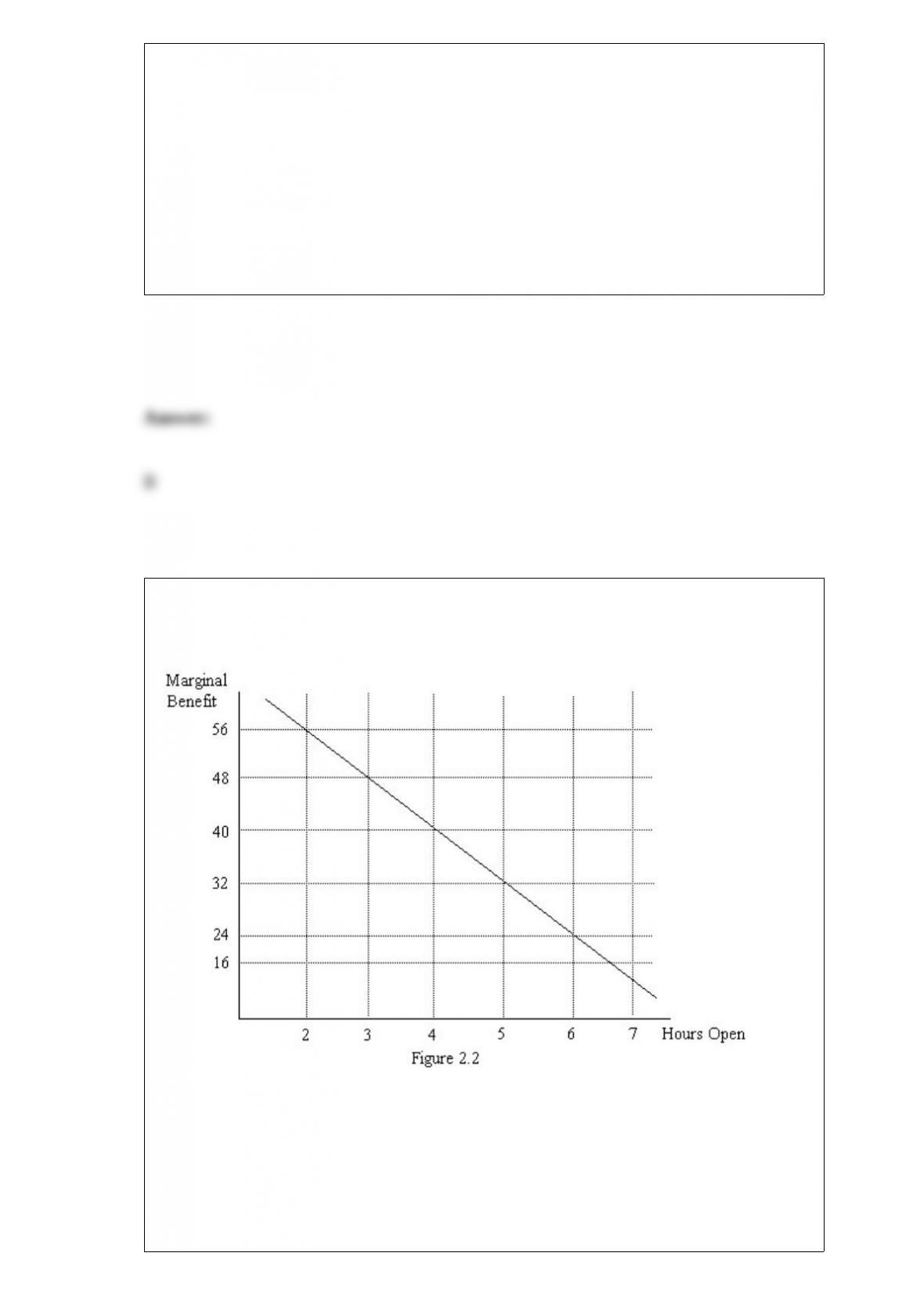
Refer to Table 10.1, which shows the relationship between the price that Gladys charges
for a product and the quantity of that product that Gladys sells. Gladys’ marginal
revenue becomes negative starting with the production of which unit?
Table 10.1
A) 2
B) 4
C) 6
D) None of the above; marginal revenue is always positive or zero.
The idea that the demand for autoworkers stems from the demand for automobiles is
known as:
A) the value of the marginal product of autoworkers.
B) derived demand.
C) indirect demand.
D) output demand.
Joe runs a business and needs to decide how many hours to stay open. Figure 2.2
illustrates his marginal benefit of staying open for each additional hour.
Suppose that Joe’s marginal cost of staying open per hour is $32. How many hours
should Joe stay open?
A) 4 hours
B) 5 hours

C) 6 hours
D) 7 hours
Which of the following trade agreements, which took effect in 1994 and was
implemented over a 15-year period, eliminates all tariffs and other trade barriers
between its members?
A) North American Free Trade Agreement
B) World Trade Organization
C) Asian Pacific Economic Cooperation
D) GATT
Recall the Application about the manufacture of fake killer whales used to scare
sea lions off the Washington coast to answer the following question(s).
Recall the Application. If a fake killer whale to be used to scare sea lions away from
steelhead and other threatened and commercially valuable species cost $11,000 for the
mold and $5,000 for materials for each fake killer whale made, then the average or unit
cost of producing five fake killer whales would be:
A) $5,000.
B) $7,200.
C) $11,000.
D) $16,000.
Which of the following products has the most elastic demand?
A) Ben and Jerry’s Chunky Monkey ice cream in the pint container
B) all Ben and Jerry’s ice cream
C) all premium ice cream
D) all ice cream
Which of the following is an example of economies of scale?
A) As the computer industry has expanded, the number of professionally trained
computer programmers has also increased, which has caused the salaries of computer
programmers to increase.
B) To attract firms to locate in its state, the state government reduced the tax rate that
businesses must pay on its profits, thus lowering the costs to firms who locate in the
state.

C) A firm increases in size and is therefore able to lower its health insurance costs
because as the size of the group insured increases, the premium per person decreases
substantially.
D) As the demand for calculators increased, the price of calculators actually fell.
All of the following are considered natural resources EXCEPT:
A) a coral reef.
B) gold.
C) labor.
D) a redwood forest.
If the price a firm charges in a perfectly competitive industry is less than average total
cost:
A) the firm is earning positive economic profit.
B) the firm is earning zero economic profit.
C) the firm is earning negative economic profit.
D) it is not possible to determine anything about profits.

A consumer’s budget set:
A) is the set of all affordable combinations of two goods.
B) includes only combinations of two goods that leave the consumer with leftover
money.
C) includes only combinations of two goods that exhaust the budget.
D) Both A and C are correct answers.
If two firms have different abatement costs, in a system of marketable pollution
permits:
A) the firm with lower abatement costs will sell permits to the firm with higher
abatement costs.
B) the firm with lower abatement costs will purchase permits from the firm with higher
abatement costs.
C) no voluntary exchange that makes both firms better off is possible.
D) voluntary exchange will occur, but it is impossible to determine which firm will be
the seller and which will be the purchaser.

Utility can be thought of as the same as:
A) opportunity cost.
B) satisfaction.
C) choice.
D) none of the above.
The Clayton Act of 1914:
A) prohibited selling products at “unreasonably low prices” with the intent of reducing
competition.
B) made it illegal to monopolize a market.
C) repealed the Sherman Act.
D) outlawed price discrimination for the purpose of reducing competition.
Which of the following is a TRUE statement?
A) If demand is inelastic and the price increases, the total revenue will decrease.
B) If demand is inelastic and the price increases, the total revenue will increase.
C) If demand is elastic and the price increases, the total revenue will increase.
D) If demand is elastic and the price decreases, the quantity demanded will decrease.
Quality information for goods that are sold online:
A) is available from ratings given by other buyers.
B) is of no value because anyone can write anything on the Internet.
C) is unavailable because online sellers cannot be identified with certainty.
D) is ineffective at reducing asymmetric information problems.
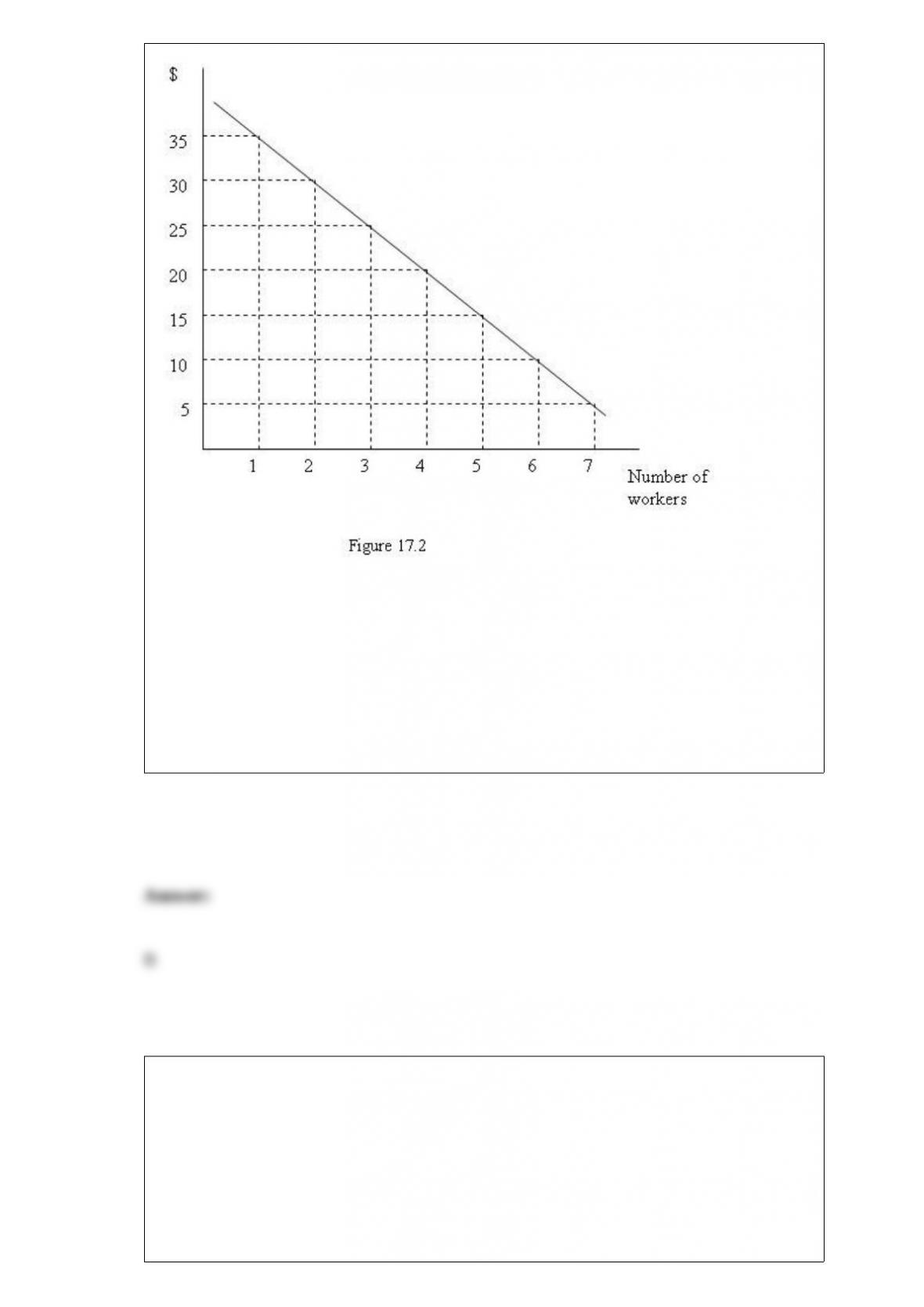
Figure 17.2 depicts a firm’s marginal revenue product curve. Suppose that we observe
the firm demanding five workers. If the firm is maximizing its profit, the wage rate
must be between ________ and ________.
A) $5; $10
B) $10; $15
C) $15; $20
D) $25; $30
If a computer company will sell a laptop only if the price is $400 or higher, then $400 is
known as:
A) the minimum supply price.
B) the input cost price.
C) the minimum production cost.
D) the minimum average cost.
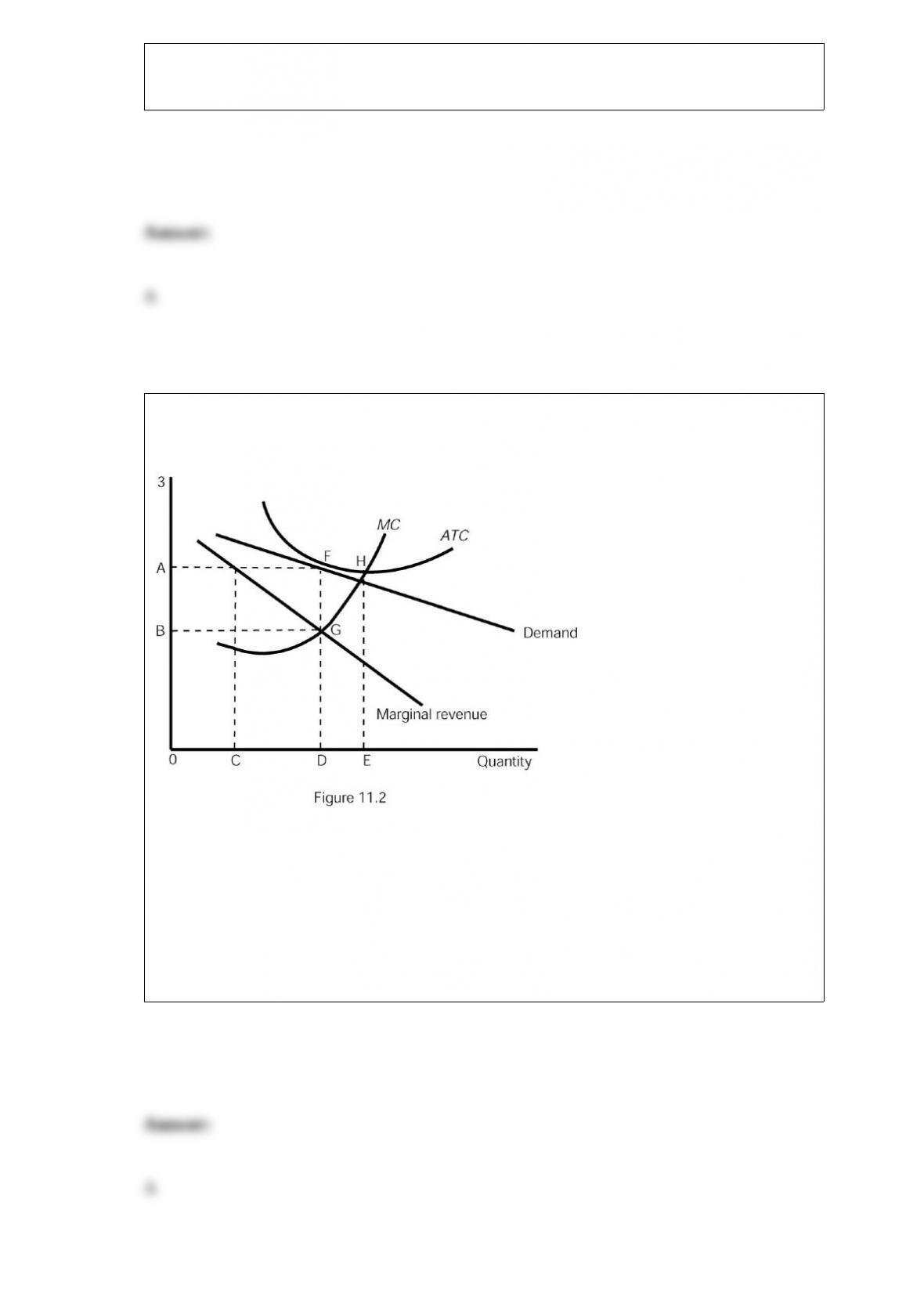
Refer to Figure 11.2. In the long run the monopolistic competitor would charge a price
of ________ per unit.
A) 0A
B) 0B
C) 0F
D) BA
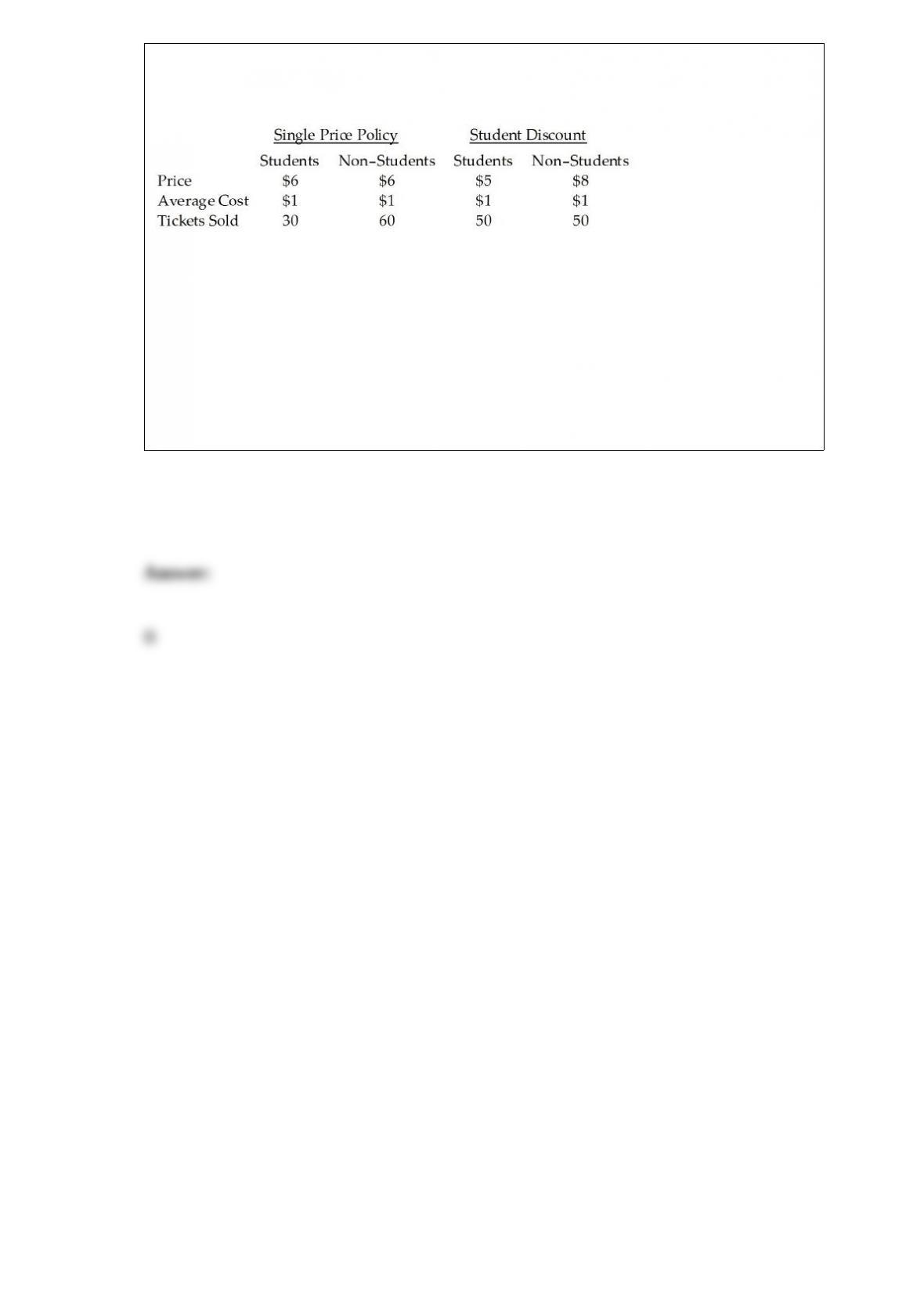
Table 10.2 contains price, demand, and cost data for the Capri Theater, the only first-run
movie theater in a small town. What is its revenue from non-students under the single
price policy?
Table 10.2
A) $300
B) $360
C) $450
D) $540