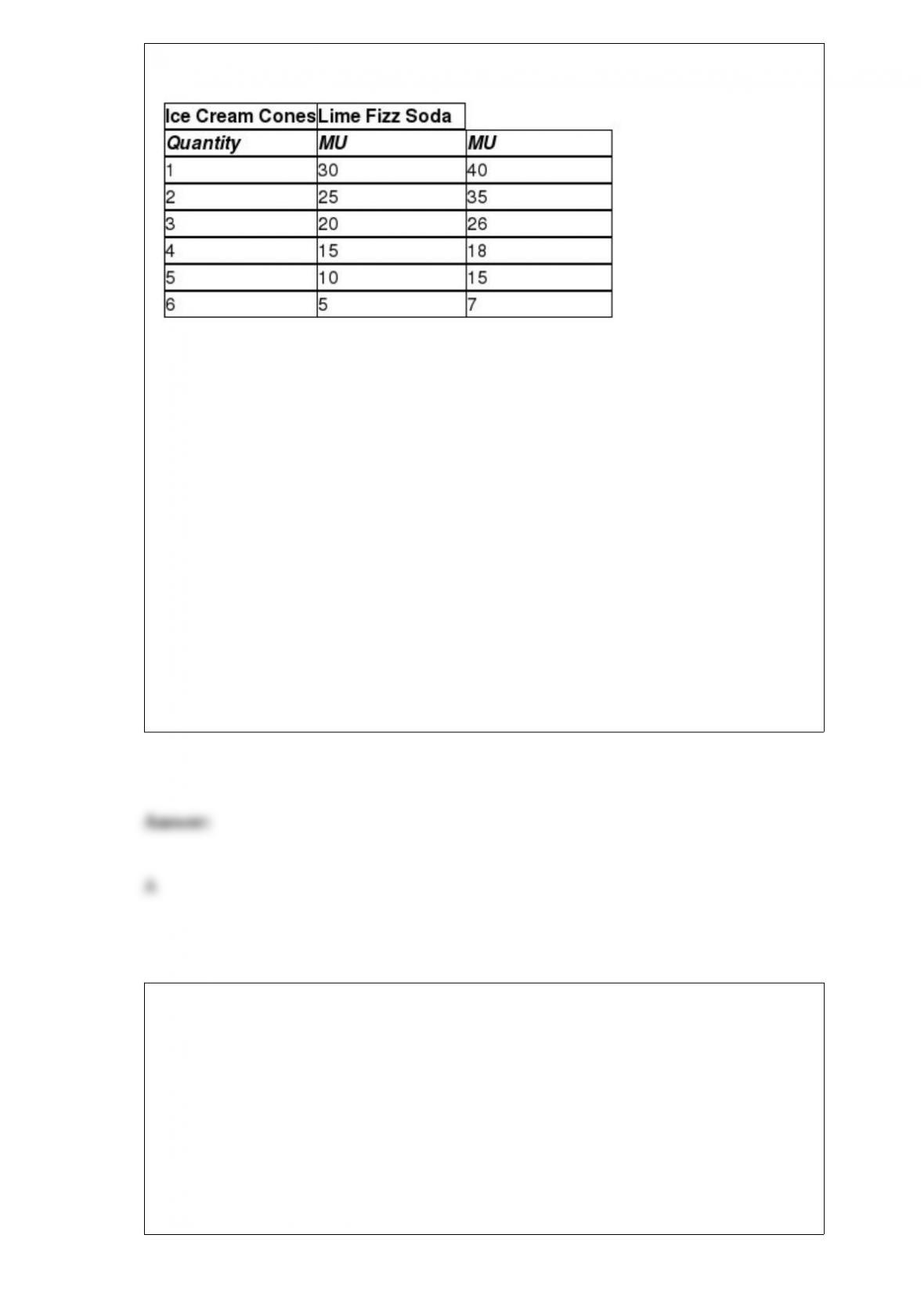
Table 10-3
The table above shows Lee’s marginal utility per dollar from consuming ice cream
cones and cans of Lime Fizz Soda. The price of an ice cream cone is $2 and the price of
Lime Fizz Soda is $1. Use this information to select the correct statement.
A) We cannot determine how many ice cream cones and cans of Lime Fizz Soda Lee
will consume without knowing what his income is.
B) To maximize his utility, Lee should consume 1 ice cream cone and 5 cans of Lime
Fizz Soda.
C) We cannot determine how many ice cream cones and cans of Lime Fizz Soda will
maximize Lee’s utility because we are given only the marginal utility per dollar values.
We also need to know the marginal utility for each quantity.
D) If Lee has an unlimited budget, he will maximize his utility by buying only Lime
Fizz Soda.
Since 1900, real GDP per capita has ________ and this measure ________ the actual
growth in standards of living in the United States over this time.
A) increased; understates
B) increased; overstates
C) decreased; understates
D) decreased; overstates

Based on the following information, what is the balance on the current account?
Exports of goods and services = $5 billion
Imports of goods and services= $3 billion
Net income on investments = -$2 billion
Net transfers = -$2 billion
Increase in foreign holdings of assets in the United States = $4 billion
Increase in U.S. holdings of assets in foreign countries = -$1 billion A) -$2 billion
B) $1 billion
C) $3 billion
D) $4 billion
If production displays diseconomies of scale, the long run average cost curve is
A) above the short run average total cost curve.
B) above the long run marginal cost curve.
C) upward sloping.
D) downward sloping.
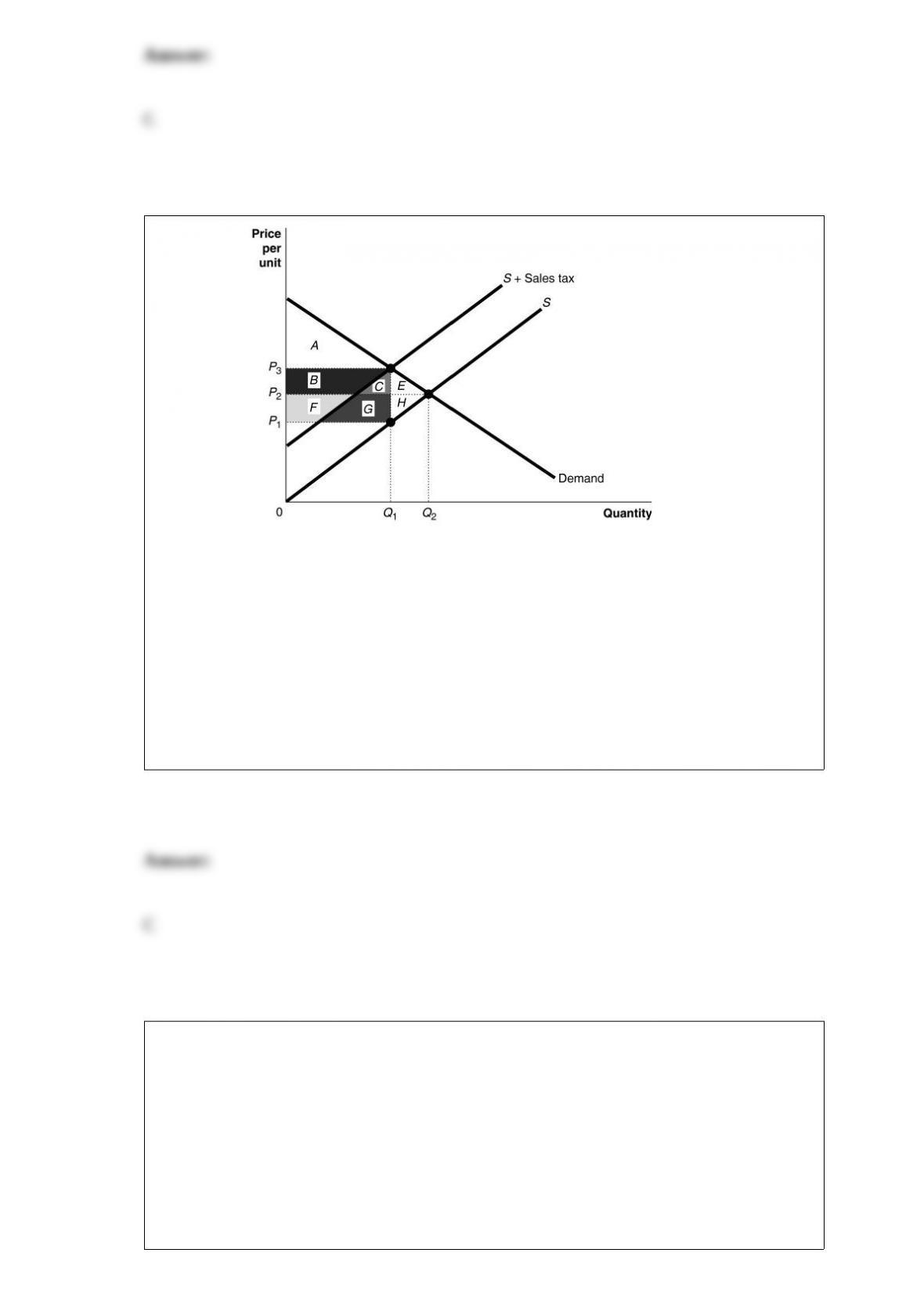
Figure 18-1
Area E + H represents
A) the portion of sales tax revenue borne by consumers.
B) the portion of sales tax revenue borne by producers.
C) the excess burden of the sales tax.
D) sales tax revenue collected by the government.
When demand is unit-elastic, a change in price causes total revenue to stay the same
because
A) the percentage change in quantity demanded exactly offsets the percentage change in
price.
B) buyers are buying the same quantity.
C) total revenue never changes with price changes.
D) the change in profit is offset by the change in production cost.
As was demonstrated in 2007, firms in the shadow banking system
A) were very vulnerable to bank runs.
B) were protected from financial ruin by federal deposit insurance.
C) were well insulated from bank runs.
D) were more insulated from the financial crisis than were commercial banks.
Knowledge capital is nonrival in the sense that
A) two people can use the same knowledge to develop and produce a product.
B) firms do not compete to be the first to develop new technologies.
C) no single company can be excluded from the benefits of new technologies.
D) firms can benefit from the research and development of rival firms without paying
for that benefit.
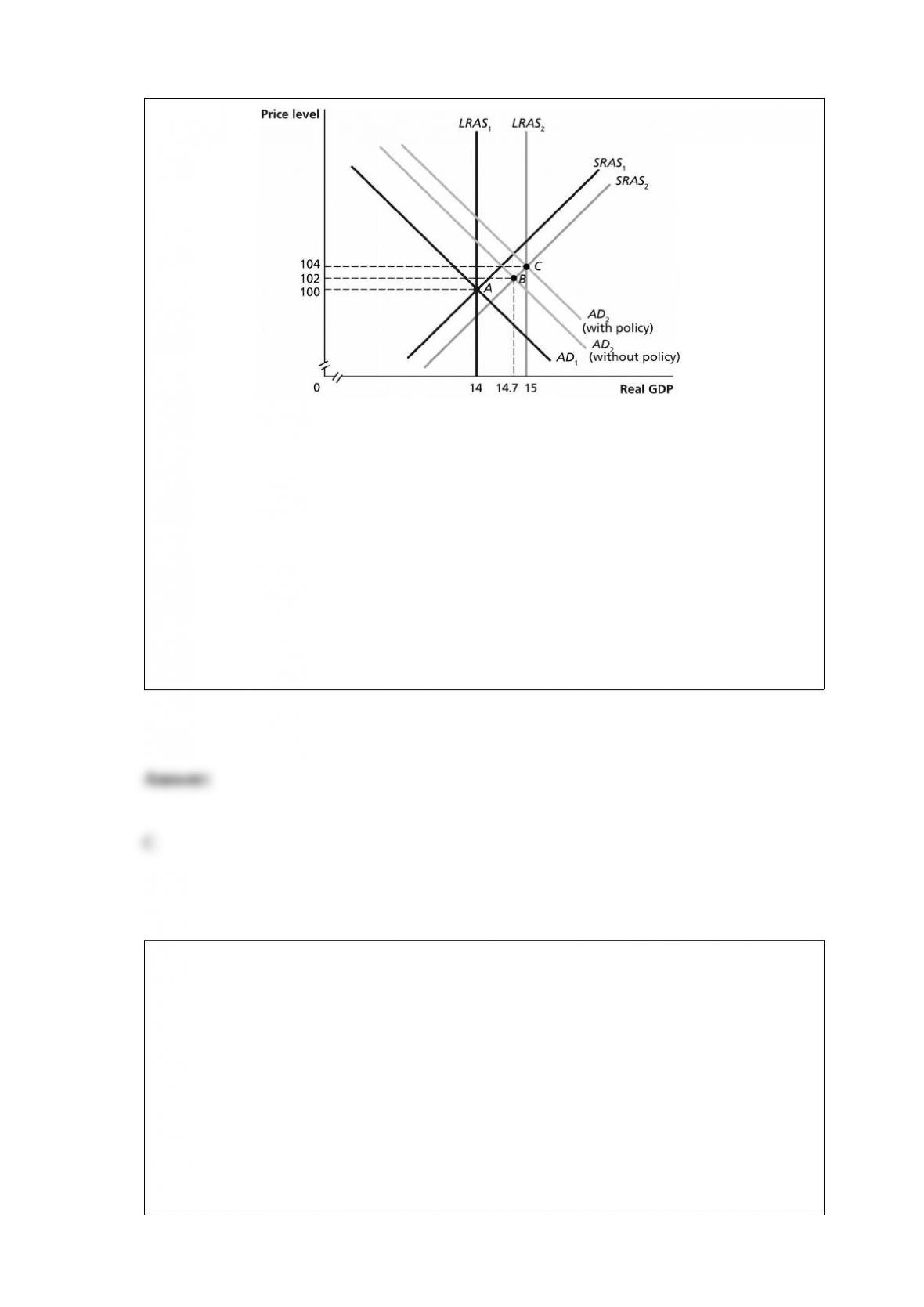
Figure 26-15
In the figure above, suppose the economy in Year 1 is at point A and expected in Year 2
to be at point B. Which of the following policies could the Federal Reserve use to move
the economy to point C?
A) decrease income taxes
B) increase the required-reserve ratio
C) buy Treasury bills
D) sell Treasury bills
Tanesha sells homemade candles over the Internet. Her annual revenue is $64,000 per
year, the explicit costs of her business are $17,000, and the opportunity costs of her
business are $22,000. What are the implicit costs of her business?
A) $17,000
B) $22,000
C) $39,000
D) $47,000

Technological advances generally result in
A) decreased incomes.
B) increased life expectancy.
C) increased infant mortality rates.
D) increased average number of hours worked per day.
Jake sells Star Wars memorabilia on eBay. His annual revenue is $42,000 per year, the
explicit costs of his business are $10,000, and the opportunity costs of his business are
$18,000 per year. What are the implicit costs of his business?
A) $8,000
B) $18,000
C) $24,000
D) $32,000

Mark Frost grows apples in a perfectly competitive market. If we drew a line in a graph
that illustrates Mark’s total revenue from selling apples, it would be
A) a straight, upward-sloping line.
B) a horizontal line.
C) a straight, downward-sloping line.
D) a curve that is negatively sloped at low levels of output and positively sloped at
higher levels of output.