
At the quantity of output for which total revenue equals total cost,
a. economic profit is zero.
b. cost is minimized.
c. cost is maximized.
d. quantity is minimized.
e. profit is maximized.
The Sherman Act of 1890
a. made conspiracy in the restraint of trade illegal.
b. made price discrimination, exclusive dealing, tying contracts, and the acquisition of
competing companies’ stock illegal when they ‘substantially lessen competition or tend
to create a monopoly.”
c. declared “unfair methods of competition in commerce” illegal.
d. attempted to decrease the failure rate of small businesses by protecting them from the
competition of large and growing chain stores.
e. banned anticompetitive mergers that occurred as a result of one company acquiring
the physical assets of another company.
Exhibit 3-15
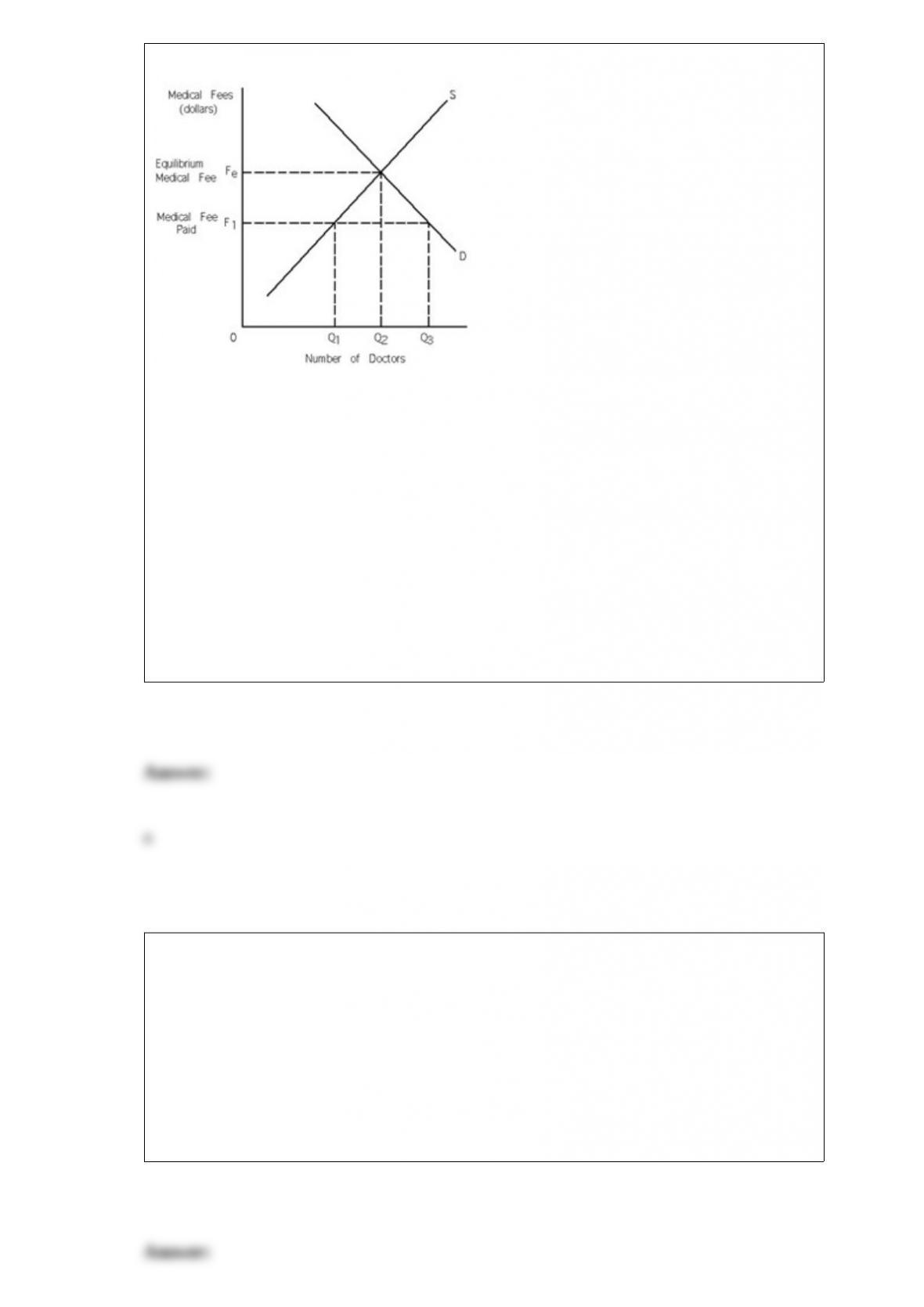
In Exhibit 3-15,
a. there is a shortage of doctors at fee F1.
b. there is a surplus of doctors at fee F1.
c. Q3 doctors are employed at fee F1.
d. Q2 doctors are employed at fee F1.
e. both a and c
Economists believe that people’s wants are
a. finite.
b. infinite.
c. irrational.
d. unimportant because needs are more important than wants.

Which of the following statements is false?
a. The value marginal product is a measure of the value that each factor unit adds to the
firm’s product.
b. For a monopolist, value marginal product equals marginal revenue product.
c. A change in the price of the product labor produces or a change in the marginal
physical product of labor (reflect in a shift in the MPP curve) will shift the demand
curve for labor.
d. For a perfectly competitive firm, value marginal product equals marginal revenue
product.
Some years ago, chemists at 3M Corporation were trying to create a super-strong glue.
Somehow they got their molecules twisted and came up with one of the weakest glues
ever made. But, rather than pouring it down the drain, they tried coating some paper
with it, and the “Post-It Note” was born. In this case, 3M was acting asa(n)
a. utility.
b. rationer.
c. entrepreneur.
d. abstraction.

If the price of good A decreases by 10 percent and the quantity demanded of good B
increases by 10 percent, this is evidence that goods A and B are
a. substitute for one another.
b. complement goods to one another.
c. both inferior goods.
d. both normal goods.
e. not related.
The coordinates of point A are 30 units of X and 70 units of Y. The coordinates of point
B are 28 units of X and 76 units of Y. With X on the horizontal axis and Y on the
vertical axis, the slope of the line between points A and B is
a. + 3.00
b. + 0.67
c. + 0.33
d. – 3.00
e. – 0.33
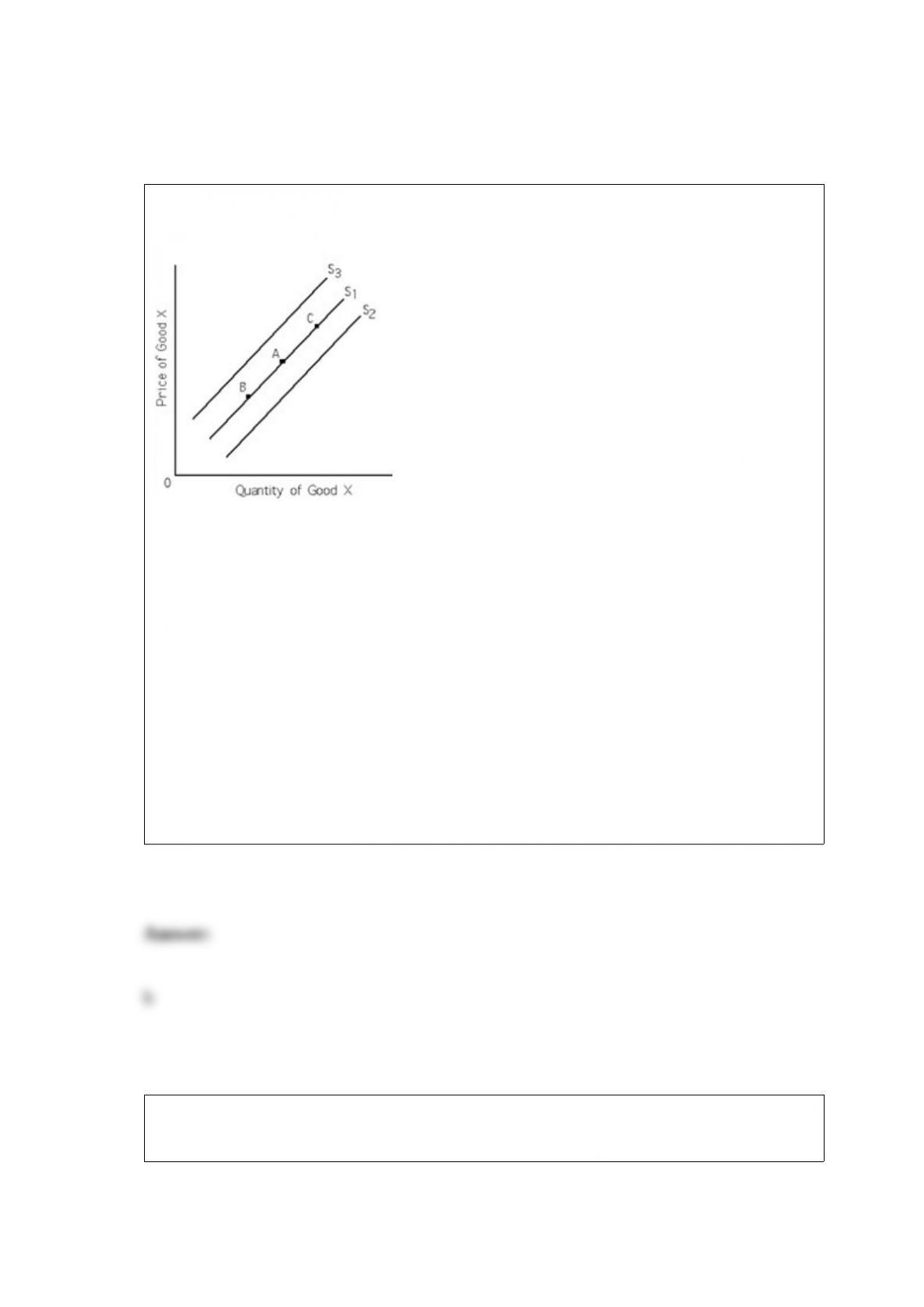
Exhibit 3-7
If S1 is the relevant supply curve, a decline in technology in theproduction of good X
causes
a. the supply of good X to shift from S1 to S2
b. the supply of good X to shift from S1 to S3.
c. a movement along S1 perhaps from point A to point B.
d. a movement along S1 perhaps from point A to point C.
e. no change in the supply of good X.
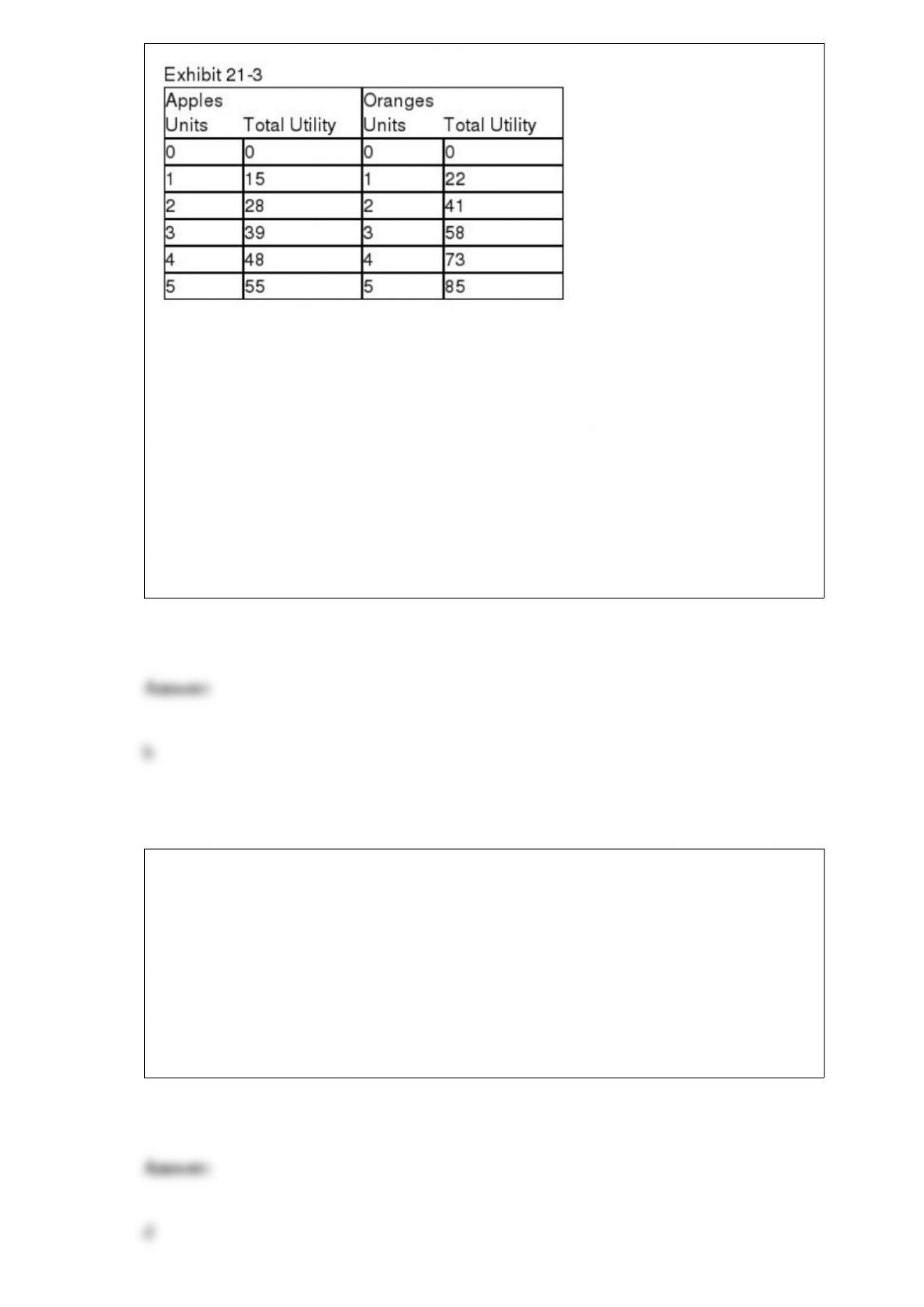
Assume that the price of oranges increases to $2, while the price of apples remains at
$1, and Linda allocates $5 of the weekly food budget to purchasing apples and oranges.
If Linda wants to maximize her utility, her new consumption bundle will consist of
a. 1 apple and 2 oranges.
b. 3 apples and 1 orange.
c. 5 apples and no oranges.
d. none of the above
Perfectly competitive firms are price takers for all of the following reasons except that
a. each firm is quite small relative to the total market supply.
b. buyers and sellers have all the necessary information about prices, etc.
c. the product is homogeneous.
d. barriers to exit force firms to sell at the market price.

In a college course it is likely that there will be ___________ shirking in a group
project than in an individual project because the costs of shirking are relatively
_________ in the group project.
a. less; higher
b. more; higher
c. less; lower
d. more; lower
When the price of Toyota Corollas rises, ceteris paribus, the demand for Corollas falls.
a. True
b. False
According to public choice theory, low voter turnouts are the result of voters
a. being apathetic.
b. being uninformed.
c. being lazy.
d. disliking the candidates.

e. calculating their costs and benefits of voting.
The answer is: “When the official price of a currency is lowered.” What is the question?
a. What is overvaluation?
b. What is revaluation?
c. What is appreciation?
d. What is depreciation?
e. none of the above