
1) Development assistance as a percentage of GDP is greatest for which of the
following industrialized nations (as of 2007)?
A.U.S.
B.Norway
C.Canada
D.Netherlands
2) Currently farm employment is about:
A.15.8 percent of total employment.
B.9.4 percent of total employment.
C.1.3 percent of total employment.
D.5.0 percent of total employment.
3) Discretionary fiscal policy is so named because it:
A.is undertaken at the option of the nation’s central bank.
B.occurs automatically as the nation’s level of GDP changes.
C.involves specific changes in T and G undertaken expressly for stabilization at the
option of Congress.
D.is invoked secretly by the Council of Economic Advisers.
4) the mr = mc rule applies:
a.in the short run, but not in the long run.
b.in the long run, but not in the short run.
c.in both the short run and the long run.
d.only to a purely competitive firm.
5) for many years the price of medical care in the united states has:
a.risen at the same rate as the overall price level.
b.risen at a faster rate than the overall price level.
c.risen, but at a slower rate than the overall price level.
d.fallen.
6) diseconomies of scale arise primarily because:
a.the short-run average total cost curve rises when marginal product is increasing.
b.of the difficulties involved in managing and coordinating a large business enterprise.
c.firms must be large both absolutely and relative to the market to employ the most
efficient productive techniques available.
d.beyond some point marginal product declines as additional units of a variable
resource (labor) are added to a fixed resource (capital).
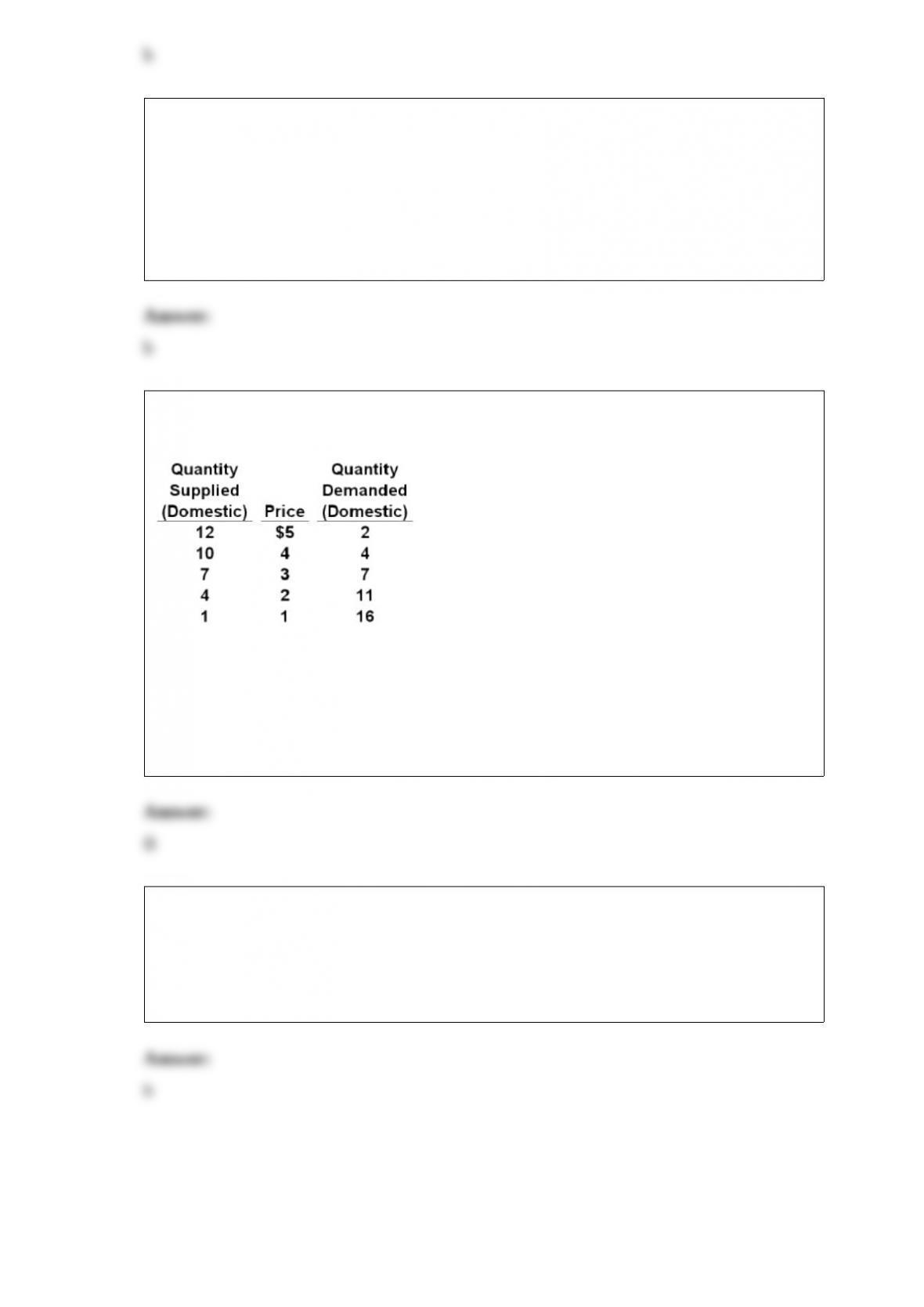
7) The following domestic supply and demand schedules for a product. Suppose that the
world price of the product is $1.
Refer to the above data. If the economy was opened to free trade and the world price of
$1 prevailed, the price and quantity sold of this product would be:
A.$1 and 1 unit.
B.$1 and 16 units.
C.$3 and 7 units.
D.$2 and 11 units.
8) trade flows measure the:
a.movement of resources between nations.
b.exports and imports of goods and services.
c.transfer of information from one nation to another.
d.transfer of money between nations.
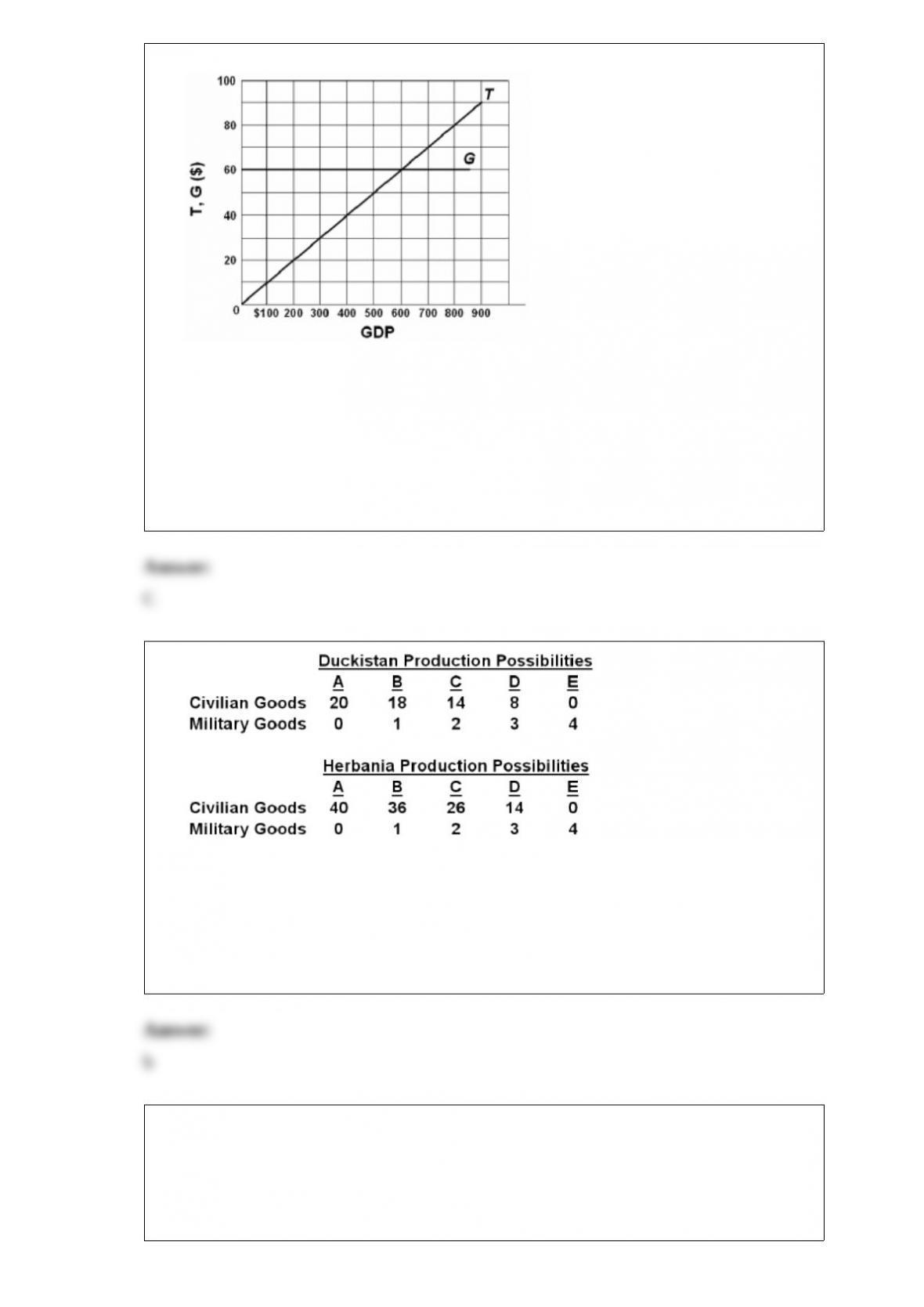
9)
Refer to the above diagram where T is tax revenues and G is government expenditures.
All figures are in billions of dollars. If the full-employment GDP is $400 billion while
the actual GDP is $200 billion, the actual budget deficit is:
A.$200 billion.
B.$20 billion.
C.$40 billion.
D.$60 billion.
10)
refer to the above tables. suppose that technology and the quality of resources are the
same in both countries. we can conclude that:
a.duckistan has more resources than herbania.
b.herbania has more resources than duckistan.
c.duckistan has greater opportunity costs than herbania.
d.prices are twice as high in herbania as in duckistan.
11) suppose that a 10 percent increase in the price of normal good y causes a 20 percent
increase in the quantity demanded of normal good x. the coefficient of cross elasticity
of demand is:
a.negative and therefore these goods are substitutes.
b.negative and therefore these goods are complements.
c.positive and therefore these goods are substitutes.
d.positive and therefore these goods are complements.
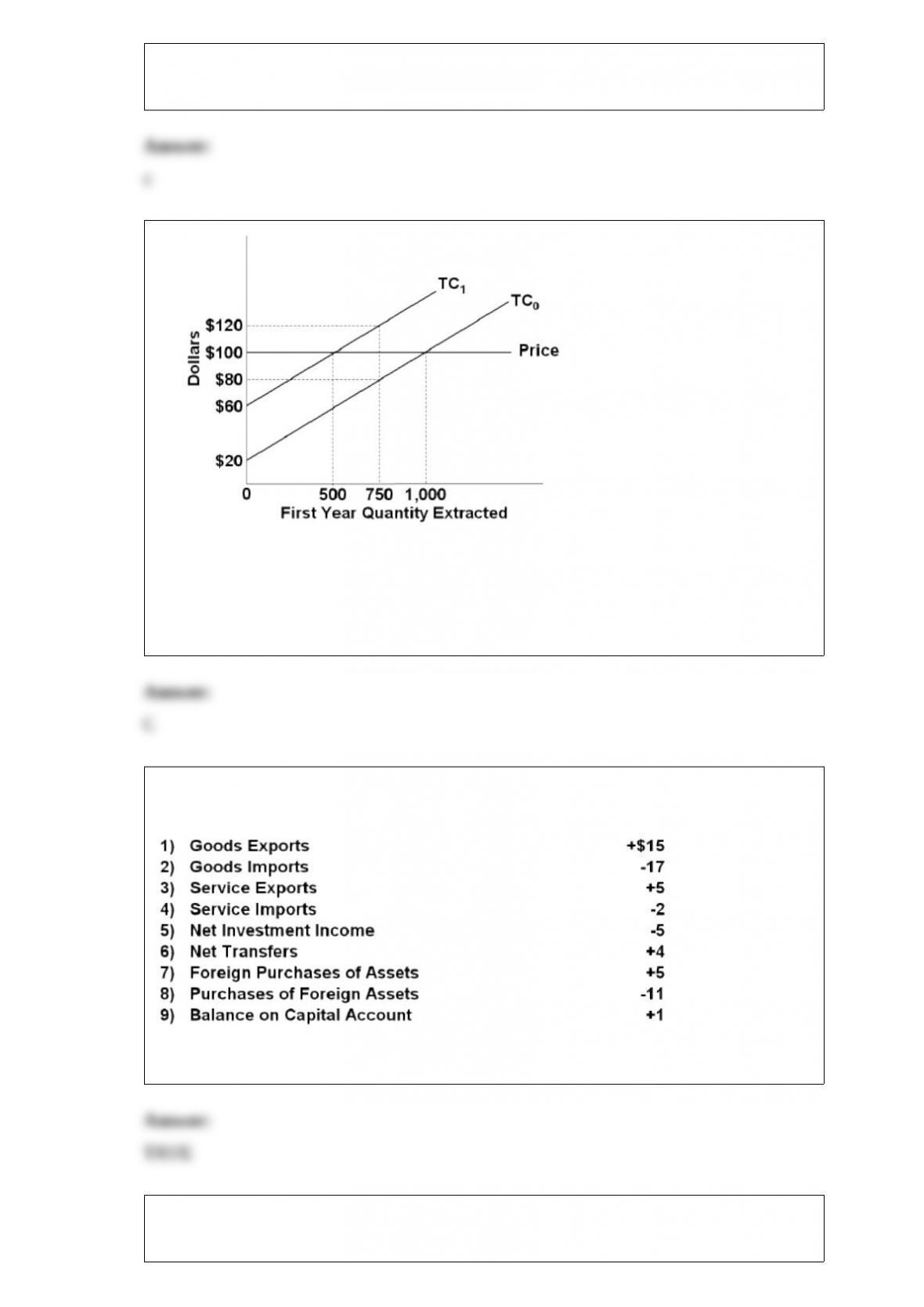
12)
Refer to the diagram above. An increase in extraction costs could be shown by:
A.An increase in the first year quantity extracted.
B.A shift from TC1 to TC0.
C.A shift from TC0 to TC1.
D.An upward shift of the price line.
13) The following 2008 balance of payments statement for Transylvania. All figures are
in billions of dollars.
Refer to the above data. In 2008 Transylvania realized a $1 billion surplus on goods and
services.
14) which of the following is not seen by economists as an underlying cause of business
cycle fluctuations?
a.unexpected financial bubbles that eventually burst.
b.shocks to the money supply by the nation’s central bank.
c.supply shocks caused by major innovations.
d.all of the above are identified as causes of business cycle changes.
15) if a purely competitive firm is producing at the p = mc output and realizing an
economic profit, at that output:
a.marginal revenue is less than price.
b.marginal revenue exceeds atc.
c.atc is being minimized.
d.total revenue equals total cost.
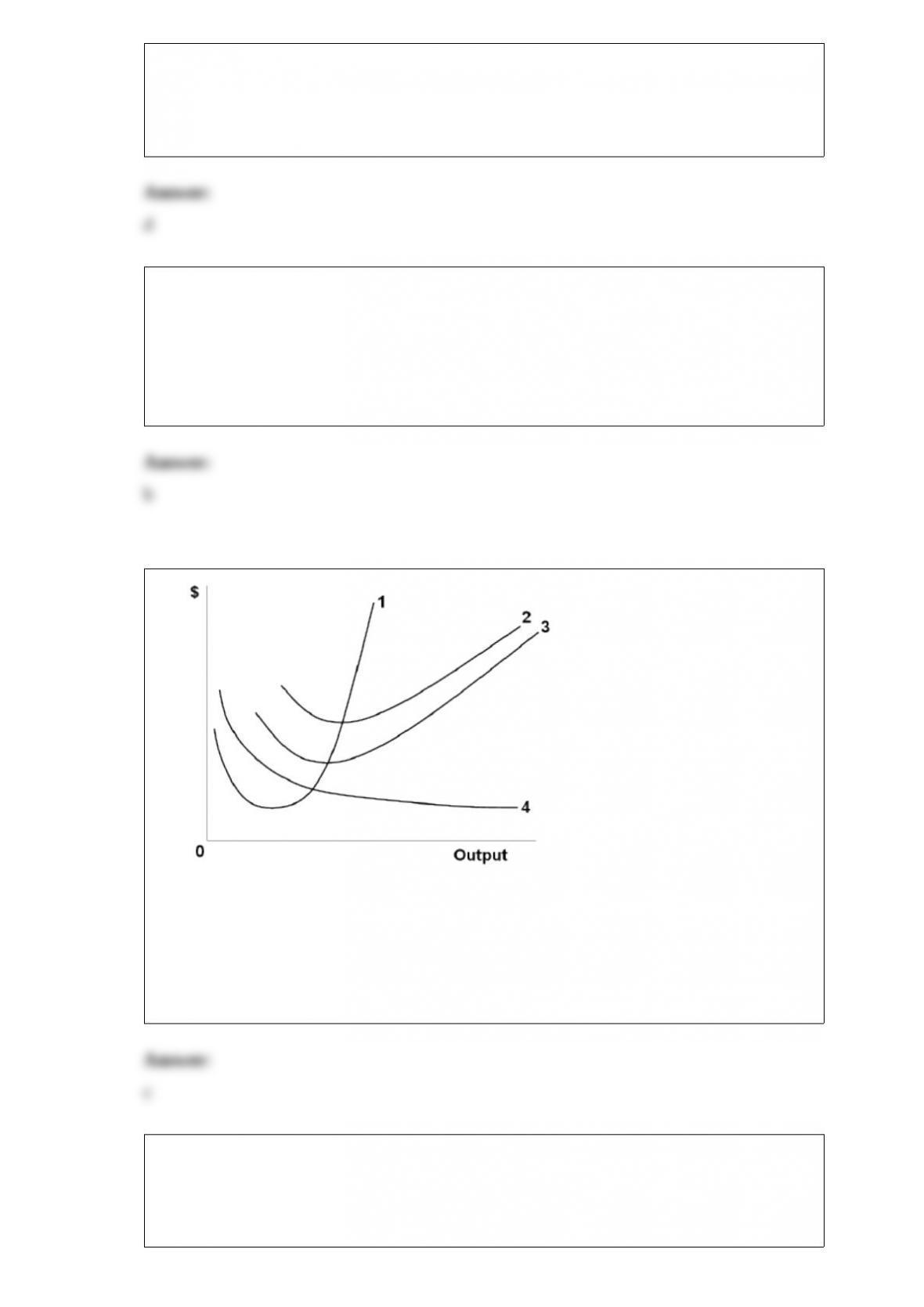
16)
in the above figure, curves 1, 2, 3, and 4 represent the:
a.atc, mc, afc, and avc curves respectively.
b.mc, afc, avc, and atc curves respectively.
c.mc, atc, avc, and afc curves respectively.
d.atc, avc, afc, and mc curves respectively.
17) nominal gdp is:
a.the sum of all monetary transactions that occur in the economy in a year.
b.the sum of all monetary transactions involving final goods and services that occur in
the economy in a year.

c.the amount of production that occurs when the economy is operating at full
employment.
d.money gdp adjusted for inflation.
18) The lifetime distribution of income is more equal than the annual distribution. This
statement is:
A.true, because the rich have gotten richer and the poor have gotten poorer.
B.true, because there is considerable income mobility over time.
C.false, because people tend to stay in the same income quintile over extended periods
of time.
D.false, because the rich have gotten richer and the poor have gotten poorer.
19) if a purely competitive constant-cost industry is realizing economic profits, we can
expect industry supply to:
a.increase, output to increase, price to decrease, and profits to decrease.
b.increase, output to increase, price to increase, and profits to decrease.
c.decrease, output to decrease, price to increase, and profits to increase.
d.increase, output to decrease, price to decrease, and profits to decrease.
20) Economic profit might result from:
A.easy entry into industries.
B.dynamic change and uncertainty.
C.X-inefficiency.
D.a decline in entrepreneurship.