
Deadweight loss refers to the reduction in economic surplus resulting from a market not
being in competitive equilibrium.
When net exports equal zero, the economy is in macroeconomic equilibrium.
An increase in liabilities will reduce a firm’s net worth.
A monopolist’s demand curve is the same as the marginal revenue curve for the product.

Eliminating structural unemployment would be good for the economy.
The act of buying a product at a low price in one market and reselling the product at a
higher price in another market is called arbitrage.
Foreign portfolio investment in the United States has continually declined since 1995.
Rapid economic growth tends to increase the degree of income mobility.

A profit-maximizing monopoly produces a lower output level than would be produced
if the industry were perfectly competitive.
Residential investment includes spending by firms on office buildings.
A normal good is a good for which the demanded decreases as income decreases,
holding everything else constant.
Investment (I) in the United States may increase with either an increase in national
saving or an increase in net foreign investment.

Health insurance companies impose deductibles on policies and co-payments on claims
to reduce the problem of adverse selection.
In the long run, the Fed may decrease the unemployment rate only if it is willing to
increase the rate of inflation.
The additional cost to a firm of producing one more unit of a good or service is equal to
producer surplus.
Figure 4-4
The figure above represents the market for pecans. Assume that this is a competitive
market. If the price of pecans is $3, what changes in the market would result in an
economically efficient output?
A) The price would increase, the quantity supplied would decrease, and the quantity
demanded would increase.
B) The quantity supplied would increase, the quantity demanded would decrease and
the equilibrium price would increase.
C) The price would increase, the demand would decrease and the supply would
increase.
D) The price would increase, the quantity demanded would decrease and the quantity
supplied would increase.
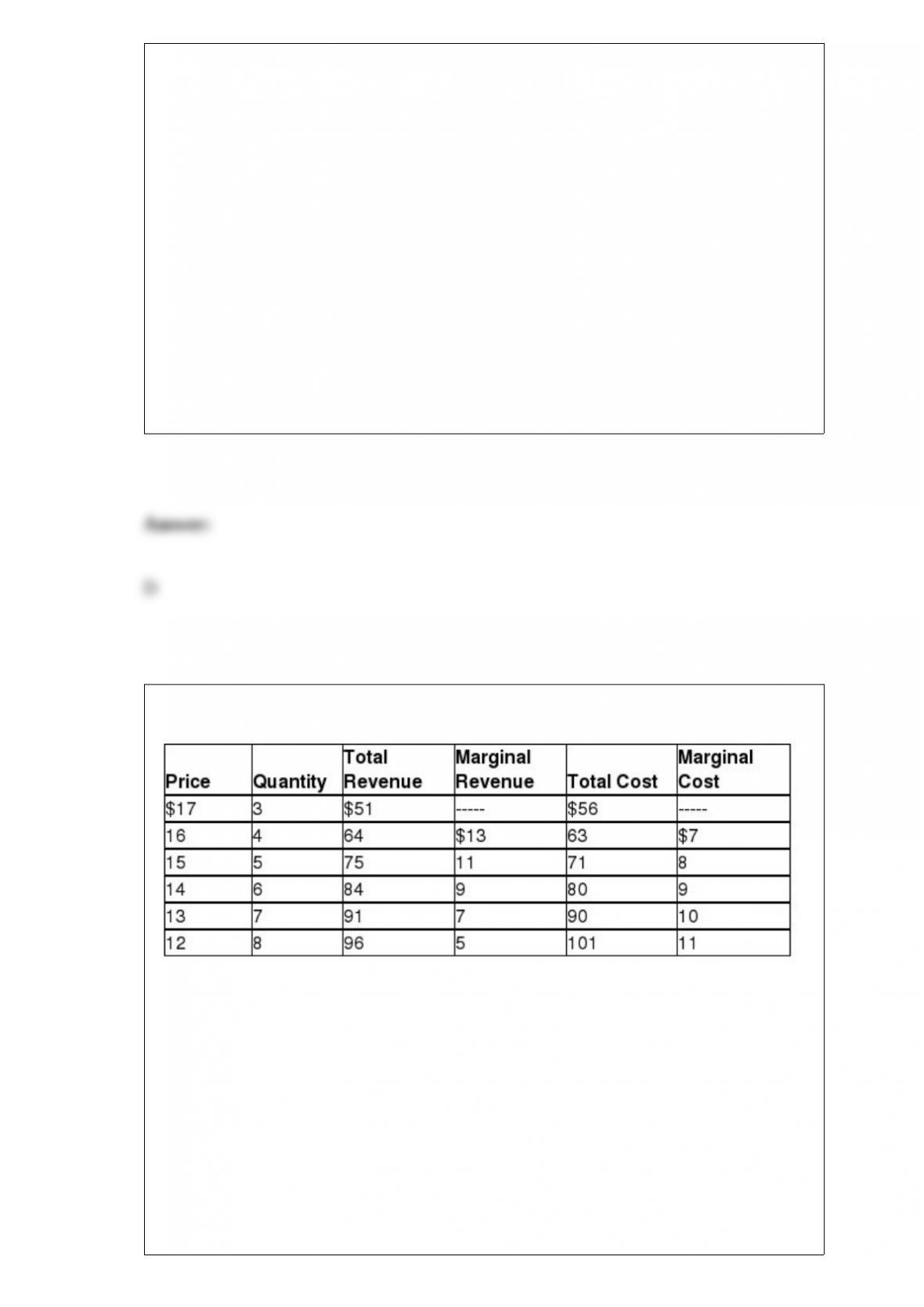
Table 15-3
Assume Table 15-3 gives the monthly demand and costs for subscriptions to basic cable
for Comcast, a cable television monopoly in Philadelphia.
If Comcast wants to maximize its profits, what price (P) should it charge and how many
cable subscriptions per month (Q) should it sell?
A) P = $12; Q = 8
B) P = $14; Q = 6
C) P = $16; Q = 4
D) P = $15: Q = 5
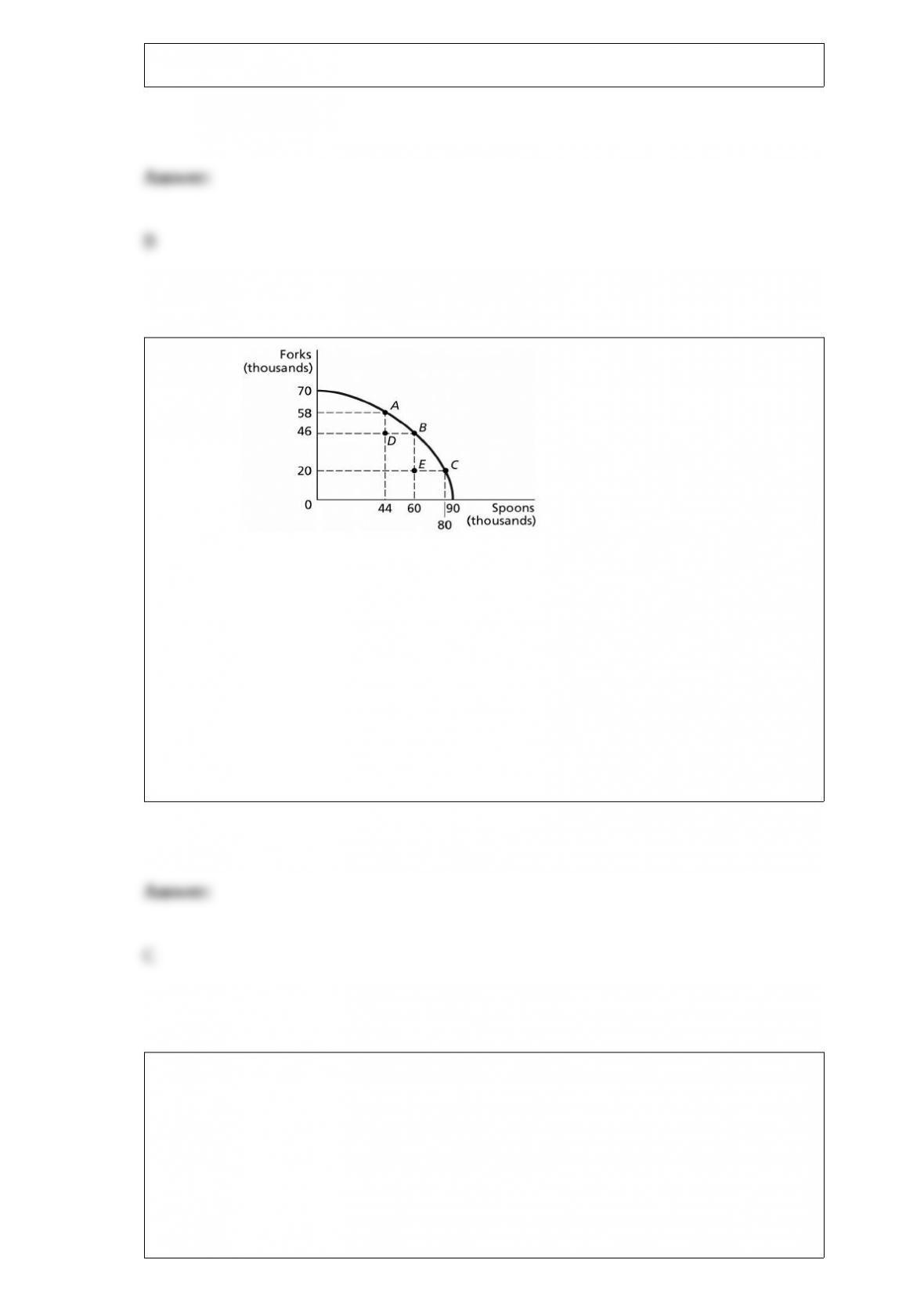
Figure 2-6
If the economy is currently producing at point E, what is the opportunity cost of moving
to point D?
A) 26 thousand forks
B) 20 thousand forks
C) 16 thousand spoons
D) 0 spoons
Which of the following is not an example of a derived demand?
A) Several of the animated films released between 1999 and 2001 failed to earn a
profit, which caused some companies to stop making these films, thereby decreasing
the demand for animators.
B) Seth Bullock, a personal-injury attorney, complains that he is earning far less now
than a few years ago largely because personal injury cases have been undercut by state

laws limiting class-action suits and payouts on damages.
C) Millicent Manning, the owner of a furniture store, is concerned that her sales have
fallen for the past six months. She attributes this to the downturn in the real estate
market.
D) As advancements in medical technology increase the safety and success of laser eye
surgery, the demand for opticians has decreased.
How will an increase in population affect the labor market?
A) It will shift the market supply curve.
B) It will cause a decrease in the quantity of labor demanded.
C) It will increase the supply of jobs.
D) It will increase the opportunity cost of leisure.
Suppose a decrease in the supply of bottled water results in a decrease in revenue. This
indicates that
A) the demand for bottled water is inelastic in the price range considered.
B) the demand for bottled water is elastic in the price range considered.
C) the supply of bottled water is inelastic in the price range considered.
D) the supply of bottled water is elastic in the price range considered.

If Lisa spends her income on veggie burgers and pints of soy milk and the price of
veggie burgers is three times the price of a pint of soy milk, then when Lisa maximizes
her utility she will buy
A) both goods until the marginal utility of veggie burgers is three times the marginal
utility of soy milk.
B) three times as many veggie burgers as pints of soy milk.
C) three times as many pints of soy milk as veggie burgers.
D) both goods until the marginal utility of a pint of soy milk is three times the marginal
utility of veggie burgers.
Increases in the marginal product of labor result from
A) the use of new technology.
B) hiring more efficient workers.
C) the division of labor and specialization.
D) increasing the usage of all inputs.

Jack lost his job six months ago, and he’s been actively looking for a new job ever
since. The Bureau of Labor Statistics would classify Jack as
A) unemployed.
B) out of the labor force.
C) a discouraged worker.
D) all of the above.
A(n) ________ is represented by a leftward shift of the demand curve while a(n)
________ is represented by a movement along a given demand curve.
A) decrease in demand; increase in demand
B) decrease in demand; increase in quantity demanded
C) increase in demand; decrease in quantity demanded
D) decrease in quantity demanded; decrease in demand
Health insurance markets have a problem with insuring people who are “poor health
risks” while many people who are “good health risks” do not buy insurance. This
problem is an example of
A) moral hazard.

B) adverse selection.
C) market signaling.
D) asymmetric information.
Suppose real GDP is currently $12.5 trillion and potential real GDP is $13 trillion. If the
president and the Congress increased government purchases by $500 billion, what
would be the result on the economy?
Figure 15-13

From the monopoly graph above, identify the area representing the deadweight loss.
Would the deadweight loss be larger if the demand curve was more elastic or less
elastic?
Explain and show graphically how an increase in incomes in the United States will
affect equilibrium in the foreign exchange market?

When potential GDP increases, is it necessarily the case that real GDP increases as
well? Explain.
What shape does a production possibilities frontier take if it displays increasing
opportunity costs? What shape does a production possibilities frontier take if it displays
constant opportunity costs? Which shape is most common in production situations?

What is the relationship between marginal revenue and average revenue for a
monopolist and is it the same for a perfect competitor?