
Market power in the United States causes a huge loss of economic efficiency.
Expansionary fiscal policy involves increasing government purchases or increasing
taxes.
If inflationary expectations are increasing, we would expect that the nominal interest
rate would also be increasing, holding all else constant.
Potential GDP is always greater than real GDP in an economy.

The additional benefit to a consumer from consuming one more unit of a good or
service is the marginal benefit.
Before 1980, U.S. investors rarely invested in foreign capital markets.
Any output combination inside a production possibility frontier is associated with
unused or underutilized resources.
An externality refers to economic events outside a market.

The unemployment rate is too high is an example of a positive economic statement.
Differentiating products to suit customers’ tastes is a form of price discrimination.
When voluntary exchange takes place, neither party gains from the exchange.
The study of how people make decisions in situations in which attaining their goals
depends on their interactions with others is called
A) game theory.
B) oligopoly.
C) competitive analysis.
D) strategic analysis.

Which of the following statements about positive economic analysis is true ?
A) Positive analysis uses an economic model to estimate the costs and benefits of
different course of actions.
B) There is much less disagreement among economists over normative economic
analysis than over positive economic analysis.
C) There is much more disagreement among economists over positive economic
analysis than over normative economic analysis.
D) Unlike positive economic analysis, normative economic analysis can be tested.
Larry and Mike are equally skilled construction workers employed by the Brown and
Root Company. Larry’s job is riskier because he typically works on a scaffold 1,000 feet
above ground. Larry’s higher wage rate is the result of
A) economic discrimination.
B) a compensating differential.
C) a negative feedback loop.
D) a higher marginal revenue product.

During the 1990s positive technological change in the production of chicken caused the
price of chicken to fall. Holding everything else constant, how would this affect the
market for pork (a substitute for chicken)?
A) The supply of pork would increase, and the equilibrium price of pork would
decrease.
B) The demand for pork would decrease, and the equilibrium price of pork would
decrease.
C) The demand for pork would increase because consumers could afford to buy more
chicken and pork.
D) The demand for pork would decrease, and the equilibrium price of pork would
increase.
The economy has gone into a recession. You have majored in computer science and,
because of the recession, have difficulty in finding a job. Should you go back to school
and get a second major?
A) Yes, the recession will ensure that you will never find a job as a programmer.
B) Yes, the recession will lower income in my field permanently.
C) No, the recession will most likely be short-lived and I can get a job after it is over.
D) No, the recession will have no impact on my ability to get a job or my future
income.
If a straight line passes through the point x = 12 and y = 4 and also through the point x =

4 and y = 8, the slope of this line is
A) negative 8 divided by 4.
B) seven tenths.
C) negative one half.
D) one -and one half.
An example of a transfer payment is
A) a teacher’s paycheck.
B) a paycheck for a member of the National Guard.
C) a welfare payment.
D) a purchase of a new bridge in Alaska.
Which of the following would not be considered a positive addition to household
wealth?
A) the equity in one’s home
B) 1,000 shares of Microsoft stock
C) a credit card balance
D) the balance in your checking account
In May 2012, Facebook stock sold for $38 per share in its initial public offering (IPO).
More than a year later, in June 2013, the value of Facebook stock
A) had more than doubled in price.
B) had declined by nearly 40 percent from the IPO price.
C) languished at the same $38 per share price.
D) had increased by almost 60 percent from the IPO price.
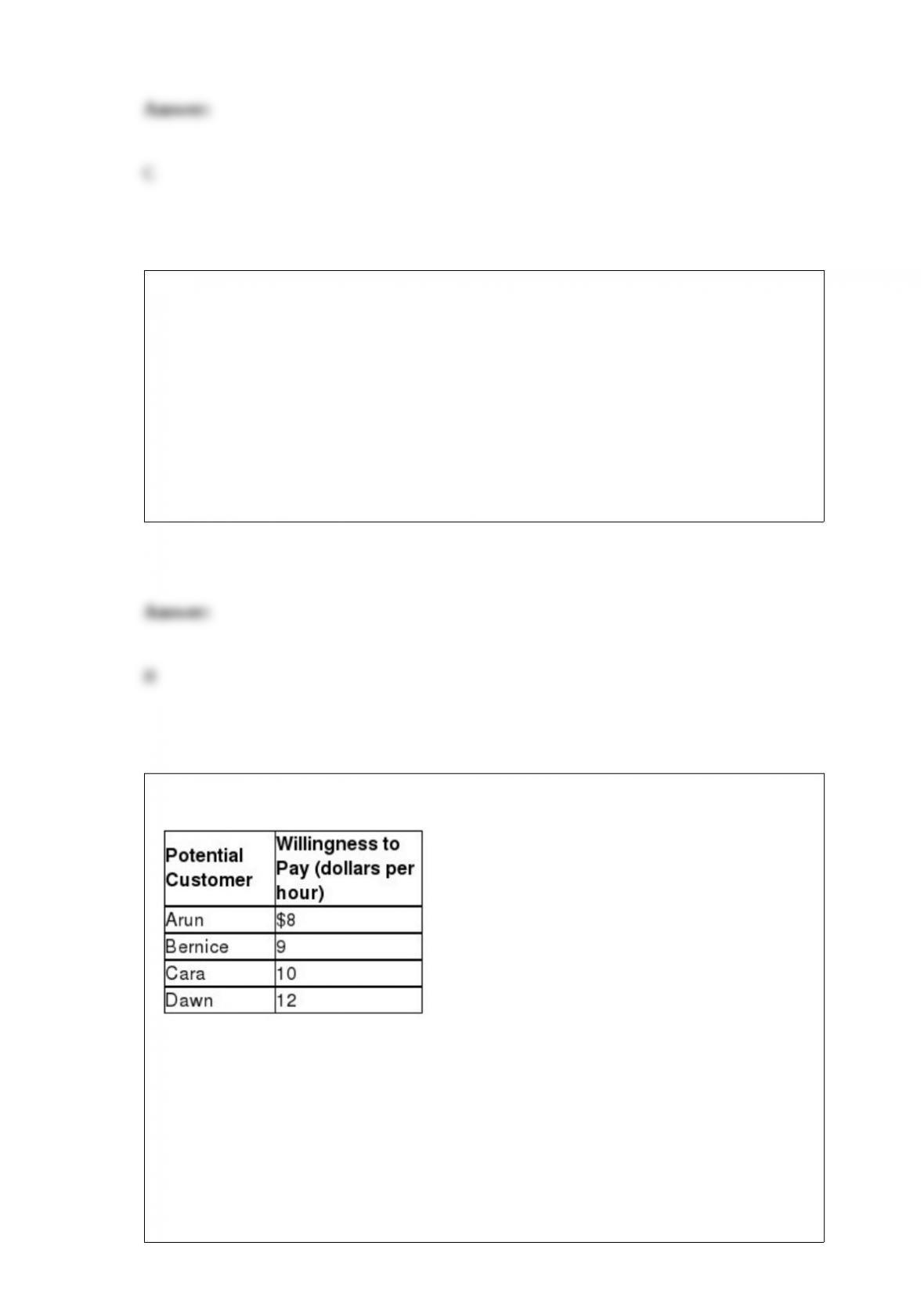
Table 16-3
Julie plans to start a pet-sitting service. She surveyed her neighborhood to determine the
demand for this service. Assume that each person surveyed demands only one hour of
pet sitting services per period. Table 16-3 above shows a portion of her survey results.
Suppose Julie’s marginal cost of providing this service is constant at $7 and she charges
each customer according to his or her willingness to pay instead of a uniform price of
$7. Which of the following statements is true?
A) Julie is worse off because the demand for her services is reduced.

B) Julie has converted the consumer surplus (from a uniform price) into economic
profit.
C) Julie’s customers are better off because their consumer surplus has increased.
D) Julie has converted the producer surplus (from a uniform price) into consumer
surplus.
Which of the following models focuses on how productivity shocks explain fluctuations
in real GDP?
A) the monetarist model
B) the new classical model
C) the real business cycle model
D) the new Keynesian model
The automatic mechanism ________ the price level in the case of ________ and
________ the price level in the case of ________.
A) raises; recession; lowers; expansion
B) lowers; expansion; lowers; recession
C) raises; expansion; raises; recession
D) lowers; recession; raises; expansion

Which of the following generates productive efficiency?
A) competition among sellers
B) competition among buyers
C) government inspectors
D) government production rules and regulations
Holding everything else constant, a decrease in the price of GPS systems will result in
A) an decrease in the quantity of GPS systems demanded.
B) an increase in the demand for GPS systems.
C) a decrease in the supply of GPS systems.
D) an increase in the quantity of GPS systems demanded.

Measuring the impact of a quota or tariff on the U.S. economy is an example of
________. Stating that a quota or tariff should be eliminated is an example of
________.
A) statistical analysis; economic analysis
B) positive analysis; normative analysis
C) econometric analysis; protectionism
D) trade analysis; an opinion
If the social benefit of consuming a good or a service exceeds the private benefit
A) a negative externality exists.
B) the market achieves economic efficiency.
C) a positive externality exists.
D) the sum of consumer surplus and producer surplus is maximized.
Consider two industries, industry Q and industry Z. In industry Q there are 10
companies, each with a market share of 10% of total sales. In industry Z, there are eight
companies. One company has a 65% market share and each of the other seven firms has
a market share of 5%. a. Calculate the four-firm concentration ratio for each industry.
b. Calculate the Herfindahl-Hirschman Index (HHI) for each industry.
c. What do the values of the two concentration measures imply about the degree of

market power in the two industries?
The number of people receiving Medicare is expected to ________ by the year 2030.
A) reach 5 million by
B) stabilize
C) decline by 10 percent
D) grow to 80 million
In 18th century Europe, governments gave guilds legal authority to limit production of
goods. Did this authority obstruct or improve the market mechanism and how?
A) It improved the market mechanism by making it more efficient because the guilds
were able to quickly identify and rectify any market shortages and surpluses.
B) It improved the market mechanism because the government’s actions provided the

correct set of signals to the market so that producers can adjust their output to better
meet the needs of consumers.
C) It obstructed the market mechanism because the guild’s actions prevented the forces
of demand and supply from coordinating the self-interested decisions of producers and
consumers.
D) It obstructed the market mechanism because with one more party having to
coordinate activities (the guilds) there were delays in getting the products to consumers.
The “new product bias” in the consumer price index refers to the idea that
A) consumers switch to new goods when the prices of old goods increase, and the CPI
overestimates the cost to consumers.
B) consumers switch to old goods when the prices of new goods increase, and the CPI
underestimates the cost to consumers.
C) consumers prefer new goods, even if they are worse in quality than old goods, and
this causes the CPI to underestimate the cost to consumers.
D) new products’ prices often decrease after their initial introduction, and the CPI is
adjusted infrequently and overestimates the cost to consumers.
Explain and show graphically how an increase in household saving affects the
equilibrium interest rate and the equilibrium quantity of loanable funds.
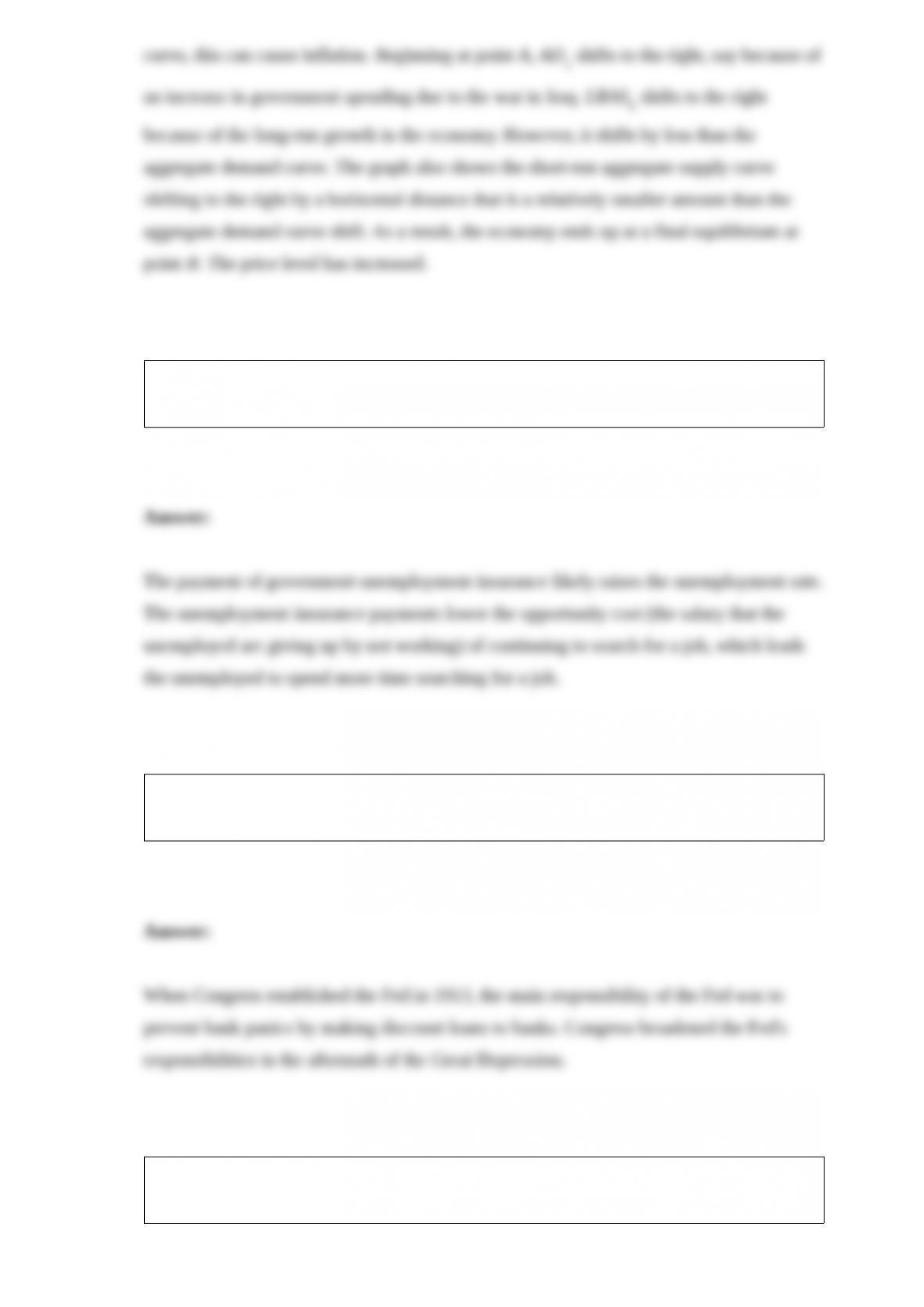
Use the dynamic model of aggregate demand and supply to illustrate a situation where
the economy is growing but experiencing inflation in the long run.
What effect does the payment of government unemployment insurance have on the
unemployment rate?
When Congress established the Federal Reserve in 1913, what was its main
responsibility? When did Congress broaden the Fed’s responsibilities?
Will equilibrium in a market always result in an outcome that is economically efficient?
Explain.