Total industry sales are $90 million. The top four firms (A, B, C, and D) account for
sales of $15 million, $3.5 million, $1.3 million and $0.8 million, respectively. What is
the four-firm concentration ratio?
a. 9.40
b. 0.23
c. 0.77
d. 0.40
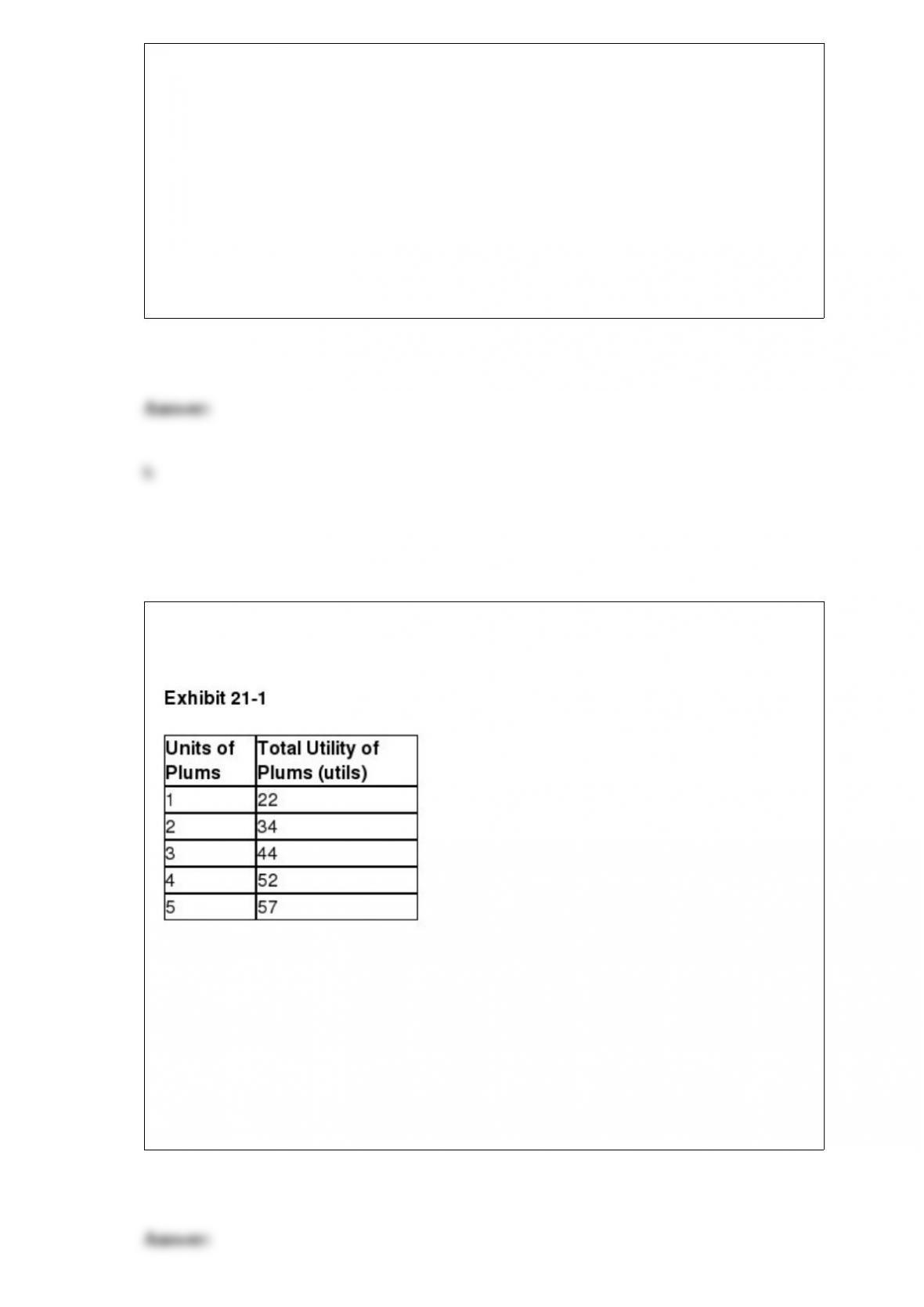
Refer to Exhibit 21-1. The marginal utility of the third plum is
a. 17 utils.
b. 10 utils.
c. 8 utils.
d. 3 utils.
e. cannot be determined
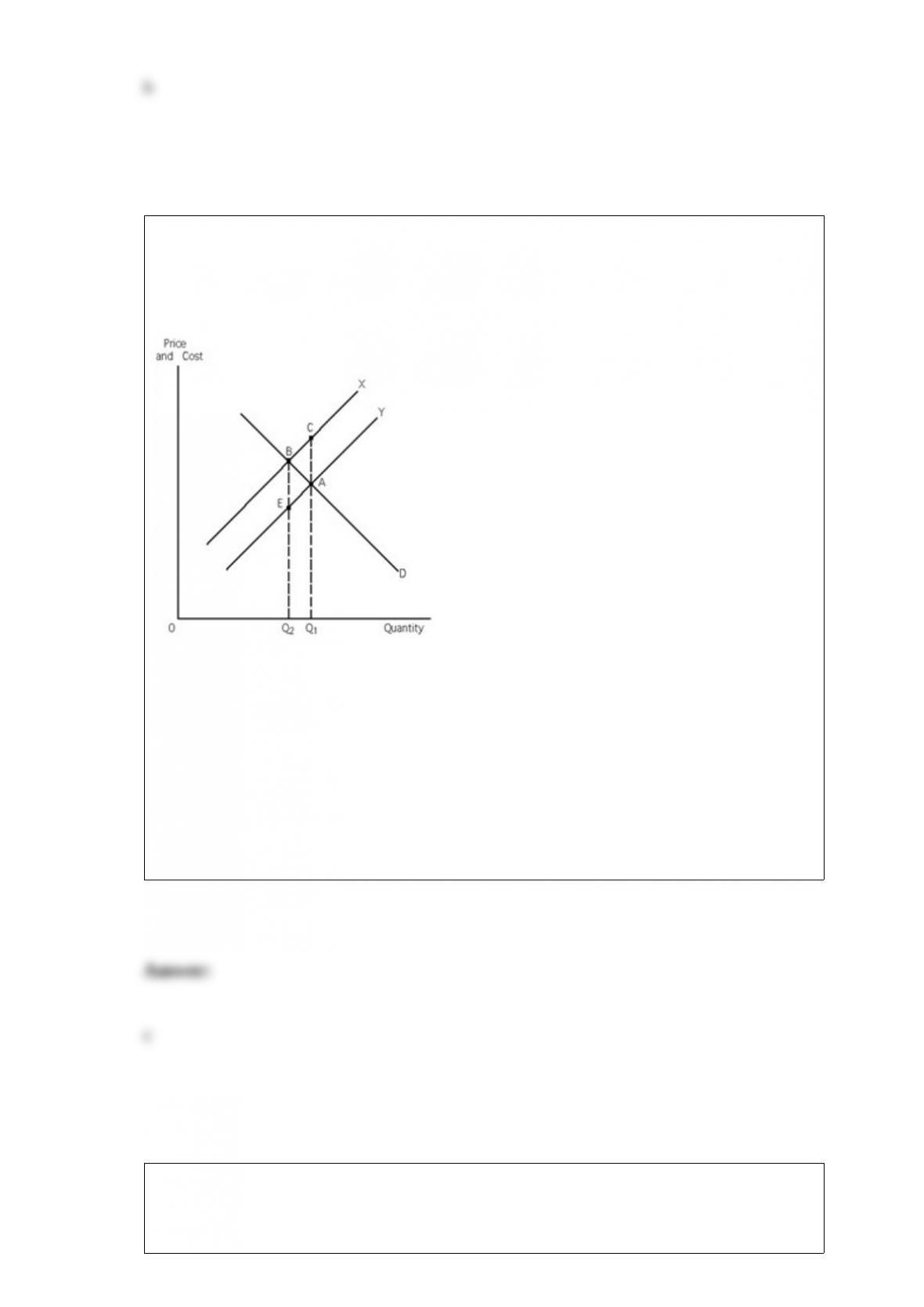
Refer to Exhibit 31-1. If the exhibit represents a negative externality situation, the
triangle ABC is representative of
Exhibit 31-1
a. social failure.
b. optimal failure.
c. market failure.
d. socially optimal output.
e. none of the above
Suppose that an increase in a nation’s income causes the nation’s residents to buy more
domestic and foreign goods. Given this, if U.S. residents experience an increase in
income, but Mexican residents do not, it is likely that, ceteris paribus,
a. both the U.S. dollar and the Mexican peso will depreciate.
b. both the U.S. dollar and the Mexican peso will appreciate.
c. the U.S. dollar will depreciate and the Mexican peso will appreciate.
d. the U.S. dollar will appreciate and the Mexican peso will depreciate.
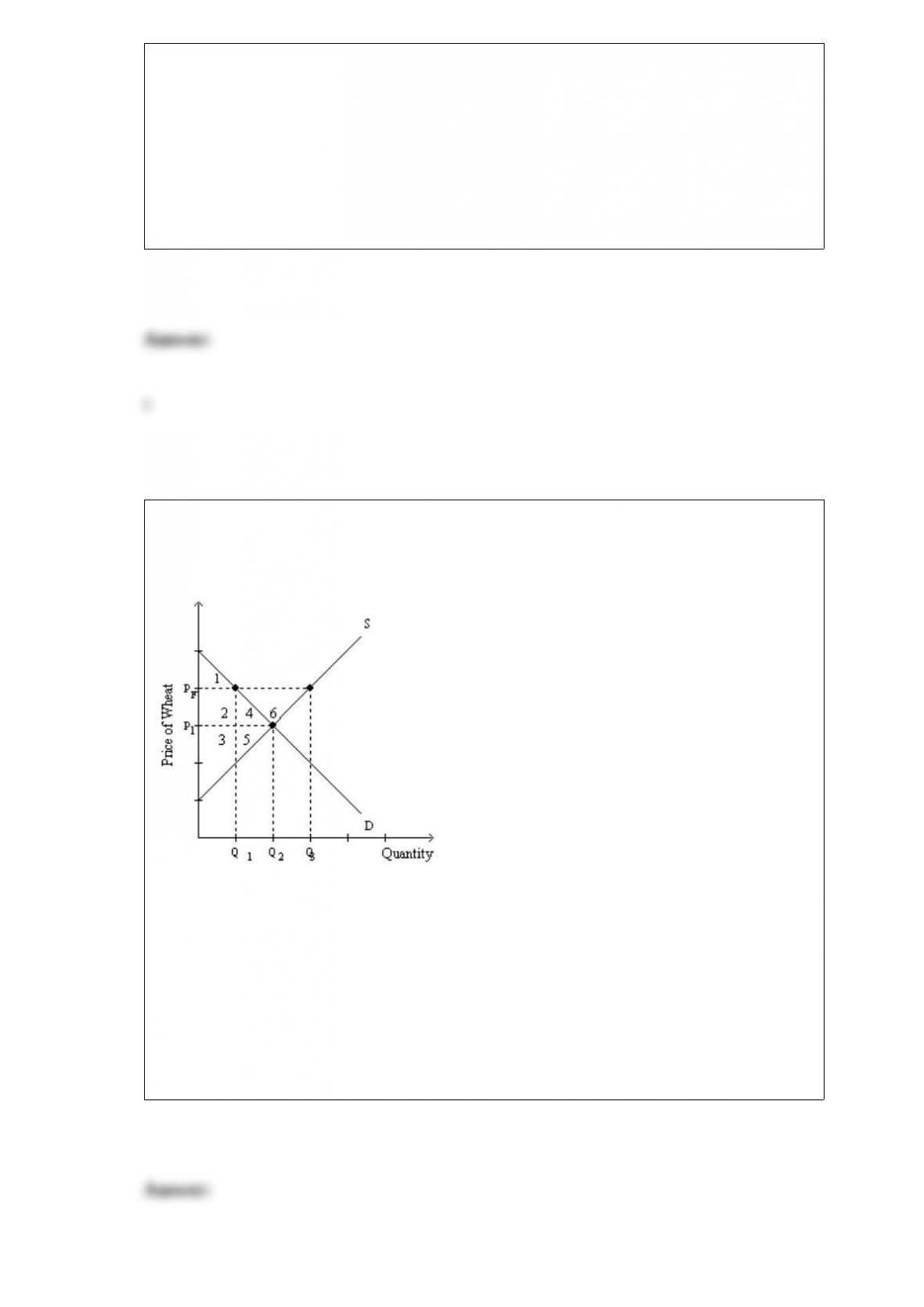
Refer to Exhibit 4-8.If the wheat market is in competitive equilibrium the producers’
surplus will equal
Exhibit 4-8
a. area 1 + 2 + 3
b. area 1 + 2 + 4
c. area 3 + 5
d. area 1 + 2 + 3 + 4 + 5
e. area 6

According to public choice theorists, people in the market sector and people in the
public sector behave differently because
a. people in the two sectors have different motives.
b. the two sectors have different institutional arrangements.
c. government employees do not act in their own self-interest.
d. there are economies of scale in the market sector.
When the actual Lorenz curve is a 45-degree line, there is
a. perfect income equality.
b. perfect income inequality.
c. a more equal distribution of income than before.
d. a less equal distribution of income than before.
e. the same distribution of income as before.
Luck is more likely to influence incomes in the short run than in the long run.
a. True
b. False
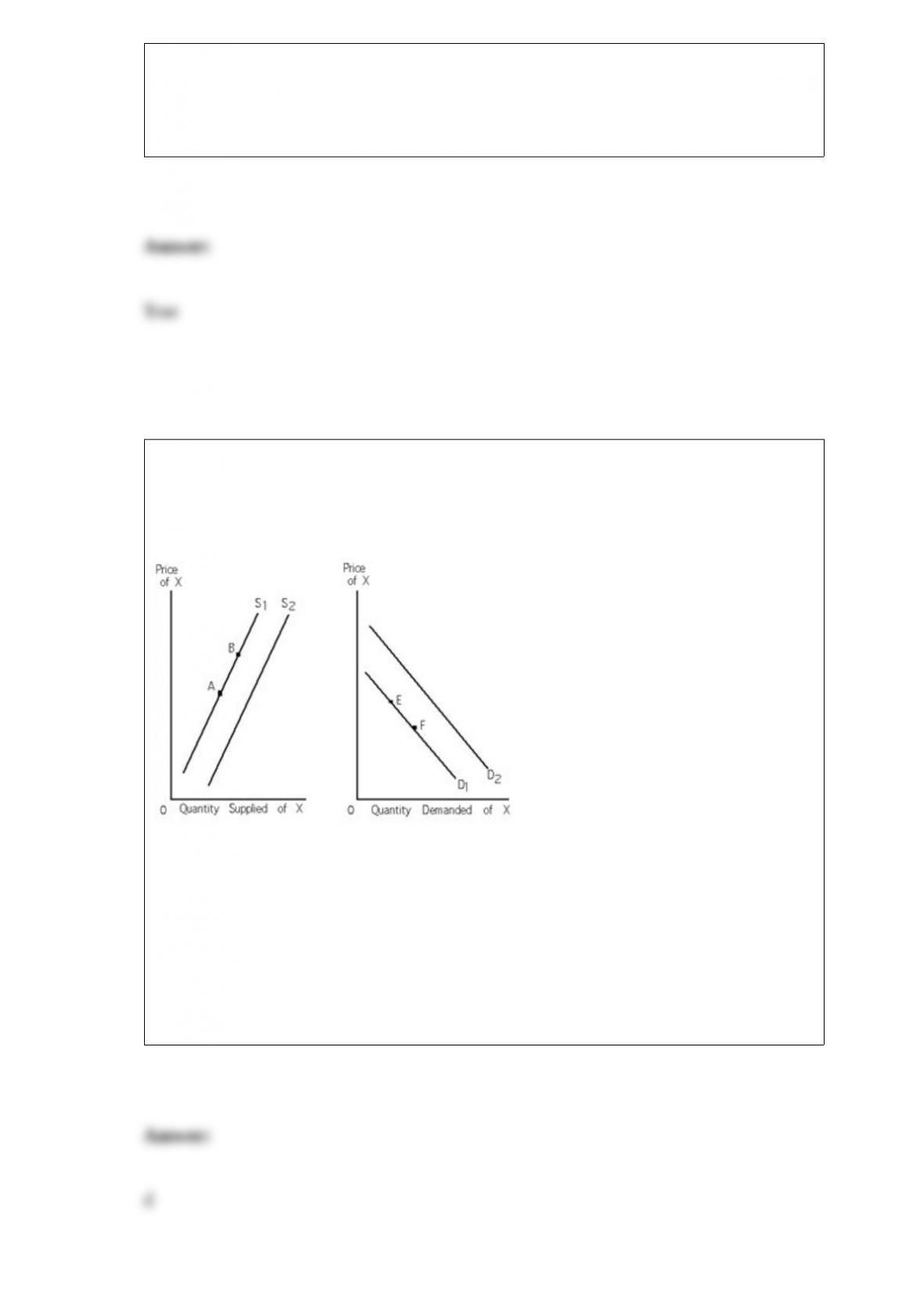
Refer to Exhibit 3-9. The production of X is more profitable than it used to be. A
number of producers enter the business of producing X. An economist would expect a
movement in the market for X from
Exhibit 3-9
a. S2 to S1.
b. D2 to D1.
c. D1 to D2.
d. S1 to S2.
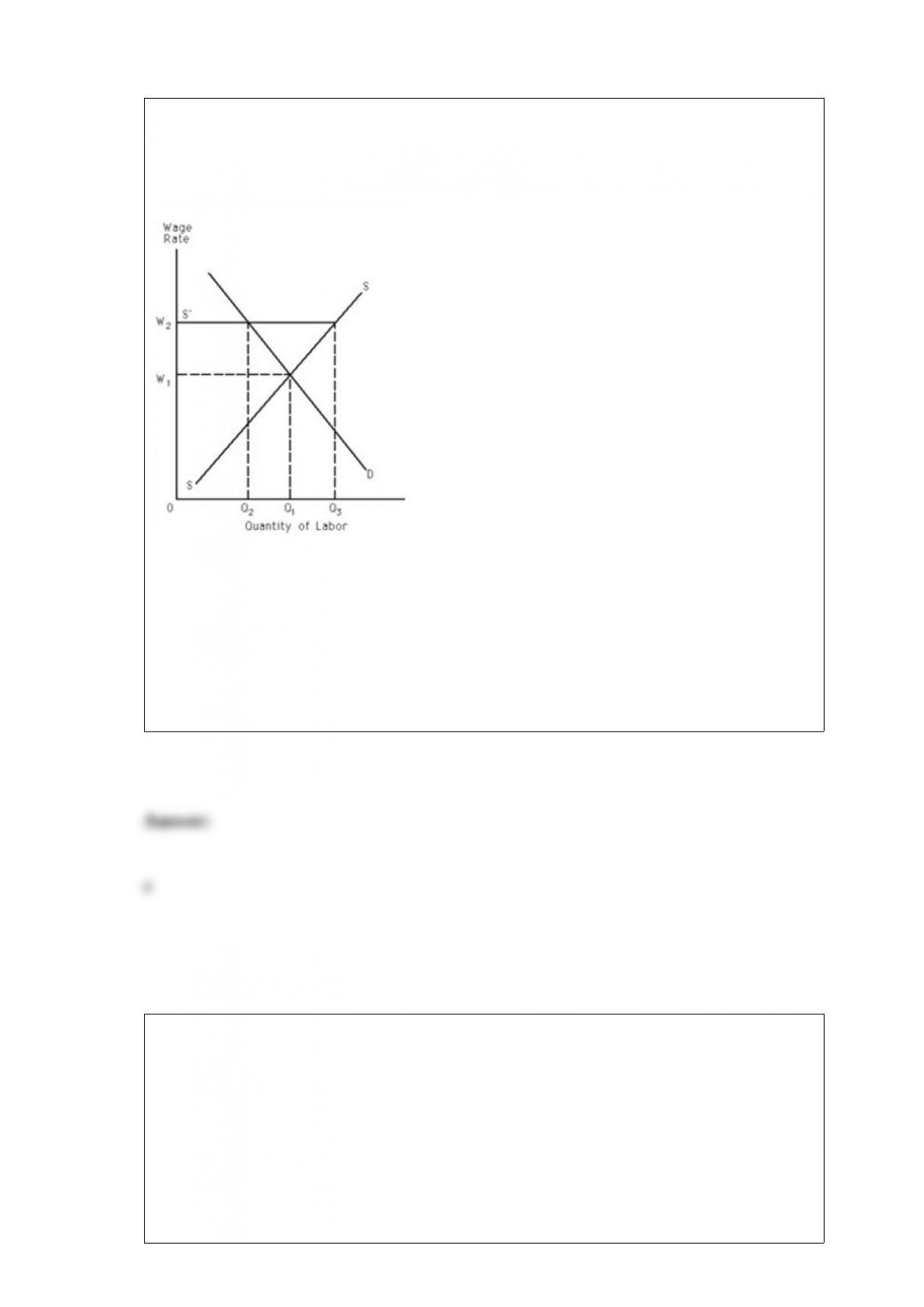
Refer to Exhibit 28-2. One of the things that the labor union probably can do to
convince management that the supply curve is S’S instead of SS is
Exhibit 28-2
a. make a credible threat of a strike.
b. ask workers to take a cut in fringe benefits.
c. try to maximize the wage bill to the union.
d. try to maximize membership in the union.
When the ratio of income to poverty for a family is
a. greater than 1.00, the family is not considered to be living in poverty.
b. greater than zero, the family is not considered to be living in poverty.
c. between 1.00 and 1.25, the family is considered to be “near poor.”
d. a and b

e. a and c
The Coase theorem is significant because it
a. implies that no transaction costs are associated with solving externalities.
b. shows that property rights can be assigned.
c. shows that under certain conditions externalities can be corrected in the market
without resorting to nonmarket means.
d. a and b
The Townsend Acts
a. are anti-trust laws passed in the U.S. in the 1930’s to limit monopoly power.
b. allow district attorneys the opportunity to plea bargain with accused criminals.
c. were British laws enacted in the 1760’s that imposed taxes on products imported to
the American colonies, leading (in part) to the Boston Tea Party.
d. were enacted in the late 1800’s to permit regulation of natural monopolies.

If the nominal interest rate is 8 percent and the real interest rate is 6 percent, then the
expected rate of inflation is
a. 14 percent.
b. 7 percent.
c. 2 percent.
d. -2 percent.
e. impossible to determine from the data given.
Resource X is necessary to the production of good Y. If the price of resource X rises,
the _____________ curve for good Y will shift ____________ resulting in a(n)
_____________ in the equilibrium price of Y and a(n) ____________ in the
equilibrium quantity of Y.
a. supply; rightward; decrease; increase.
b. demand; leftward; decrease; decrease
c. demand; rightward; increase; increase
d. supply; leftward; increase; decrease
e. supply; leftward; increase; increase

Which of the following is the best example of price discrimination?
a. a cellular telephone company charging lower rates to weekend callers than weekday
callers
b. a gas station charging less per gallon to customers who pay cash than customers who
use a credit card
c. an auto insurance company charging a higher premium to a seventeen year old boy
with a driving record that includes three accidents than the premium charged to a
middle-aged driver with a clean driving record
d. a private attorney charging higher fees to clients receiving special services than
clients receiving regular services
Explain what an economist means by the phrase “decisions made at the margin.”Cite an
example to support your answer.
Explain how the combination of major changes in the weather and price inelasticity of
demand for a food item can lead to wide fluctuations in a farmer’s income from year to
year.
Describe who benefits and who loses from tariffs and from quotas.What is the major
difference between the effects of a quota and the effects of a tariff?
Why is an oligopolist more likely to be able to earn a profit in the long run compared to
a monopolistic competitive firm?

Describe the relationship between income and education in the United States.Cite
evidence that supports and explains this relationship.
Explain what it means to say that a theory is falsifiable or refutable?Give a specific
example to help support your answer.

Explain the difference between resource allocative efficiency and productive efficiency.
Explain the difference between a change in supply and a change in quantity supplied.
Be sure to state what causes each to change and how they differ when graphed.

Alex Rodriguez was the highest played baseball player in 2012, earning about $32
million playing for the New York Yankees. Explain the economic justification for the
owners paying such a high salary; be sure to incorporate the concept of marginal
revenue product (MRP) into your answer.