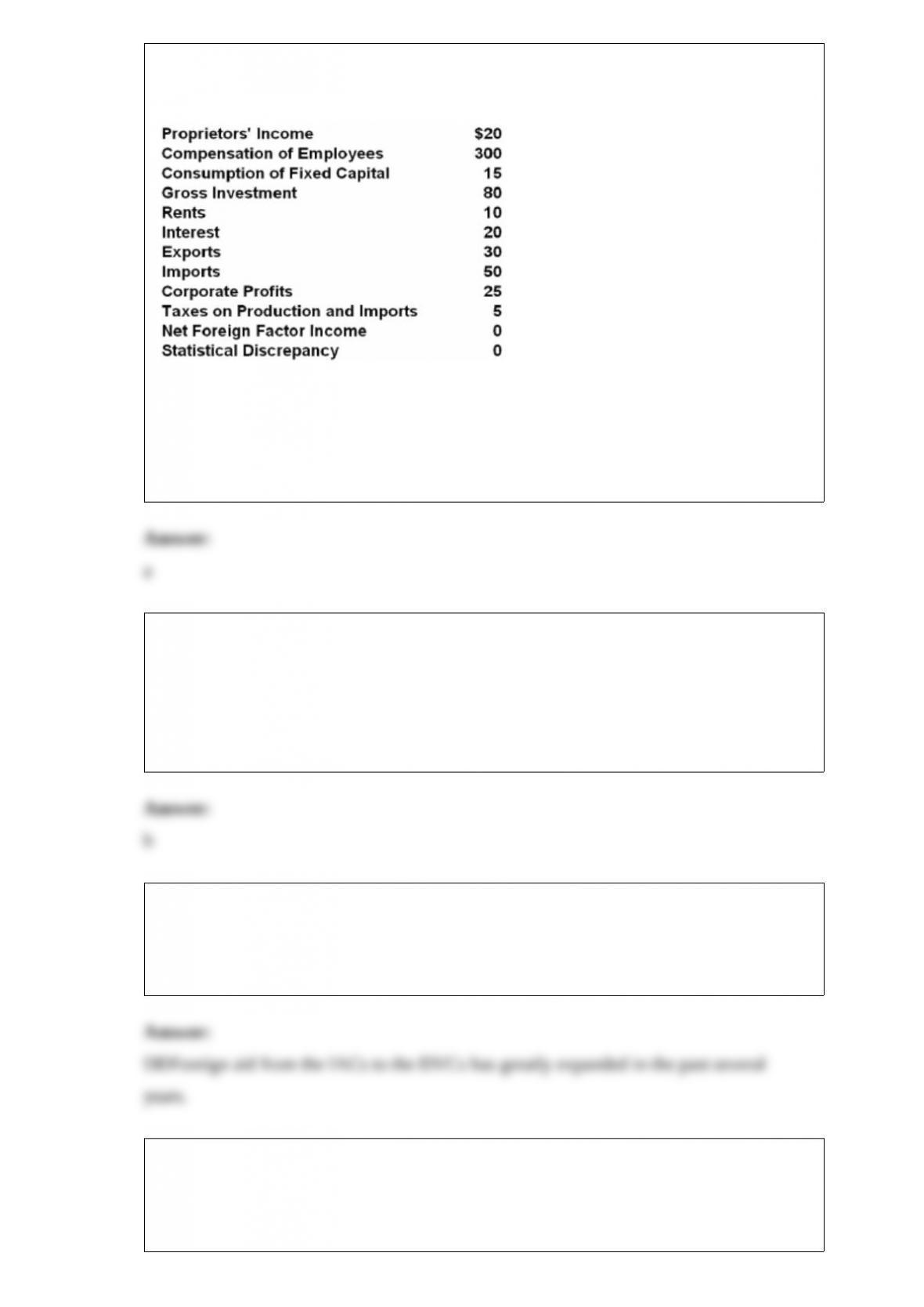
1) answer the next question(s) on the basis of the following data. all figures are in
billions of dollars.
refer to the above data. gross domestic product is:
a.$395.
b.$380.
c.$375.
d.$360.
2) according to estimates, what percentage of construction workers in the united states
are illegal immigrants?
a.12
b.14
c.17
d.24
3) Which of the following is a true statement?
A.The DVC debt problem has been totally solved.
B.Direct foreign investment to DVCs has dwindled to near zero in recent years.
C.Approximately 5 percent of the GDP of IACs goes to foreign aid.
4) In the insider-outsider theory:
A.insiders are workers who retain employment during recession.
B.insiders are managers who have more information about their firms’ performance
than outsiders.
C.insiders are “principals” and outsiders are “agents.”
D.outsiders are foreigners.
5)
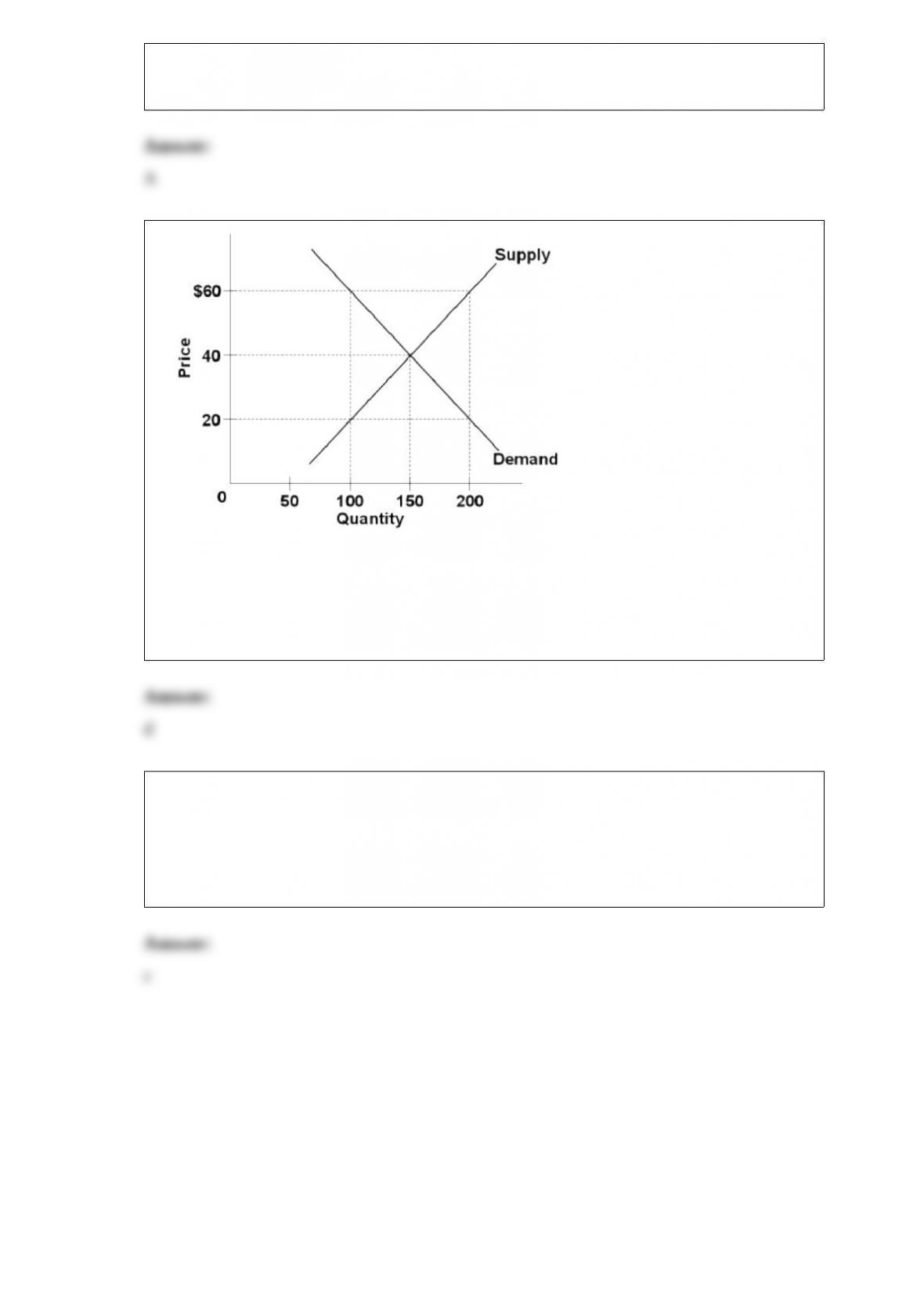
refer to the above diagram. a price of $20 in this market will result in:
a.a shortage of 50 units.
b.a surplus of 50 units.
c.a surplus of 100 units.
d.a shortage of 100 units.
6) if a firm decides to produce no output in the short run, its costs will be:
a.its marginal costs.
b.its fixed plus its variable costs.
c.its fixed costs.
d.zero.
7)
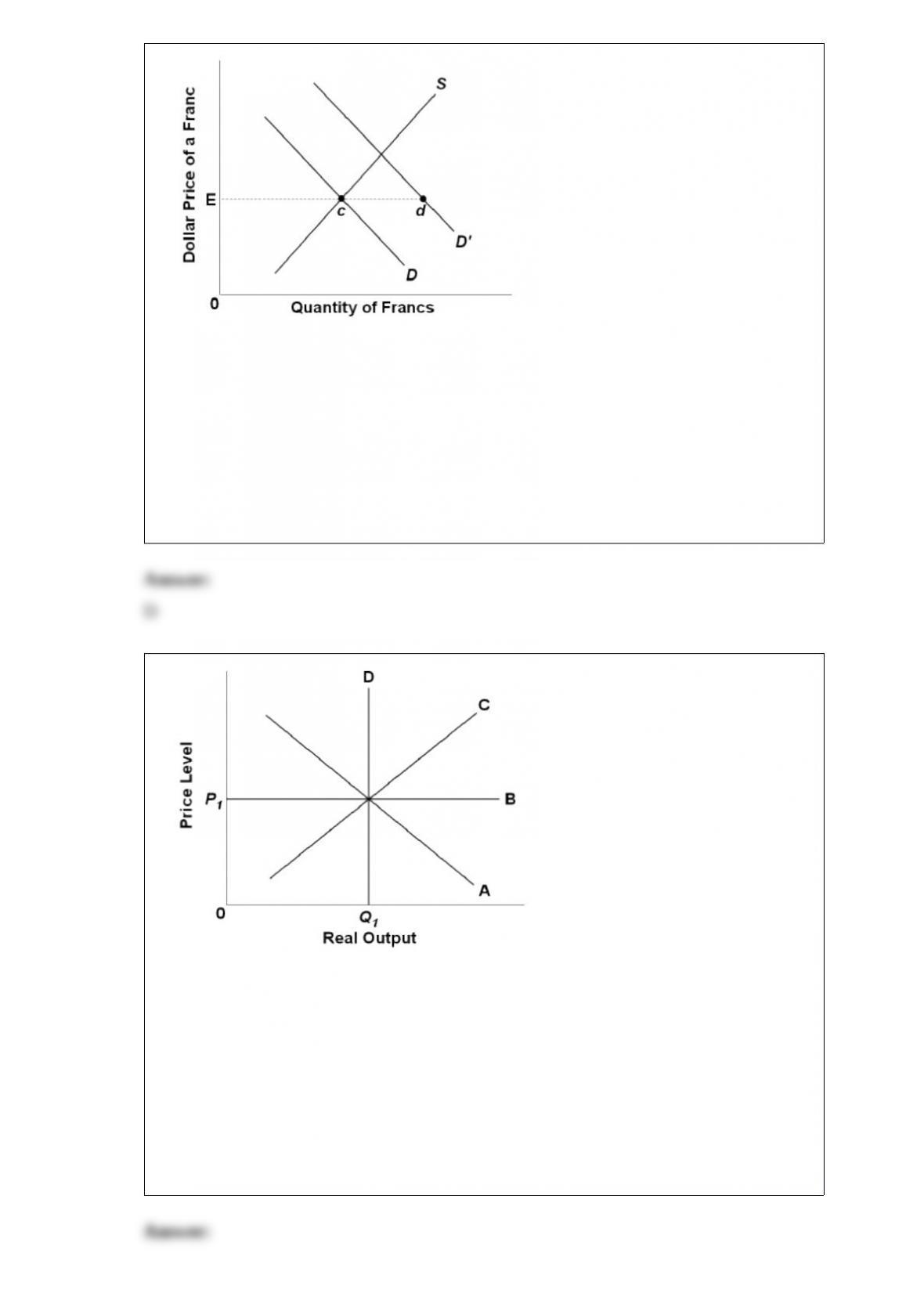
Refer to the above diagram where D and S are the United States’ demand for and supply
of Swiss francs. At the equilibrium exchange rate, E, the United States’ balance of
payments is in equilibrium. Given a change in demand from D to D’ the United States
could maintain the dollar price of Swiss francs by:
A.shifting the S curve to the right through the use of domestic expansionary policies.
B.instituting exchange controls to ration Ed Swiss francs to U.S. importers who want
Ec francs.
C.using international monetary reserves to cover the Ec shortage of Swiss francs.
D.using international monetary reserves to cover the cd shortage of Swiss francs.
8)
Refer to the above diagram and assume that prices and wages are flexible both upward
and downward in the economy. In the extended AD-AS model:
A.demand-pull inflation would involve a rightward shift of curve A, followed by a
rightward shift of curve C
B.cost-push inflation would involve first a leftward shift of curve C, then a rightward
shift of curve C
C.recession would involve a leftward shift of curve A followed by a leftward shift of
curve C
D.recession would involve a rightward shift of curve D, followed by leftward shifts of
curves A and C
9)
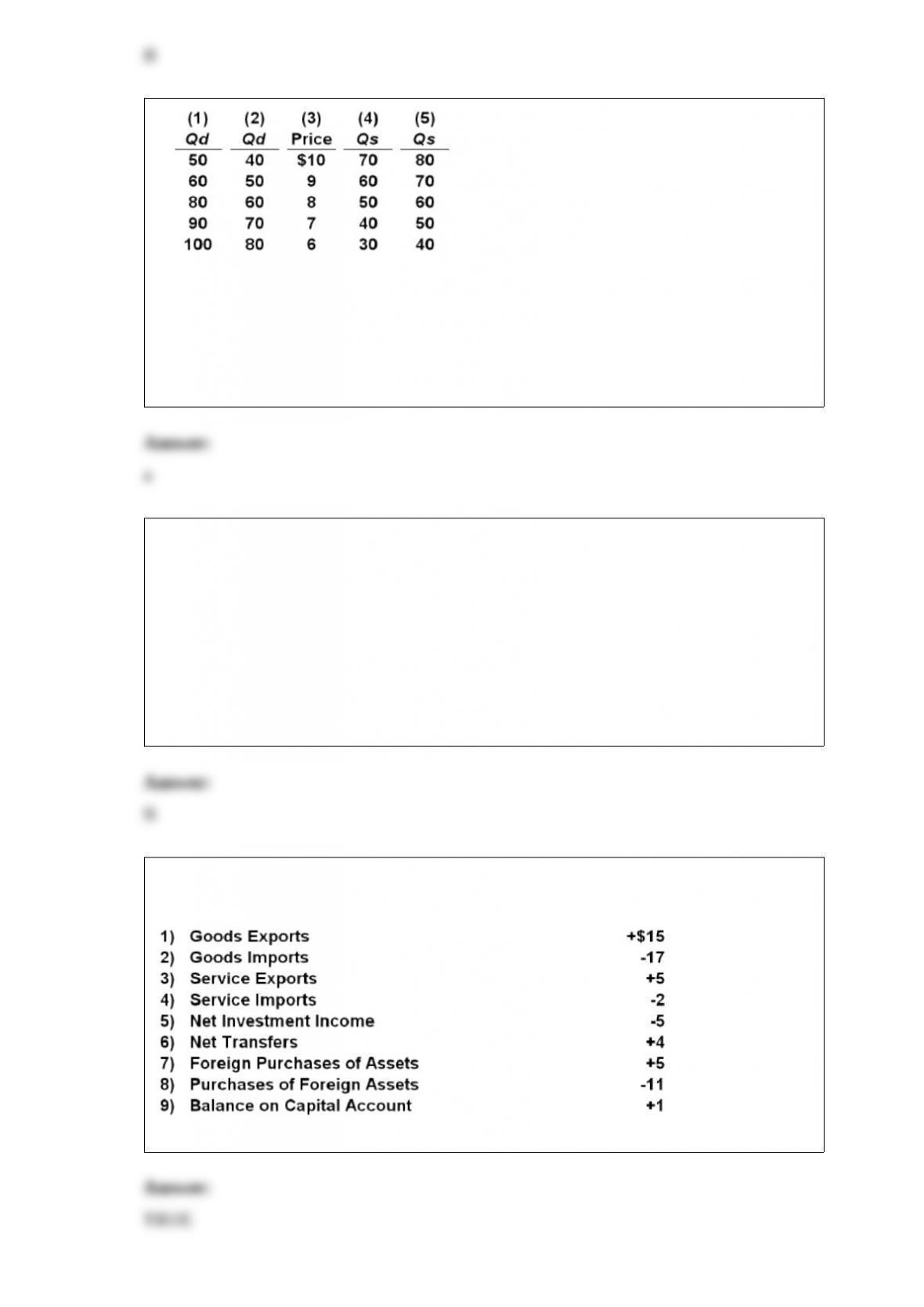
refer to the above table. in relation to column (3), a change from column (1) to column
(2) would mostly likely be caused by:
a.reduced taste for the good.
b.an increase in input prices.
c.consumers expecting that prices will be lower in the future.
d.government subsidizing production of the good.
10) When a check is drawn and cleared, the
A.reserves and deposits of both the bank against which the check is cleared and the
bank receiving the check are unchanged by this transaction.
B.bank against which the check is cleared loses reserves and deposits equal to the
amount of the check.
C.bank receiving the check loses reserves and deposits equal to the amount of the
check.
D.bank against which the check is cleared acquires reserves and deposits equal to the
amount of the check.
11) The following 2008 balance of payments statement for Transylvania. All figures are
in billions of dollars.
Refer to the above data. In 2008, Transylvania imported more products than it exported.
12) the natural rate of unemployment:
a.is fixed over time.
b.is found by adding the cyclical and structural unemployment rates.
c.may change from one decade to another.
d.cannot be influenced by public policy.
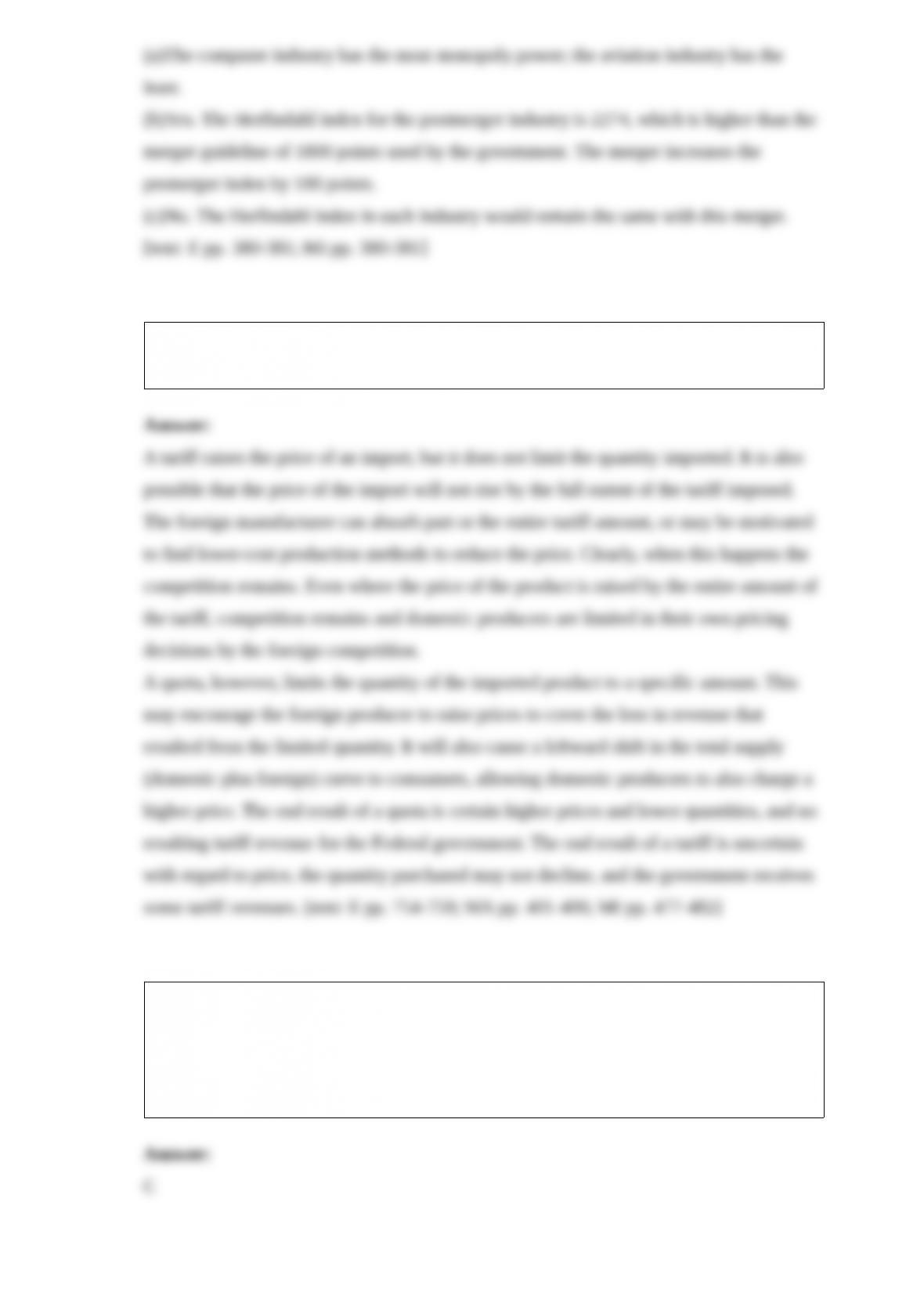
13) In the table below are data on five different industries and the market shares for
each of the firms in the industry. Assume that there is no foreign competition, entry into
the industry is difficult, and that no firm in each industry is on the verge of bankruptcy.
In the column to the right of the table, calculate the Herfindahl index.
(a)Which industry has the most monopoly power and which industry has the least
monopoly power?
(b)If the sixth firm in the automotive industry sought to merge with the fifth firm in that
industry, would the government be likely to challenge the merger?
(c)Would a conglomerate merger between the first firm in the computer industry and the
second firm in the textiles industry likely be challenged by the government?
14) Unless a tariff is prohibitive, it does not inhibit competition as much as a quota.
Evaluate.
15) The two main characteristics of a public good are:
A.production at constant marginal cost and rising demand.
B.nonexcludability and production at rising marginal cost.
C.nonrivalry and nonexcludability.
D.nonrivalry and large negative externalities.

16) if the output of product x is such that marginal benefit equals marginal cost:
a.the correct amount of resources is being allocated to x’s production.
b.the value of producing x exceeds the value of producing alternative products with the
available resources.
c.there can be a net gain to society by allocating either more or less resources to
producing x.
d.resources are overallocated to the production of x.