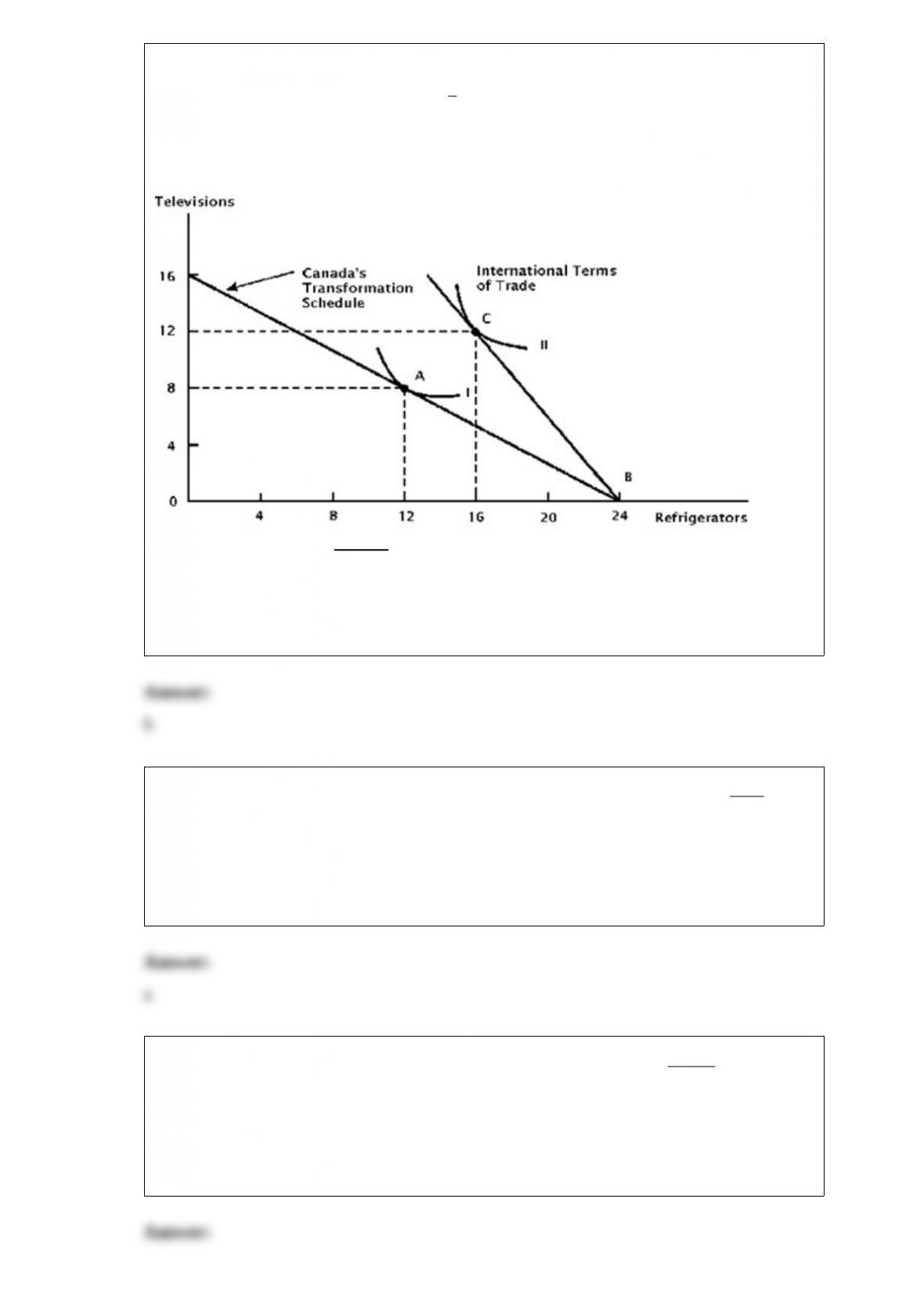
1) figure 2.2 illustrates trade data for canada. the figure assumes that canada attains
international trade equilibrium at point c.
figure 2.2. canadian trade possibilities
according to figure 2.2, exports for canada total:
a.16 refrigerators
b.8 refrigerators
c.12 refrigerators
d.16 refrigerators
2) which of the following represents the stage where economic integration is least
complete?
a.free trade area
b.monetary union
c.common market
d.customs union
3) which chain of events would promote payments equilibrium for a deficit nation,
according to the price-adjustment mechanism?
a.increasing money supply–increasing domestic prices–rising imports–falling exports
b.increasing money supply–falling domestic prices–rising imports–falling exports
c.decreasing money supply–increasing domestic prices–falling imports–rising exports
d.decreasing money supply–decreasing domestic prices–falling imports–rising exports
4) in figure 2.4 the marginal rate of transformation of autos into wheat is
a.one and two-thirds
b.two and one-third
c.three fifths
d.three sevenths
5) assume that russia has a comparative advantage in vodka. if the united states extends
russia the benefits of the normal-trade-relations (most favored nation)principle, u.s.
consumer surplus decreases in the vodka market.
a.true
b.false
6) the purpose of currency devaluation is to cause a depreciation in a currency’s
exchange value.
a.true
b.false
7) a system of fixed exchange rates and high capital mobility strengthens which policy
in combating a recession:
a.expansionary fiscal policy
b.expansionary monetary policy
c.contractionary fiscal policy
d.contractionary monetary policy
8) which of the following refers to the price charged for products sold to a subsidiary of
a multinational enterprise by another subsidiary in another nation?
a.transfer pricing
b.international dumping
c.price discrimination
d.full-cost pricing
9) assume identical interest rates on comparable securities in the united states and
foreign countries. suppose investors anticipate that in the future the u.s. dollar will
depreciate against foreign currencies. investment funds would tend to:
a.flow from the united states to foreign countries
b.flow from foreign countries to the united states
c.remain totally in foreign countries
d.remain totally in the united states
10) under the price-adjustment mechanism, a trade-surplus nation would realize gold
inflows, an increase in its money supply, and a loss of international competitiveness.
a.true
b.false
11) figure 8.1 depicts the supply and demand schedules of calculators for greece, a
‘small” country that is unable to affect the world price. greece’s supply and demand
schedules of calculators are respectively depicted by sg and dg. assume that greece
imports calculators from either germany or france. suppose germany is the world’s
low-cost producer who can supply calculators to greece at $20 per unit, while france
can supply calculators at $30 per unit.
figure 8.1. effects of a customs union
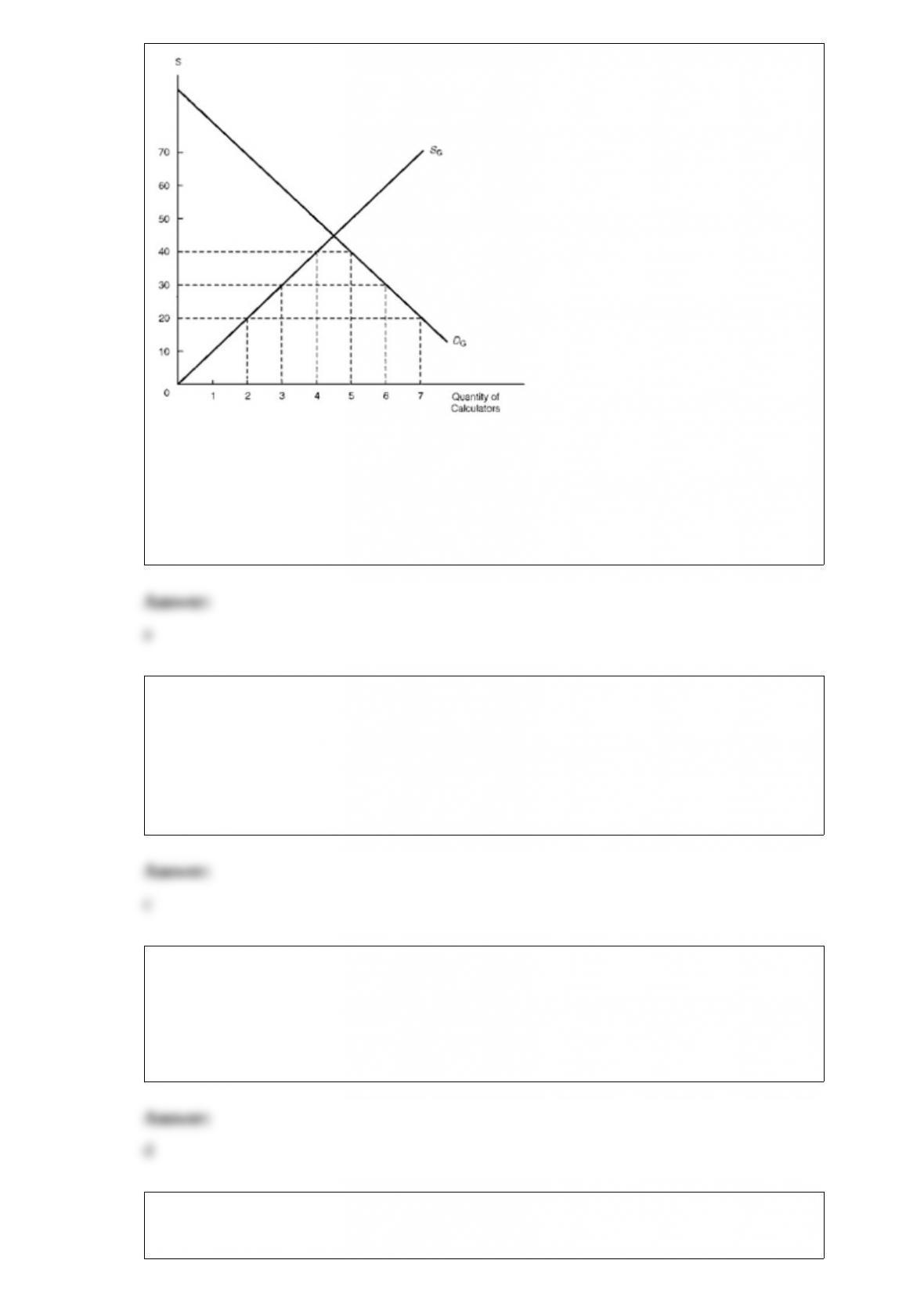
referring to figure 8.1, suppose greece forms a customs union with france. greece will
import:
a.3 calculators at a per-unit price of $30
b.3 calculators at a per-unit price of $40
c.6 calculators at a per-unit price of $30
d.6 calculators at a per-unit price of $40
12) in a supply-and-demand diagram for japanese yen, with the exchange rate in dollars
per yen on the vertical axis, the demand schedule for yen is drawn sloping:
a.upward
b.vertical
c.downward
d.horizontal
13) export embargoes induce greater losses in consumer surplus for the target country:
a.the lesser its initial dependence on foreign produced goods
b.the more elastic the target country’s demand schedule
c.the greater the available output from alternative suppliers
d.the more inelastic the target country’s supply schedule
14) concerning international lending risk, country risk refers to the risk that part or all
of the interest or principal of a loan will not be repaid.
a.true
b.false
15) bonded warehouses and foreign trade zones have the effect of allowing domestic
importers to postpone and prorate over time their import duty obligations.
a.true
b.false
16) if toyota inc. of japan builds an automobile assembly plant in the united states, the
japanese capital account would register an outflow.
a.true
b.false
17) mergers differ from joint ventures in that they involve the creation of a new
business firm, rather than the union of two existing companies.
a.true
b.false
18) the larger the size and the greater the number of countries in a customs union, the
greater will be the trade-diversion effect.
a.true
b.false
19) some trade creation was expected to occur as a result of the u.s.-canada free-trade
agreement, since canadian exports to the united states and u.s. exports to canada were

expected to expand at the expense of imports from germany and japan that faced trade
restrictions.
a.true
b.false