1) Which of the following statements is correct?
A.Economic profits can properly be regarded as the salaries received by the hired
managers of corporations.
B.Economic rent is a price paid for productive land resources whose supply is perfectly
inelastic.
C.Economic profits would be nonexistent in a dynamic, purely competitive economy.
D.Economic or pure profit is the minimum return which entrepreneurs must receive to
continue in a particular line of production.
2) the fact that most medical care purchases are financed through insurance:
a.has no effect on health care consumption because aggregate costs are the same
regardless of payment method.
b.reduces the amount of health care consumed.
c.has decreased health care costs and therefore reduced aggregate health care
expenditures.
d.increases the amount of health care consumed.
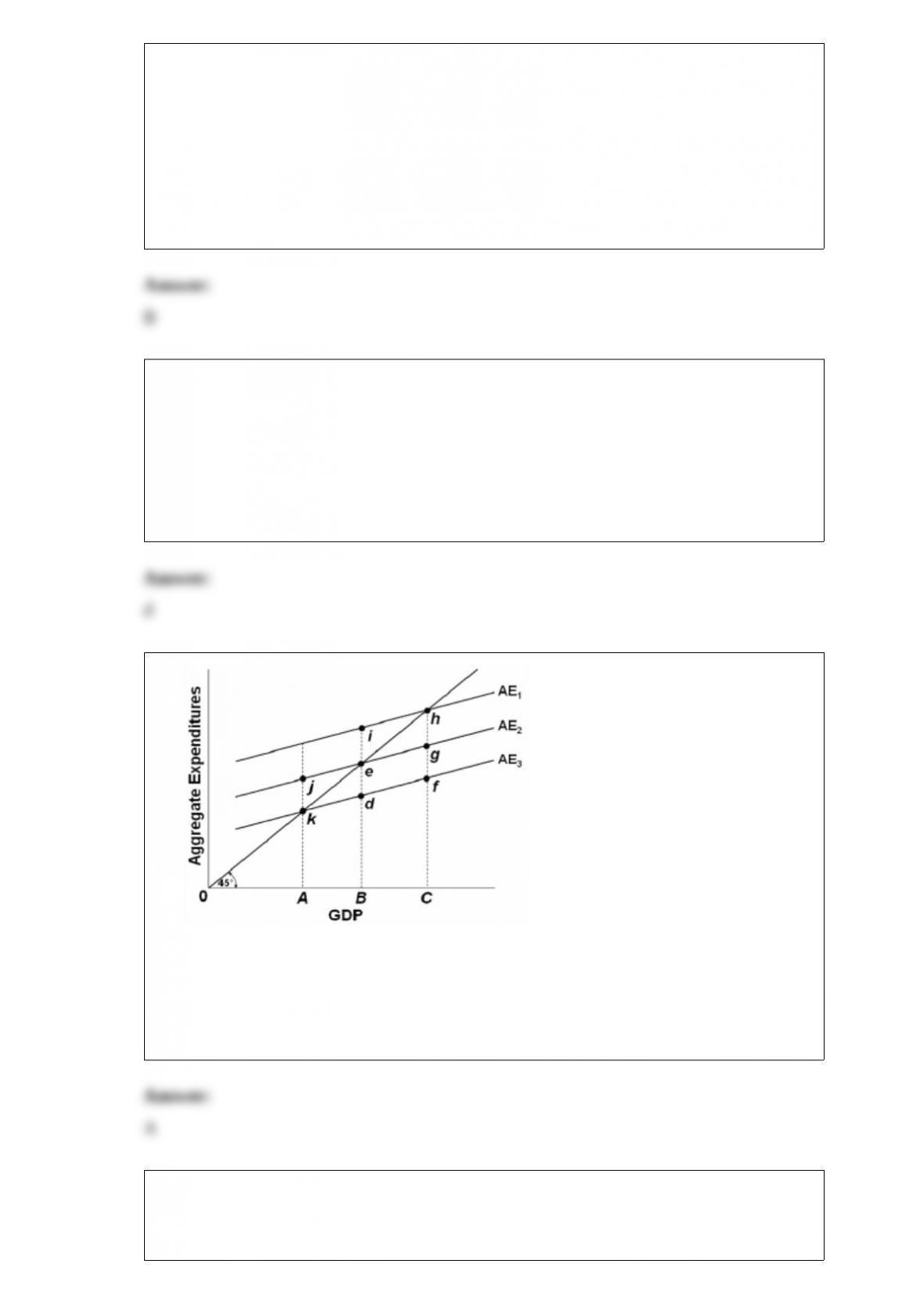
3)
Refer to the above diagram. The value of the multiplier for this economy is:
A.BC/hg.
B.BC/AB.
C.ed/di.
D.df/BC.
4) the phase of the business cycle in which real gdp is at a minimum is called:
a.the peak.
b.a recession.

c.the trough.
d.the pits.
5) if you owned a small farm, which of the following would be a fixed cost?
a.harvest labor
b.hail insurance
c.fertilizer
d.seed
6) because the marginal product of a variable resource at first increases and then
decreases as the output of the firm is increased:
a.total cost at first increases at a decreasing rate and then increases at an increasing rate.
b.total variable cost at first increases at an increasing rate and then increases at a
decreasing rate.
c.average total cost at first increases and then diminishes.
d.average fixed cost will rise beyond the point of diminishing returns.
7) A nation’s import demand curve for a specific product:
A.is upsloping.
B.shows the amount of the product it will import at prices below its domestic price.
C.lies above its export supply curve for the product.
D.depends on domestic demand for the product, but not on domestic supply.
8) In which of the following U.S. cities is one of the twelve Federal Reserve Banks
located?
A.New York City
B.Seattle
C.Miami
D.Denver

9) Inflation accompanied by falling real output and employment is known as:
A.Laffer’s law.
B.Okun’s law.
C.stagflation.
D.the Phillips Curve.
10) The theory of creative destruction was advanced many years ago by:
A.Bill Gates.
B.John Maynard Keynes.
C.Joseph Schumpeter.
D.Adam Smith.
11) suppose a nation’s 2008 nominal gdp was $972 billion and the general price index
was 90. to make the 2008 gdp comparable with the base year gdp, the 2008 gdp must
be:
a.adjusted downward to $678 billion.
b.deflated to $896 billion.
c.inflated to $1080 billion.
d.deflated to $1080 billion.
12) At the equilibrium level of GDP:
A.MV = nominal GDP.
B.MV = real GDP.
C.M = nominal GDP.
D.V = 1/MPS.
13) Which one of the following might offset a crowding-out effect of financing a large
public debt?
A.a decline in net exports
B.an increase in public investment
C.a decrease in the money supply
D.a decline in public investment

14) Assume the government purposely incurs a budget deficit that is financed by
borrowing. As a result, interest rates rise and the amount of private investment spending
declines. This illustrates:
A.the equation-of-exchange effect.
B.the paradox of thrift.
C.the crowding-out effect.
D.the wealth effect.
15) the economizing problem is:
a.the need to make choices because economic wants exceed economic means.
b.how to distribute resources equally amongst all members of society.
c.that people’s means often exceed their wants.
d.that people do not know how to rationally allocate resources.
16) The demographic transition view of population growth argues that, on average (and
as perceived by parents) the marginal:
A.benefits of extra children are larger in IACs than in DVCs.
B.costs of extra children are lower in IACs than in DVCs.
C.costs of extra children are larger in IACs than in DVCs.
D.benefits of extra children are the same in DVCs and IACs.
17) The foreign purchases effect:
A.shifts the aggregate demand curve rightward.
B.shifts the aggregate demand curve leftward.
C.shifts the aggregate supply curve rightward.
D. moves the economy along a fixed aggregate demand curve.
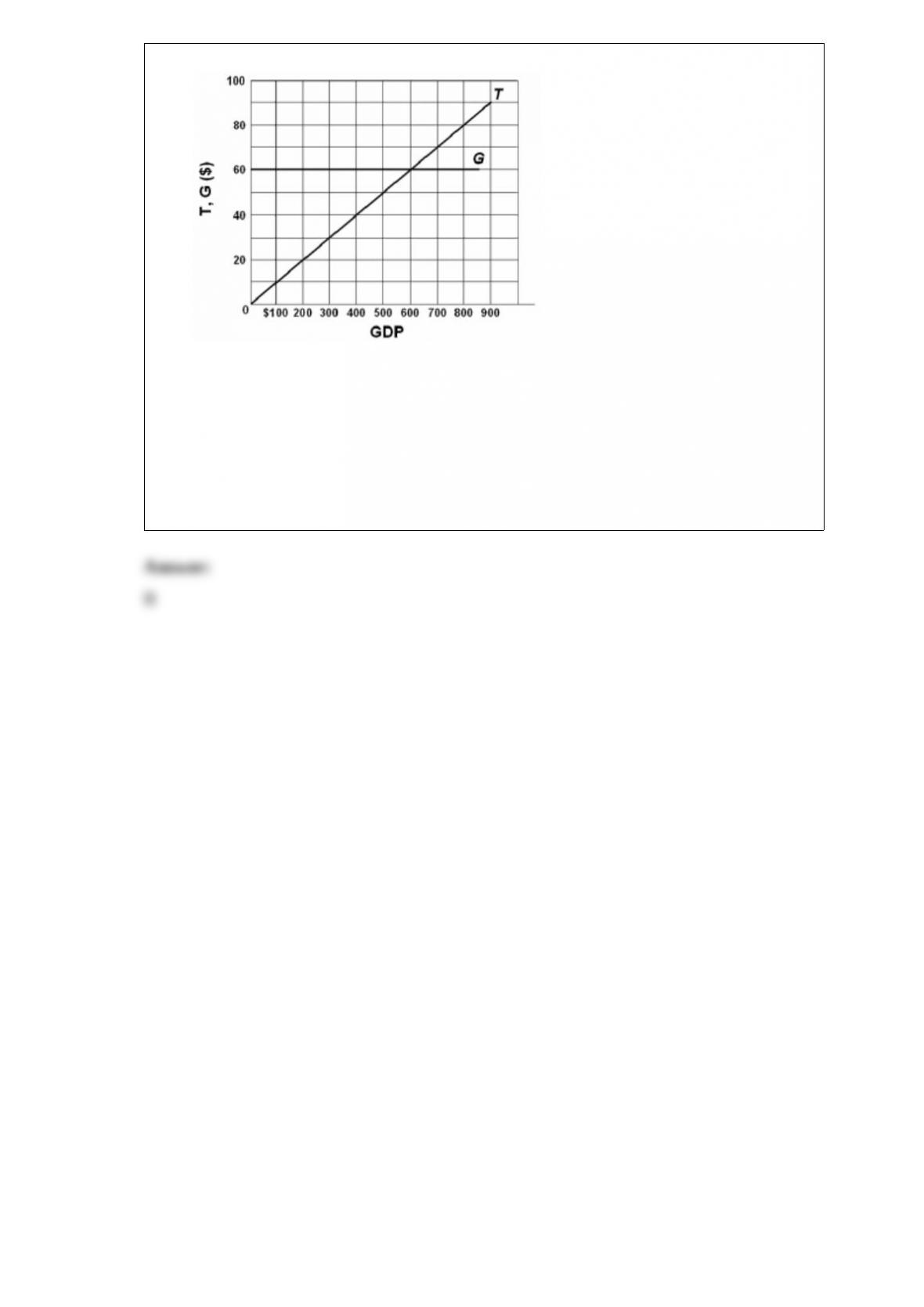
18)
Refer to the above diagram where T is tax revenues and G is government expenditures.
All figures are in billions of dollars. If the full-employment and actual GDP are each
$400 billion, government can balance its standardized budget by:
A.increasing T by $40 billion.
B.reducing G by $20 billion.
C.reducing T by $20 billion.
D.increasing T by $10 billion and reducing G by $20 billion.