
According to the U.S. Treasury,
A) the government will not accept cash in payment of taxes.
B) creditors do not have to accept cash in payment of debts.
C) firms do not have to accept cash as payment for goods and services.
D) U.S. dollars must be accepted as payment for any good or service sold in the United
States.
Among potential stores of value, money
A) offers the highest rate of return.
B) increases in value during periods of inflation.
C) has the advantage of being the most liquid asset.
D) provides more services than the other assets.
If the nominal exchange rate between the American dollar and the New Zealand dollar
is 1.36 New Zealand dollars per American dollar, how many American dollars are
required to buy a product that costs 3.50 New Zealand dollars?
A) $2.14
B) $2.24
C) $2.57

D) $4.76
An increase in aggregate demand in the economy will have what effect on
macroeconomic equilibrium in the long run?
A) The price level will fall, and the level of GDP will rise.
B) The price level will fall, and the level of GDP will fall.
C) The price level will rise, and the level of GDP will fall.
D) The price level will rise, and the level of GDP will be unaffected.
Which of the following will shift the aggregate demand curve to the right, ceteris
paribus?
A) an increase in interest rates
B) a decrease in disposable income
C) a decrease in expected profits for firms
D) an increase in net exports

The more excess reserves banks choose to keep,
A) the larger the deposit multiplier.
B) the smaller the deposit multiplier.
C) the higher the required reserve ratio.
D) the lower the required reserve ratio.
Tanesha sells homemade candles over the Internet. Her annual revenue is $64,000 per
year, the explicit costs of her business are $17,000, and the opportunity costs of her
business are $22,000. What are the implicit costs of her business?
A) $17,000
B) $22,000
C) $39,000
D) $47,000
Countries gain from specializing in producing goods in which they have ________ and
trading for goods in which other countries have ________.

A) a comparative advantage; an absolute advantage
B) an absolute advantage; an absolute advantage
C) a comparative advantage; a comparative advantage
D) an absolute advantage; a comparative advantage
Adverse selection in the market for health insurance arises because
A) many insurance companies care more about profits than they do about providing
services for their customers in the event of illness.
B) the federal government intervenes in insurance markets by controlling prices and
reimbursement policies.
C) insurance companies are not allowed to charge premiums that are high enough to
insure against “worst-case” illness.
D) buyers of insurance know more than insurance companies about the likelihood of an
illness for which buyers want insurance.
The natural rate of unemployment is made up of
A) frictional, cyclical, and structural unemployment.
B) frictional and cyclical unemployment.
C) cyclical and structural unemployment.
D) frictional and structural unemployment.
E) seasonal and structural unemployment.
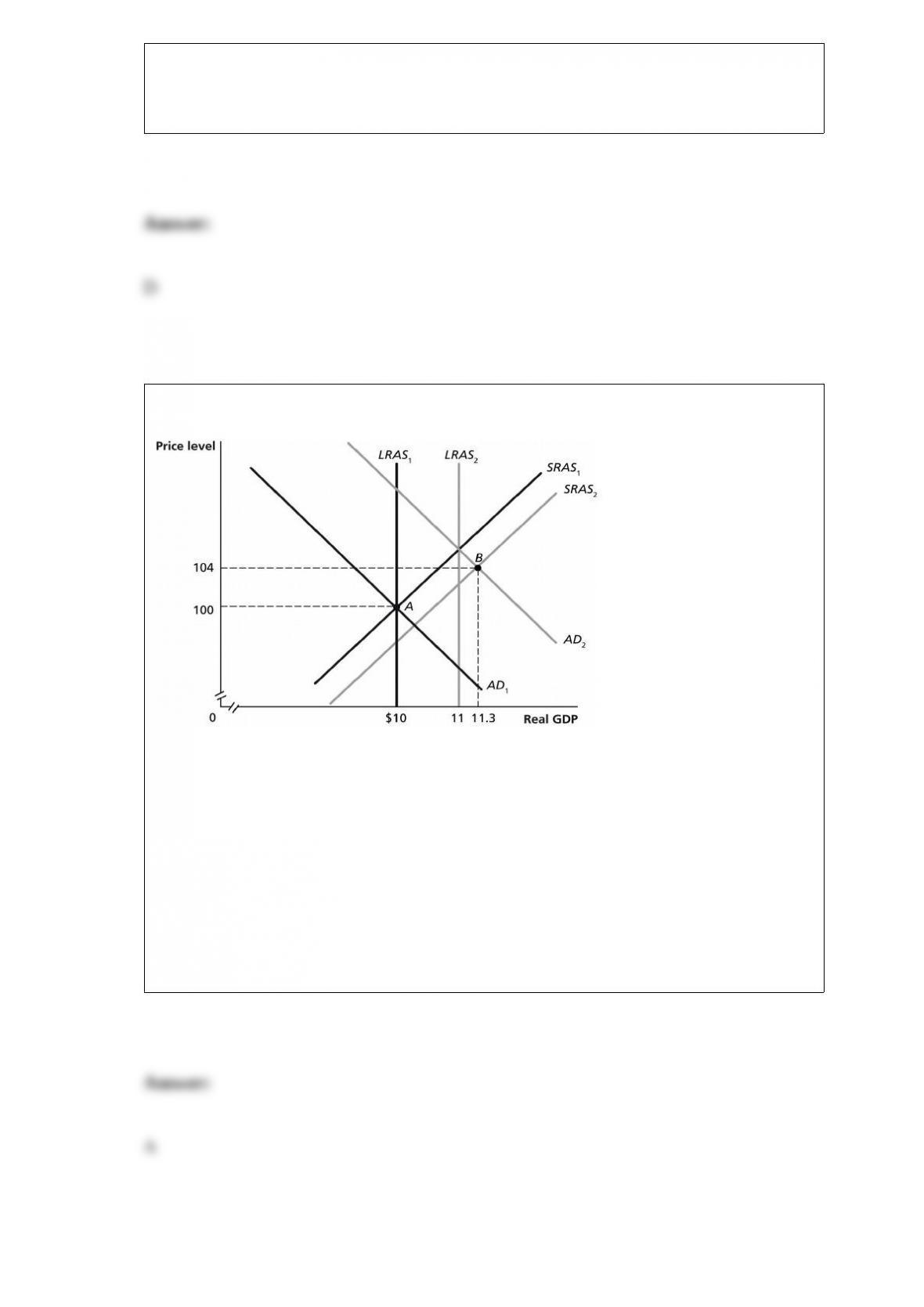
Figure 15-12
Refer to Figure 15-12. In the dynamic AD–AS model, if the economy is at point A in
year 1 and is expected to go to point B in year 2, and the Federal Reserve pursues no
policy, then at point B
A) firms are producing above capacity.
B) there is pressure on wages and prices to fall.
C) the unemployment rate is greater than the natural rate of unemployment.
D) incomes and profits are falling.

According to the “rational expectations” school of thought in macroeconomics, the
short-run Phillips curve is ________ in face of unanticipated changes in monetary
policy.
A) negatively sloped
B) positively sloped
C) vertical
D) horizontal
Figure 13-3
Refer to Figure 13-3. Suppose the economy is at point A. If investment spending
increases in the economy, where will the eventual long-run equilibrium be?
A) A
B) B
C) C
D) D
Dumping refers to
A) selling inferior products to unsuspecting consumers.
B) selling a product for a price below its cost of production.

C) exporting products that do not meet domestic safety standards.
D) illegally avoiding tariffs by selling products on the black market.
The ratio of the increase in equilibrium real GDP to the increase in autonomous
expenditure is called the
A) MPC.
B) multiplier.
C) MPS.
D) consumption function.