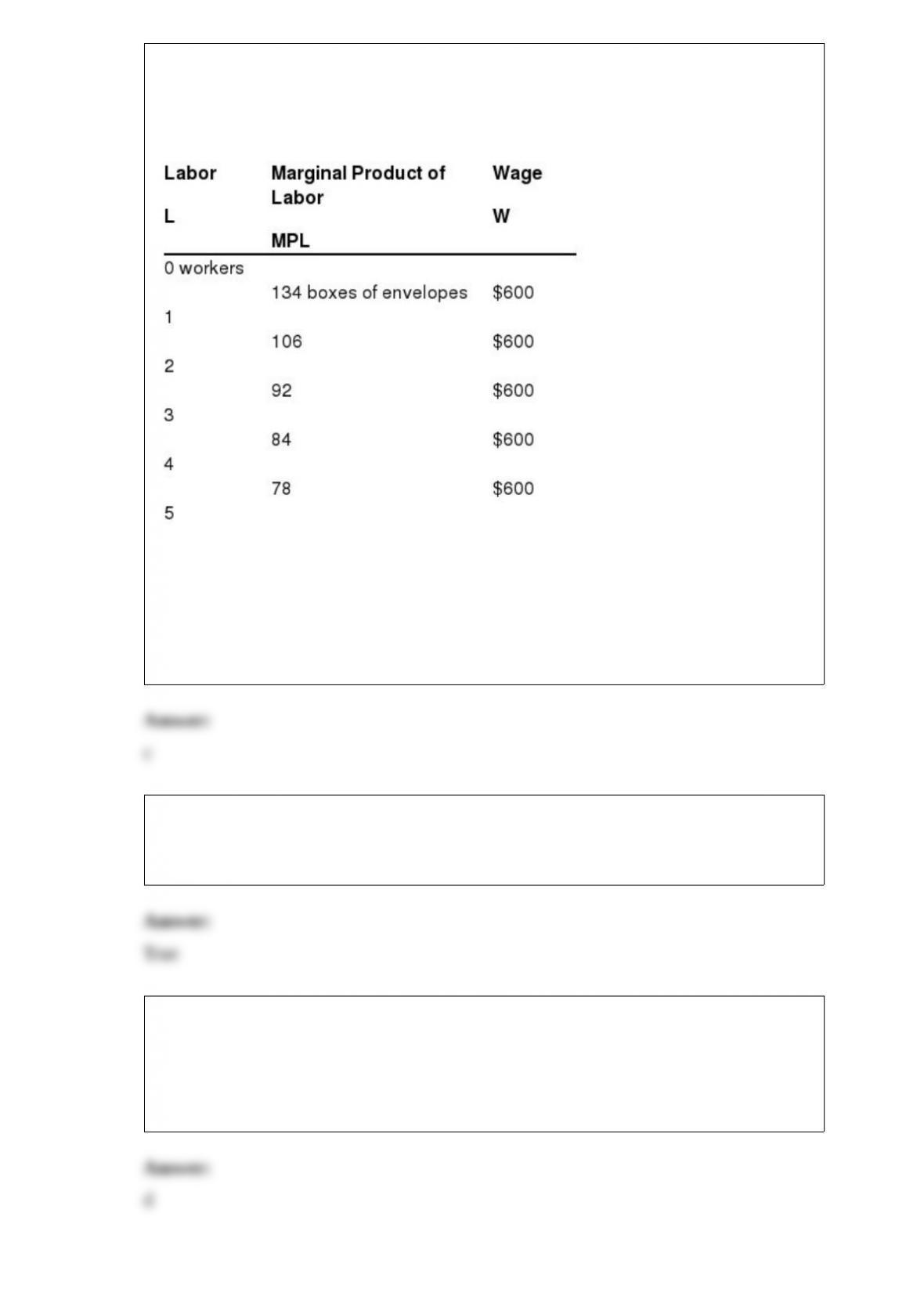
1) Table 18-12
The table displays data for a small, competitive, profit-maximizing firm that produces
and sells envelopes. The time frame is one week.
Refer to Table 18-12. Suppose the firm sells each box of envelopes that it produces for
$6. What is the value of the marginal product of the second worker?
a.$1,440
b.$1,212
c.$636
d.$552
2) A rational person can have a negatively-sloped labor supply curve.
a.True
b.False
3) Trade between countries tends to
a.reduce both competition and specialization.
b.reduce competition and increase specialization.
c.increase competition and reduce specialization.
d.increase both competition and specialization.
4) When a tax is levied on a good,
a.neither buyers nor sellers are made worse off.
b.only sellers are made worse off.
c.only buyers are made worse off.
d.both buyers and sellers are made worse off.
5) The marginal product of an input in the production process is the increase in
a.total revenue obtained from an additional unit of that input.
b.profit obtained from an additional unit of that input.
c.total revenue obtained from an additional unit of that input.
d.quantity of output obtained from an additional unit of that input.
6) Suppose the cost of flying a 200-seat plane for an airline is $100,000 and there are 10
empty seats on a flight. If the marginal cost of flying a passenger is $200 and a standby
passenger is willing to pay $300, the airline should
a.sell the ticket because the marginal benefit exceeds the marginal cost.
b.sell the ticket because the marginal benefit exceeds the average cost.
c.not sell the ticket because the marginal benefit is less than the marginal cost.
d.not sell the ticket because the marginal benefit is less than the average cost.
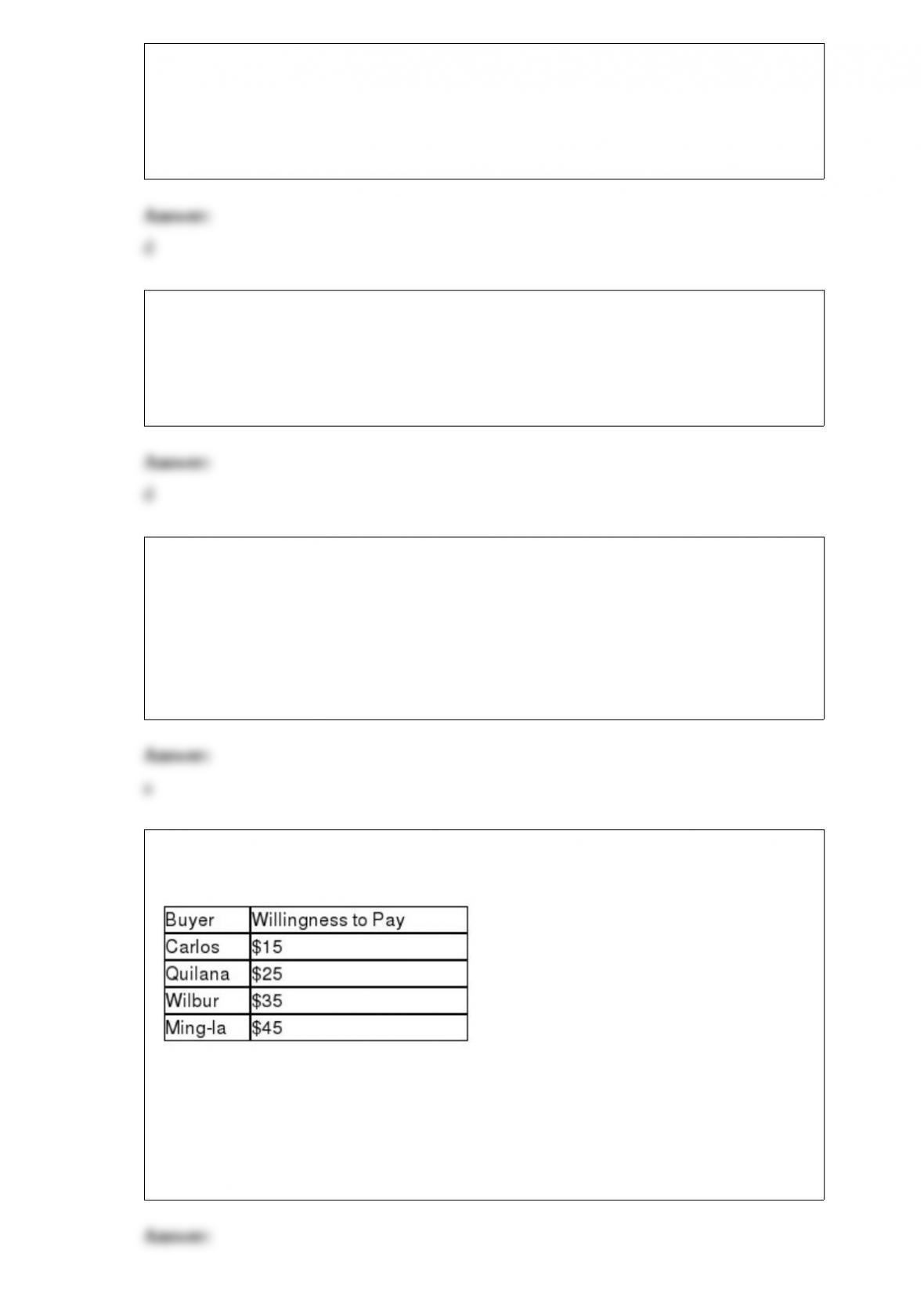
7) Table 7-3
The only four consumers in a market have the following willingness to pay for a good:
Who experiences the largest loss of consumer surplus when the price of the good
increases from $20 to $22?
a.Quilana
b.Wilbur
c.Ming-la
d.All three buyers experience the same loss of consumer surplus.
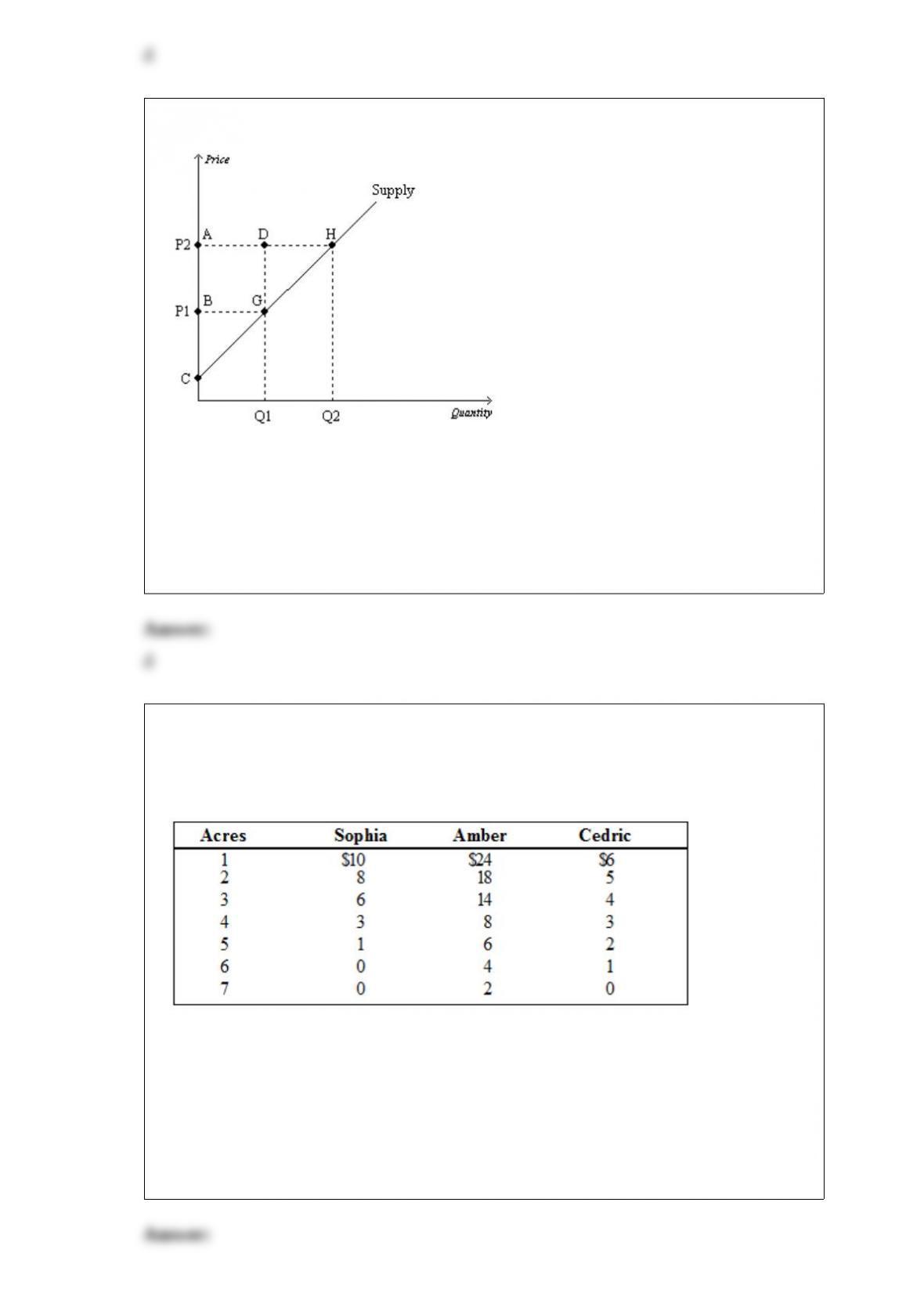
8) Figure 7-10
When the price rises from P1 to P2, which area represents the increase in producer
surplus to existing producers?
a.BCG
b.ACH
c.DGH
d.ABGD
9) Consider the town of Springfield with only three residents, Sophia, Amber, and
Cedric. The three residents are trying to determine how large, in acres, they should
build the public park. The table below shows each resident’s willingness to pay for each
acre of the park.
Suppose the cost to build the park is $24 per acre and that the residents have agreed to
split the cost of building the park equally. To maximize his own surplus, how many
acres would Cedric like Springfield to build?
a.0 acres
b.1 acre
c.2 acres
d.3 acres
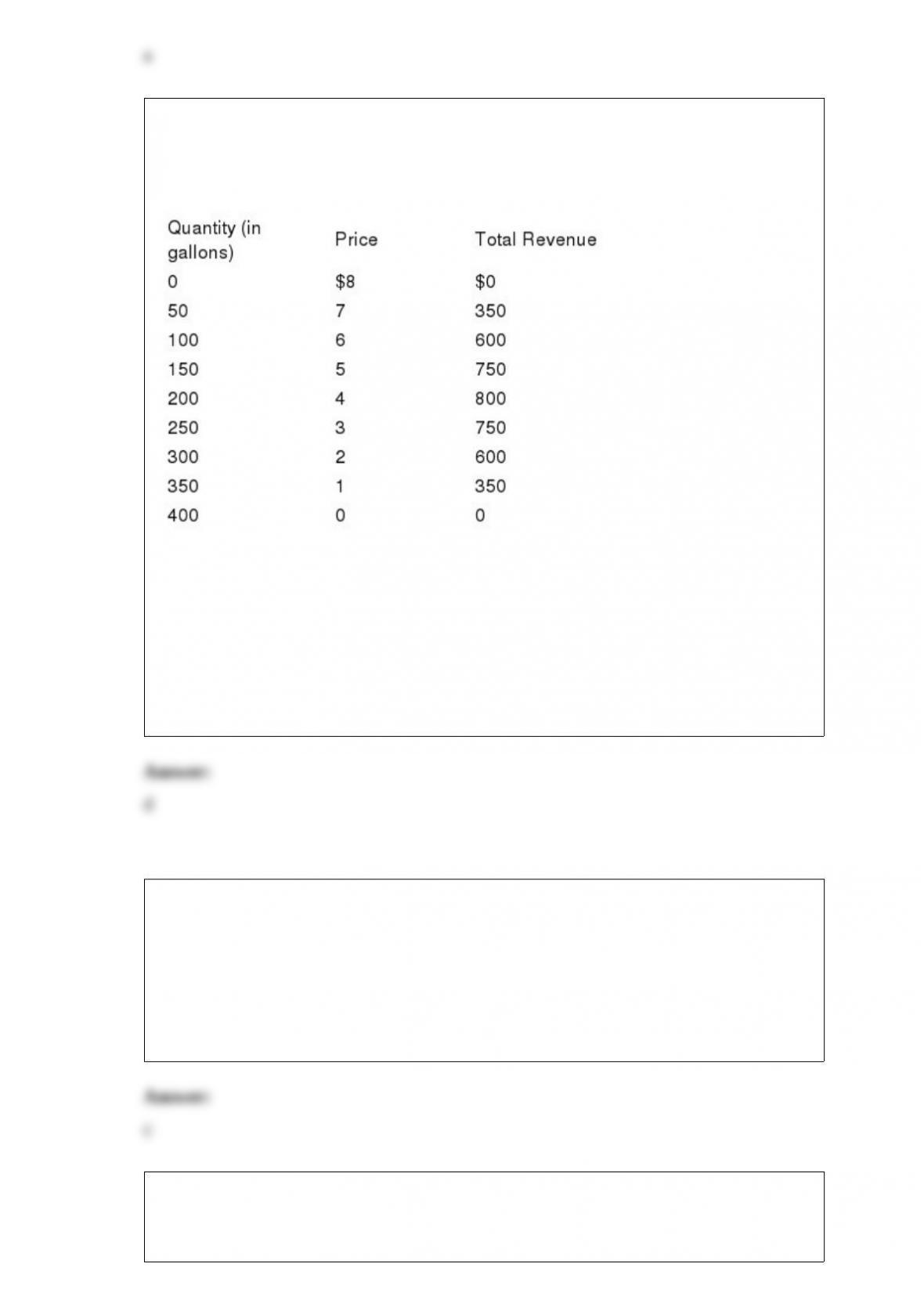
10) Table 17-12
The table shows the town of Driveaway’s demand schedule for gasoline. Assume the
town’s gasoline seller(s) incurs a cost of $2 for each gallon sold, with no fixed cost.
Refer to Table 17-12. Suppose we observe that the price of a gallon of gasoline in
Driveaway is $2. Given this observation, which of the following scenarios is most
likely?
a.There is one seller of gasoline in Driveaway.
b.There are two sellers of gasoline in Driveaway.
c.There are a few sellers of gasoline in Driveaway, but the number of sellers exceeds
two.
d.There are many sellers of gasoline in Driveaway.
11) When the government provides poor families with antipoverty programs such as
welfare, Medicaid, food stamps, and the Earned Income Tax Credit which are all tied to
income,
a.the government creates an egalitarian distribution of income.
b.the recipients can usually receive benefits for an unlimited amount of time.
c.it is common for families to face very high effective marginal tax rates.
d.the incentive to work and earn more income remains unchanged.
12) For a good that is taxed, the area on the relevant supplyanddemand graph that
represents government’s tax revenue is
a.smaller than the area that represents the loss of consumer surplus and producer
surplus caused by the tax.
b.bounded by the supply curve, the demand curve, the effective price paid by buyers,
and the effective price received by sellers.
c.a right triangle.
d.a triangle, but not necessarily a right triangle.
13) The field of behavioral economics builds a more subtle and complex model of
economic behavior using insights from
a.physics.
b.biology.
c.psychology.
d.anthropology.
14) For state and local governments, in 2011, education accounted for approximately
what percentage of spending?
a.25 percent
b.34 percent
c.50 percent
d.75 percent
15) One of the effects of gas prices rising from about $2 to about $4 per gallon was
airlines ordering new, fuel-efficient aircraft.
a.True
b.False
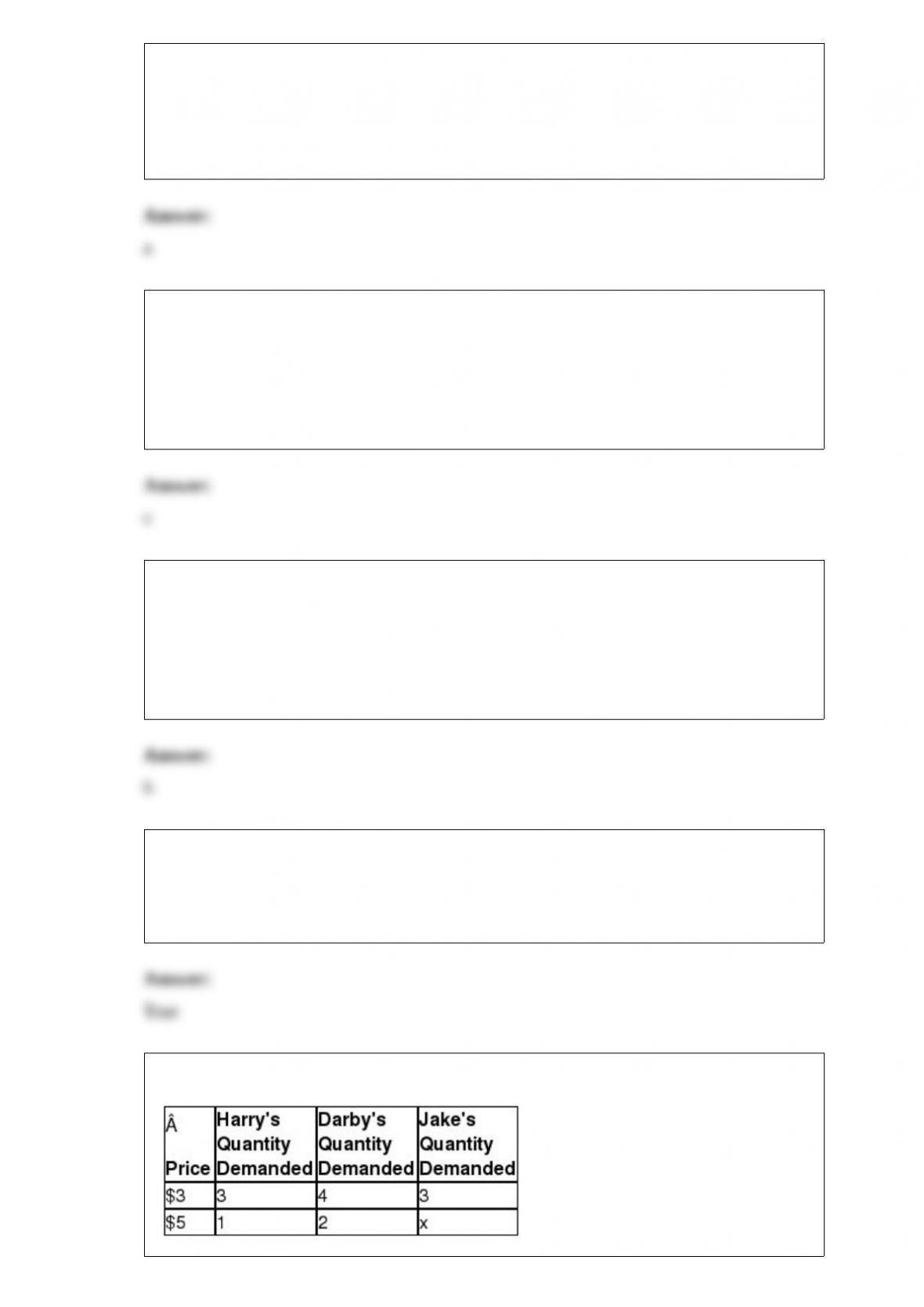
16) The demand schedule below pertains to sandwiches demanded per week.

Suppose x = 1. Then it must be true that
a.Harry and Jake have the same income, which is lower than Darby’s income.
b.if sandwiches and potato chips are complements for Harry, then those two goods are
also complements for Jake.
c.Harry’s demand curve is identical to Jake’s demand curve.
d.All of the above are correct.
17) If households are
buyers in the markets represented by Box C of this circular-flow diagram, then
a.Box C must represent the markets for the factors of production.
b.Box D must represent the markets for goods and services.
c.firms are sellers in the markets represented by Box C.
d.All of the above are correct.
18) Which of the following statements is correct?
a.The average tax rate gauges the sacrifice made by a taxpayer, whereas the marginal
tax rate gauges the distortion of taxes on consumer decisions.
b.The marginal tax rate gauges the sacrifice made by a taxpayer, whereas the average
tax rate gauges the distortion of taxes on consumer decisions.
c.The average tax rate measures how much the tax system discourages people from
working.
d.The marginal tax rate measures total taxes paid divided by total income.
19) Table 14-14
The following table presents cost and revenue information for Bob‘s bakery production
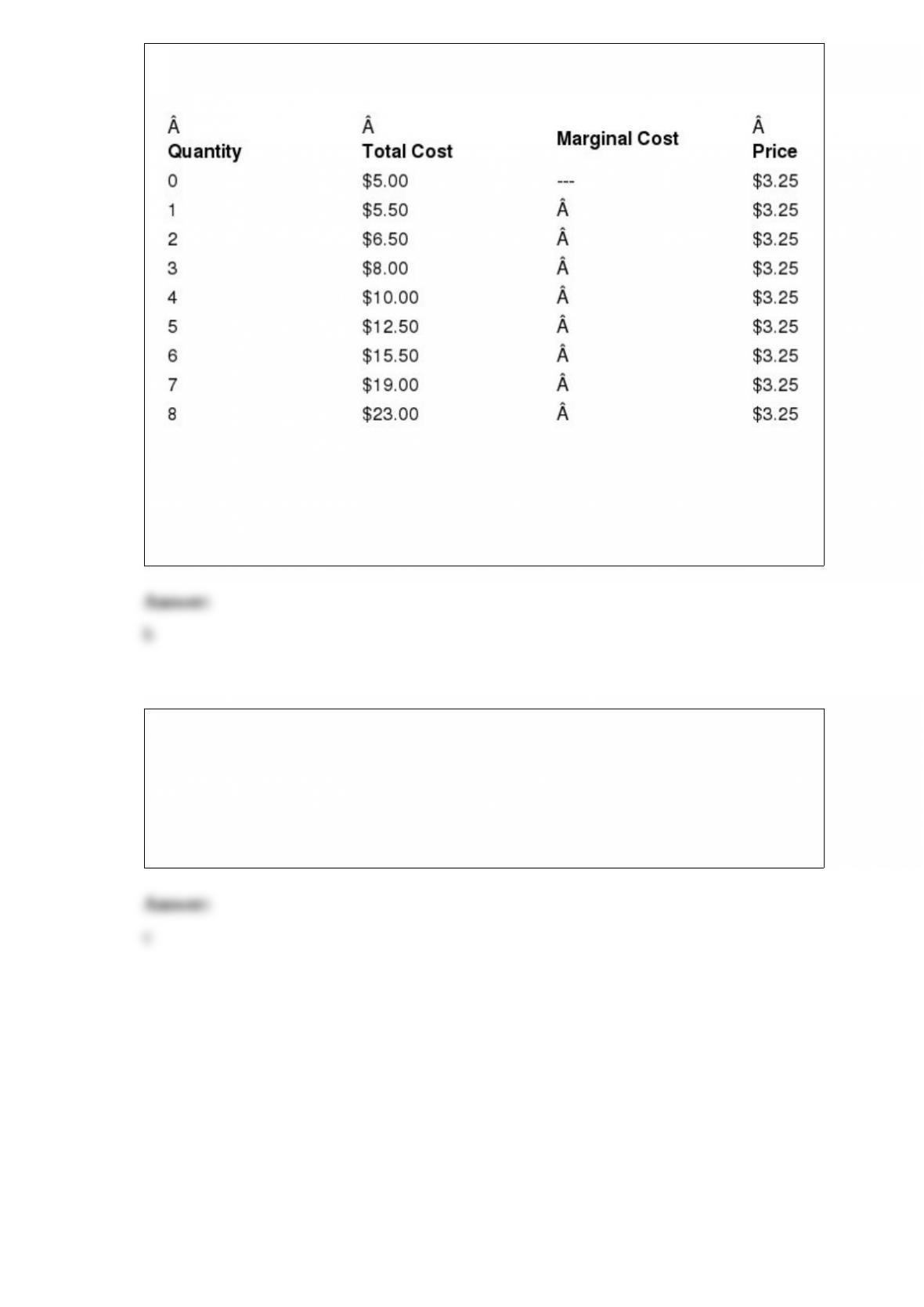
and sales.
What is the marginal revenue of the 4th unit?
a. $2.00
b. $3.25
c. $10.00
d. $13.00
20) For a monopoly, the level of output at which marginal revenue equals zero is also
the level of output at which
a.average revenue is zero.
b.profit is maximized.
c.total revenue is maximized.
d.marginal cost is zero.