Consider two single-malt whiskey distillers, Laphroaig and Knockando. If they
advertise, they can both sell more whiskey and increase their revenue. However, the
cost of advertising more than offsets the increased revenue so that each distiller ends up
with a lower profit than if they do not advertise. On the other hand, if only one
advertises, that distiller increases its market share and also its profit.
a. Construct a payoff matrix using the following hypothetical information: If neither
distiller advertises, each earns a profit of $35 million per year. If both advertise, each
earns a profit of $20 million per year. If one advertises and the other does not, the
distiller who advertises earns a profit of $50 million and the distiller who does not
advertise earns a profit of $9 million.
b. If Laphroaig wants to maximize profit, will it advertise? Briefly explain.
c. If Knockando wants to maximize profit, will it advertise? Briefly explain.
d. Is there a dominant strategy for each distiller? Briefly explain.

What is regulatory capture?
A) It is a situation in which a policy maker seeks to improve his election prospects by
aligning himself with a powerful special interest group which will finance his political
campaign.
B) It is the exchange of political support between a regulatory agency and the regulated
firm resulting in both parties capturing economic rents.
C) It is a situation in which a firm being regulated successfully influences the
regulatory agency’s actions to benefit the interests of the firm, rather than the public
interest.
D) It is a situation in which a regulatory agency uses its authority to force actions that
are not favored by the regulated firms but are in the public’s interest.
Which type of businesses earns the majority of revenues in the United States?
A) corporations
B) partnerships
C) sole proprietorships
D) none of these
Silver is an example of a
A) commodity money.

B) barter money.
C) fiat money.
D) representative money.
Which of the following is not a source of comparative advantage?
A) relative abundance of labor and capital
B) technology
C) climate and natural resources
D) a strong foreign currency exchange rate
Hurricane Katrina destroyed oil and natural gas refining capacity in the Gulf of Mexico.
This subsequently drove up natural gas, gasoline, and heating oil prices. As a result, this
should
A) shift the short-run aggregate supply curve to the left.
B) shift the short-run aggregate supply curve to the right.
C) move the economy up along a stationary short-run aggregate supply curve.
D) move the economy down along a stationary short-run aggregate supply curve.
Which of the following statements is true?
A) A decrease in the crime rate increases GDP as people will spend more on security.
B) Household production is counted in GDP as it amounts to real production.
C) GDP accounting rules do not adjust for production that pollutes the economy.
D) GDP growth distributes income equally to people in the economy.
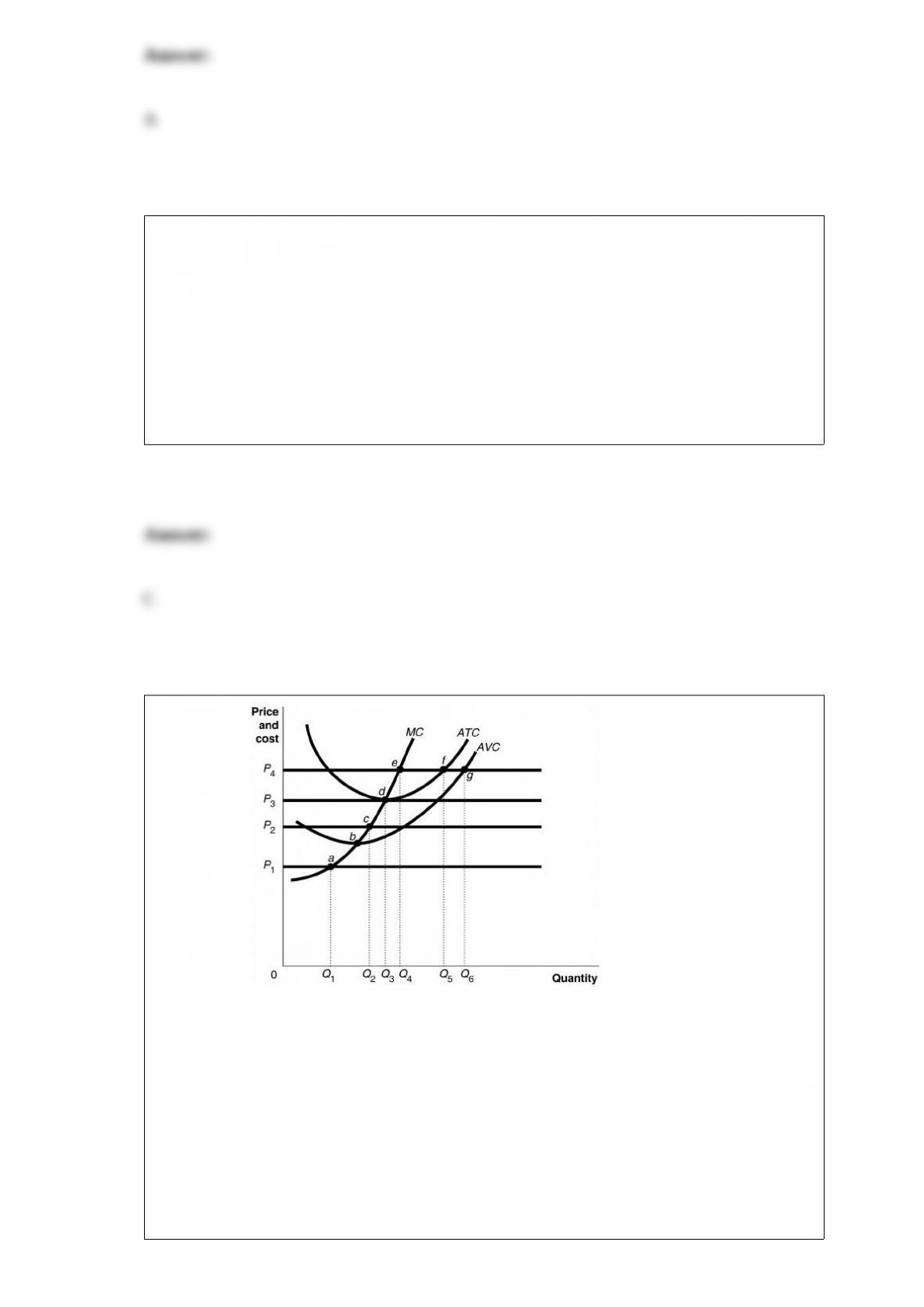
Figure 12-9 Figure 12-9 shows cost and
demand curves facing a profit-maximizing, perfectly competitive firm.
At price P3, the firm would
A) lose an amount equal to its fixed cost.
B) lose an amount more than fixed cost.
C) lose an amount less than fixed cost.

D) break even.
Which of the following is a true statement about the impact of World War II on the U.S.
economy?
A) U.S. GDP decreased dramatically from 1941 to 1945.
B) The war time years were a period of prosperity for U.S. consumers.
C) Less than 10% of the labor force was in the military or producing war goods.
D) Increased production of tanks, ships, planes, and munitions accounted for most of
the increase in GDP.
Economies of scale can lead to an oligopolistic market structure because
A) if larger firms have lower costs, new small entrants will not be able to produce at the
low costs achieved by the big established firms.
B) if economies of scale are insignificant, only a few firms are able to produce at the
low costs achieved by the big established firms.
C) a few firms can force rivals to produce at low levels of output.
D) a few firms can use high profits to keep out new entrants.

If a monopolistically competitive firm lowers its price and, as a result, its total revenue
decreases then
A) the output effect of the price change was less than the price effect.
B) the output effect of the price change was greater than the price effect.
C) the firm’s demand curve must have decreased.
D) the substitution effect of the price change was greater than the income effect.
Consider two single-malt whiskey distillers, Laphroaig and Knockando. If they
advertise, they can both sell more whiskey and increase their revenue. However, the
cost of advertising more than offsets the increased revenue so that each distiller ends up
with a lower profit than if they do not advertise. On the other hand, if only one
advertises, that distiller increases its market share and also its profit.
a. Construct a payoff matrix using the following hypothetical information: If neither
distiller advertises, each earns a profit of $35 million per year. If both advertise, each
earns a profit of $20 million per year. If one advertises and the other does not, the
distiller who advertises earns a profit of $50 million and the distiller who does not
advertise earns a profit of $9 million.
b. If Laphroaig wants to maximize profit, will it advertise? Briefly explain.
c. If Knockando wants to maximize profit, will it advertise? Briefly explain.
d. Is there a dominant strategy for each distiller? Briefly explain.
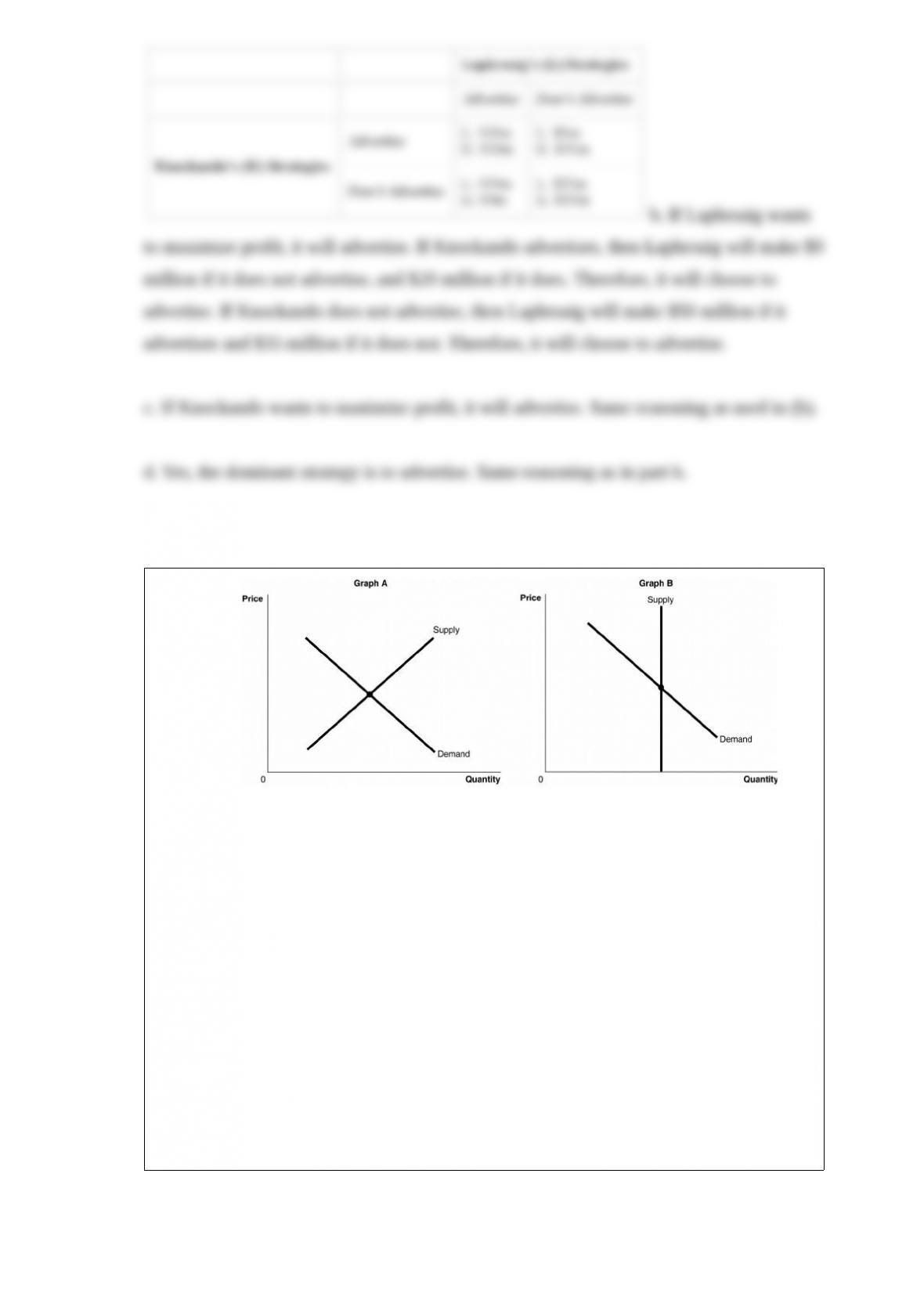
Figure 3-3
The figure above shows the supply and demand curves for two markets: the market for
original Michelangelo sculptures and the market for Ray Ban sunglasses. Which graph
most likely represents which market?
A) Graph B represents the market for original Michelangelo sculptures and Graph A
represents the market for Ray Ban sunglasses.
B) Graph A represents the market for original Michelangelo sculptures and Graph B
represents the market for Ray Ban sunglasses.
C) Graph A represents both the market for original Michelangelo sculptures and Ray
Ban sunglasses.
D) Graph B represents both the market for original Michelangelo sculptures and Ray
Ban sunglasses.

In the United States, health care spending on people over age 65 is ________ on people
aged 18 to 24.
A) one third as much as
B) twice as much as
C) six times greater than
D) forty times greater than
How does an increase in the budget deficit affect the demand for dollars and the supply
of dollars on the foreign exchange market?
A) The demand for dollars falls, and the supply of dollars falls.
B) The demand for dollars rises, and the supply of dollars rises.
C) The demand for dollars rises, and the supply of dollars falls.
D) The demand for dollars falls, and the supply of dollars rises.

Leisure is
A) an inferior good.
B) a complementary good to labor.
C) wasteful to society.
D) a normal good.