
A reduction in the inflation rate would make relative prices
a. less variable, making it more likely that resources will be allocated to their best use.
b. less variable, making it less likely that resources will be allocated to their best use.
c. more variable, making it more likely that resources will be allocated to their best use.
d. more variable, making it less likely that resources will be allocated to their best use.
The inputs into production of goods and services that are provided by nature, such as
land, rivers, and mineral deposits are called
a. physical capital.
b. natural resources.
c. human capital.
d. technological knowledge.
Suppose the income of buyers in a market for an inferior good decreases and a
technological advancement occurs also. What would we expect to happen in the
market?
a. Equilibrium price would decrease, but the impact on equilibrium quantity would be
ambiguous.

b. Equilibrium quantity would increase, but the impact on equilibrium price would be
ambiguous.
c. Equilibrium quantity would decrease, but the impact on equilibrium price would be
ambiguous.
d. None of the above is correct.
Some degree of unemployment is inevitable in a complex economy.
a. True
b. False
Three employers have justified their actions as follows. Whose logic is notconsistent
with the logic of efficiency wage theory?
a. Instead of spending money on an electronic timing system that monitors worker
hours, Tom spends an equivalent amount of money on higher wages.
b. Dick pays his workers less than the equilibrium wage so that they will not have the
time or money to look for work somewhere else.
c. Harry pays his workers in a developing country more than the going wage hoping
that they will get a better diet and so be more productive.

d. None of the above is consistent with the logic of efficiency wage theory.
What will happen to the equilibrium price and quantity of new cars if the price of
gasoline rises, the price of steel rises, public transportation becomes cheaper and more
comfortable, and auto-workers negotiate higher wages?
a. Price will fall, and the effect on quantity is ambiguous.
b. Price will rise, and the effect on quantity is ambiguous.
c. Quantity will fall, and the effect on price is ambiguous.
d. Quantity will rise, and the effect on price is ambiguous.
If the reserve ratio is 20 percent, then $100 of new reserves can generate
a. $60 of new money in the economy.
b. $250 of new money in the economy.
c. $500 of new money in the economy.
d. $2,000 of new money in the economy.

If the tax rate fell, holding municipal bonds would be less desirable so the interest rates
on them would fall.
a. True
b. False
Trade policies
a. alter the trade balance because they alter imports of the country that implemented
them.
b. alter the trade balance because they alter net capital outflow of the country that
implemented them.
c. do not alter the trade balance because they cannot alter the national saving or
domestic investment of the country that implements them.
d. do not alter the trade balance because they cannot alter the real exchange rate of the
currency of the country that implements them.

In the long run, inflation
a. and unemployment are primarily determined by labor market factors.
b. and unemployment are primarily determined by the rate of money supply growth.
c. is primarily determined by the rate of money supply growth while unemployment is
primarily determined by labor market factors.
d. is primarily determined by labor market factors while unemployment is primarily
determined by the rate of money supply growth.
If a bank desires to hold no excess reserves, the reserve requirement is 8 percent, and it
receives a new deposit of $500,
a. its required reserves increase by $40.
b. its total reserves initially increase by $460.
c. it will be able to make a new loan of up to $492.
d. All of the above are correct.
Which of the following is correct?
a. capital flight from the United States decreases net capital outflow

b. an increase in the government budget deficit creates no change in net capital outflow
c. if the U.S. imposes a restriction on imports, net capital outflow increases
d. None of the above is correct.
If the investment accelerator from an increase in government purchases is larger than
the crowding-out effect, then
a. the multiplier is probably zero.
b. the multiplier is probably equal to one.
c. the multiplier is probably greater than one.
d. the multiplier is probably less than one.
If a central bank wants to counter the change in the price level caused by an adverse
supply shock, it could change the money supply to shift
a. aggregate demand right.
b. aggregate demand left.
c. aggregate supply right.
d. aggregate supply left.

Zora can produce 4 quilts in a week and she can produce 1 corporate website in a week.
Lou can produce 9 quilts in a week and he can produce 2 corporate websites in a week.
Zora has the comparative advantage in quilts and the absolute advantage in neither
good, while Lou has the comparative advantage in corporate websites and the absolute
advantage in both goods.
a. True
b. False
To state that national saving is equal to investment, for a closed economy, is to state an
accounting identity.
a. True
b. False

As an alternativeto selling shares of stock as a means of raising funds, a large company
could, instead,
a. invest in physical capital.
b. use equity finance.
c. sell bonds.
d. purchase bonds.
Which of the following is correct concerning opportunity cost?
a. Except to the extent that you pay more for them, opportunity costs should not include
the cost of things you would have purchased anyway.
b. To compute opportunity costs, you should subtract benefits from costs.
c. Opportunity costs and the idea of trade-offs are not closely related.
d. Rational people should compare various options without considering opportunity
costs.
You find that to attract a sufficient number of workers you have to pay them more
dollars. Given the price of your output you determine you are paying your workers
more in goods than before. Which of the following has risen?

a. The real and nominal value of the wages you pay.
b. The real but not the nominal value of wages you pay.
c. The nominal but not the real value of the wages you pay.
d. Neither the real nor the nominal value of the wages you pay.
When a minimum-wage law forces the wage to remain above the level that balances
supply and demand, the result is a shortage of labor.
a. True
b. False
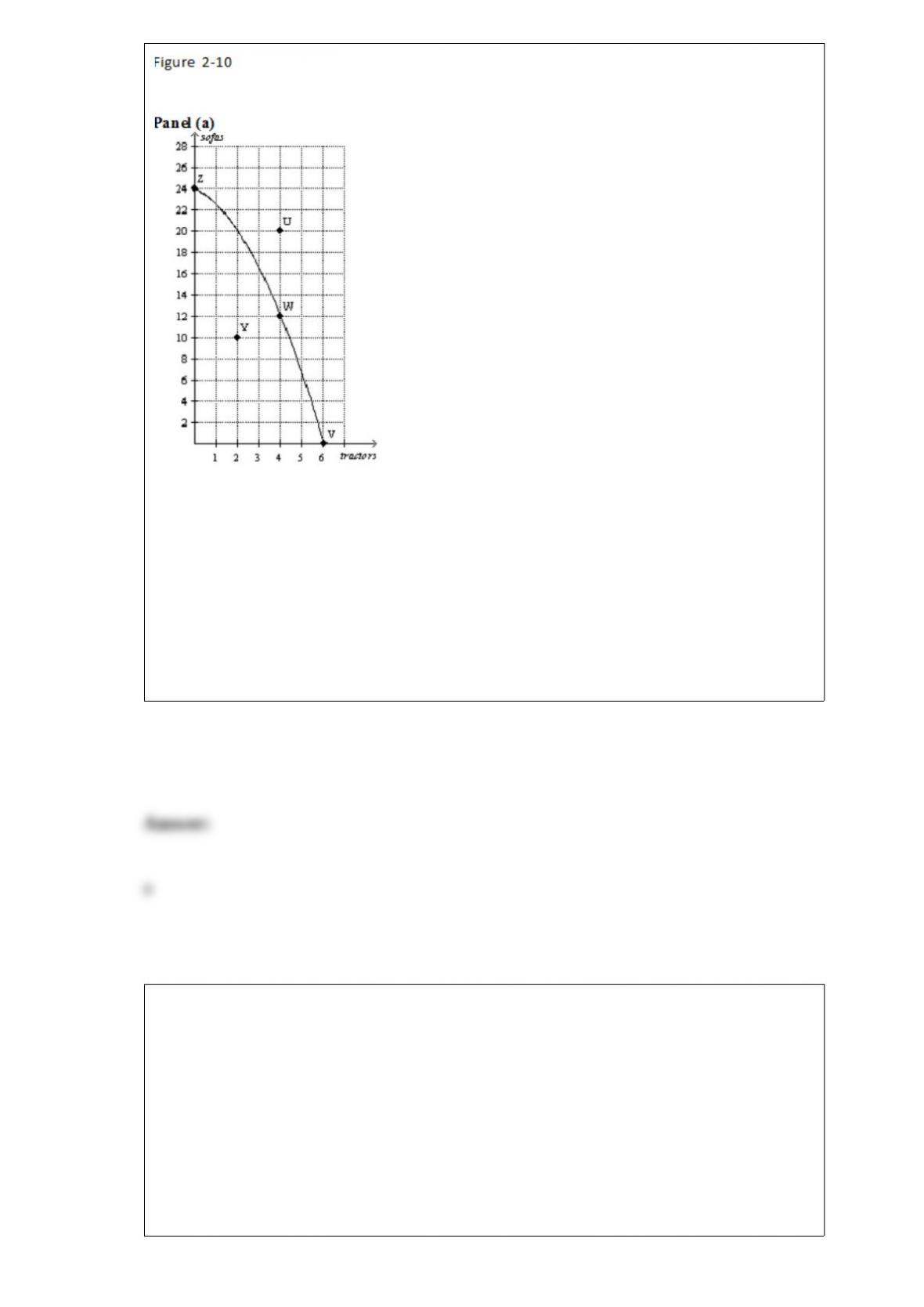
RefertoFigure2-10,Panel(a).Production is
a. possible at points V, W, Y, and Z, but efficient only at points V, W, and Z.
b. possible at points V, W, Y, and Z, but efficient only at point Y.
c. possible at points U, V, W, and Z, but efficient only at points V, W, and Z.
d. possible at points U, V, W, and Z, but efficient only at point U.
Midwestern corporation issues bonds. Southern corporation issues stock. Which
corporation used equity financing?
a. both Midwestern corporation and Southern corporation
b. Midwestern corporation but not Southern corporation
c. Southern corporation but not Midwestern corporation
d. neither Midwestern nor Southern corporation

According to the Fisher effect, if inflation rises then the nominal interest rate rises.
a. True
b. False
If the Fed wants to reverse the effects of an adverse supply shock on unemployment, it
should
a. increase the money supply growth rate which raises the inflation rate.
b. increase the money supply growth rate which reduces the inflation rate.
c. decrease the money supply growth rate which raises the inflation rate.
d. decrease the money supply growth rate which reduces the inflation rate.

The nominal exchange rate is .80 euros per U.S. dollar and a basket of goods in France
costs 1,000 euros while the same basket costs $800 in the U.S. The nominal exchange
rate is 1.2 Australian dollars per U.S. dollar and a basket of goods in Australia costs 960
Australian dollars while the same basket costs $800 in the U.S.. Which country has
purchasing-power parity with the U.S.?
a. both France and Australia
b. France but not Australia
c. Australia but not France
d. neither France nor Australia
Consider two individuals Marquis and Serena each of whom would like to wear
sweaters and eat tasty food. The gains from trade between Marquis and Serena are most
obvious in which of the following cases?
a. Marquis is very good at knitting sweaters and at cooking tasty food, but Serena’s
skills in both of these activities are very poor.
b. Marquis and Serena both are very good at cooking tasty food, but neither has the
necessary skills to knit a sweater.
c. Marquis’s cooking and knitting skills are very poor, and Serena’s cooking and knitting
skills are also very poor.
d. Marquis’s skills are such that he can produce only sweaters, and Serena’s skills are
such that she can produce only tasty food.
Which of the following statements is correct about the extent of disagreement among
economists?
a. There is a great deal of agreement among economists on virtually every economic
issue.
b. There is a great deal of agreement among economists on many important economic
issues.
c. All disagreements among economists are attributable to differences in their values.
d. All disagreements among economists are attributable to the fact that different
economists have different degrees of faith in the validity of alternative economic
theories.
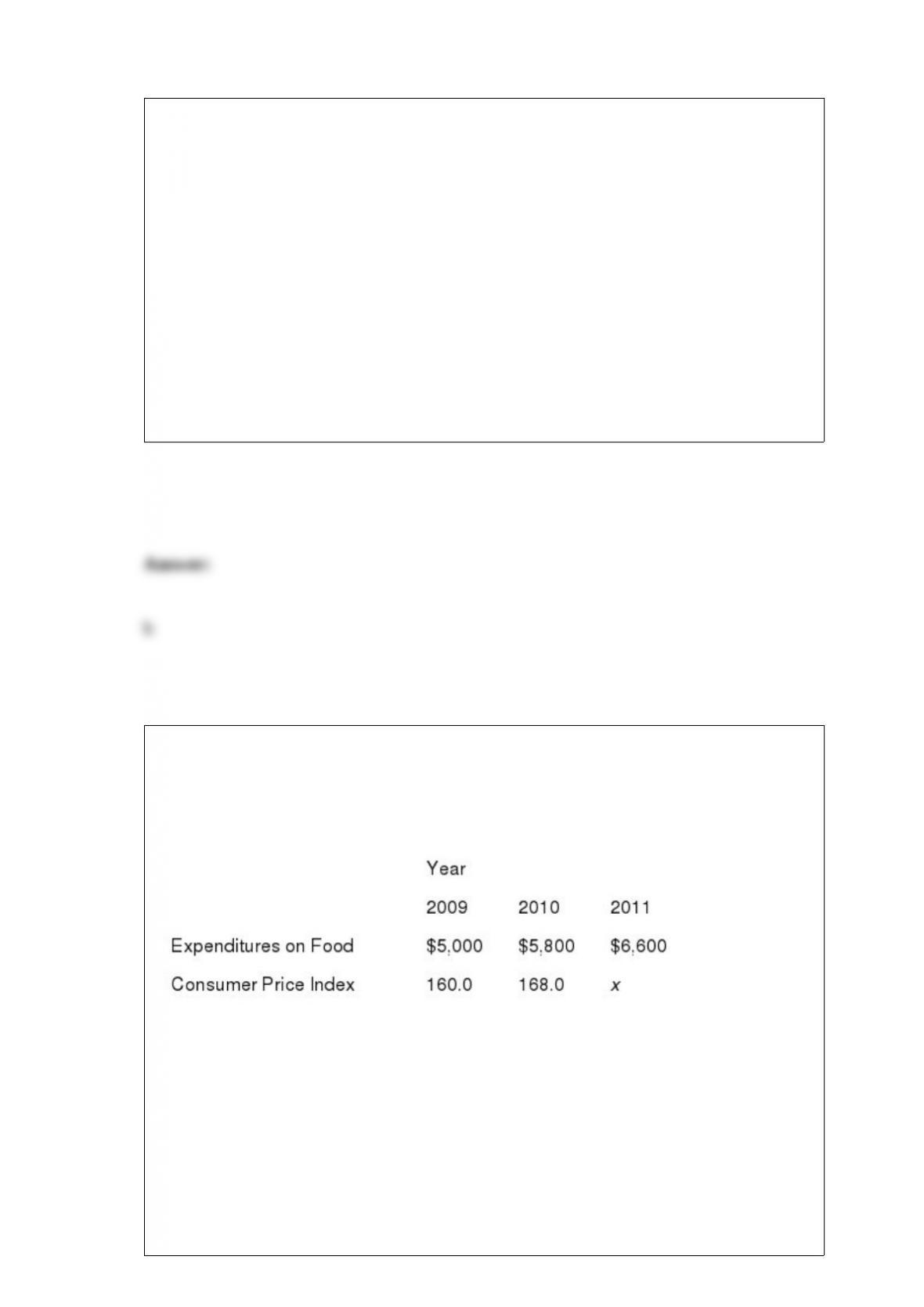
Table24-12.Will’s expenditures on food for three consecutive years, along with other
values, are presented in the table below.
RefertoTable24-12.Suppose Will’s 2009 food expenditures in 2011 dollars amount to
$5,750. Then the inflation rate for 2011 is about
a. 9.08 percent.
b. 9.52 percent.
c. 10.24 percent.
d. 10.78 percent.
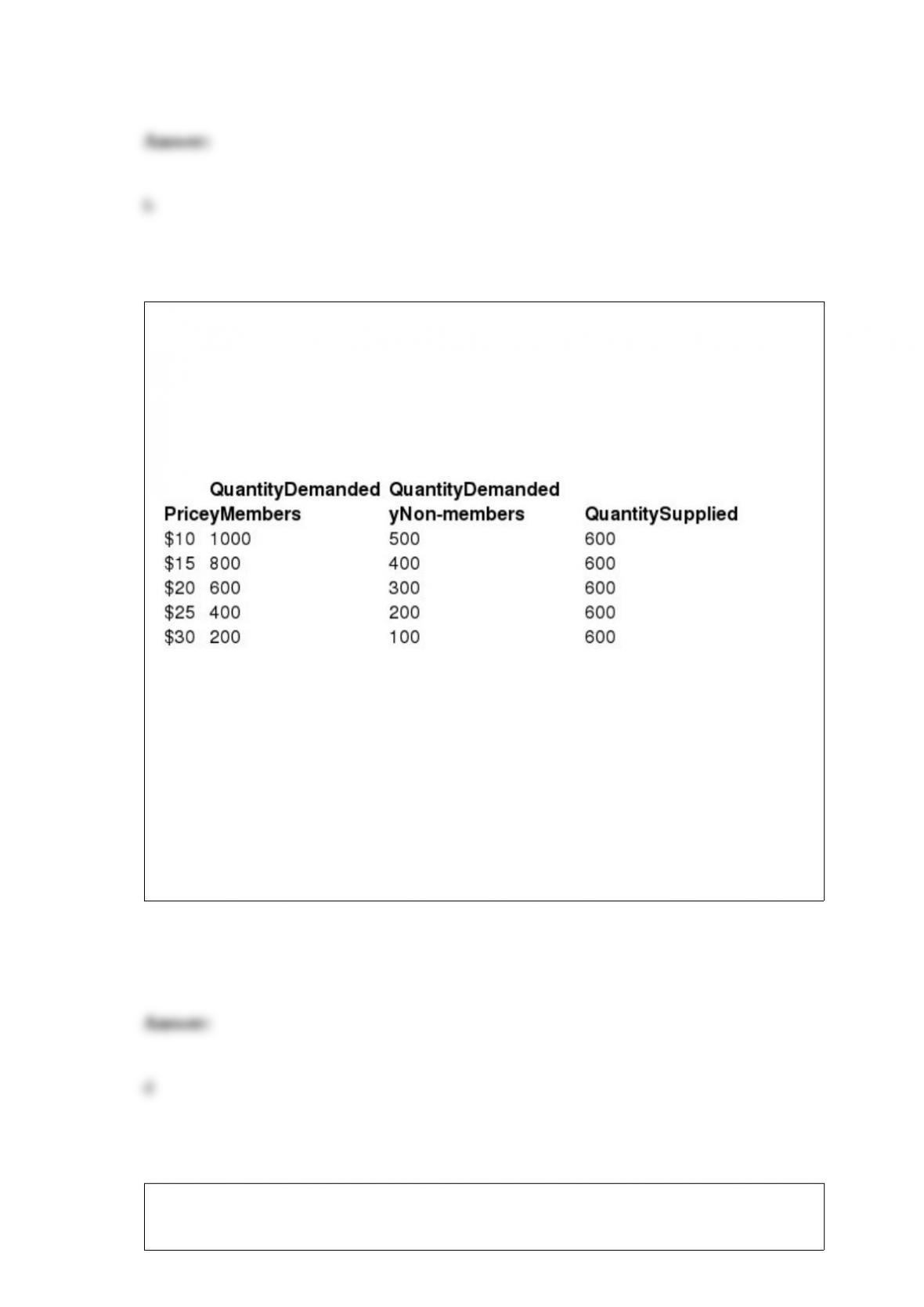
Table 4-12
A country club usually only allows members to purchase tickets for its celebrity golf
tournament, but the club is considering allowing non-members to purchase tickets this
year. The demand and supply schedules are as follows:
RefertoTable4-12.If both members and non-members are allowed to purchase tickets
to this year’s celebrity golf tournament, then what will be the equilibrium price?
a. $10
b. $15
c. $20
d. $25
Which of the following is upward-sloping?

a. both the long-run and the short-run Phillips curve
b. neither the long-run nor the short-run Phillips curve
c. the long-run Phillips curve, but not the short-run Phillips curve
d. the short-run Phillips curve, but not the long-run Phillips curve
Measuring unemployment is the job of the
a. Congressional Budget Office.
b. Department of Commerce.
c. Council of Economic Advisers.
d. Bureau of Labor Statistics.
In an open economy, gross domestic product equals $1,970 billion, government
expenditure equals $300 billion, investment equals $500 billion, and net capital outflow
equals $280 billion. What is consumption expenditure?
a. $280 billion
b. $780 billion
c. $890 billion
d. $1,170 billion
Which of the following is nota characteristic of a perfectly competitive market?
a. Sellers set the price of the product.
b. There are many sellers.
c. Buyers must accept the price the market determines.
d. All of the above are characteristics of a perfectly competitive market.
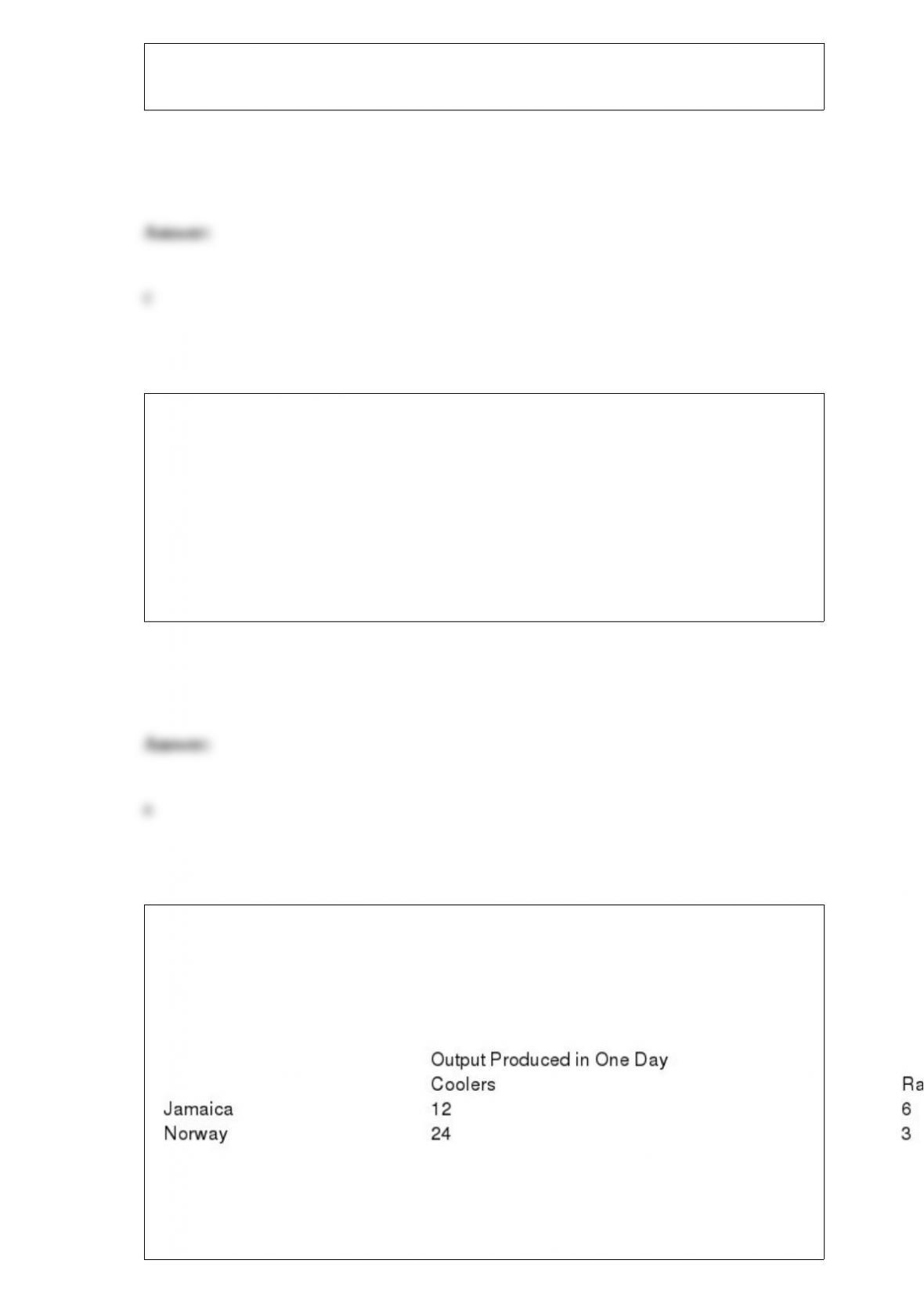
Table 3-21
Assume that Jamaica and Norway can switch between producing coolers and producing
radios at a constant rate. The following table shows the number of coolers or number of
radios each country can produce in one day.
RefertoTable3-21.Jamaica has a comparative advantage in the production of
a. coolers and Norway has a comparative advantage in the production of radios.

b. radios and Norway has a comparative advantage in the production of coolers.
c. both goods and Norway has a comparative advantage in the production of neither
good.
d. neither good and Norway has a comparative advantage in the production of both
goods.