
A perfectly competitive firm breaks even at a price equal to its minimum average total
cost.
Answer:
Peanut butter and jelly are complements. If the price of peanut butter increases, the
demand for jelly will increase.
Answer:
Suppose at a price of $50, Yoshi’s Jazz Bar sells 20 tickets to its nightly jazz
performance and at a price of $40, it sells 25 tickets. Based on this information, the
demand for Yoshi’s jazz performance is elastic.
Answer:
Monopolistically competitive firms face a perfectly elastic demand curve.
Answer:

An decrease in quantity supplied is represented by a leftward shift of the supply curve.
Answer:
If the equilibrium exchange rate exceeds the par exchange rate in the market for
pounds, the pound is overvalued.
Answer:
A decrease in liabilities will reduce a firm’s net worth.
Answer:
According to Porter’s Five Competitive Forces Model, similar products produced by
different firms within the industry affects a firm’s ability to raise prices far more than
substitutable products produced outside the industry.
Answer:

When a tax on output is imposed to internalize the external costs of pollution, the
supply curve shifts down by the amount of the tax.
Answer:
If a monopolist’s marginal revenue is $15 per unit and its marginal cost is $25, then to
maximize profit the firm should decrease output.
Answer:
The change in consumption divided by the change in disposable income is equal to
A) the slope of the consumption function.
B) aggregate expenditure.
C) household saving.
D) real GDP.
Answer:
In response to the destructive bank panics of the Great Depression, future bank panics

are designed to be prevented by
A) the Federal Reserve System acting as a lender of last resort.
B) the Federal Reserve System conducting open market operations.
C) the establishment of the Federal Deposit Insurance Corporation.
D) establishing a fractional reserve system of banking.
E) increasing the required reserve ratio to 100%.
Answer:
Long-run economic profits would most likely exist in which market structure?
A) monopoly, monopolistic competition and oligopoly
B) monopoly and oligopoly
C) monopoly and monopolistic competition
D) monopoly only
Answer:
Reducing the marginal tax rate on income will
A) reduce the tax wedge faced by workers and increase labor supplied.
B) raise the return to entrepreneurship and encourage the opening of new businesses.
C) increase the after-tax return on saving, and encourage saving.
D) All of the above are correct.
Answer:
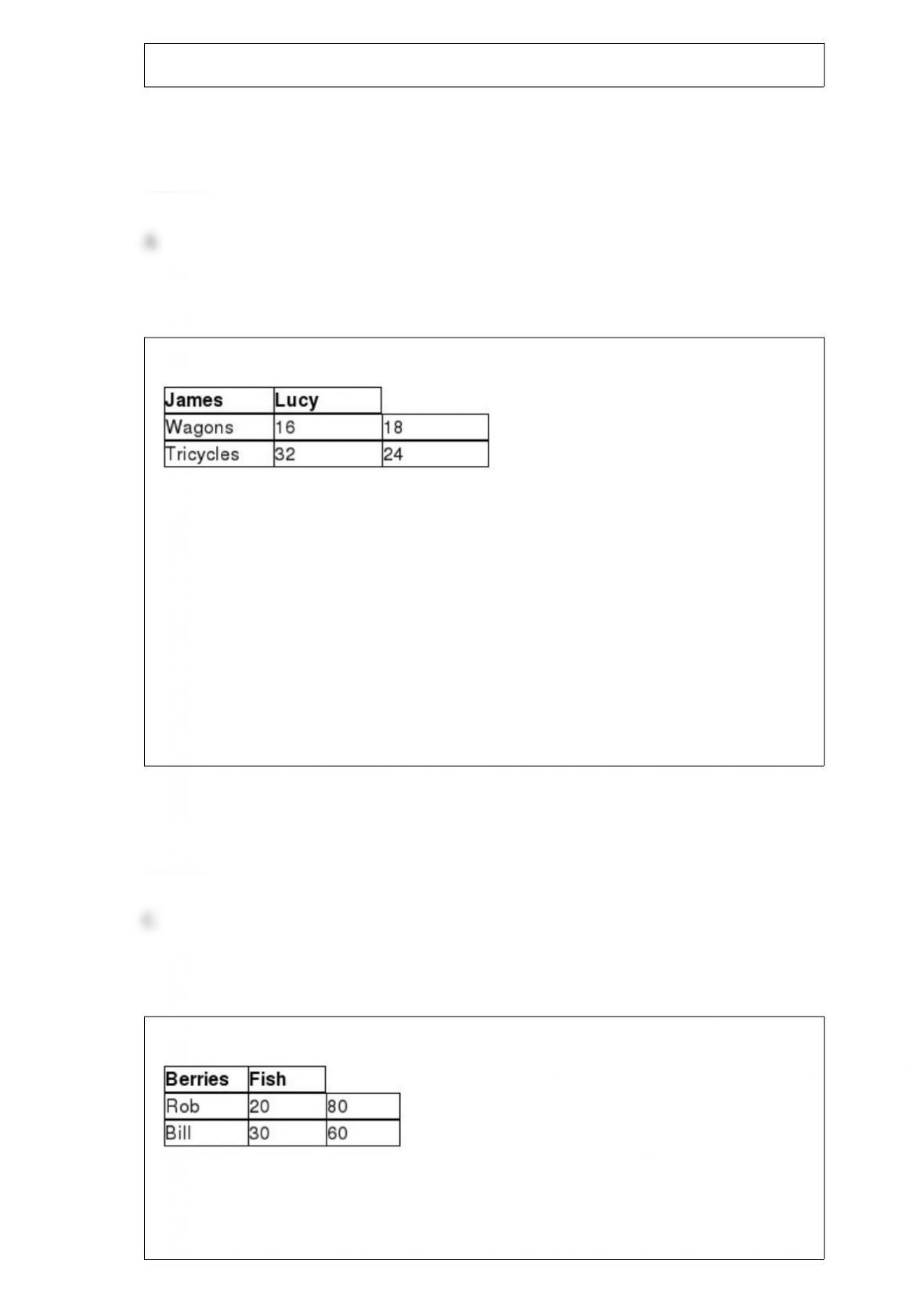
Table 2-17
Table 2-17 shows the output per week of two people, James and Lucy. They can either
devote their time to making wagons or making tricycles.
Which of the following statements istrue?
A) Lucy has an absolute advantage in making both products.
B) James has an absolute advantage in making both products.
C) Lucy has an absolute advantage in making wagons and James in making tricycles.
D) James has an absolute advantage in making tricycles and Lucy in making wagons.
Answer:
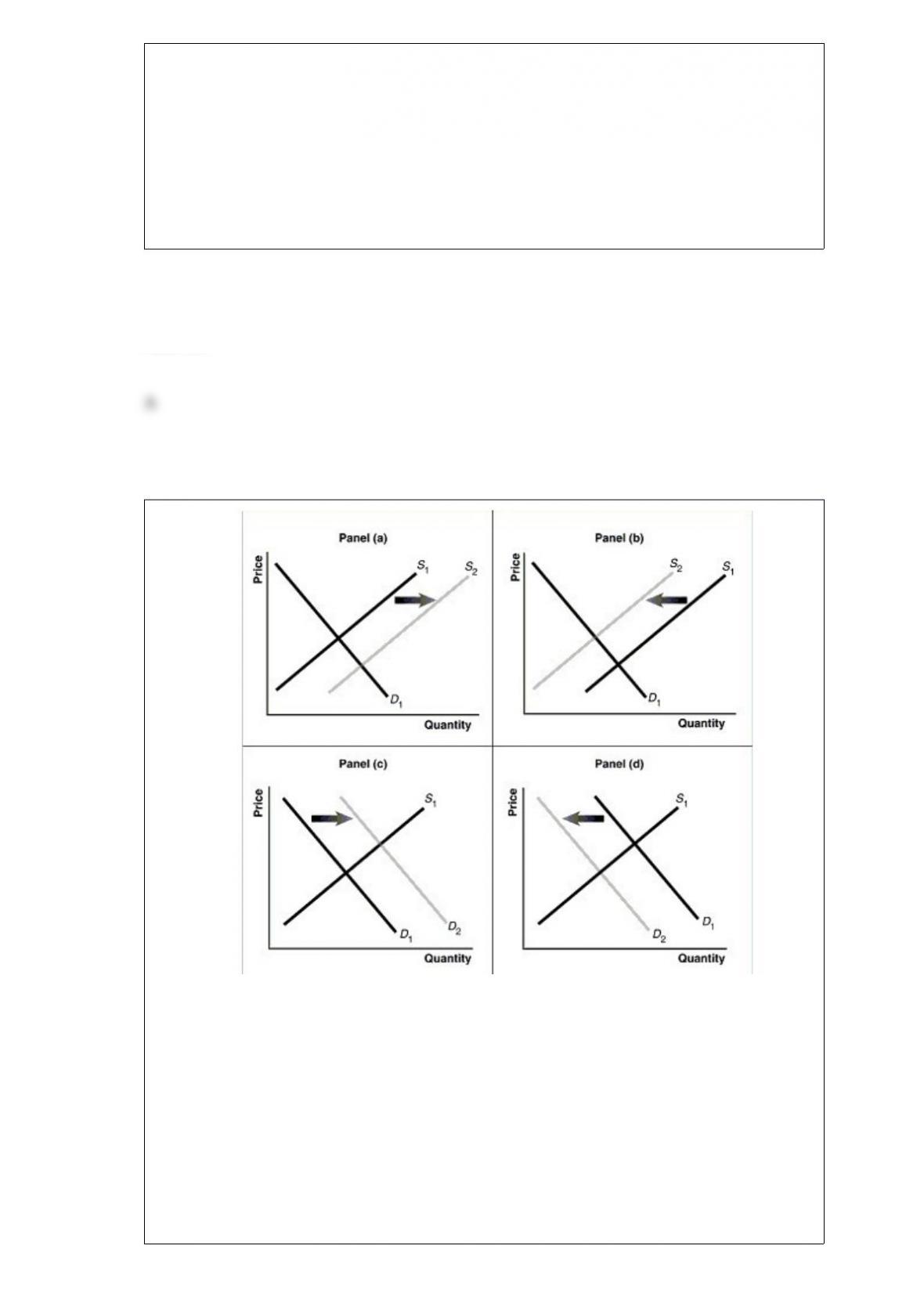
Table 9-4
Rob Crusoe and Bill Friday spent their week-long vacation on a desert island where
they had to find and make their own food. Rob and Bill spent one day each fishing and
picking berries. The table lists the pounds of output Rob and Bill produced. Use the
table above to select the statement that accurately interprets the data in the table.
A) Rob has a comparative advantage in catching fish.
B) Bill has an absolute advantage in catching fish.
C) Bill has a comparative advantage in catching fish.
D) Rob has a comparative advantage in picking berries and catching fish.
Answer:
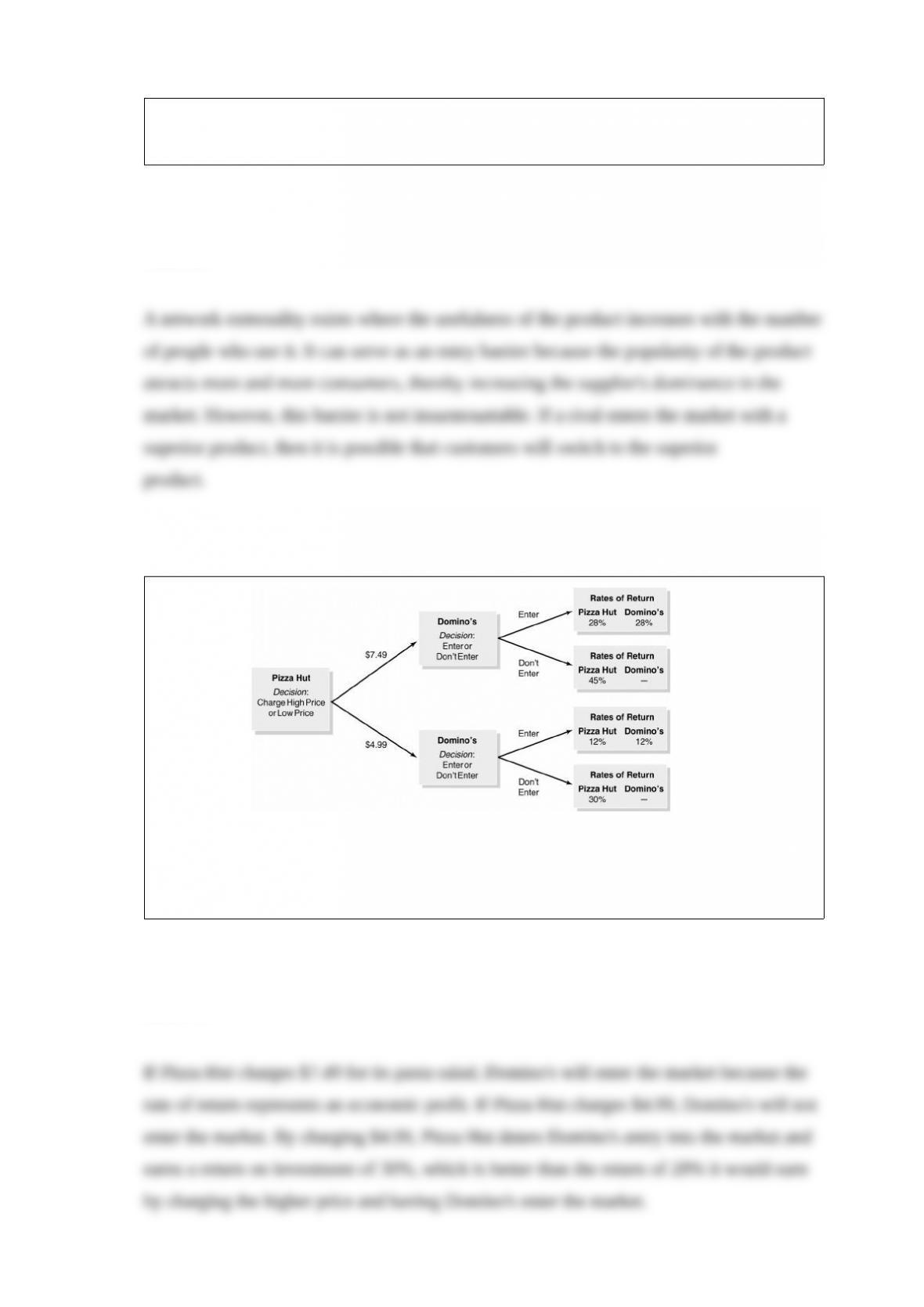
Figure 3-7
Assume that the graphs in this figure represent the demand and supply curves for
mustard and that bratwurst and mustard are complements. Which panel describes what
happens in this market when the price of bratwurst falls?
A) Panel (a)
B) Panel (b)
C) Panel (c)

D) Panel (d)
Answer:
Equations for C, I, G, and NX are given below. If the equilibrium level of GDP is
$21,500, what is the marginal propensity to consume? C = 1,500 + (MPC)Y
I = 1,000
G = 2,000
NX = -200 A) 0.67
B) 0.75
C) 0.8
D) 0.9
Answer:
Unlike firms that sell stock in financial markets, which are known as ________ firms,
companies which do not sell stock in financial markets are known as ________ firms.
A) public; private
B) open; closed
C) corporate; proprietary
D) stock market; bond market
Answer:

If firms sell exactly what they expected to sell, all of the following will be true except
A) aggregate expenditure will be greater than GDP.
B) there is no unplanned change in inventories.
C) inventories will not change, and GDP and employment will remain stable.
D) aggregate expenditure will be equal to GDP.
Answer:
A bank’s liabilities are
A) things owned by or owed to the bank.
B) things the bank owes to someone else.
C) a measure of the bank’s net losses.
D) included as part of the bank’s reserves.
Answer:
The major shortcoming of a barter economy is
A) the requirement of a double coincidence of wants.
B) the requirement of specialization and exchange.

C) that goods and services are not traded.
D) that money loses value from inflation.
Answer:
Economists estimated that the cross-price elasticity of demand for beer and wine is
-0.83 and the income elasticity of wine is 5.03. This means that
A) beer and wine are substitutes and wine is an inferior good.
B) beer and wine are complements and wine is a luxury good.
C) beer and wine are substitutes and wine is a luxury good.
D) beer and wine are complements and wine is an inferior good.
Answer:
Cigars are becoming increasingly popular in the United States, and a growing number
of cigar manufacturers in the Caribbean and Central America have begun producing and
exporting cigars to the U.S. market. How has this affected the equilibrium price and
quantity of cigars?
Answer:
How does a network externality serve as a barrier to entry? Is this barrier
surmountable? Explain.
Answer:
Figure 14-6
Use the decision tree to determine whether Pizza Hut should deter Domino’s from
entering the market for pasta salad. Assume that each firm must earn a 25% return on
investment to break even. Explain Pizza Hut’s decision process.
Answer:
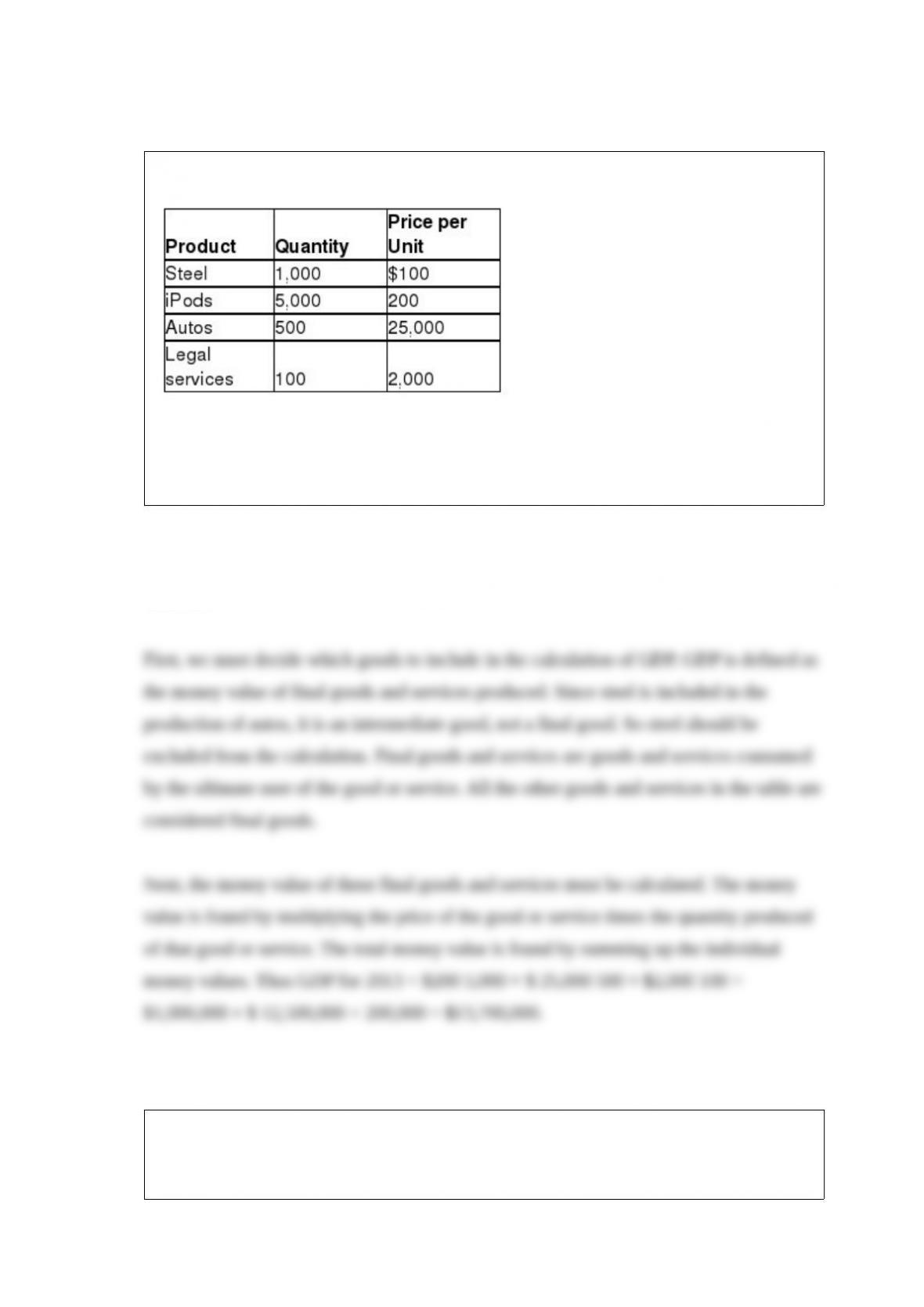
Table 19-9
Suppose that the above table represents the goods and services produced in a very
simple economy in 2013. Assume that steel is used as an input in the production of
autos. Using that information, calculate GDP for the year 2013.
Answer:
What economic impact would the closing of a nearby military base have on a town?
Would people and businesses that did not directly deal with the military personnel be
affected?
Answer:
Use the money demand and money supply model to show graphically and explain the
effect on interest rates of the Federal Reserve’s open market purchase of Treasury
securities.
Answer:
Explain how market economies are generally better able to achieve technological
progress than are centrally planned economies.
Answer:
What is an economic variable? Give an example of an economic variable.
Answer:
One of the results of Paul Romer’s new growth theory is that investment in research and
development will be too low in an economy. Explain how he comes to this conclusion.
Answer:
What does the phrase “Keynesian revolution” refer to?
Answer: