
All else equal, as the price of a product falls, the quantity supplied increases.
As the number of firms in a market increases, the supply curve will shift to the right and
the equilibrium quantity will rise.
Increasing a fixed exchange rate is called a revaluation.
In the United States, partnership profits are taxed at the business level and then are
taxed again as personal income in the form of dividend payments.

A product is considered to be excludable if it is jointly owned by all members of a
community.
For a profit-maximizing monopolistically competitive firm, for the last unit sold, the
marginal cost of production is less than the marginal benefit received by a customer
from the purchase of that unit.
Crude oil is not an example of a factor of production, but when crude oil is processed
into gasoline, it is a factor of production.
In order to maintain an undervalued yuan to encourage a trade surplus, the Chinese
government must buy dollars and increase the supply of yuan.

In the short run, a profit-maximizing firm will shut down if its total revenue is greater
than its variable costs.
Using cross-sectional data from the two Housing Assistance Supply Experiment
(HASE) sites€Brown County, Wisconsin, and St. Joseph County, Indiana, John Mulford
of Rand Research estimates that the long-run “permanent” income elasticity of housing
expenditures to be 0.45 for owners. Using this information, what is likely to happen to
housing expenditures if the government increases income transfers to recipients in
HASE sites?
A) Housing expenditures will increase significantly.
B) Housing expenditures in HASE sites significantly will fall as recipients moved out
of these areas to higher-income areas.
C) Housing expenditures will increase, but not significantly.
D) Housing expenditures will decrease by a small amount.
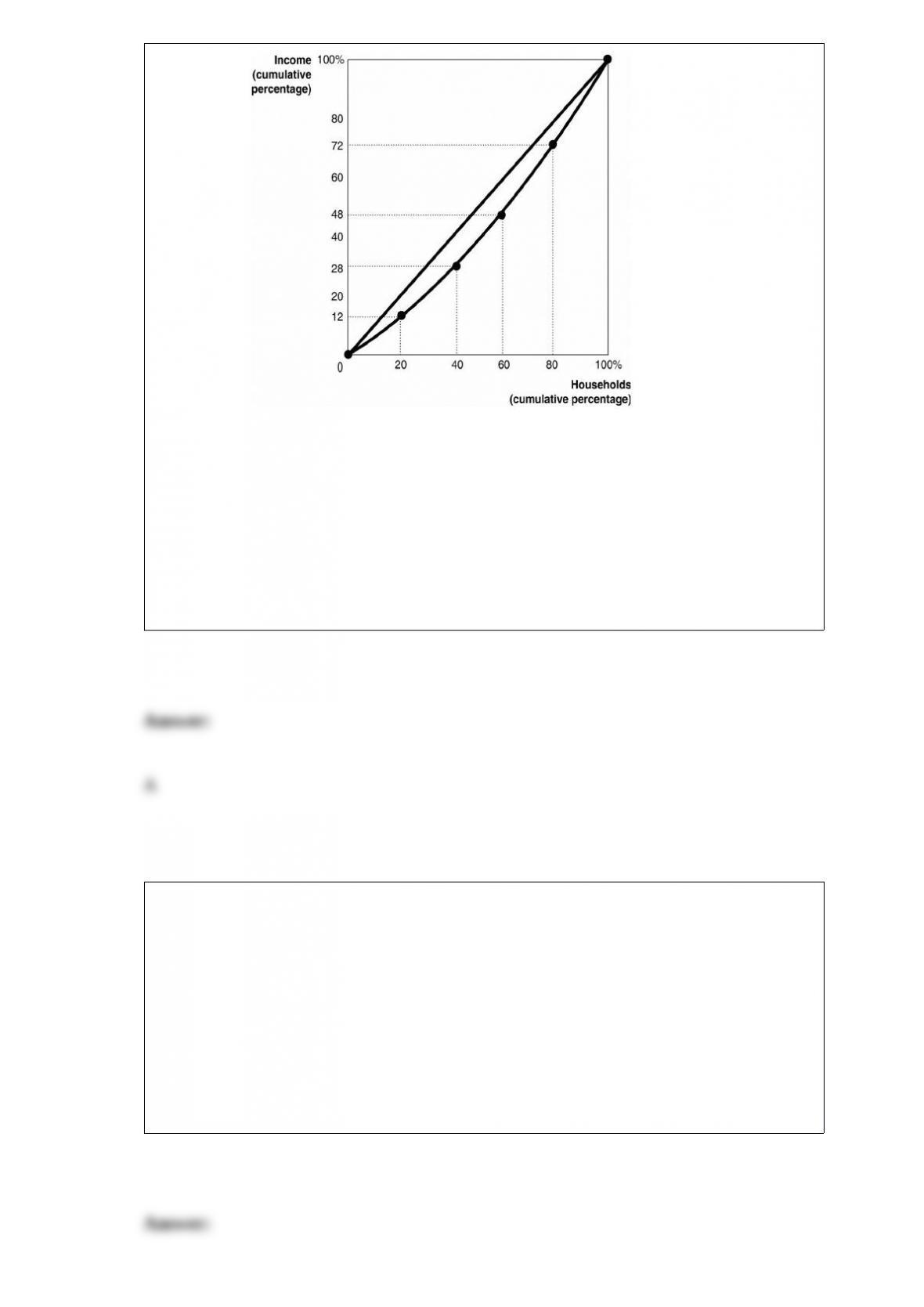
Figure 18-5 Figure 18-5 shows the
Lorenz curve for a hypothetical country. The middle 20 percent of households
A) earn 20 percent of the society’s total income.
B) earn 36 percent of the society’s total income.
C) earn 48 percent of the society’s total income.
D) earn 50 percent of the society’s total income.
A consumer’s budget constraint is
A) the limited income that a consumer has to spend on goods and services.
B) the rate at which the consumer must give up one good to purchase an additional unit
of the other goods in the market.
C) the price ratio a consumer faces in the marketplace.
D) the extent to which one’s preferences are limited by one’s income.
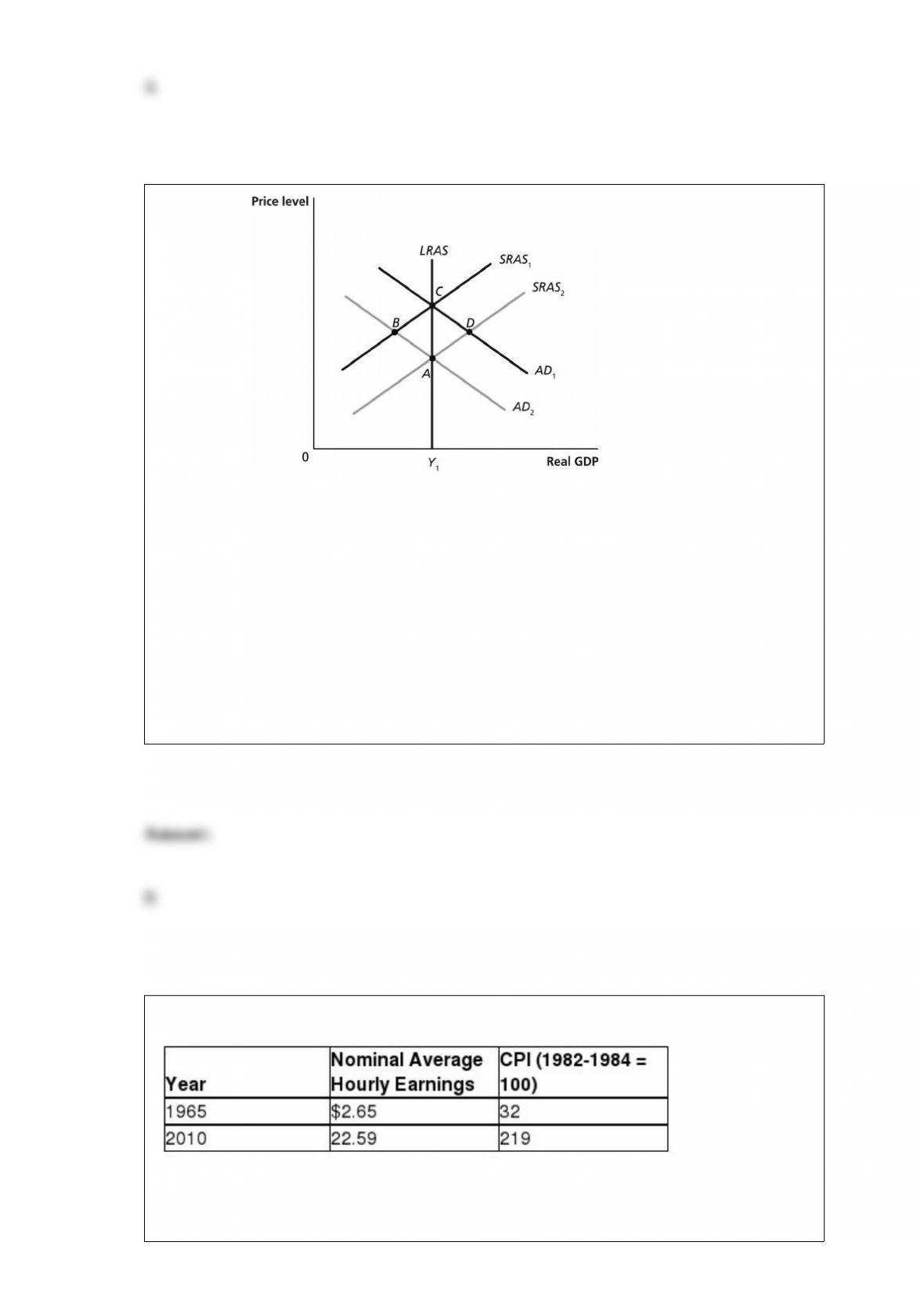
Figure 24-3
Suppose the economy is at point A. If the economy experiences a supply shock, where
will the eventual short-run equilibrium be?
A) A
B) B
C) C
D) D
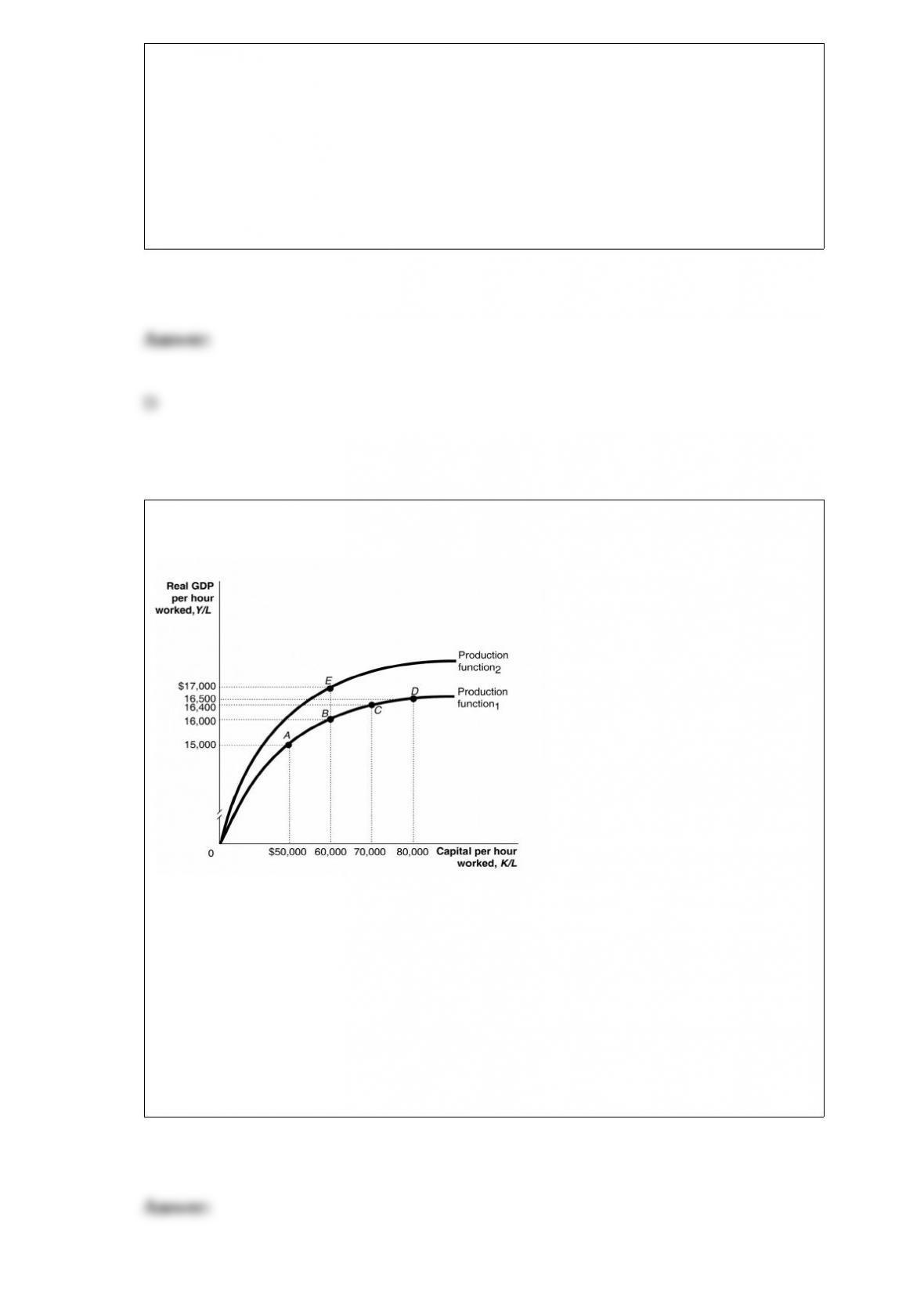
Table 9-14
The table above reports the nominal average hourly earnings in private industry and the
consumer price index for 1965 and 2010. The real average hourly earnings for 1965 in
2010 dollars equal
A) $3.87.
B) $5.80.
C) $12.10.
D) $18.14.
Figure 22-3
Technological change is shown in the figure above by the movement from
A) B to C.
B) B to D.
C) B to E.
D) B to A.

Between 1960 and 2010, deaths among children have
A) declined in most high-income countries and have risen in most low-income
countries.
B) declined in nearly all countries, including most low-income countries.
C) remained relatively unchanged in most high-income countries and have declined in
most low-income countries.
D) declined in most high-income countries and have remained relatively unchanged in
most low-income countries.
Although advertising raises the price of a monopolistic competitor’s product, it does
confer a benefit to consumers. Which of the following is a benefit to consumers?
A) Advertising acts as a barrier to entry.
B) Advertising engenders brand loyalty.
C) Advertising could provide consumers with useful information about new products
and enable them to comparison shop.
D) Advertised products tend to be of higher quality so consumers feel special when they
consume advertised products.

The smaller the fraction of an investment financed by borrowing,
A) the greater the potential return and potential loss on that investment.
B) the smaller the potential return and potential loss on that investment.
C) the greater the potential return and the smaller the potential loss on that investment.
D) the smaller the potential return and the greater the potential loss on that investment.
In order to support an undervalued euro, the European Central Bank must ________
dollars. Over time, this action will cause the rate of inflation in the EU to ________.
A) buy; decrease
B) buy; increase
C) sell; increase
D) sell; decrease
Explain how advances in technology are critical to sustaining economic growth, even if
capital per hour worked is consistently increasing. Provide a graph of a per-worker
production function to support your answer.
What is a supply shock, and why might a supply shock lead to stagflation?
Last year, the unemployment rate was 4 percent and the inflation rate was 3 percent. If
the natural rate of unemployment is 3 percent, how do you expect inflation to change?
What is cost-plus pricing? Why do some firms use cost-plus pricing even when the
firms’ managers have the resources to devise a pricing strategy that would result in
greater profits?
Why would a firm pay efficiency wages?

What are sticky prices, and how can contracts make them ‘sticky”?
U.S. antitrust laws are designed to prohibit monopolization and encourage competition.
Why, then, does the government erect barriers to entry and create monopoly power by
granting firms patents?