
If, for a given percentage increase in price, quantity demanded falls by a
proportionately smaller percentage, then demand is
A) unit-elastic.
B) perfectly elastic.
C) relatively inelastic.
D) relatively elastic.
If a perfectly competitive firm’s total revenue is less than its total variable cost, the firm
A) should raise its price above its average variable cost.
B) should continue to produce and increase its demand.
C) should stop production by shutting down temporarily.
D) should adopt new technology in order to lower its costs of production.
Insurance companies typically charge women lower prices than men for automobile
insurance. Is this an example of price discrimination?
A) No, because, on average, women have better driving records than men and the costs
of insuring men are greater than the costs of insuring women.
B) Yes, because the costs of selling insurance to men and women are the same.
C) Yes, because insurance companies can prevent arbitrage; that is, women cannot
transfer their insurance coverage to men.
D) No, because there are too many insurance companies for any one company to have
market power. A firm must possess market power in order to practice price
discrimination.
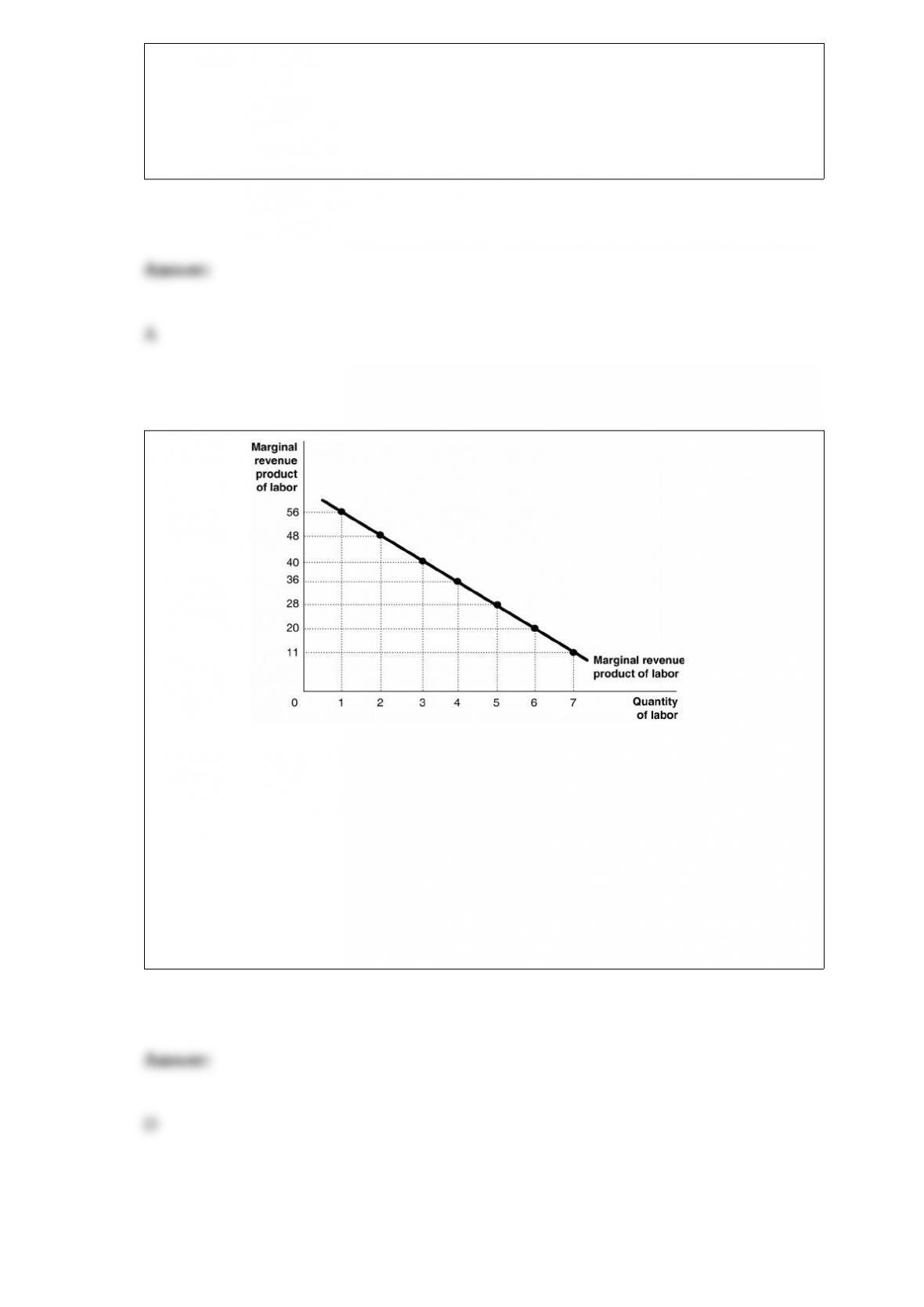
Figure 17-1 Figure 17-1
shows the marginal revenue product for Dale’s Hand-Sewn Doilies, a producer of linen
doilies. If the wage rate is $40, how many workers should Dale hire?
A) 6 units
B) 5 units
C) 4 units
D) 3 units

Table 2-6
Table 2-6 shows the output per week of two jewelers, Serena and Haley. They can either
devote their time to making bracelets or making necklaces.
What is Haley’s opportunity cost of making a necklace?
A) 3/4 of a bracelet
B) 3 bracelets
C) 1 1/3 necklaces
D) 2 necklaces
Figure 18-1
The French fall in love with California wines and triple their purchases of this beverage.
Assuming all else remains constant, this would be represented as a movement from
A) B to A.
B) C to D.
C) B to C.

D) A to D.
E) A to B.
The long-run aggregate supply curve shows the relationship between
A) short-run aggregate supply and short-run aggregate demand.
B) the price level and quantity of real GDP supplied.
C) the real interest rate and the nominal interest rate.
D) the quantity of real GDP supplied and the quantity of nominal GDP supplied.
Interest rates in the economy have risen. How will this affect aggregate demand and
equilibrium in the short run?
A) Aggregate demand will fall, the equilibrium price level will fall, and the equilibrium
level of GDP will fall.
B) Aggregate demand will fall, the equilibrium price level will rise, and the equilibrium
level of GDP will fall.
C) Aggregate demand will rise, the equilibrium price level will rise, and the equilibrium
level of GDP will rise.
D) Aggregate demand will rise, the equilibrium price level will fall, and the equilibrium
level of GDP will rise.

Table 20-1
Consider the data above for a simple economy.
The unemployment rate for this simple economy equals
A) (100/1,000) 100.
B) (100/1,100) 100.
C) (100/15,000) 100.
D) (100/20,000) 100.
For years economists believed that market structure explained the ability of some firms
to earn economic profits. Today, economists and business strategists put greater
emphasis on
A) the number of years a firm has been in business and the average price of the
products sold by the firm.
B) the number of countries in which a firm conducts business and the number of
employees the firm has in each country.
C) the characteristics of individual firms and the strategies their managements use to
continue to earn economic profits.

D) the size of a firm relative to the industry average and the number of firms in the
domestic industry.
What is the rationale behind a marketable emission allowance scheme?
A) to create of a market for externalities: the scheme brings together buyers and sellers
of marketable permits
B) to discipline polluting firms by specifying the maximum amount of emissions
allowed and giving them permits to pollute up to their allowance
C) to raise revenue for the government through the sale of emission permits and at the
same time set an emissions target
D) to provide firms with the incentive to consider less costly alternatives to pollution
reduction by making firms pay for the right to pollute beyond their specified allowance
The number of people who have gray hair is very high among residents living in
Florida. A student concludes that living in Florida causes hair to turn gray. What is the
flaw in this student’s reasoning?
A) The student is drawing a false conclusion by making the mistake of omitting critical
variables such as the age and gender of the residents.
B) The student is using an inadequate sample size.
C) The student is drawing a false conclusion; he is confusing cause and effect.
D) The student has failed to take into account other causes of gray hair.

If firms find that consumers are purchasing less than expected, which of the following
would you expect?
A) Aggregate expenditure will likely be greater than GDP.
B) Aggregate expenditure will likely be less than GDP.
C) The economy will adjust to macroeconomic equilibrium as inventories rise, and
production and employment rise.
D) The economy will adjust to macroeconomic equilibrium as inventories fall, and
production and employment rise.
Table 4-4
Table 4-4 shows the demand and supply schedules for the low-skilled labor market in
the city of Westover.
Suppose that the quantity of labor demanded increases by 40,000 at each wage level.
What are the new free market equilibrium hourly wage and the new equilibrium

quantity of labor?
A) W = $10.00; Q = 390,000
B) W = $9.50; Q = 380,000
C) W = $8.50; Q = 380,000
D) W = $8.00; Q = 390,000