U.S. international trade has
a. decreased because of a decrease in the trade of goods with a high value per pound.
b. decreased because of an increase in the trade of goods with a high value per pound.
c. increased because of a decrease in trade of goods with a high value per pound.
d. increased because of an increase in trade of goods with a high value per pound.
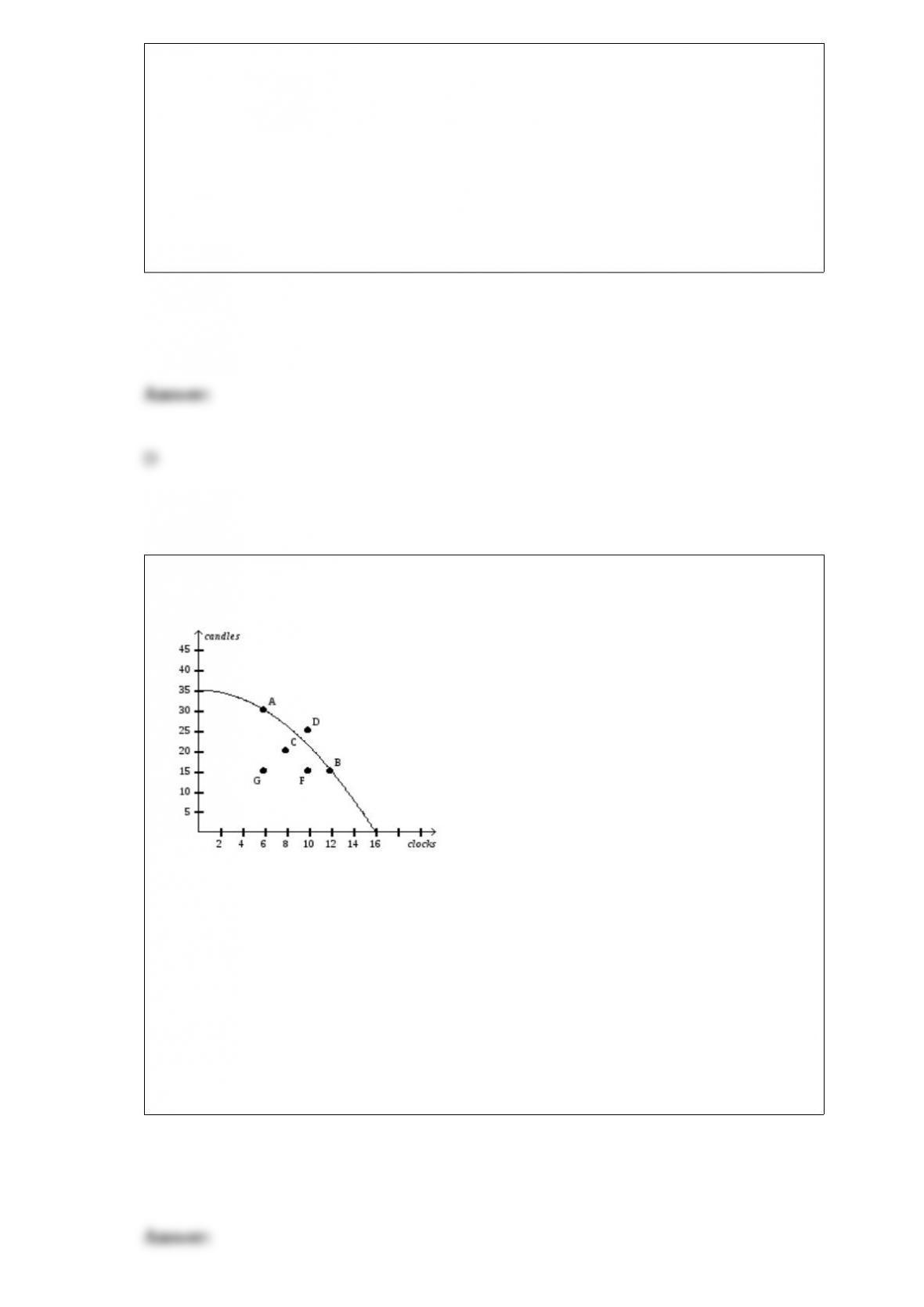
Figure 2-6
Refer to Figure 2-6. If this economy moved from point C to point F, then
a. it still would not be producing efficiently.
b. there would be no gain in either candles or clocks.
c. it would be producing more candles and more clocks than at point C.
d. It is not possible for this economy to move from point C to point F without additional
resources.

Stagflation exists when prices
a. and output rise.
b. rise and output falls.
c. fall and output rises.
d. and output fall.
Olivia was accepted to Notre Dame and another college. She is trying to decide where
to go. Which of the following should she include in making her decision?
a. how much she spent applying to Notre Dame, and the difference between living
expenses at Notre Dame and the other college
b. how much she spent applying to Notre Dame, but not the difference between living
expenses at Notre Dame and the other college
c. the difference between living expenses at Notre Dame and her second choice, but not
how much she spent applying to Notre Dame
d. neither how much she spent applying to Notre Dame nor the difference between
living expenses at Notre Dame and her second choice
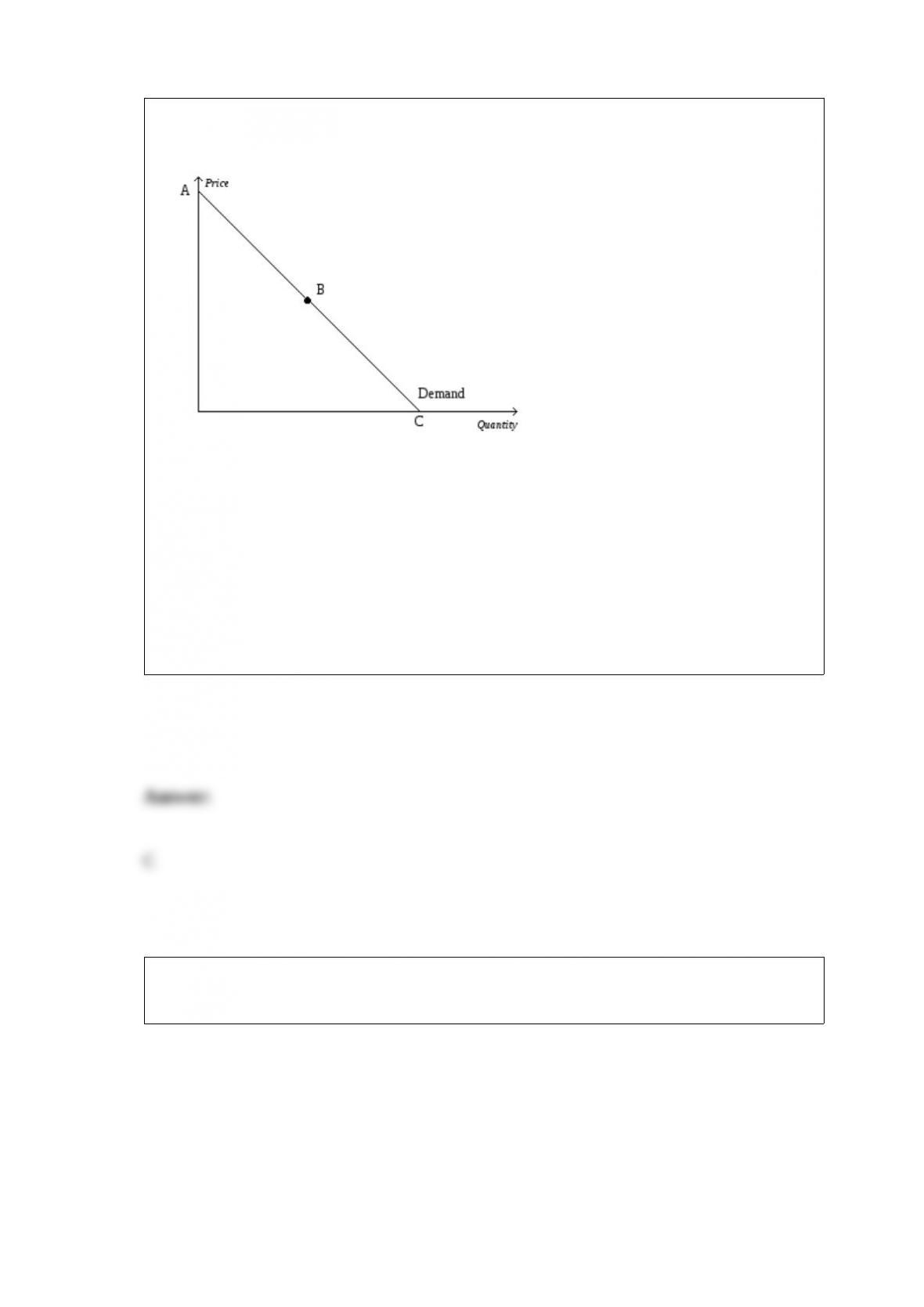
Figure 5-4
Refer to Figure 5-4. The section of the demand curve at point B represents the
a. elastic section of the demand curve.
b. inelastic section of the demand curve.
c. unit elastic section of the demand curve.
d. perfectly elastic section of the demand curve.
Figure 2-4
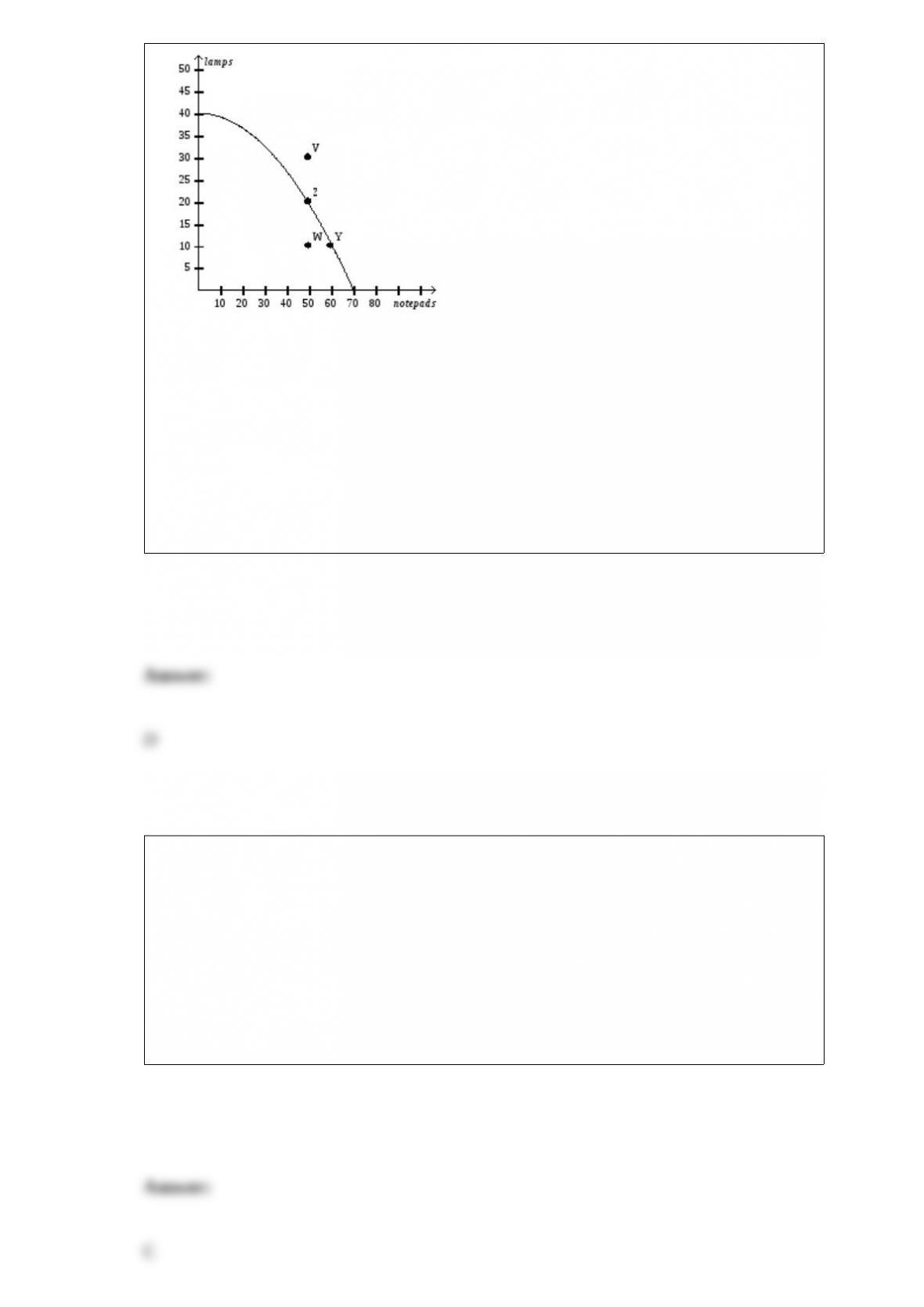
Refer to Figure 2-4. Inefficient production is represented by which point(s)?
a. Y, Z
b. V
c. V, W
d. W
Recent entrants into the labor force account for about
a. 1/5 of those who are unemployed.
b. 1/4 of those who are unemployed.
c. 1/3 of those who are unemployed.
d. 1/2 of those who are unemployed.

When government policies are enacted,
a. equality can usually be enhanced without an efficiency loss, but efficiency can never
be enhanced without a reduction in equality.
b. efficiency can usually be enhanced without a reduction in equality, but equality can
never be enhanced without an efficiency loss.
c. it is always the case that either efficiency and equality are both enhanced, or
efficiency and equality are both diminished.
d. None of the above are correct.
Chad is willing to pay $5.00 to get his first cup of morning latté; he is willing to pay
$4.50 for a second cup. He buys his first cup from a vendor selling latté for $3.75 per
cup. He returns to that vendor later in the morning to find that the vendor has increased
her price to $3.90 per cup. Chad buys a second cup. Which of the following statements
is correct?
a. Chad’s willingness to pay for his second cup of latté was smaller than his willingness
to pay for his first cup of latté.
b. Chad’s consumer surplus on his second cup of latté was larger than his consumer
surplus on his first cup of latté.
c. Chad is irrational in that he is willing to pay a different price for his second cup of
latté than what he is willing to pay for his first cup of latté.
d. Chad places a higher value on his second cup of latté than on his first cup of latté.
The purchase of rice produced this period is included in GDP if the rice is
a. used in a meal a restaurant sells during the same period they buy the rice.
b. purchased by a family who uses it to make tuna casserole for its supper.
c. purchased by a frozen food company to increase its inventory.
d. B and C are correct.
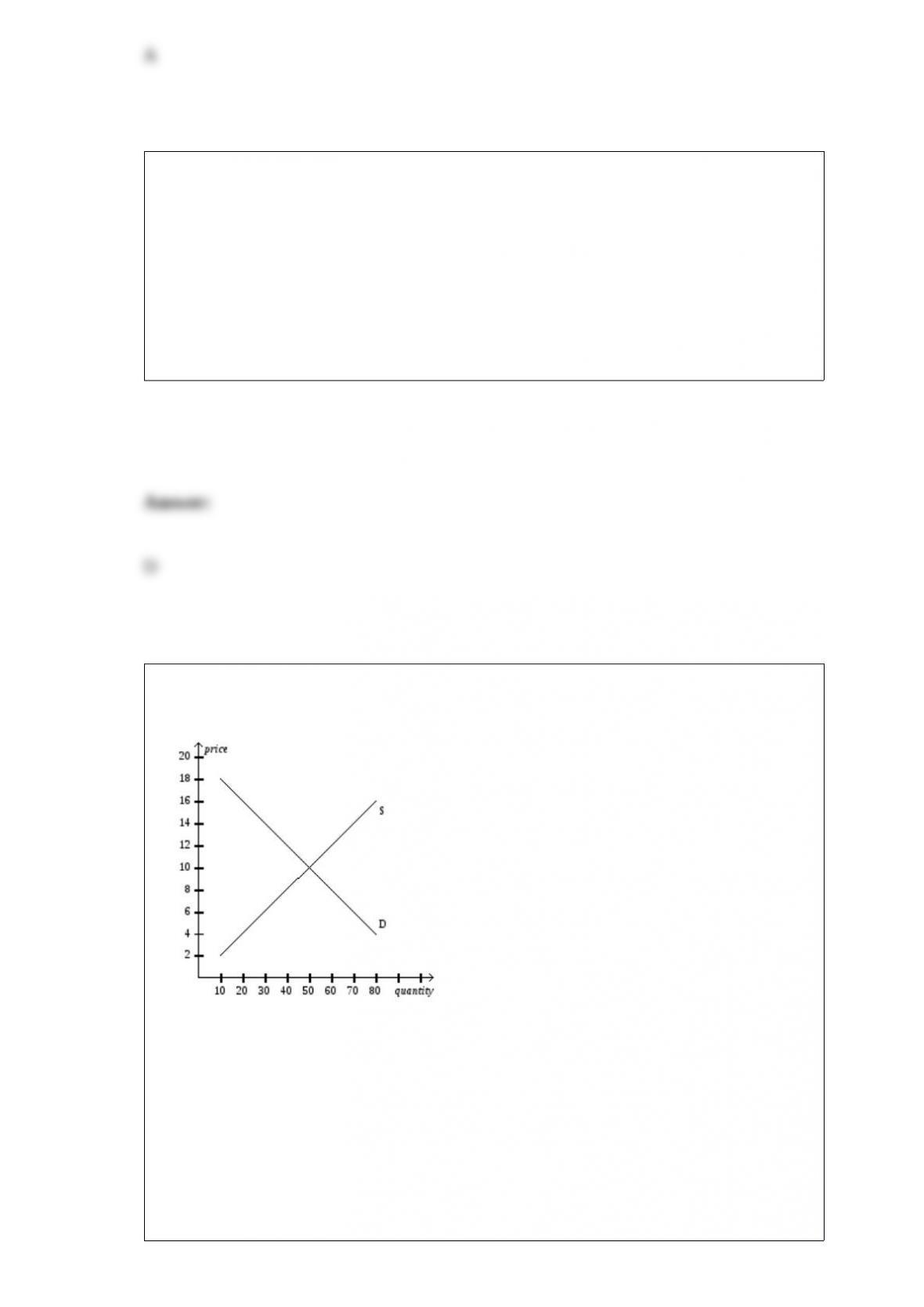
Figure 6-6
Refer to Figure 6-6. Which of the following statements is not correct?
a. A price ceiling set at $8 would be binding, but a price ceiling set at $12 would not be
binding.
b. A price floor set at $14 would be binding, but a price floor set at $8 would not be
binding.
c. A price ceiling set at $9 would result in a surplus.
d. A price floor set at $11 would result in a surplus.
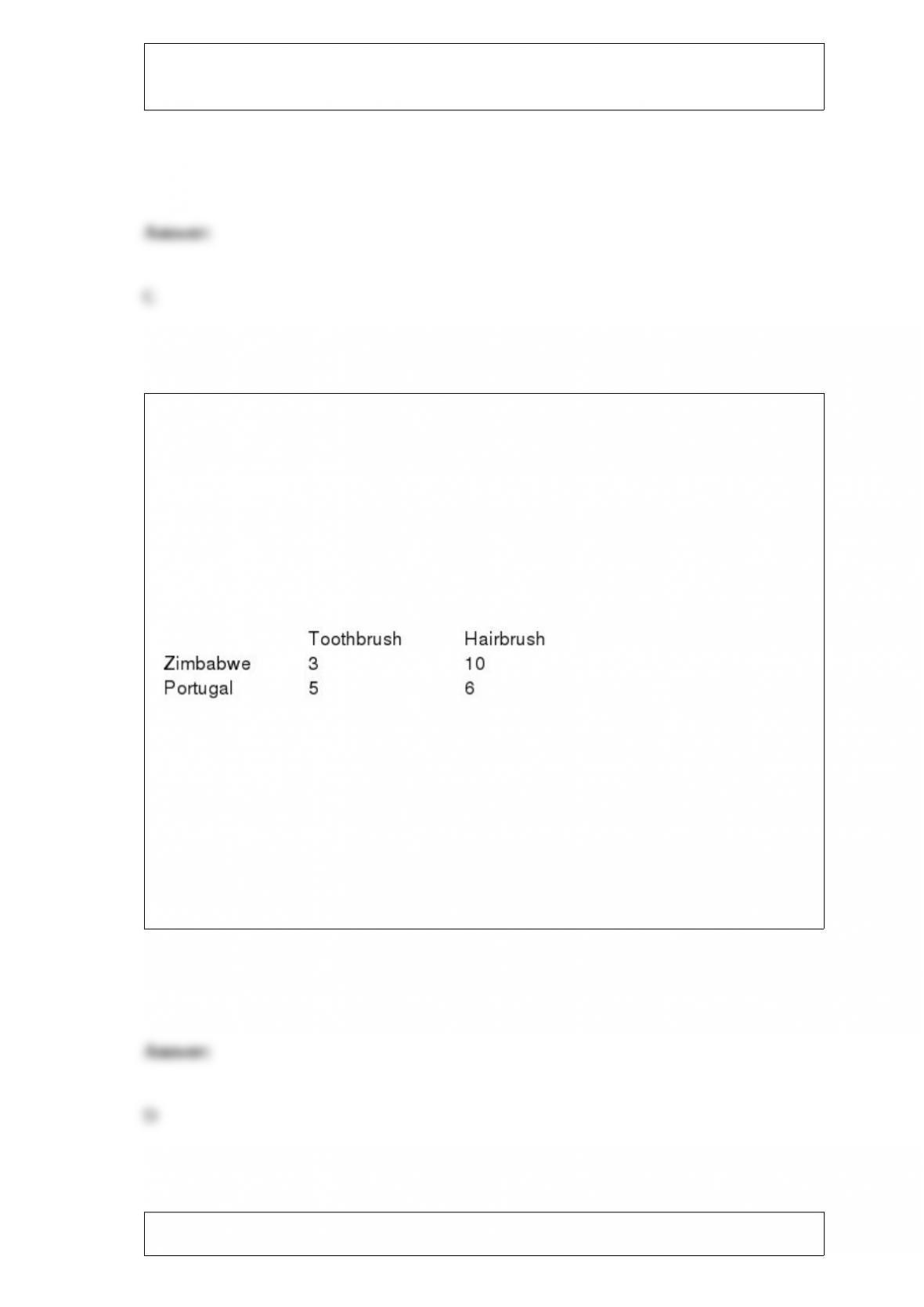
Table 3-3
Assume that Zimbabwe and Portugal can switch between producing toothbrushes and
producing hairbrushes at a constant rate.
Machine Minutes
Needed to Make 1
Refer to Table 3-3. Portugal has an absolute advantage in the production of
a. toothbrushes and a comparative advantage in the production of toothbrushes.
b. toothbrushes and a comparative advantage in the production of hairbrushes.
c. hairbrushes and a comparative advantage in the production of toothbrushes.
d. hairbrushes and a comparative advantage in the production of hairbrushes.
By definition, imports are

a. people who work in foreign countries.
b. goods in which a country has an absolute advantage.
c. limits placed on the quantity of goods leaving a country.
d. goods produced abroad and sold domestically.
If a central bank attempts to lower the inflation rate but the public doesn”t believe the
inflation rate will fall as far as the central bank says, then in the short run
unemployment
a. rises. As inflation expectations adjust, the short-run Phillips curve shifts right.
b. rises. As inflation expectations adjust, the short-run Phillips curve shifts left.
c. falls. As inflation expectations adjust, the short-run Phillips curve shifts right.
d. falls. As inflation expectations adjust, the short-run Phillips curve shifts left.
Other things the same, as the price level falls, a country’s exchange rate
a. and interest rates rise.
b. and interest rates fall.

c. falls and interest rates rise.
d. rises and interest rates fall.
The “invisible hand” refers to
a. the marketplace guiding the self-interests of market participants into promoting
general economic well-being.
b. the fact that social planners sometimes have to intervene, even in perfectly
competitive markets, to make those markets more efficient.
c. the equality that results from market forces allocating the goods produced in the
market.
d. the automatic maximization of consumer surplus in free markets.
Table 4-4
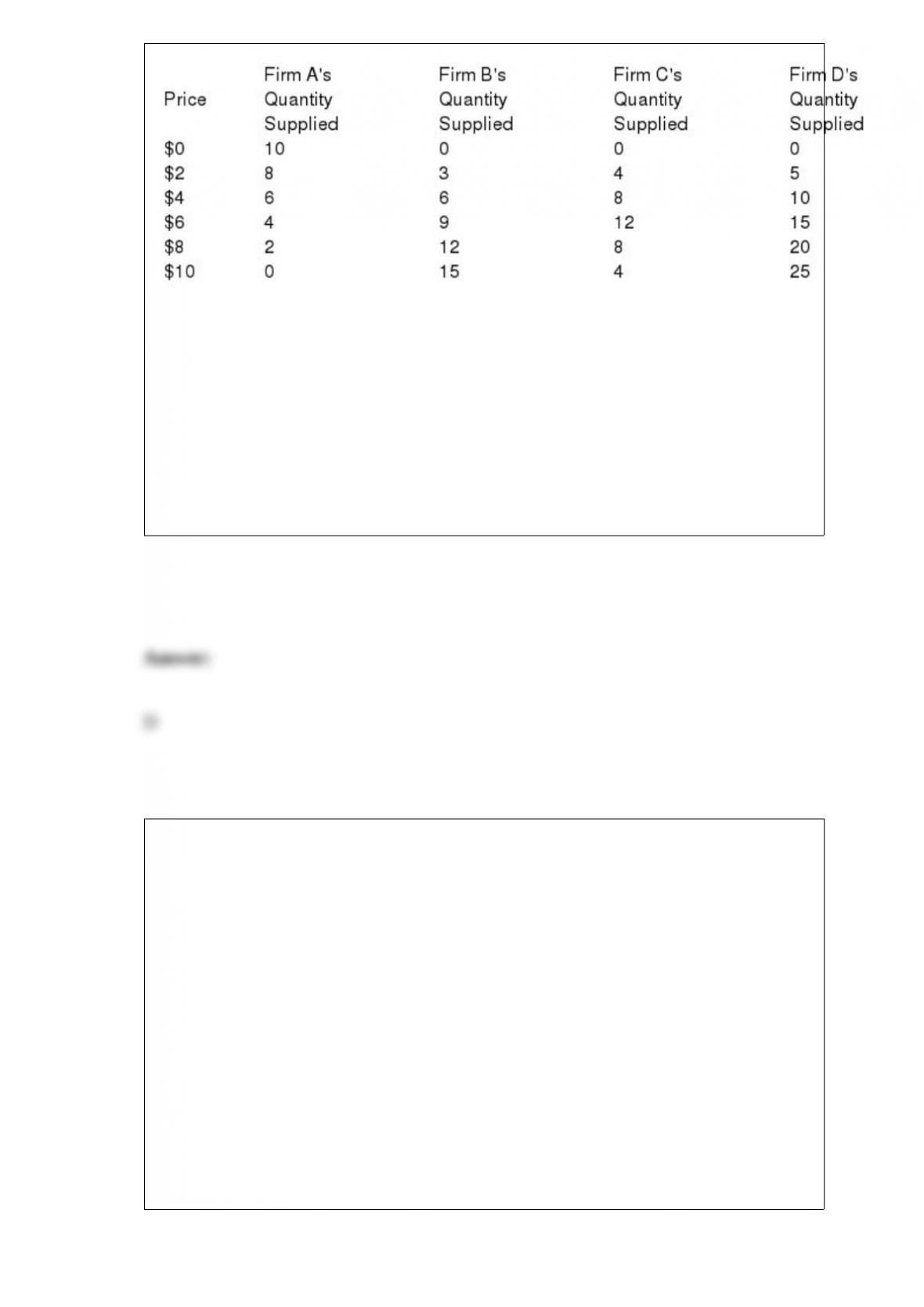
Refer to Table 4-4. If these are the only four sellers in the market, then the market
quantity supplied at a price of $4 is
a. 4 units.
b. 7.5 units.
c. 10 units.
d. 30 units.
Optimism
Imagine that the economy is in long-run equilibrium. Then, perhaps because of
improved international relations and increased confidence in policy makers, people
become more optimistic about the future and stay this way for some time.
Refer to Optimism. What happens to the expected price level and what’s the result for
wage bargaining?
a. The expected price level falls. Bargains are struck for higher wages.
b. The expected price level falls. Bargains are struck for lower wages.
c. The expected price level rises. Bargains are struck for higher wages.
d. The expected price level rises. Bargains are struck for lower wages.
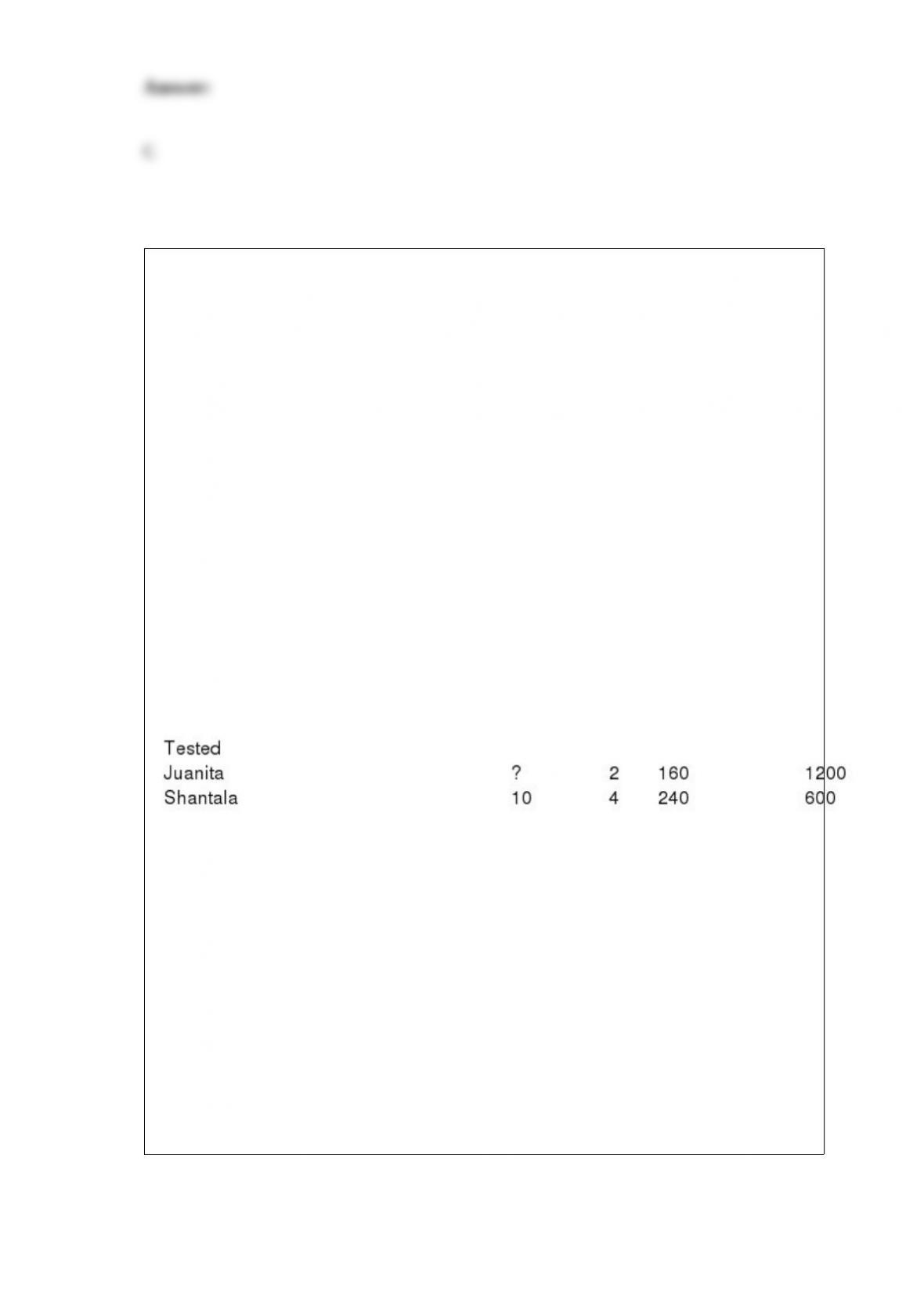
Table 3-10
Juanita and Shantala run a business that programs and tests cellular phones. Assume
that Juanita and Shantala can switch between programming and testing cellular phones
at a constant rate. The following table applies.
Minutes Needed to Number of Cellular Phones
Programmed or Tested in a
40-Hour Week
Program 1
Cellular Phone Test 1
Cellular Phone Cellular Phones
Programmed Cellular Phones
Refer to Table 3-10. Juanita’s opportunity cost of testing one cellular phone is
programming
a. 0.133 cellular phones and Shantala’s opportunity cost of testing one cellular phone is
programming 2.5 cellular phones.
b. 0.133 cellular phones and Shantala’s opportunity cost of testing one cellular phone is
programming 0.4 cellular phones.
c. 7.5 cellular phones and Shantala’s opportunity cost of testing one cellular phone is
programming 2.5 cellular phones.
d. 7.5 cellular phones and Shantala’s opportunity cost of testing one cellular phone is
programming 0.4 cellular phones.
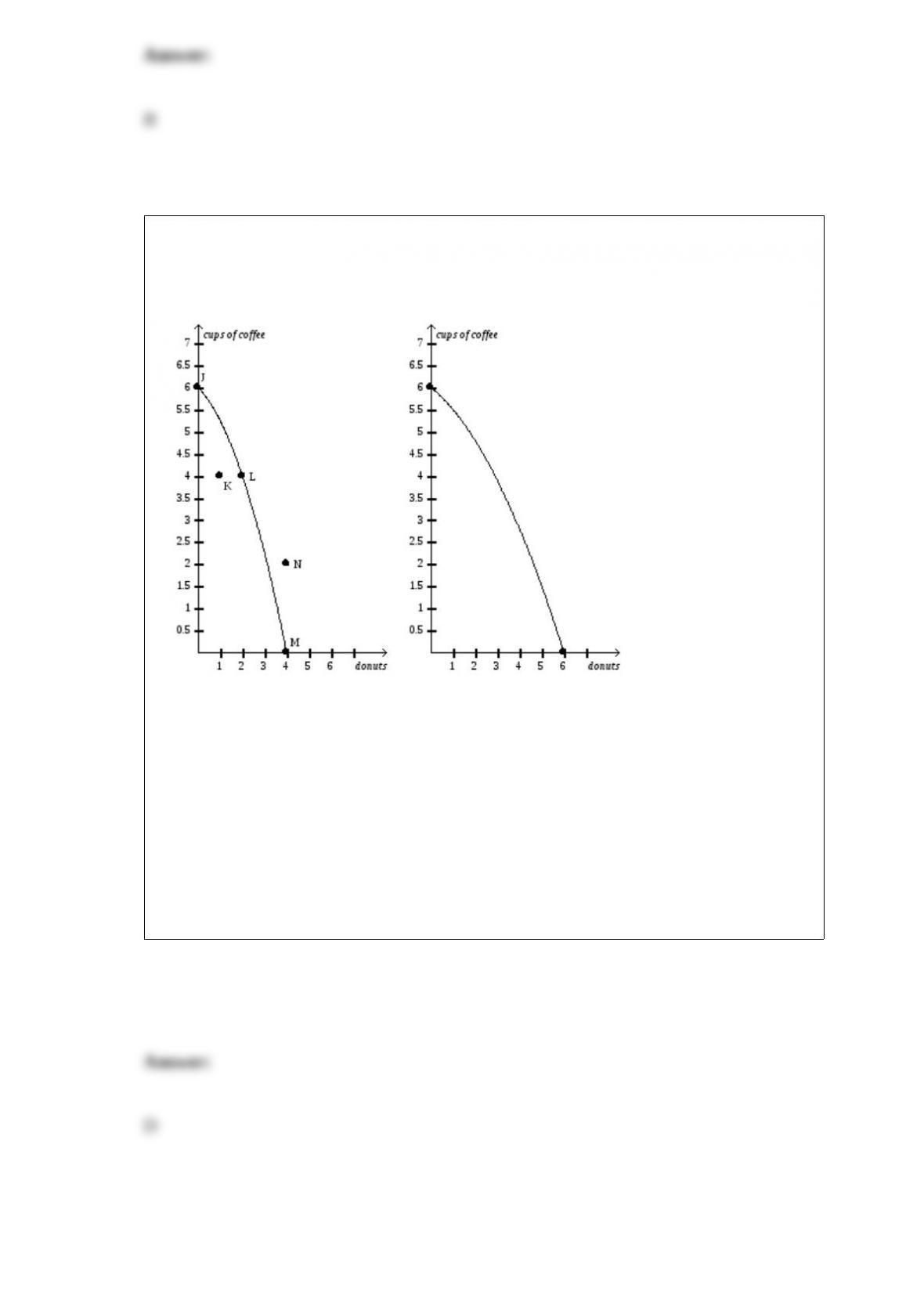
Figure 2-8
Panel (a) Panel (b)
Refer to Figure 2-8, Panel (a). The movement from point M to point K could be
caused by
a. an advance in production technology.
b. an improvement in efficiency.
c. economic growth.
d. unemployment.

Inefficiency exists in an economy when a good is
a. being produced with less than all available resources.
b. not distributed fairly among buyers.
c. not being produced by the lowest-cost producers.
d. being consumed by buyers who value it most highly.
For which pairs of goods is the cross-price elasticity most likely to be negative?
a. peanut butter and jelly
b. automobile tires and coffee
c. pens and pencils
d. paperback novels and electronic books for e-readers
Who was reappointed Chair of the Board of Governors in 2009 by President Barrack
Obama?
a. Ben Bernanke
b. Christina Romer

c. Timothy Geithner
d. Bernie Madoff
The Fed purchases $200 worth of government bonds from the public. The reserve
requirement is 8 percent, people hold no currency, and the banking system keeps no
excess reserves. The U.S. money supply eventually increases by
a. $16.
b. $200.
c. $1,600.
d. $2,500.
Which of the following statements is correct?
a. The consumer price index is a measure of the overall level of prices, whereas the
GDP deflator is not a measure of the overall level of prices.
b. If, in the year 2011, the consumer price index has a value of 50, then the inflation rate
for 2011 must be 23.50 percent.
c. Compared to the GDP deflator, the consumer price index is the more common gauge
of inflation.

d. The consumer price index and the GDP deflator reflect the goods and services bought
by consumers equally well.
At a price of $1.20, a local coffee shop is willing to supply 100 cinnamon rolls per day.
At a price of $1.40, the coffee shop would be willing to supply 150 cinnamon rolls per
day. Using the midpoint method, the price elasticity of supply is about
a. 0.15
b. 0.375
c. 2.5
d. 2.60
If inflation falls,
a. people choose to put in more effort to keep money balances low. When inflation is
unexpectedly low it redistributes wealth from lenders to borrowers.
b. people choose to put in more effort to keep money balances low. When inflation is
unexpectedly low it redistributes wealth from borrowers to lenders.
c. people choose to put in less effort to keep money balances low. When inflation is
unexpectedly low it redistributes wealth from lenders to borrowers.
d. people choose to put in less effort to keep money balances low. When inflation is
unexpectedly low it redistributes wealth from borrowers to lenders.
When a country that imported a particular good abandons a free-trade policy and adopts
a no-trade policy,
a. producer surplus increases and total surplus increases in the market for that good.
b. producer surplus increases and total surplus decreases in the market for that good.
c. producer surplus decreases and total surplus increases in the market for that good.
d. producer surplus decreases and total surplus decreases in the market for that good.
Policies such as rent control and trade barriers persist
a. because economists are about evenly divided as to the merits of those policies.
b. because almost all economists agree that those policies have no discernible economic
effects.
c. because almost all economists agree that those policies are desirable.
d. despite the fact that almost all economists agree that those policies are undesirable.
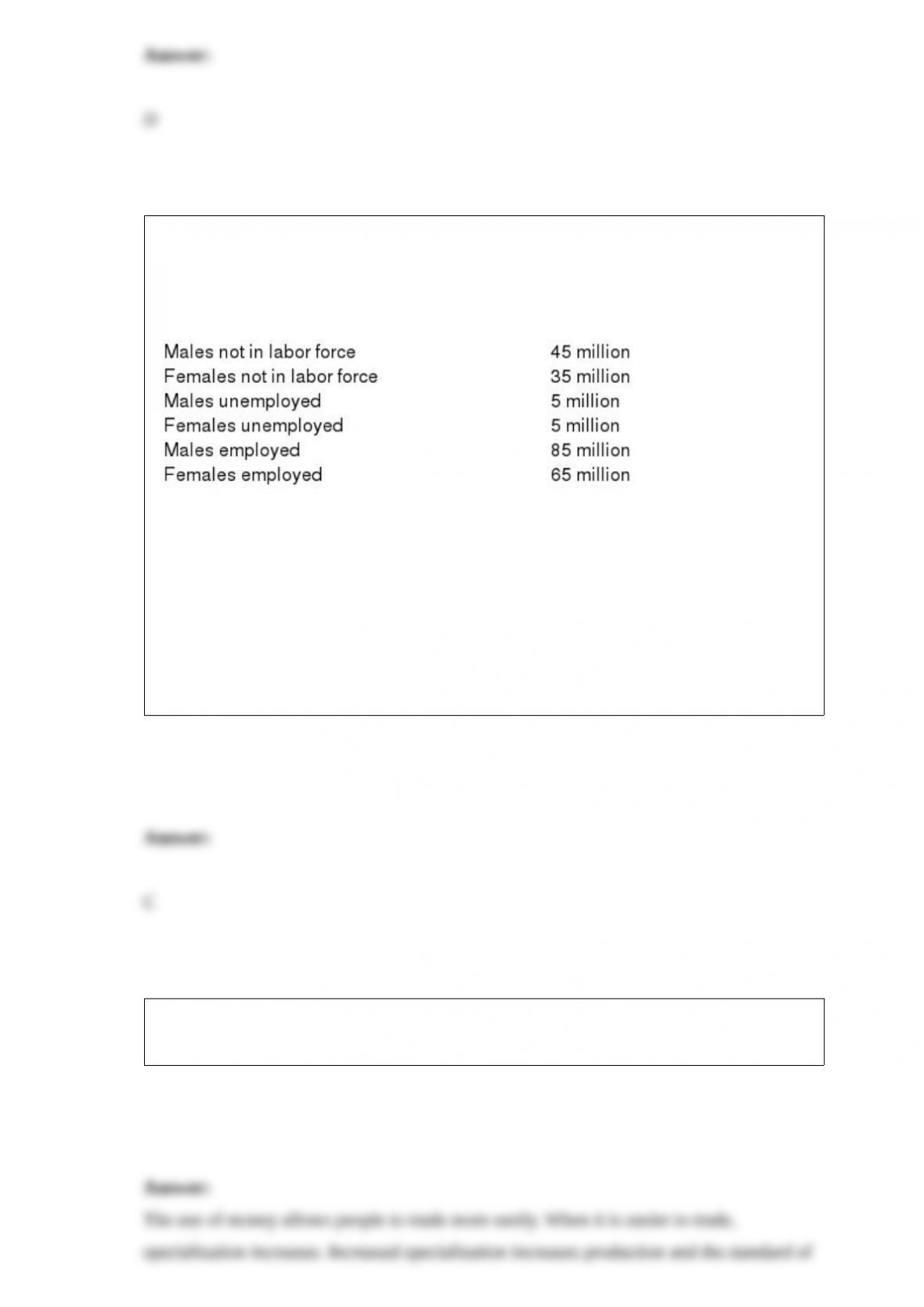
Table 15-3
2010 Labor Data for Adults (age 16 and older) in Meditor
Refer to Table 15-3. What is the adult female labor-force participation rate in Meditor?
a. 38.1 percent
b. 61.9 percent
c. 66.7 percent
d. 95.2 percent
Economists argue that the move from barter to money increased trade and production.
How is this possible?
When the market price is above the equilibrium price, suppliers are unable to sell all
they want to sell.
Two countries can achieve gains from trade even if one country has an absolute
advantage in the production of both goods.
If a country’s domestic price of a good is lower than the world price, then that country
has a comparative advantage in producing that good.
If, for an imaginary closed economy, investment amounts to $12,000 and the
government is running a $2,000 deficit, then private saving must amount to $10,000.
Rent control may lead to lower rents for those who find housing, but the quality of the
housing may also be lower.
Economic models can help us understand reality only when they include all details of
the economy.
One tradeoff society faces is between efficiency and equality. Define each term. If the
U.S. government redistributes income from the rich to the poor, explain how this action
affects equality as well as efficiency in the economy.
The housing shortages caused by rent control are larger in the long run than in the short
run because both the supply of housing and the demand for housing are more elastic in
the long run.
The present value of $100 to be paid in two years is less than the present value of $100
to be paid in three years.
Rent subsidies and wage subsidies are better than price controls at helping the poor
because they have no costs associated with them.
A price ceiling is always a binding price control, whereas a price floor may be either
binding or not binding.
Explain why the interest rate is the opportunity cost of holding currency. What is the
benefit of holding currency?
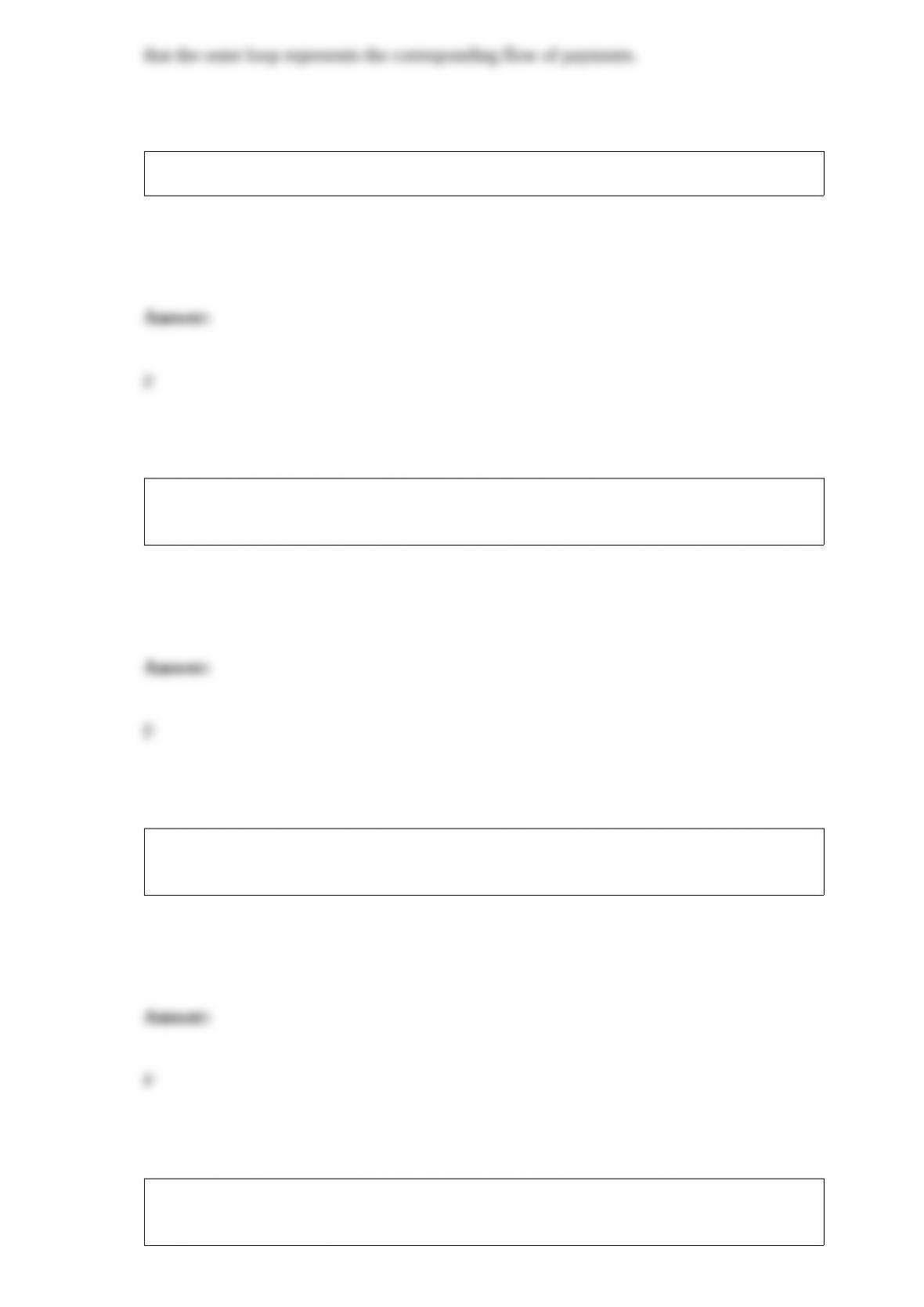
Using the outline below, draw a circular-flow diagram representing the interactions
between households and firms in a simple economy. Explain briefly the various parts of
the diagram.
The cost of inflation reduction is a large, permanent increase in unemployment.
A buyer is willing to buy a product at a price greater than or equal to his willingness to
pay, but would refuse to buy a product at a price less than his willingness to pay.
Because economists understand what things change GDP, they can predict recessions
with a fair amount of accuracy.
Explain the logic according to liquidity preference theory by which an increase in the
money supply changes the aggregate demand curve.