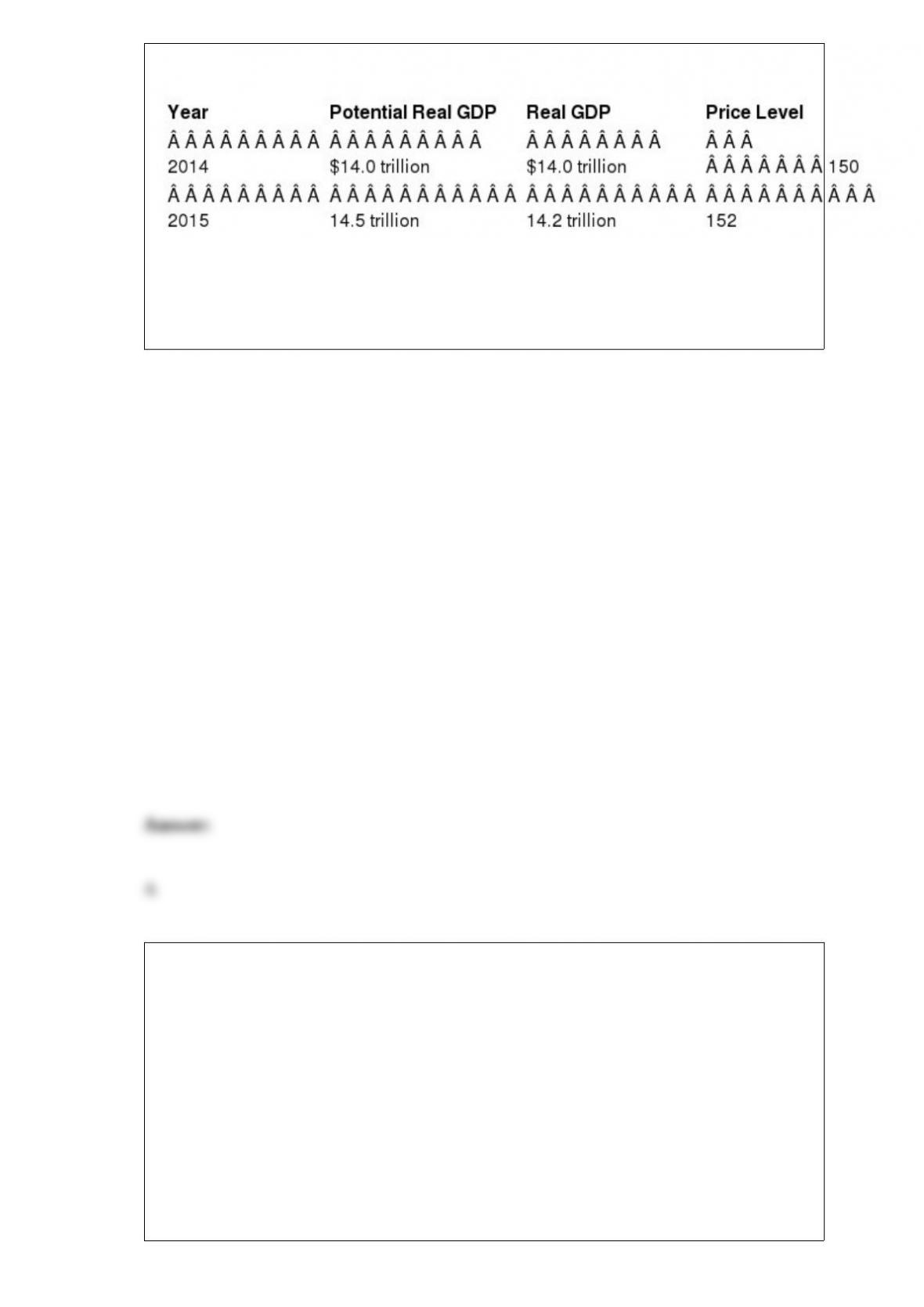
Table 15-2
Refer to Table 15-2. Consider the hypothetical information in the table above for
potential real GDP, real GDP and the price level in 2014 and in 2015 if the Federal
Reserve does not use monetary policy. If the Fed wants to keep real GDP at its potential
level in 2015, it should
1. A) buy Treasury securities.
2. B) sell Treasury securities.
3. C) increase the required reserve ratio.
4. D) increase income taxes.
Under which of the following circumstances would the government be running a
deficit?
A) G = $5 trillion
T = $5 trillion
TR = $1 trillion
B) G = $5 trillion
T = $7 trillion
TR = $1 trillion
C) G = $7 trillion
T = $7 trillion
TR = $0
D) G = $7 trillion
T = $10 trillion
TR = $3 trillion
Credit card balances are
A) part of M1.
B) part of M2.
C) part of M3.
D) not part of the money supply.
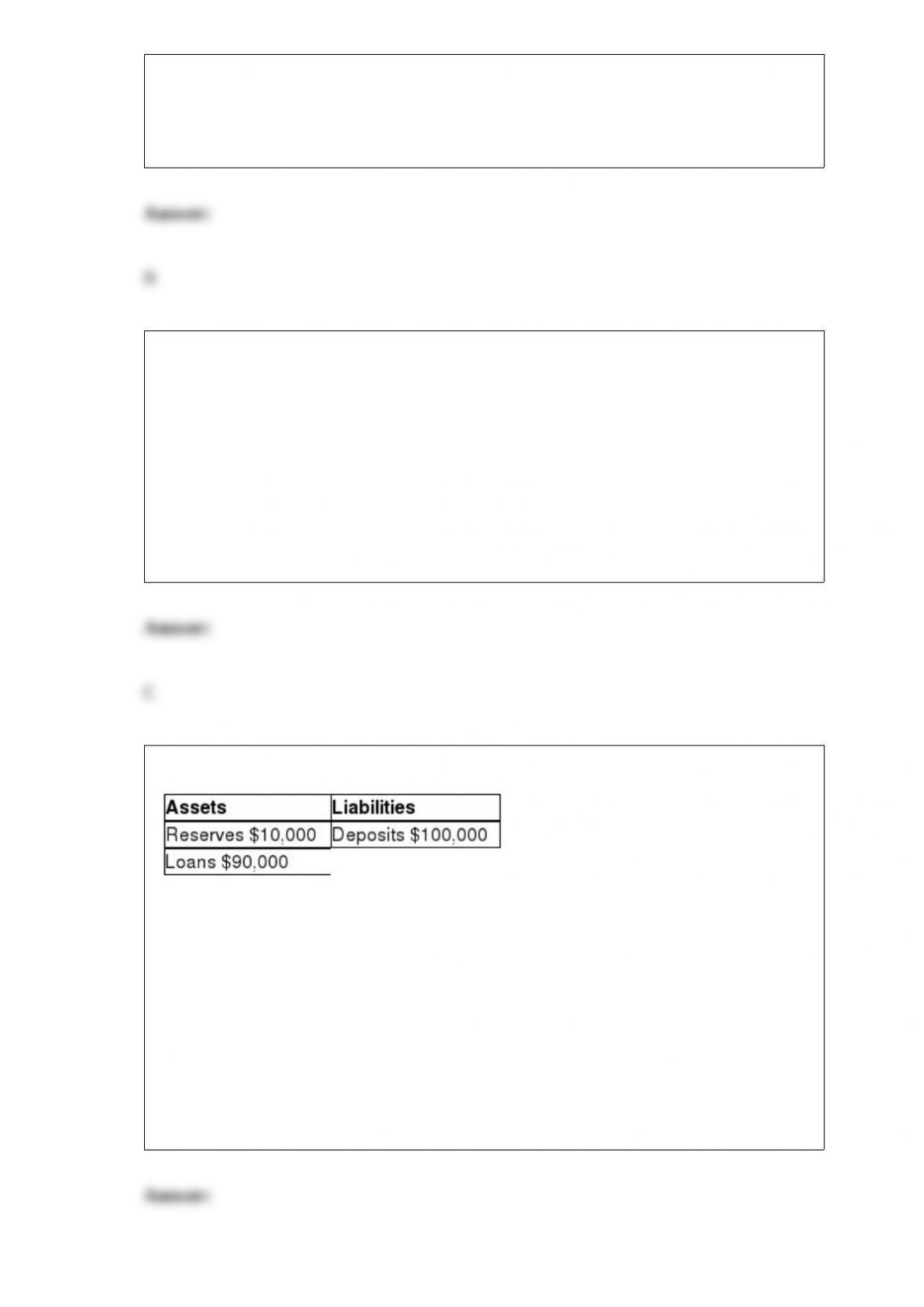
Figure 2-2
Figure 2-2 above shows the production possibilities frontier for Vidalia, a nation that
produces two goods, roses and orchids.
Refer to Figure 2-2. If Vidalia chooses to produce 80 dozen roses, how many orchids
can it produce to maximize production?
A) 24 dozen orchids
B) 48 dozen orchids
C) 60 dozen orchids
D) 74 dozen orchids
If national income increases by $75 million and consumption increases by $15 million,
the marginal propensity to consume is
A) 5
B) 0.75
C) 0.20
D) 0.15
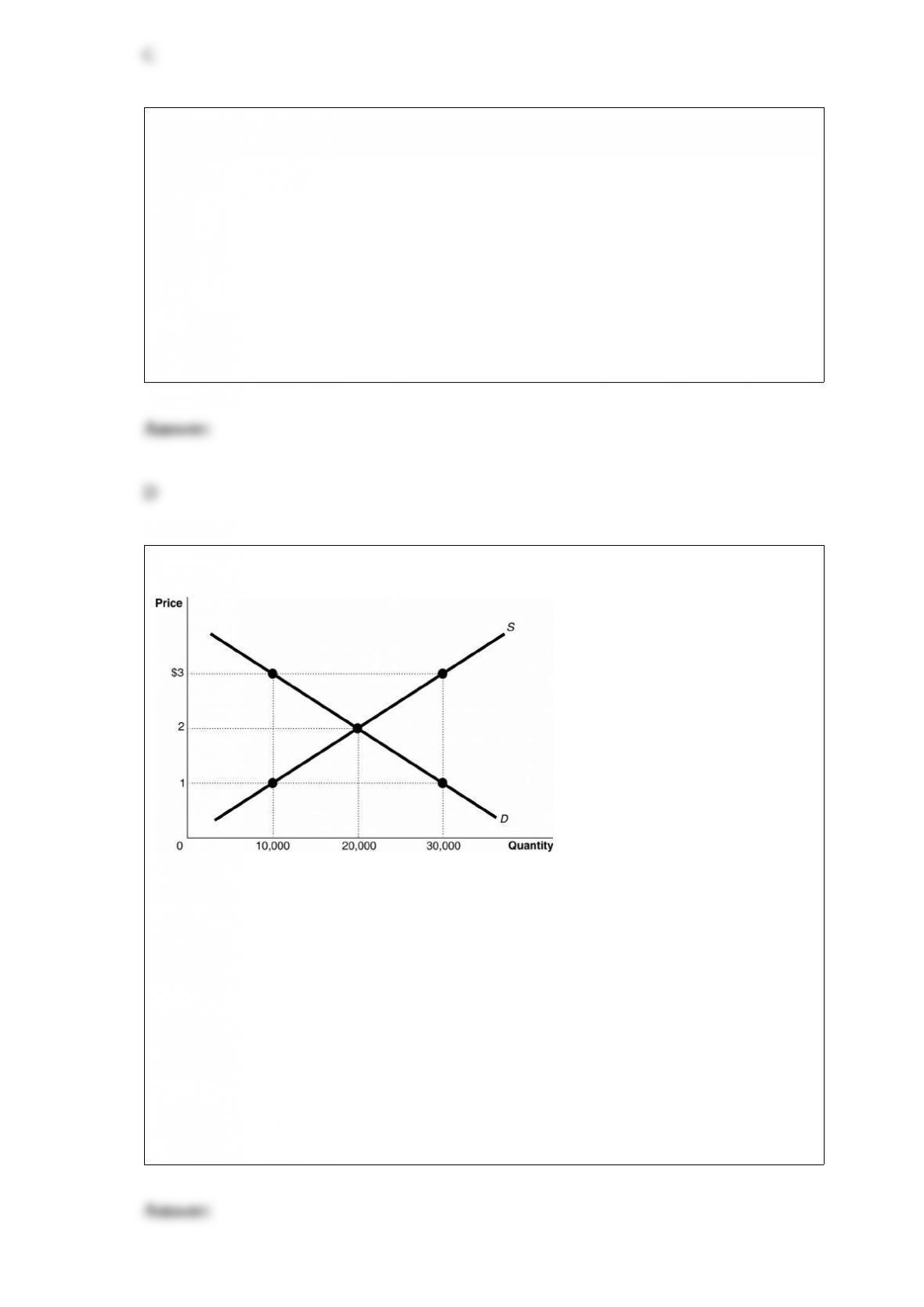
Consider the following T-account for National City Bank:
If the required reserve ratio is lowered to 8 percent, how much can National City loan
out?
A) $10,000
B) $8,000
C) $2,000
D) $0
Domestic producers require time to gain experience and lower their unit costs; this will
allow these producers to compete successfully in international markets. This statement
describes the ________ argument for protectionism.
A) diseconomies of scale
B) protecting national security
C) anti-dumping
D) infant industry
Figure 4-4
Refer to Figure 4-4. The figure above represents the market for iced tea. Assume that
this is a competitive market. Which of the following is true?
A) If the price of iced tea is $3 the output will be economically efficient but there will
be a deadweight loss.
B) If the price of iced tea is $3 consumers will purchase more than the economically
efficient output.
C) Both 10,000 and 30,000 are economically inefficient rates of output.
D) If the price of iced tea is $3 producers will sell 30,000 units of iced tea but this
output will be economically inefficient.

Which of the following best explains the negative slope of the short-run Phillips curve?
A) Weak growth in aggregate demand keeps the economy below potential GDP, so
unemployment rises but inflation falls.
B) Aggregate demand grows so quickly that the inflation rate rises as unemployment
rises.
C) Long-run aggregate supply increases quickly enough that inflation falls as
unemployment also falls.
D) Short-run aggregate supply increases at the same pace as aggregate demand
increases so that inflation and unemployment do not change.
Article Summary
In a September 2013 speech to the Independent Bankers Association of Texas, Federal
Reserve Bank of Dallas president Richard Fisher stated that the Fed’s credibility was
harmed when it announced the previous week that it would continue its large bond
purchasing program. In June, Fed Chairman Ben Bernanke had stated that that the
program could begin to be cut back later in the year, and several other Fed officials
expressed being open to the announced timing of this policy. Bernanke’s change in his
announced timeline of the Fed’s intentions regarding the bond purchasing program
brought criticism that the Fed had misled investors. In his speech, Fisher stated “I
disagreed with the decision of the committee and argued against it. Doing nothing at
this meeting would increase uncertainty about the future conduct of policy and call the
credibility of our communications into question. I believe that is exactly what has
occurred, though I take no pleasure in saying so.” Fisher has been a long-time
opponent of the Fed’s bond purchasing program, claiming it is ineffective and may well
lead to future inflation, and had been calling for the Fed to begin phasing out this
program in September.
Source: “Fisher: Standing pat on policy hurt Fed’s credibility,” Reuters, September 23,
2013.Refer to the Article Summary. If the Federal Reserve’s announcements about
upcoming monetary policy decisions are not seen as credible, as Richard Fisher alludes
to regarding the announcements about the bond purchasing program, which of the
following would you expect to see?
A) Inflation expectations will accurately reflect actual inflation.
B) Expansionary monetary policy will result in lower rates of inflation.
C) Firms and workers will be unable to accurately forecast changes in the rate of
inflation.
D) The Federal Reserve will have more control over the inflation rate.
A country in which a significant fraction of domestic production takes place in
foreign-owned factories and facilities is most likely a country where
A) GNP is much larger than GDP.
B) GDP is much larger than GNP.
C) GDP is equal to GNP.
D) GDP is not comparable to GDP.
Why is the study of asymmetric information associated with the market for “lemons”?
A) Sellers of citrus fruit – lemons, oranges, grapefruit – know the difference between
bad fruit and good fruit; buyers do not have this information.
B) Because there is little advertising in the market for lemons, buyers have difficulty
determining the quality of lemons before they are purchased.
C) Potential buyers of used cars have difficulty separating good used cars from bad
used cars; bad used cars are often referred to as “lemons.”
D) Most sellers of used cars have less information about their cars than the dealers who
buy them; used cars are often referred to as “lemons.”

Each of the following is one of the four main categories of spending identified by John
Maynard Keynes except
A) consumption.
B) net exports.
C) government purchases.
D) taxes.