1) refer to the above data sets. which of the data sets would graph as an upsloping line?
a.1 only.
b.1, 2, and 3 only.
c.4 and 5 only.
d.1, 2, and 5 only.
2) Which of the following would cause the present optimal extraction level of a
non-renewable resource to fall?
A.A reduction in extraction costs.
B.A reduction in user costs.
C.A reduction in total costs.
D.A reduction in the price of the resource.
3)
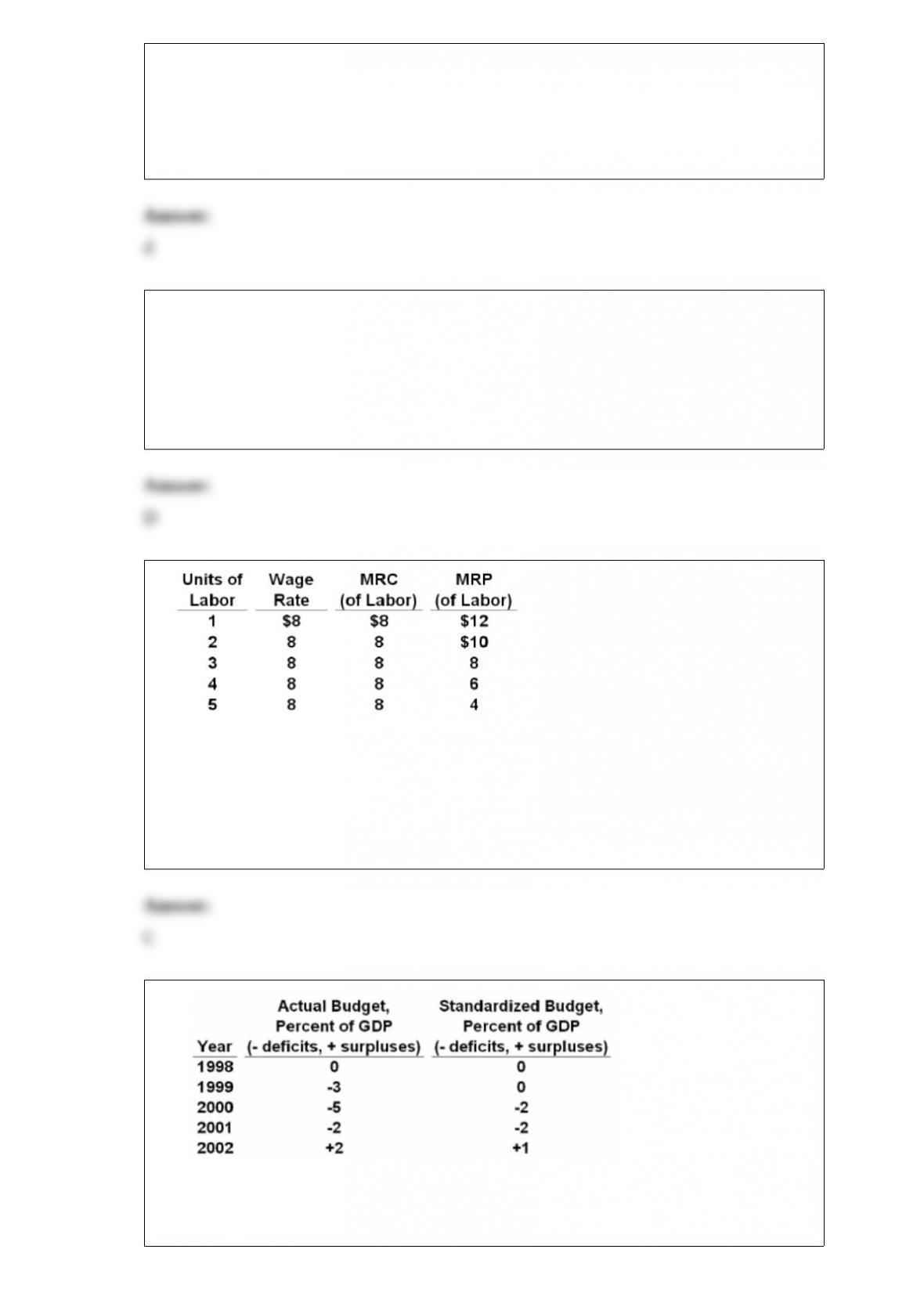
Refer to the above data. At the profit maximizing level of employment, this firm’s, total
labor cost will be:
A.$16.
B.$30.
C.$24.
D.$32.
4)
Refer to the above data for a fictional economy. The changes in the budget conditions
between 1999 and 2000 best reflect:
A.demand-pull inflation.

B.an expansionary fiscal policy.
C.a tax increase.
D.a contractionary fiscal policy.
5) (Advanced analysis) Answer the next question(s) on the basis of the following
information for a private closed economy.
where S is saving, Ig is gross investment, i is the real interest rate, and Y is GDP.
Refer to the above information. In equilibrium the level of saving will be:
A.$10.
B.$15.
C.$20.
D.$30.
6) World commodity prices over the past 150 years have:
A.steadily decreased in both the short run and long run.
B.decreased in the long run despite occasional short-run increases.
C.remained constant in the long run despite occasional short-run fluctuations.
D.steadily increased in both the short run and long run.
7) If a nation has a comparative advantage in the production of X, this means the
nation:
A.cannot benefit by producing and trading this product.
B.must give up less of other goods than other nations in producing a unit of X.
C.has a production possibilities curve identical to those of other nations.
D.is not subject to increasing opportunity costs.
8) when total revenue is increasing:
a.marginal revenue may be either positive or negative.
b.the demand curve is relatively inelastic.
c.marginal revenue is positive.
d.marginal revenue is negative.
9)
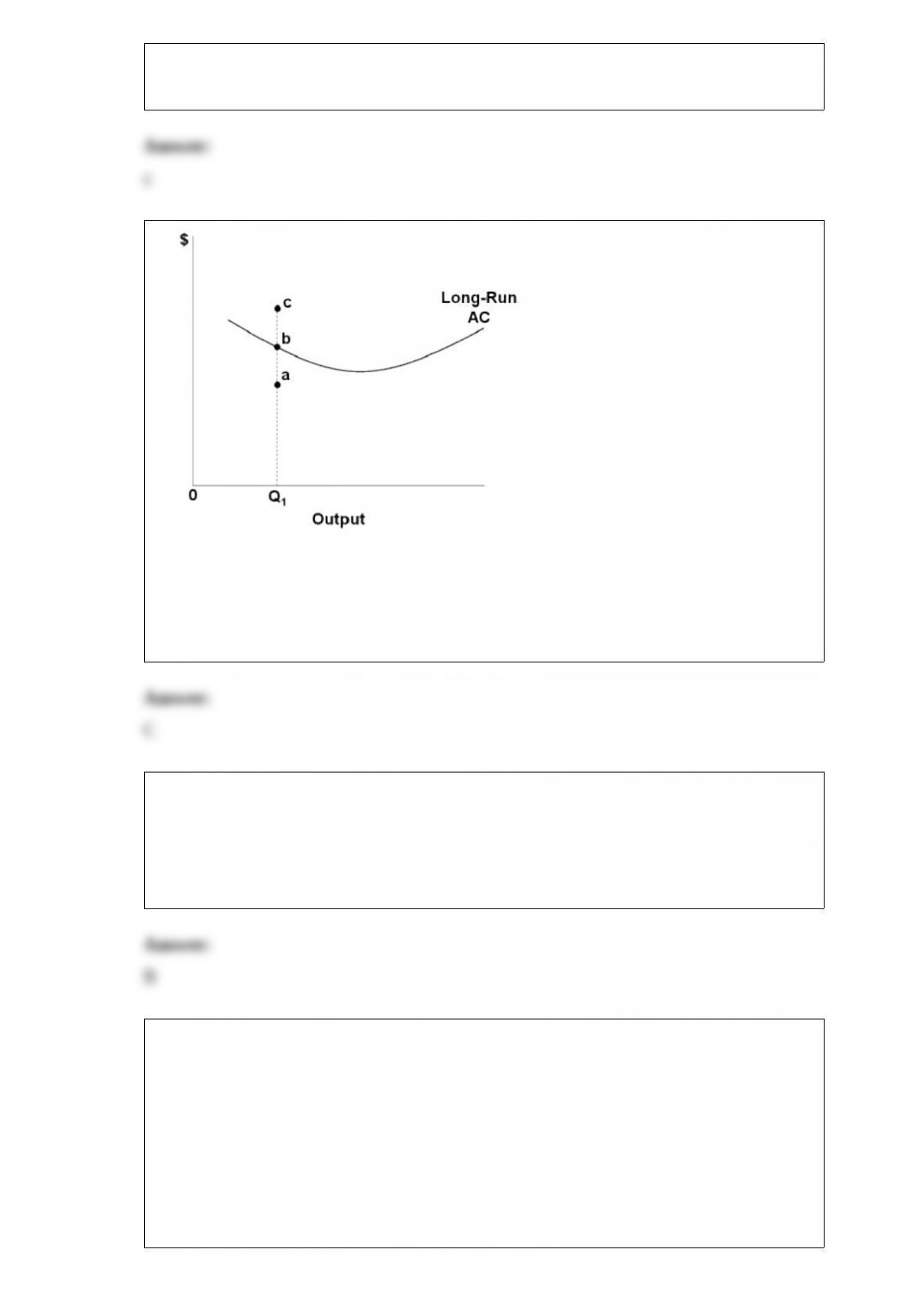
Refer to the above diagram. If a firm produces output Q1 at a unit cost of c, then the:
A.firm is operating in a purely competitive industry.
B.firm is maximizing profits.
C.marginal product per dollar’s worth of each resource employed is not the same.
D.firm is fulfilling the least-cost rule in employing resources.
10) The demand for farmland will increase if:
A.the demand for food decreases.
B.technological advances make land more productive.
C.the price of farm labor increases and the output effect exceeds the substitution effect.
D.the supply of farmland increases.
11) what is the difference between national income and personal income?
a.personal taxes.
b.national income includes income earned both at in the united states and abroad, while
personal income only includes that income earned within the borders of the united
states.
c.national income represents before-tax income, while personal income measures how
much is available for spending after all taxes have been subtracted.
d. national income represents income earned by american-owned resources, while
personal income measures received income, whether earned or unearned.

12) use the list below to answer the following questions:
1. improvements in technology
2. increases in the supply (stock) of capital goods
3. purchases of expanding output
4. obtaining the optimal combination of goods, each at least-cost production
5. increases in the quantity and quality of natural resources
6. increases in the quantity and quality of human resources
which set of items in the above list would move an economy from a point inside its
production possibilities curve to a point on its production possibilities curve?
a.1, 2, 5, and 6 only
b.3 and 4 only
c.3 only
d.1, 3, 4 only