
A stock with a price-earnings ratio of 11.2 means that the stock is selling for a closing
share price that is 11.2 times its latest available net earnings per share.
a. True
b. False
The producer of good X is contemplating a price change and has asked for your advice.
After some empirical investigation, you conclude that the price elasticity of demand for
good X is 0.75. Your best advice to the producer would be to
a. increase the price of good X to raise total revenue.
b. decrease the price of good X to raise total revenue.
c. leave the price of good X unchanged since it will not influence total revenue.
d. increase the price of good X to reduce total revenue.
An unrecoverable cost that should be disregarded in any current or future decision is
also called a(n) __________ cost.
a. sunk
b. explicit
c. implicit
d. variable

The buyer of a good has less information than the seller of the good. This is a case of
a. externality information.
b. free ridership.
c. asymmetric information.
d. biased information.
e. a public good not being a private good.
A deadweight loss is the loss to society of not producing the supply-and-demand
determined level of output.
a. True
b. False
Suppose that the annual dividend per share of stock is $1.40 and the closing price of the

stock is $22.00, the yield on the stock would be approximately
a. 6.36%
b. 15.71%
c. 21.60%
d. 9.70%
What is the Herfindahl index of an industry made up of four equal-sized firms?
a. 1,667
b. 2,500
c. 2,250
d. 125
e. This cannot be determined without further information.
If a firm is a monopsonist, then it faces
a. a downward sloping demand curve for its product, and its marginal revenue curve
will lie below its demand curve.
b. a horizontal marginal factor cost curve.
c. an upward sloping factor supply curve, and its marginal factor cost curve will lie

above the factor supply curve.
d. an upward sloping factor supply curve, and its marginal factor cost curve will
coincide with the factor supply curve.
e. an upward-sloping factor supply curve, and its marginal factor cost curve will lie
below the factor supply curve.
The Lorenz curve of perfect income equality is a
a. vertical line.
b. horizontal line.
c. 45-degree line.
d. downward-sloping line.
e. line with a slope of negative 1.
The long-run industry supply curve is the graphic representation of the quantity of
output that the industry is prepared to
a. supply at different prices after the entry and exit of firms is completed.
b. supply at a single price after the entry and exit of firms is completed.
c. purchase at different prices after the entry and exit of firms is completed.
d. purchase at different prices after the entry of firms is completed.
e. supply at different prices after the exit of firms is completed.
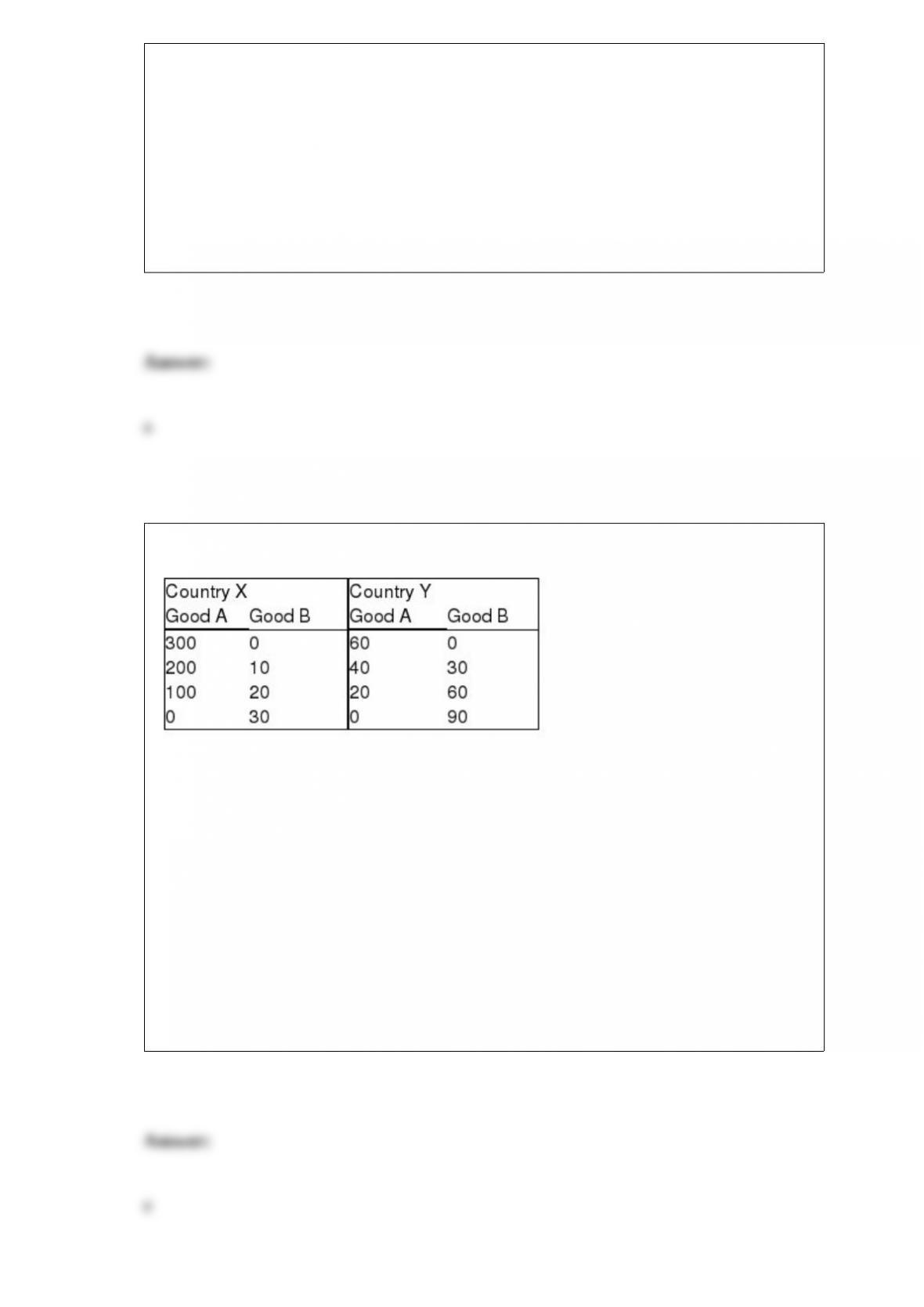
Exhibit 34-9
Which of the following statements is true?
a. Country X has a comparative advantage in the production of good A.
b. Country Y has a comparative advantage in the production of good B.
c. It would be better for country A to specialize in (the production of) and trade good A
than to specialize in and trade good B.
d. a and c
e. a, b, and c

Scarcity means
a. wants are greater than the limited resources available to satisfy these wants.
b. wants are less than the limited resources available to satisfy these wants.
c. resources are infinite.
d. wants are limited.
e. both c and d
Which of the following statements is false?
a. If people were more alike in terms of their marketable innate abilities and attributes,
there would be less income inequality.
b. Some degree of income inequality can be attributed to the fact that some people
consume less leisure than others.
c. Schooling is referred to as human capital.
d. Education differences are generally not reflected in income differences.
Which of the following comes closest to being a monopsony?
a. a car manufacturer in Detroit
b. a McDonald’s in a big city
c. a coal company who employees all of the workers in a given town
d. a farmer who hires labor
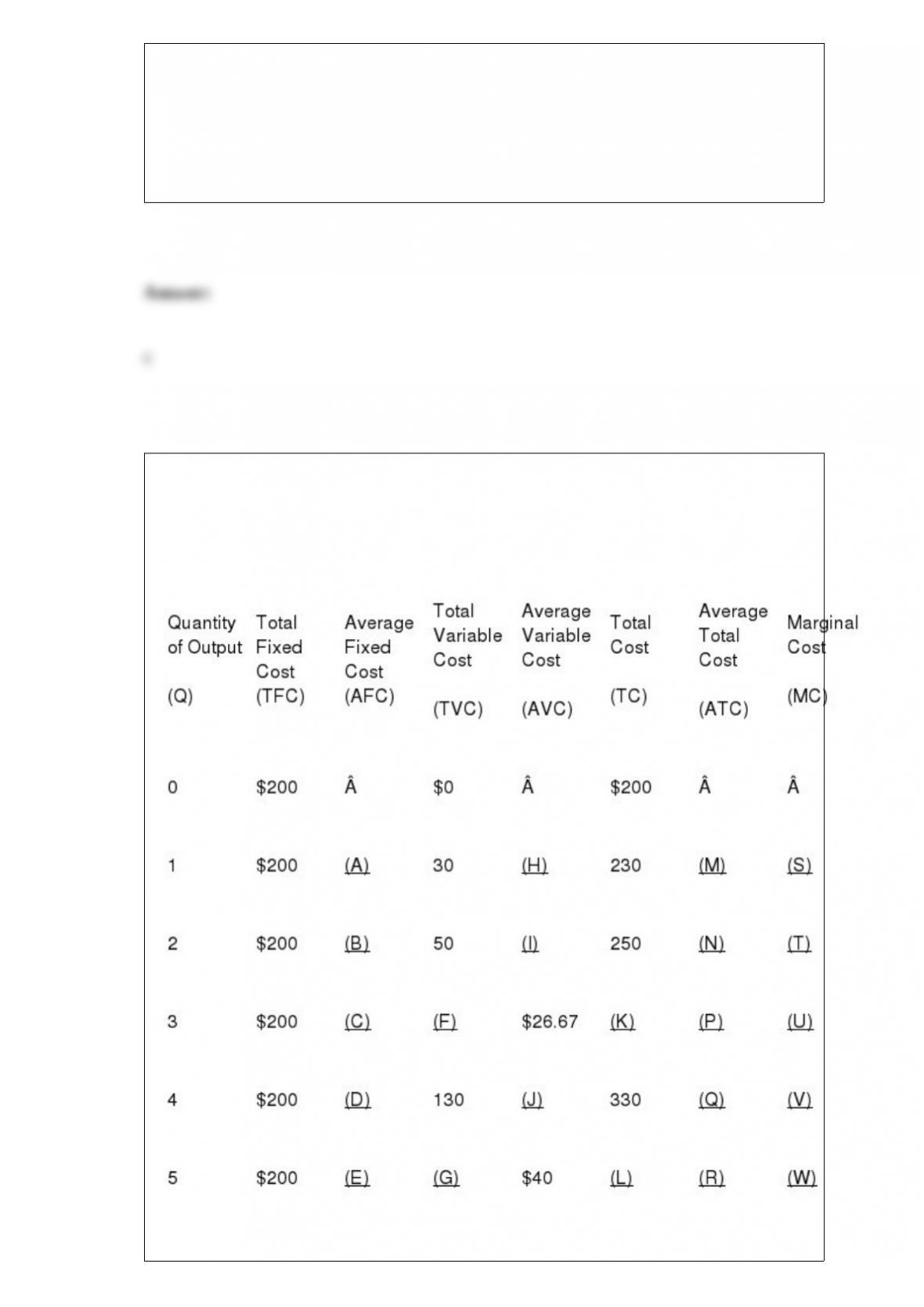
Exhibit 22-13

What dollar amounts go in blanks (I) and (J), respectively?
a. $100; $50
b. $25; $32.50
c. $500; $40
d. $50; $32
e. There is not enough information to answer this question.
The price elasticity of demand is the percentage change in
a. price divided by the percentage change in quantity demanded.
b. price divided by the percentage change in demand.
c. quantity demanded divided by the percentage change in price.
d. demand divided by the percentage change in price.
e. c and d

Excess capacity results from a
a. downward-sloping demand curve and a U-shaped ATC curve.
b. downward-sloping demand curve and no fixed costs.
c. horizontal demand curve and an upward-sloping marginal cost curve.
d. perfectly inelastic demand curve and a downward-sloping ATC curve.
e. none of the above
The monopoly power problem is that a monopoly
a. produces a smaller output than that produced by a perfectly competitive firm.
b. charges a higher price than the price a perfectly competitive firm would charge.
c. creates a deadweight loss to society.
d. a and b
e. a, b, and c
For the monopoly firm that does not engage in perfect price discrimination,
a. the marginal revenue curve lies below the demand curve.
b. the marginal revenue curve and demand curve are the same.
c. the marginal revenue curve lies above the demand curve.
d. marginal revenue equals price.
e. c and d
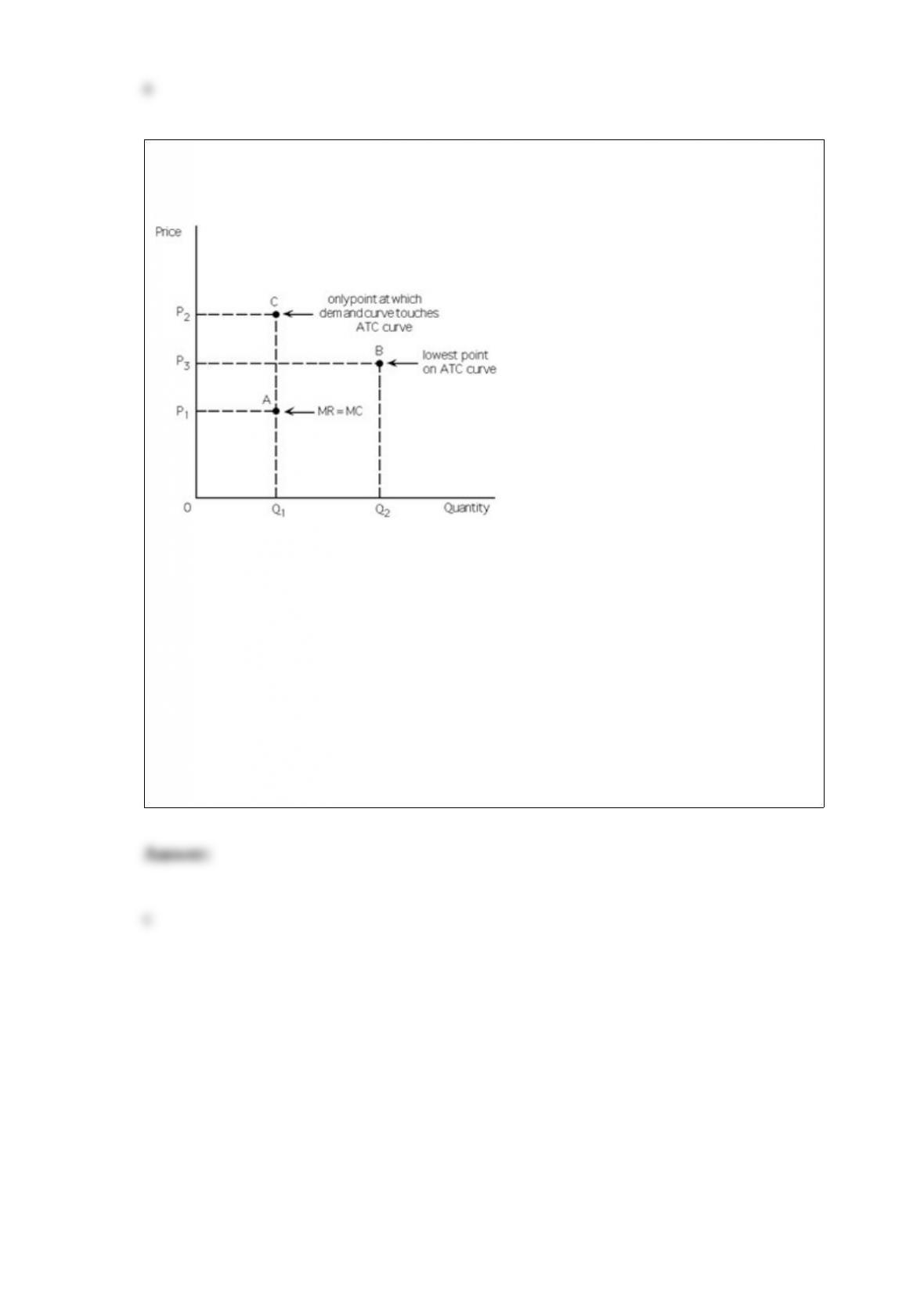
Exhibit 25-6
The monopolistic competitor in the exhibit is
a. earning positive economic profits.
b. taking losses.
c. earning a normal profit.
d. exhibiting productive efficiency.
e. a and d