If a tax is levied on the sellers of a product, then there will be a(n)
a. downward shift of the demand curve.
b. upward shift of the demand curve.
c. decrease in quantity demanded.
d. increase in quantity demanded.
Music compact discs are normal goods. What will happen to the equilibrium price and
quantity of music compact discs if musicians accept lower royalties, compact disc
players become cheaper, more firms start producing music compact discs, and music
lovers experience an increase in income?
a. Price will fall, and the effect on quantity is ambiguous.
b. Price will rise, and the effect on quantity is ambiguous.
c. Quantity will fall, and the effect on price is ambiguous.
d. Quantity will rise, and the effect on price is ambiguous.
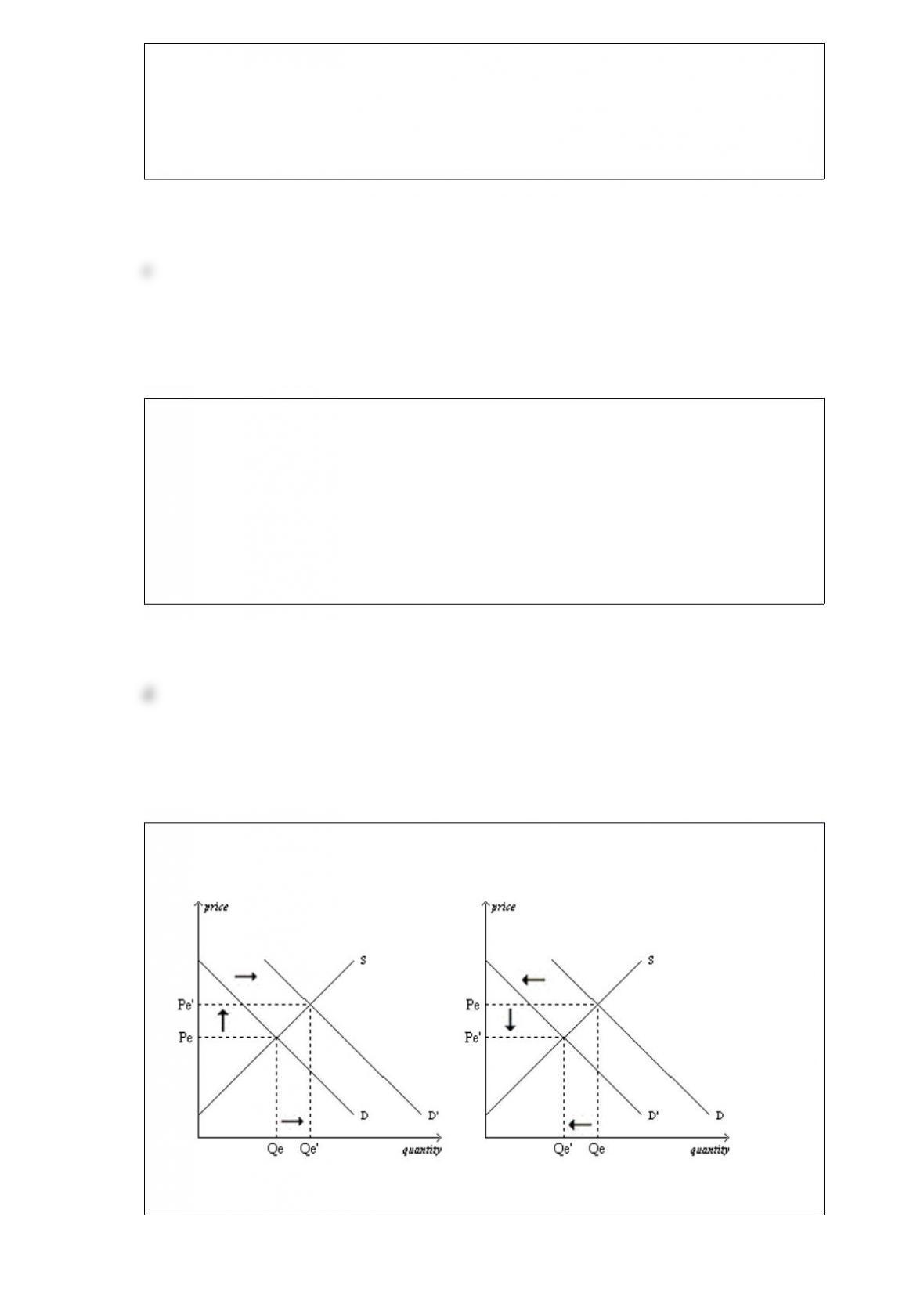
Figure 427
Panel (a)Panel (b)
Panel (c)Panel (d)
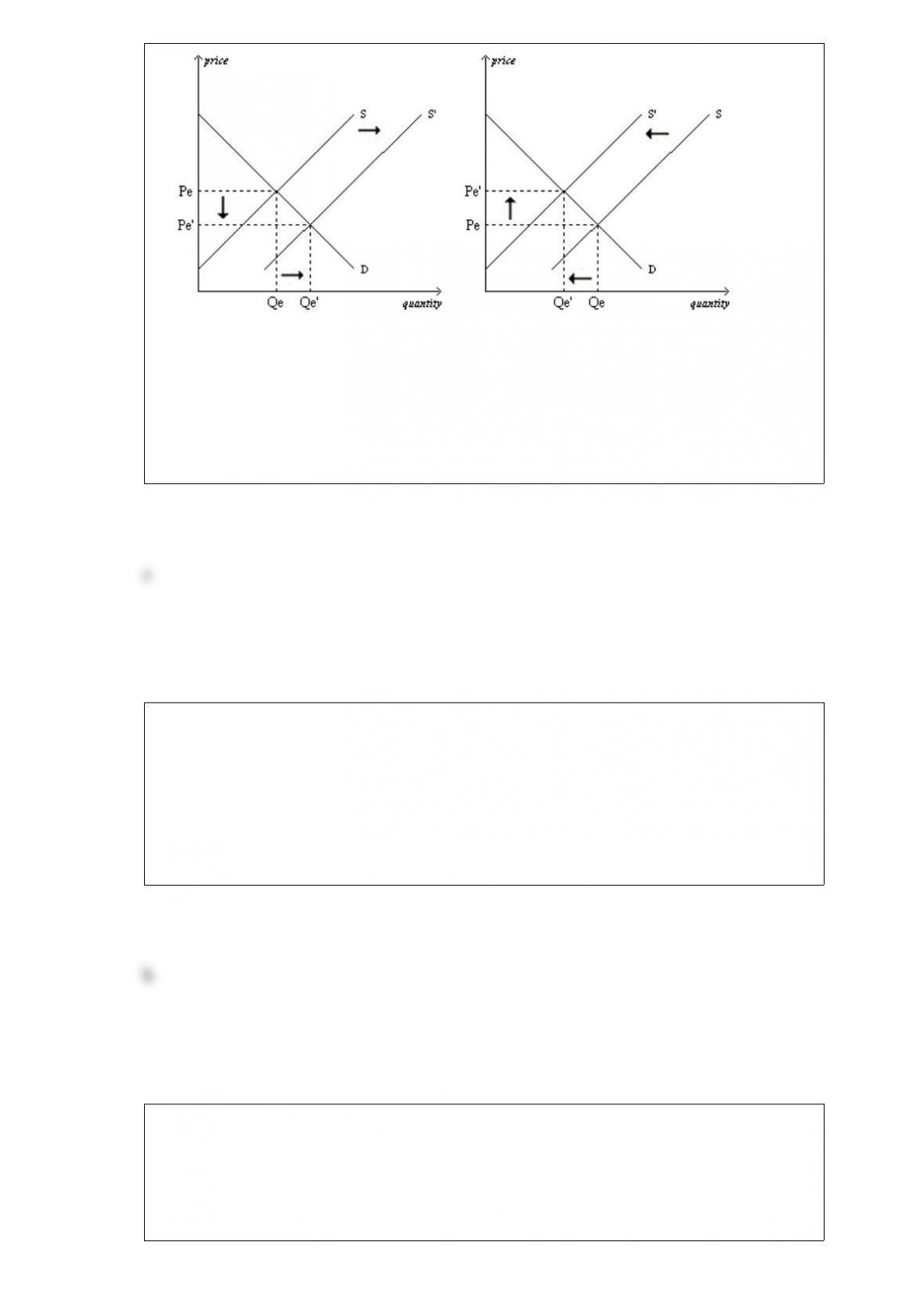
Refer to Figure 427. Which of the four panels illustrates an increase in quantity
demanded?
a. Panel (a)
b. Panel (b)
c. Panel (c)
d. Panel (d)
Jeff decides that he would pay as much as $3,000 for a new laptop computer. He buys
the computer and realizes consumer surplus of $700. How much did Jeff pay for his
computer?
a. $700
b. $2,300
c. $3,000
d. $3,700
When a tax is levied on a good,
a. neither buyers nor sellers are made worse off.
b. only sellers are made worse off.
c. only buyers are made worse off.
d. both buyers and sellers are made worse off.

Costa Rica allows trade with the rest of the world. We can determine whether Costa
Rica has a comparative advantage in producing pharmaceuticals if we
a. know whether Costa Rica imports or exports pharmaceuticals.
b. compare the world price of pharmaceuticals to the price of pharmaceuticals that
would prevail in Costa Rica if trade with the rest of the world were not allowed.
c. compare the quantity of pharmaceuticals consumed in Costa Rica with the quantity of
pharmaceuticals that would be consumed in Costa Rica if trade with the rest of the
world were not allowed.
d. All of the above are correct.
Table 715
The following table represents the costs of five possible sellers.
SellerCost ($)
Quentin10
Ruby30
Sandra60
Thomas100
Ursula150
Refer to Table 715. Suppose each of the five sellers can supply at most one unit of the
good. At which of the following prices would the market quantity supplied be exactly
three units?
a. $20
b. $50
c. $90
d. $120
Trade among nations is ultimately based on
a. absolute advantage.
b. strategic advantage.
c. comparative advantage.
d. technical advantage.
Holding all other things constant, a higher price for ski lift tickets would
a. increase the number of skiers.
b. increase the price of skis.
c. decrease the number of skis sold.
d. decrease the demand for other winter recreational activities.
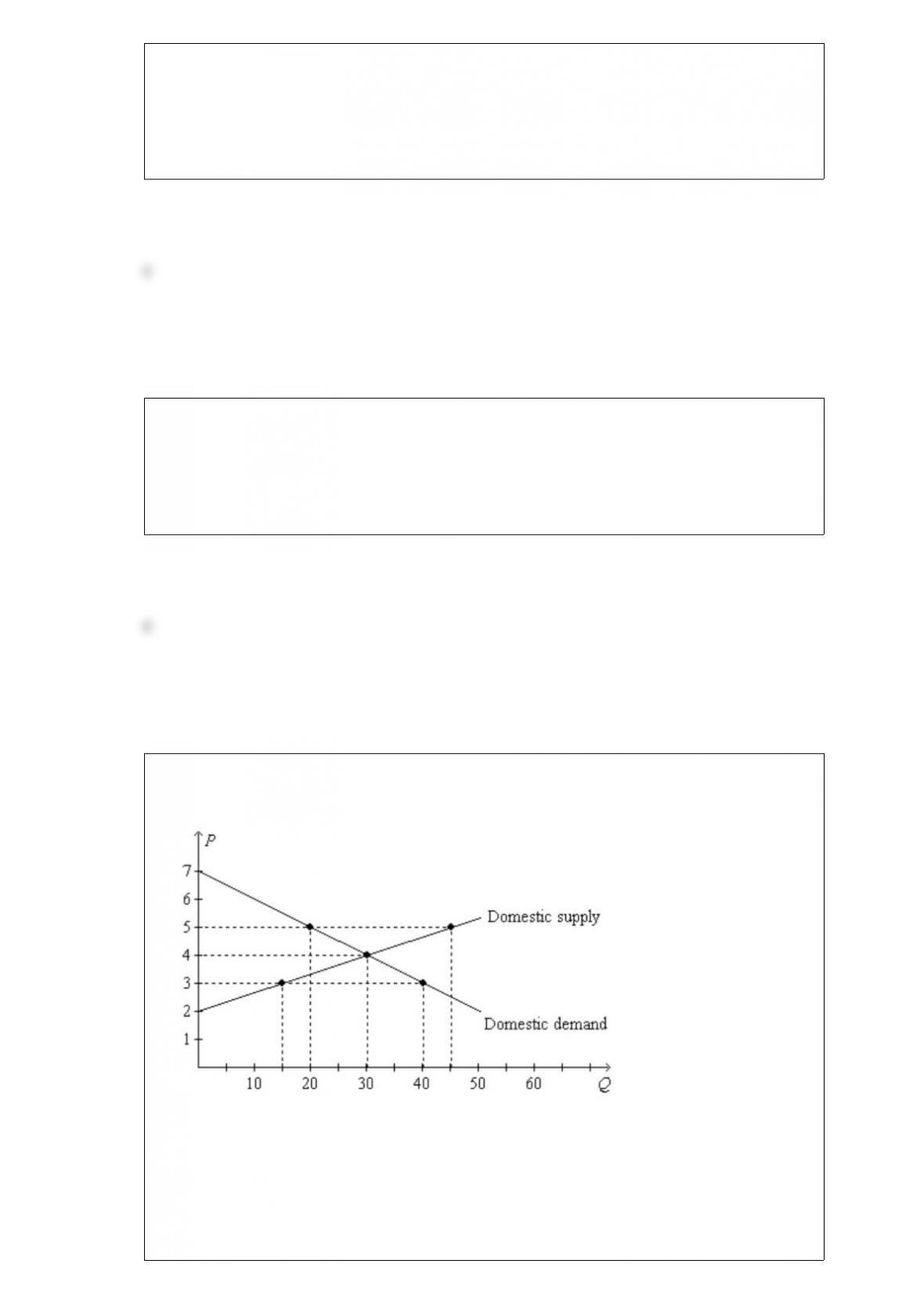
Figure 918. On the diagram below, Q represents the quantity of peaches and P
represents the price of peaches. The domestic country is Isoland.
Refer to Figure 918. If Isoland allows international trade, then it will be an exporter of
peaches if and only if the world price of peaches is
a. above $2.
b. below $4.
c. above $4.
d. below $7.

Last month, sellers of good Y took in $100 in total revenue on sales of 50 units of good
Y. This month sellers of good Y raised their price and took in $120 in total revenue on
sales of 40 units of good Y. At the same time, the price of good X stayed the same, but
sales of good X increased from 20 units to 40 units. We can conclude that goods X and
Y are
a. substitutes, and have a crossprice elasticity of 0.60.
b. complements, and have a crossprice elasticity of 0.60.
c. substitutes, and have a crossprice elasticity of 1.67.
d. complements, and have a crossprice elasticity of 1.67.
Table 326
Assume that Japan and Korea can switch between producing cars and producing
airplanes at a constant rate.
Hours Needed to Make 1Quantity Produced in 2400 Hours
CarAirplaneCarsAirplanes
Japan301508016
Korea501504816
Refer to Table 326. Assume that Japan and Korea each has 2400 hours available. If
each country spends all its time producing the good in which it has a comparative
advantage and trade takes place at a price of 12 cars for 6 airplanes, then
a. Japan and Korea will both gain from this trade.
b. Japan will gain from this trade, but Korea will not.
c. Korea will gain from this trade, but Japan will not.
d. neither Japan nor Korea will gain from this trade.
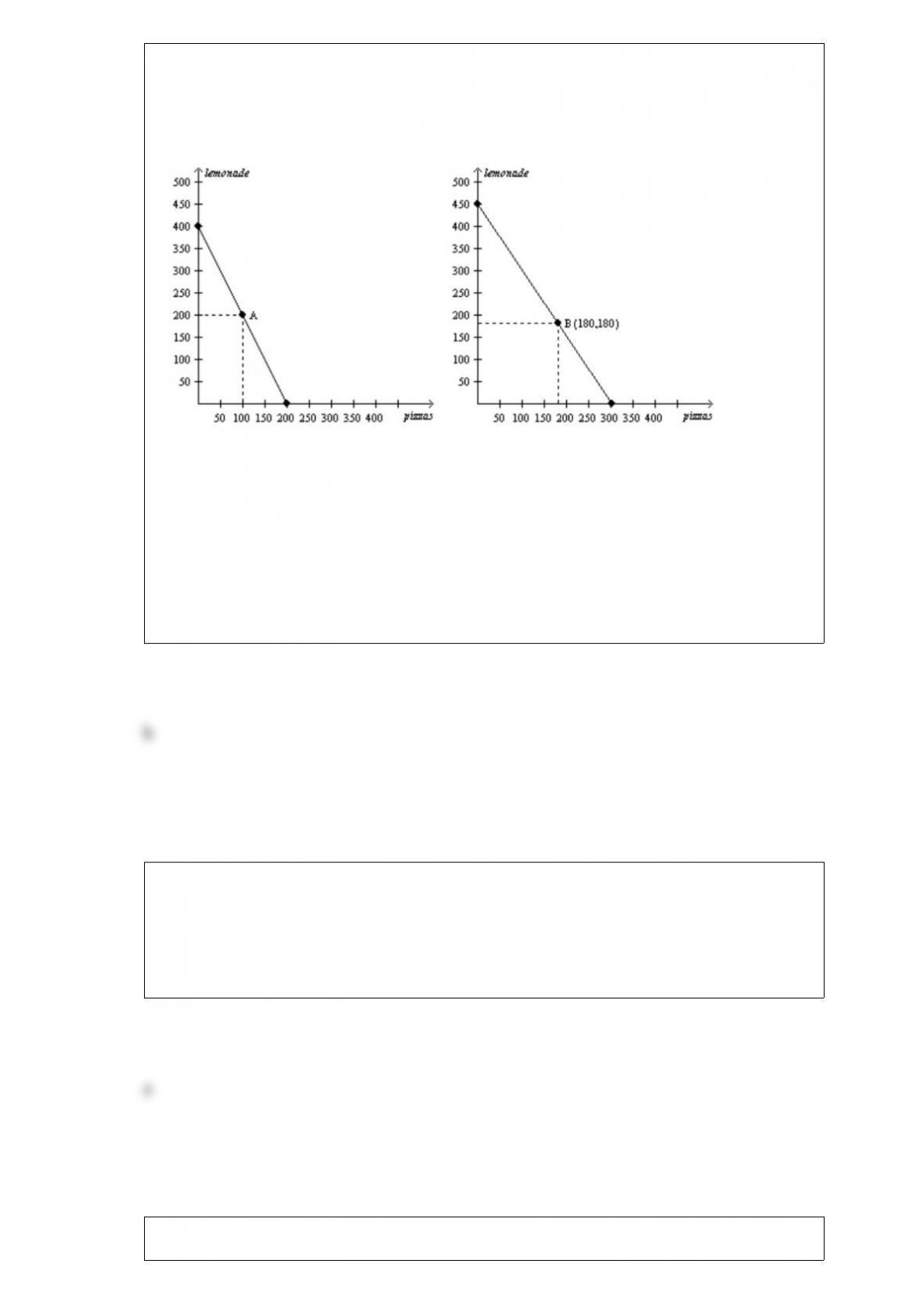
Figure 310
Alice and Betty’s Production Possibilities in one 8hour day.
Alice’s Production Possibilities FrontierBetty’s Production Possibilities Frontier
Refer to Figure 310. If point A represents Alice’s current production and point B
represents Betty’s current production, under what circumstances can both Alice and
Betty benefit from specialization and trade?
a. Alice produces more pizzas and Betty produces more lemonade.
b. Alice produces more lemonade and Betty produces more pizzas.
c. Both Alice and Betty produce only pizzas.
d. There are no circumstances under which both Alice and Betty can benefit from
specialization and trade.
Which of the following events must result in a higher price in the market for cigars?
a. Demand for cigars increases, and supply of cigars decreases.
b. Demand for cigars and supply of cigars both decrease.
c. Demand for cigars decreases, and supply of cigars increases.
d. Demand for cigars and supply of cigars both increase
The price received by sellers in a market will increase if the government decreases a
a. binding price floor in that market.
b. binding price ceiling in that market.
c. tax on the good sold in that market.
d. None of the above is correct.
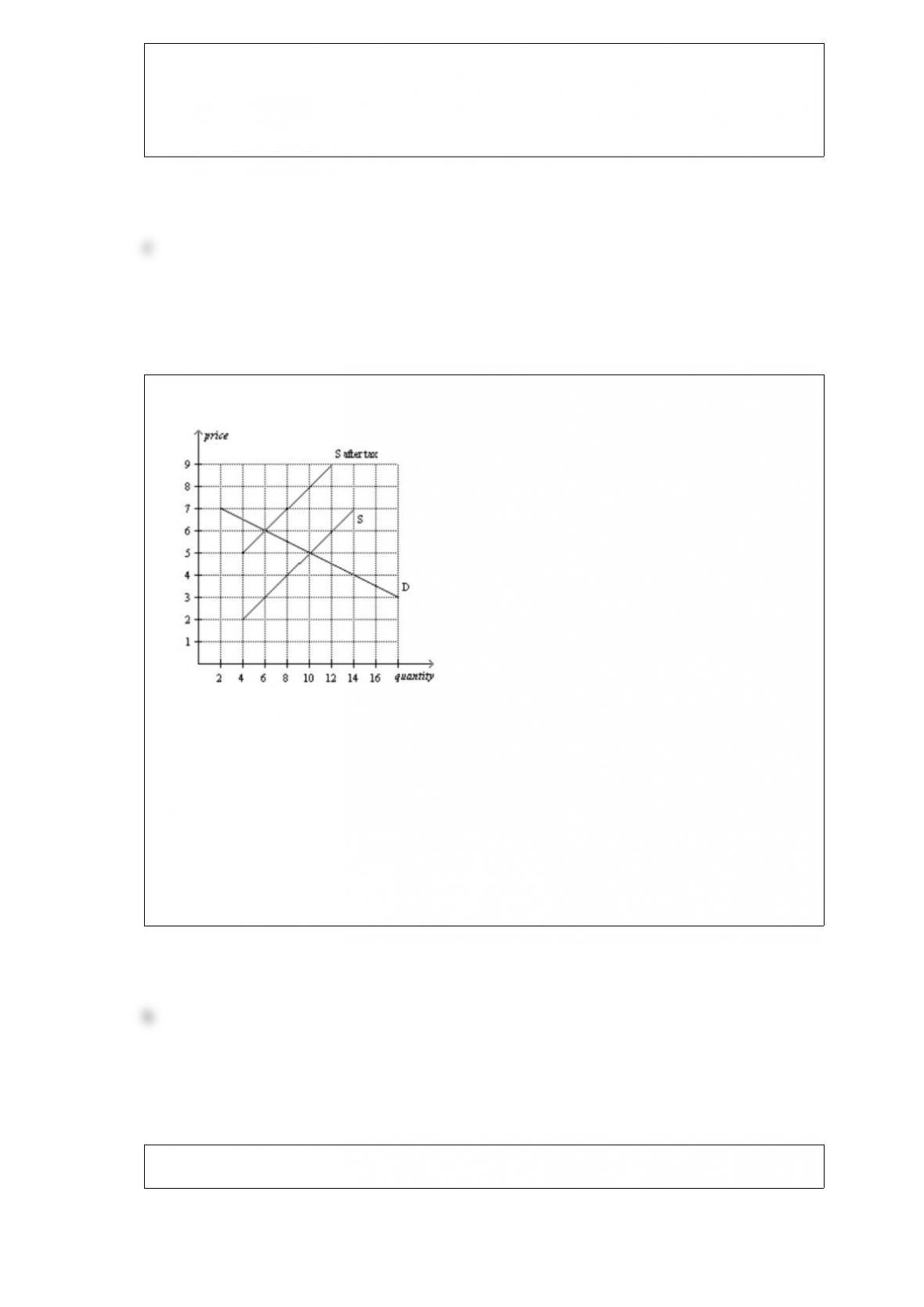
Figure 623
Refer to Figure 623. Which of the following is correct?
a. The entire burden of the tax falls on sellers, and none of the burden of the tax falls on
buyers.
b. Onethird of the burden of the tax falls on buyers, and twothirds of the burden of the
tax falls on sellers.
c. Onehalf of the burden of the tax falls on buyers, and onehalf of the burden of the tax
falls on sellers.
d. Twothirds of the burden of the tax falls on buyers, and onethird of the burden of the
tax falls on sellers.
Figure 422
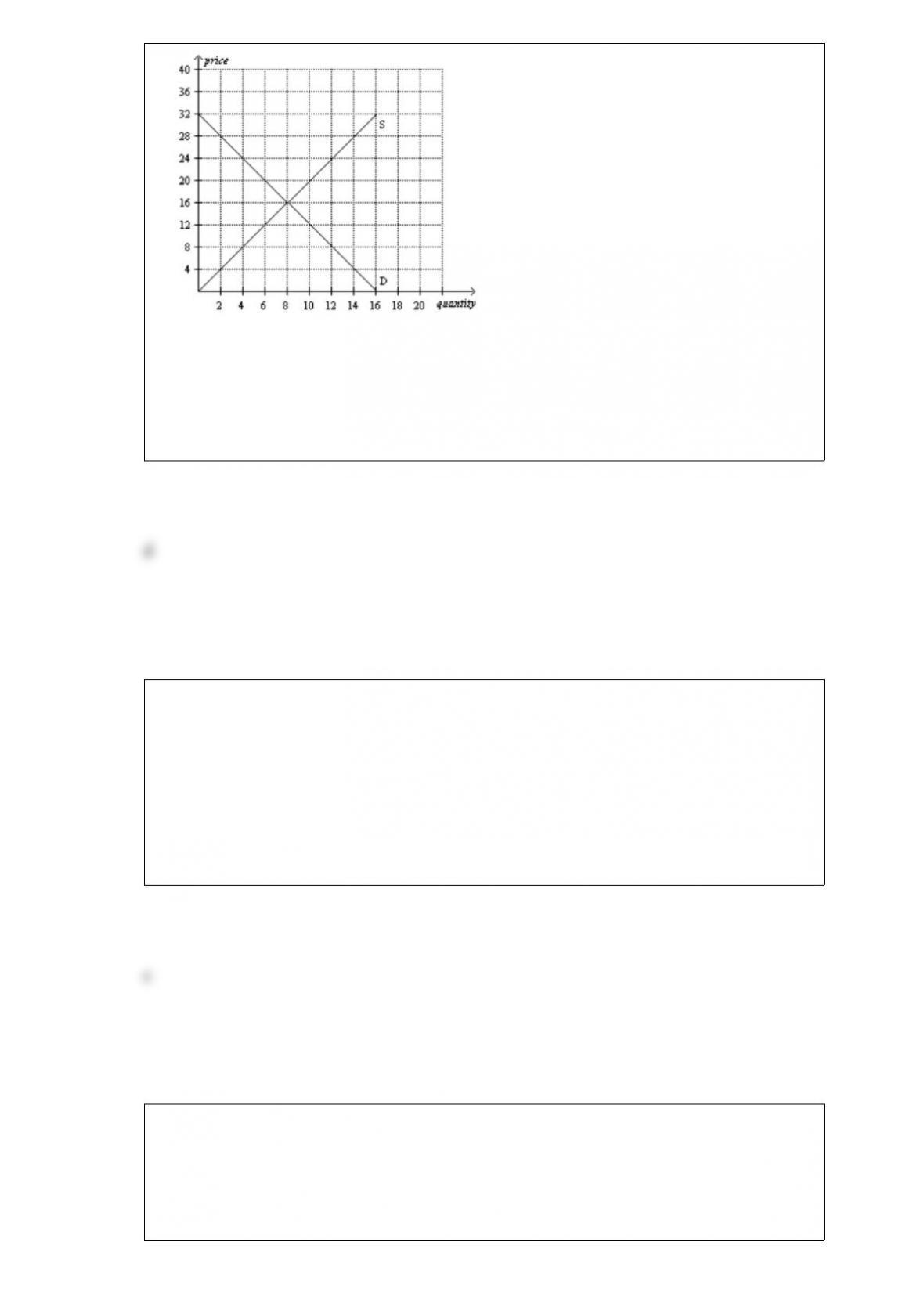
Refer to Figure 422. At a price of $12, there is a
a. surplus of 2 units.
b. surplus of 4 units.
c. shortage of 2 units.
d. shortage of 4 units.
Which of the following is not correct?
a. When developing economic theories, graphs offer a way to visually express ideas that
might be less clear if described with equations or words.
b. Graphs are one way of expressing the relationships among variables.
c. When studying the relationship between two economic variables, graphs allow
economists to draw indisputable conclusions about causes and effects.
d. When analyzing economic data, graphs provide a powerful way of finding and
interpreting patterns.
Suppose that demand for a good increases and, at the same time, supply of the good
decreases. What would happen in the market for the good?
a. Equilibrium price would decrease, but the impact on equilibrium quantity would be
ambiguous.
b. Equilibrium price would increase, but the impact on equilibrium quantity would be
ambiguous.
c. Equilibrium quantity would decrease, but the impact on equilibrium price would be
ambiguous.
d. Equilibrium quantity would increase, but the impact on equilibrium price would be
ambiguous.
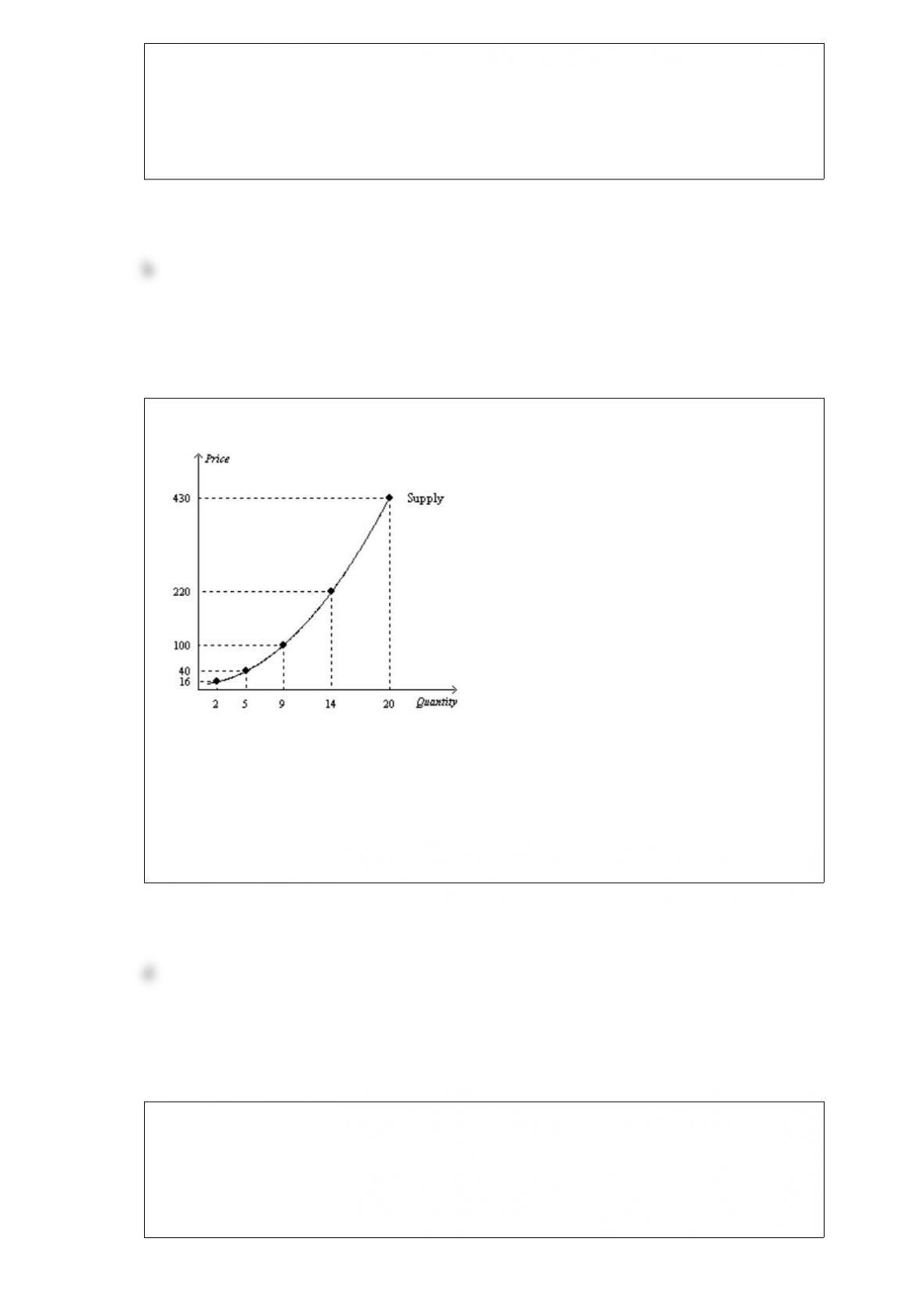
Figure 514
Refer to Figure 514. Over which range is the supply curve in this figure the least
elastic?
a. $16 to $40
b. $40 to $100
c. $100 to $220
d. $220 to $430
Congress intended that
a. the entire FICA tax be paid by workers.
b. the entire FICA tax be paid by firms.
c. onequarter of the FICA tax be paid by workers, and threequarters be paid by firms.
d. half the FICA tax be paid by workers, and half be paid by firms.

Suppose good X has a positive income elasticity of demand. This implies that good X
could be
(i)a normal good.
(ii)a necessity.
(iii)an inferior good.
(iv)a luxury.
a. (i) only
b. (i) and (ii) only
c. (i), (ii), and (iv) only
d. (iii) only
Which of the following is not one of the four principles of individual decision making?
a. People face tradeoffs.
b. Trade can make everyone better off.
c. People respond to incentives.
d. Rational people think at the margin.
Motor oil and gasoline are complements. If the price of motor oil increases, consumer
surplus in the gasoline market
a. decreases.
b. is unchanged.
c. increases.
d. may increase, decrease, or remain unchanged.
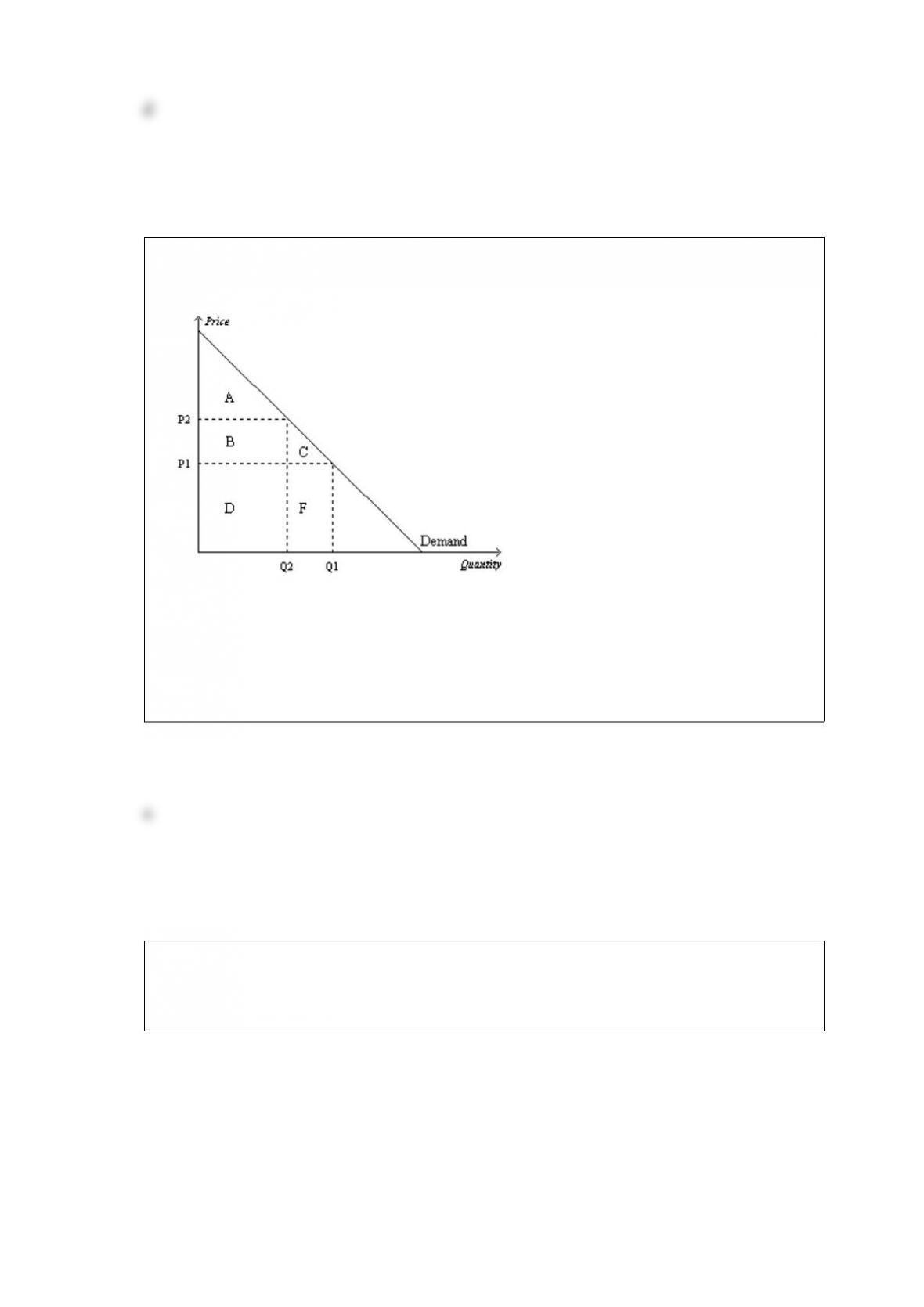
Figure 73
Refer to Figure 73. When the price is P2, consumer surplus is
a. A.
b. B.
c. A+B.
d. A+B+C.
Figure 317
Maxine’s Production Possibilities FrontierDaisy’s Production Possibilities Frontier
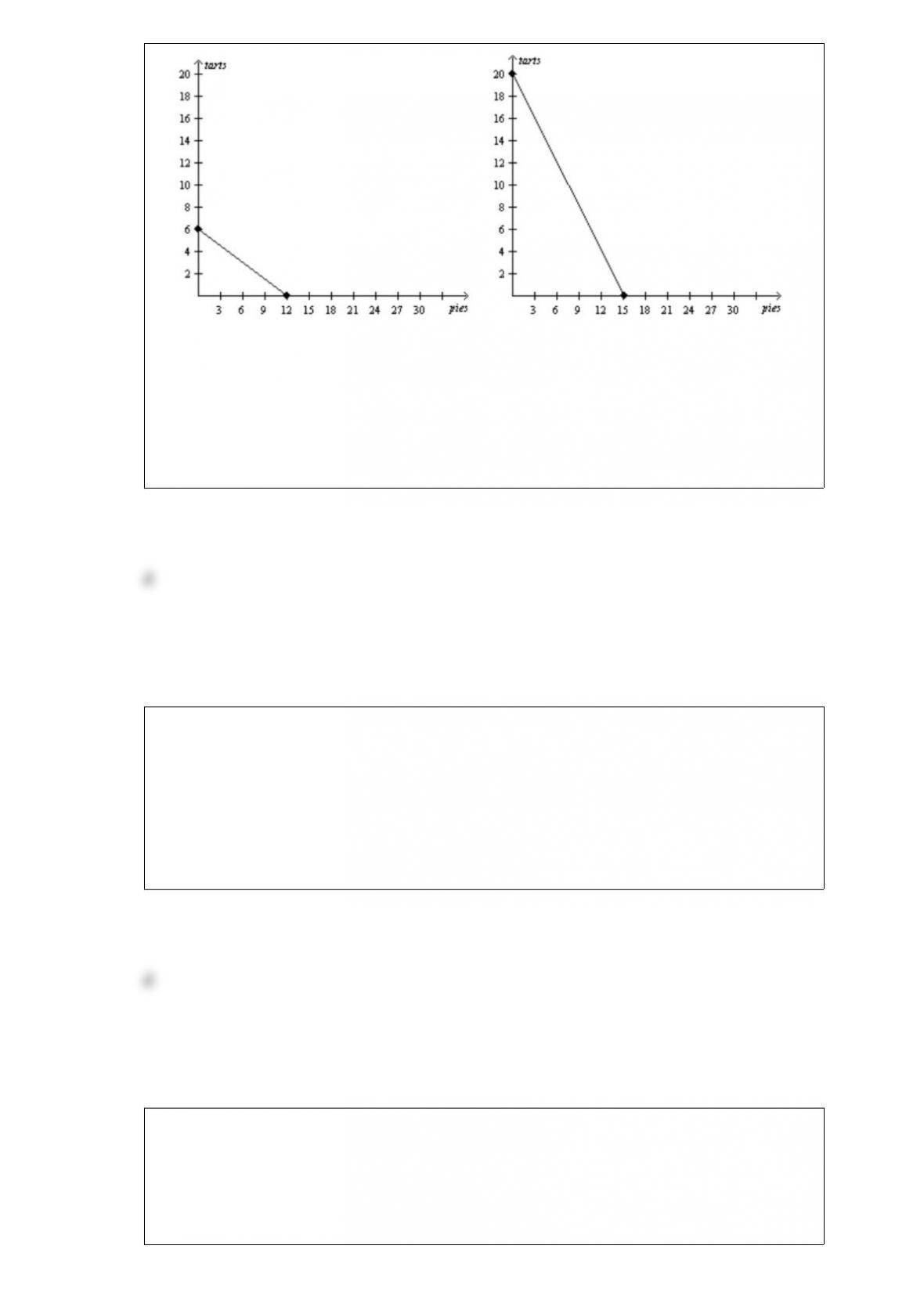
Refer to Figure 317. Suppose Maxine decides to increase her production of tarts by 5.
What is the opportunity cost of this decision?
a. 2/5 pie
b. 2 pies
c. 5/2 pies
d. 10 pies
Assume that for good X the supply curve for a good is a typical, upwardsloping straight
line, and the demand curve is a typical downwardsloping straight line. If the good is
taxed, and the tax is tripled, the
a. base of the triangle that represents the deadweight loss triples.
b. height of the triangle that represents the deadweight loss triples.
c. deadweight loss of the tax increases by a factor of nine.
d. All of the above are correct.
Table 332
US and French Production Opportunities
Wine (in millions of gallons)Cheese (in millions of lbs.)

US1632
France84
Refer to Table 332 France has an absolute advantage in the production of
a. wine.
b. cheese.
c. both wine and cheese.
d. neither wine nor cheese.
If the demand for a good falls when income falls, then the good is called a(n)
a. normal good.
b. regular good.
c. luxury good.
d. inferior good.
The quantity sold in a market will increase if the government
a. decreases a binding price floor in that market.
b. decreases a binding price ceiling in that market.
c. increases a tax on the good sold in that market.
d. More than one of the above is correct.
If Max experiences a decrease in his income, then we would expect Max’s demand for
a. each good he purchases to remain unchanged.
b. normal goods to decrease.

c. luxury goods to increase.
d. inferior goods to decrease.