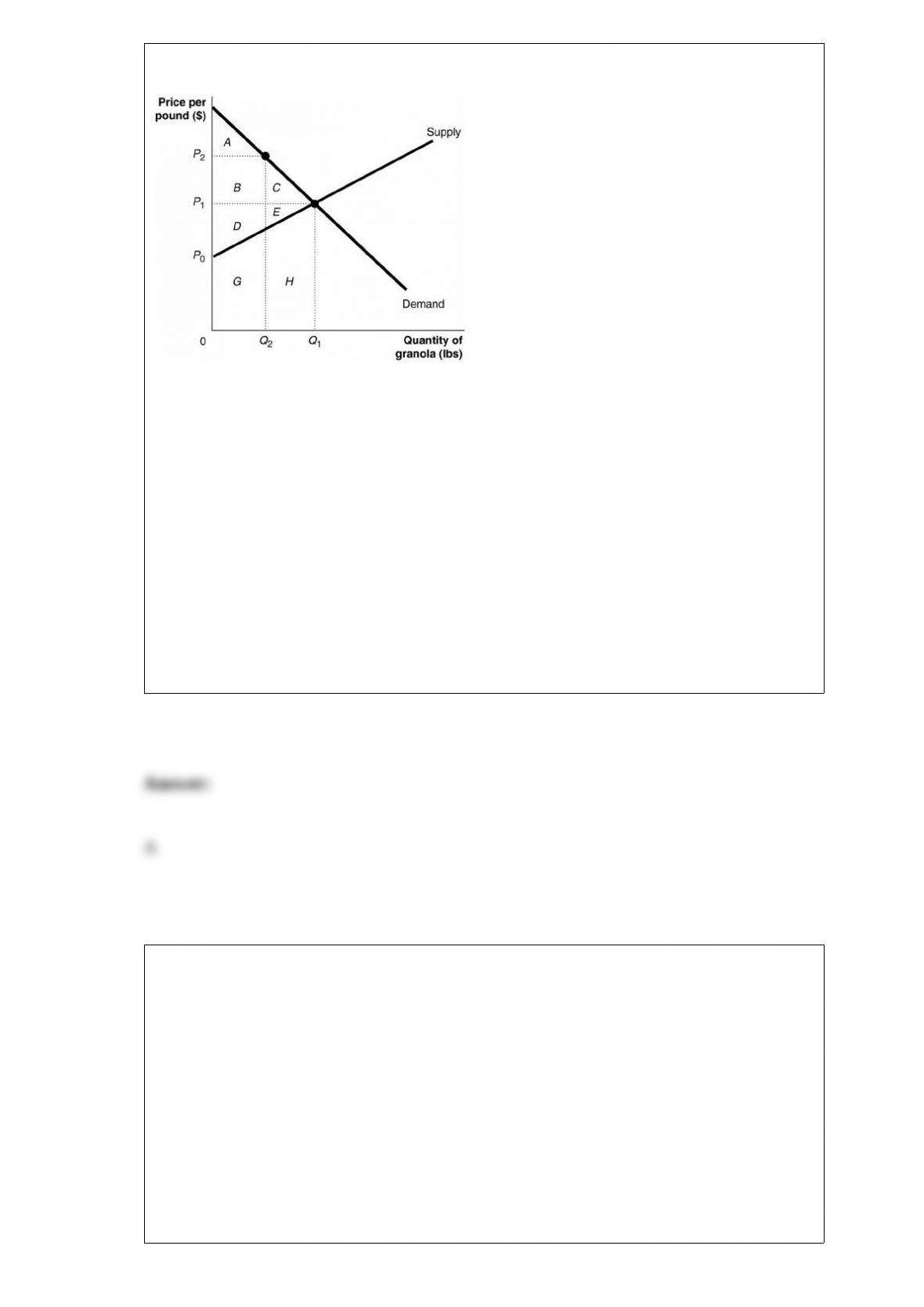
Figure 4-3
Figure 4-3 shows the market for granola. The market is initially in equilibrium at a price
of P1 and a quantity of Q1. Now suppose producers decide to cut output to Q2 in order
to raise the price to P2.
Refer to Figure 4-3. What area represents consumer surplus at P2?
A) A
B) A + B
C) B + C
D) A + B + D + E
During 2008, oil price increases
A) shifted the short-run aggregate supply curve farther to the left than similar increases
had 30 years earlier.
B) shifted the aggregate demand curve farther to the right than similar increases had 30
years earlier.
C) did not shift the short-run aggregate supply curve as far to the left as similar
increases had 30 years earlier.
D) shifted the aggregate demand curve farther to the left than similar increases had 30

years earlier.
The equilibrium wage in a local labor market is $6 per hour. If a minimum wage of $8
per hour is imposed, which of the following will occur?
A) There will be an increase in unemployment.
B) There will be an increase in the quantity of labor demanded by firms.
C) There will be a decrease in the quantity of labor supplied by households.
D) All of the above will occur.
Which of the following equations correctly measures GDP in an economy?
A) GDP = C + I + G + X
B) GDP = C + net I + G + NX
C) GDP = C + I + G + NX
D) GDP = C + G + I – taxes

In a competitive market equilibrium the ________ equals the ________ of the last unit
sold.
A) total profit; marginal benefit
B) total cost; marginal cost
C) profit; selling price
D) marginal benefit; marginal cost
What is potential GDP?
A) It is the level of real GDP in the long run.
B) It is the difference between current GDP and maximum GDP.
C) It is the level of real GDP in the short run.
D) It is the level of GDP at which inflation is constant.
Figure 4-4
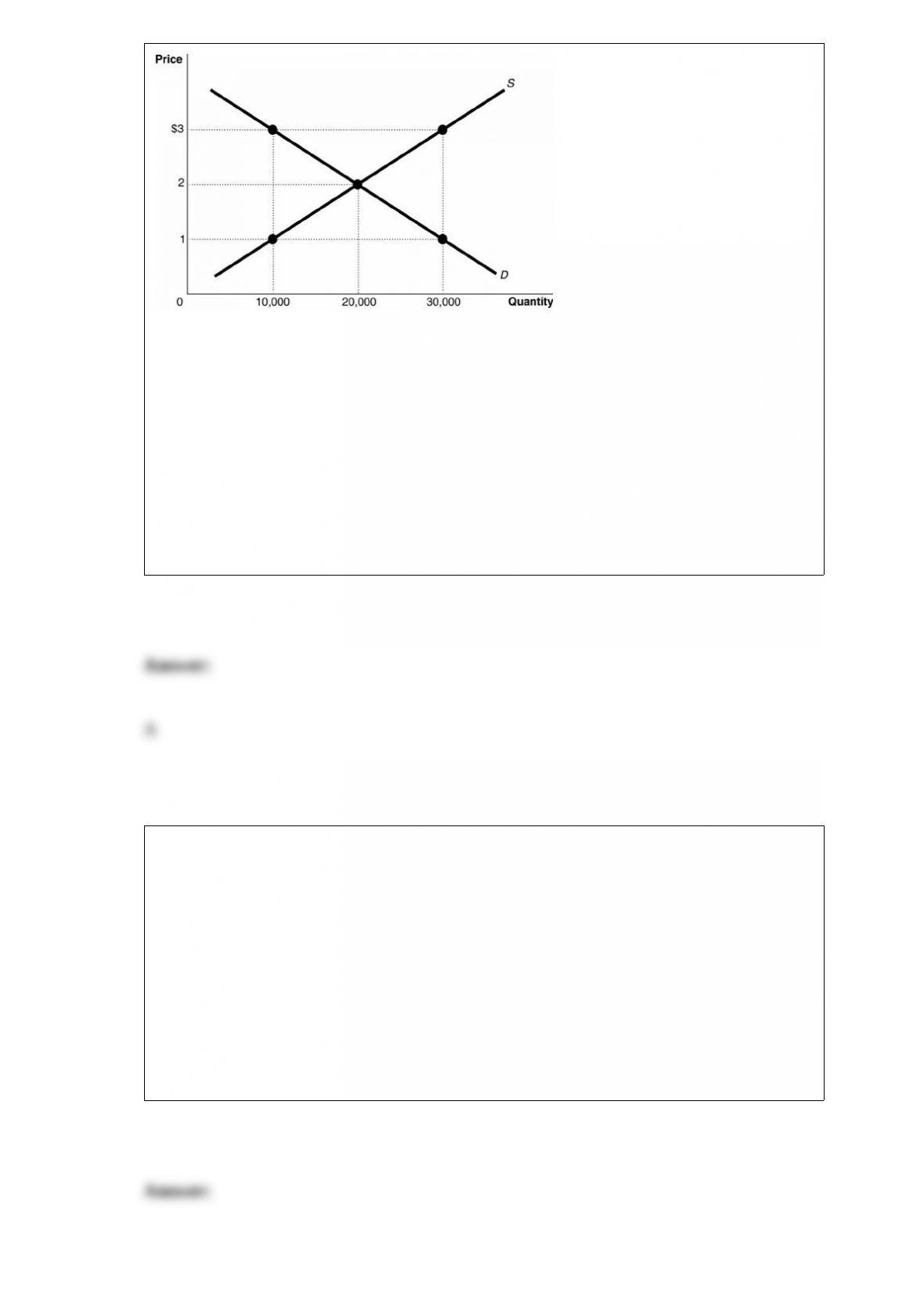
Refer to Figure 4-4. The figure above represents the market for iced tea. Assume that
this is a competitive market. If the price of iced tea is $1
A) the quantity supplied is less than the economically efficient quantity.
B) the quantity supplied is economically efficient but the quantity demanded is
economically inefficient.
C) economic surplus is maximized.
D) not enough consumers want to buy iced tea.
If the slope of the per-worker production function is 1/4 in a given range, how will a
$10,000 increase in capital per hour worked affect real GDP per hour worked in the
same given range?
A) Real GDP per hour worked will increase by $2,500.
B) Real GDP per hour worked will increase by $40,000.
C) Real GDP per hour worked will increase by $10,000.
D) Real GDP per hour worked will decrease by $40.000.

Which of the following would increase the balance on the current account?
A) an increase in foreign direct investment
B) an increase in the amount of aid money the government sends abroad
C) an increase in imports
D) an increase in the balance of trade
The largest proportion of M1 is made up of
A) currency.
B) checking account deposits.
C) traveler’s checks.
D) savings account deposits.
E) time deposits.
Liquidity is defined as
A) the ease with which a given asset can be converted to a store of value.

B) the ease with which a given asset can be converted to a unit of account.
C) the ease with which a given asset can be converted to a medium of exchange.
D) the ease with which a given asset can be converted to a standard of deferred
payment.
If policy makers implement an expansionary fiscal policy but do not take into account
the potential for crowding out, the new equilibrium level of GDP is likely to
A) be at potential GDP.
B) be above potential GDP.
C) be below potential GDP.
D) There is insufficient information given here to draw a conclusion.
Suppose you lend $1,000 at an interest rate of 10 percent over the next year. If the
expected real interest rate at the beginning of the loan contract is 4 percent, then what
rate of inflation over the upcoming year would be most beneficial to you as the lender?
An inflation rate
A) equal to 0 percent.
B) greater than 6 percent.
C) equal to 6 percent.

D) equal to 4 percent.
Under current tax law individuals do not pay taxes on health insurance benefits they
receive from their employers. As a result
A) the federal government spends more than it receives in tax revenue.
B) individuals are encouraged to want generous health coverage that reduces their
incentives to cut costs.
C) the quality of health care provided is less than it would be if benefits were taxed.
D) politicians are encouraged to raise income and payroll taxes.
Of the following countries, which had the highest level of GDP per capita in 2012?
A) Japan
B) France
C) Italy
D) the United States

When net capital flows are positive,
A) capital inflows are greater than capital outflows.
B) net foreign investment is negative.
C) capital outflows are greater than capital inflows.
D) A and B are both correct.
According to the saving and investment equation, if net foreign investment falls by $35
million,
A) national saving in excess of domestic investment will decrease by $35 million.
B) national savings will rise by $35 million.
C) domestic investment will fall by $35 million.
D) national saving in excess of domestic investment will rise by $35 million.
Because workers in the United States work fewer hours per week, on average, than they
did over 100 years ago,
A) workers in the United States are worse off than they were over 100 years ago.
B) workers in the United States earn less income than they did over 100 years ago.

C) GDP is lower than it would be if U.S. workers worked the same workweek they had
100 years ago.
D) GDP is higher than it would be if U.S. workers worked the same workweek they had
100 years ago.
Since 2000, the Fed uses ________ to measure inflation.
A) the index of leading economic indicators
B) the personal consumption expenditures index
C) the consumer price index
D) the GDP deflator
E) the producer price index