If aggregate quantity demanded exceeds aggregate quantity supplied, we can expect an
unplanned
a. depletion of inventories, causing firms to raise prices.
b. depletion of inventories, causing firms to lower prices.
c. accumulation of inventories, causing firms to raise prices.
d. accumulation of inventories, causing firms to lower prices.
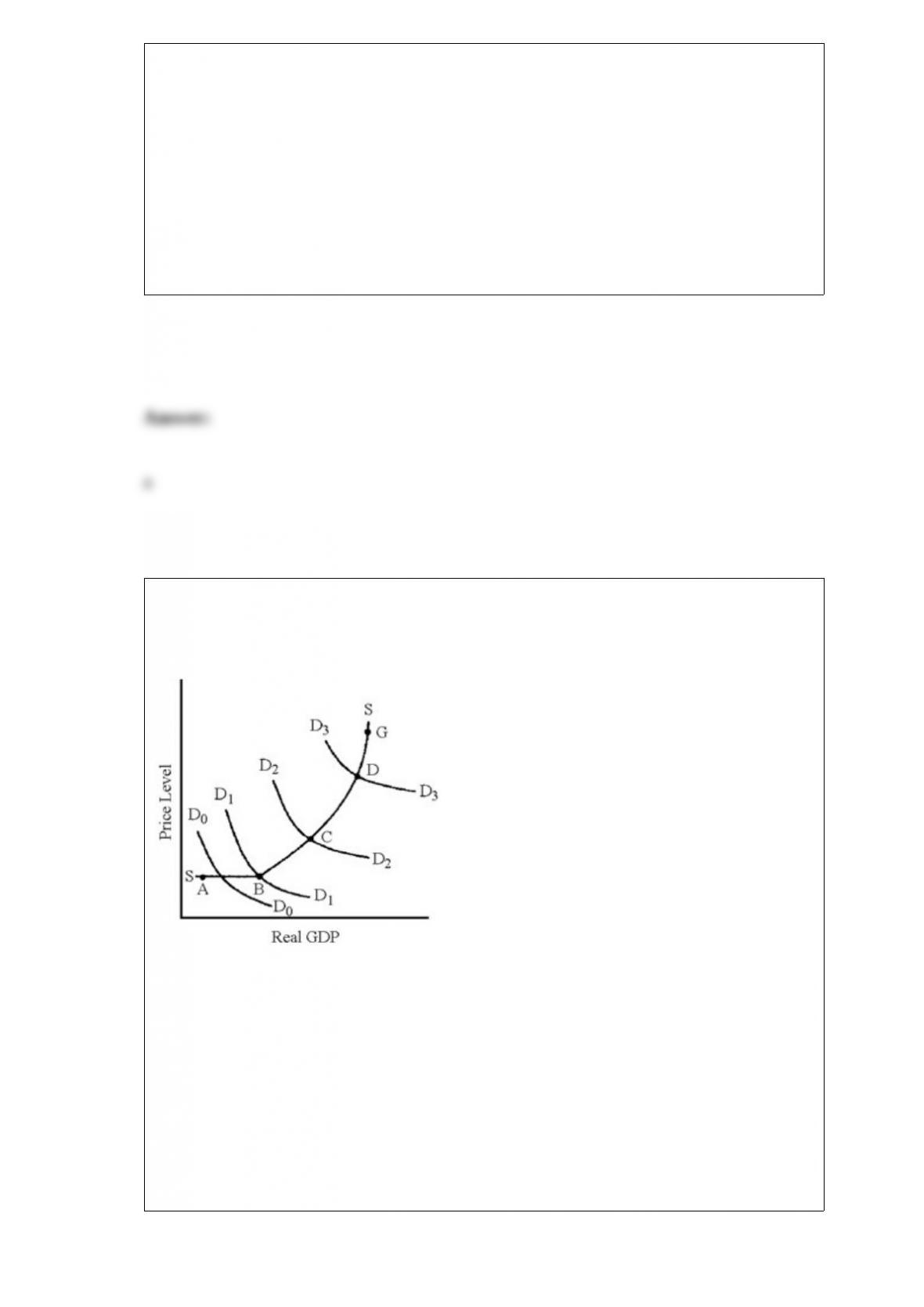
Figure 10-2
In Figure 10-2, which segment of the aggregate supply curve has the smallest multiplier
effect?
a. AB
b. BC
c. CD
d. DG

Government controls over market prices frequently “backfire.”
a. True
b. False
If the price elasticity of supply of doodads equals 0.50 and the price rises by 3 percent,
then the quantity supplied of doodads will rise by ____.
a. 0.50 percent.
b. 1.50 percent.
c. 6.00 percent.
d. 15 percent.
If one includes in-kind income in the calculation, the

a. official poverty rate becomes meaningless.
b. incidence of poverty actually increases.
c. poverty rate is unchanged.
d. fraction of the population in poverty drops.
The Department of Justice generally
a. is not involved in merger policy.
b. opposes horizontal mergers but permits conglomerate mergers.
c. opposes only mergers that might reduce competition.
d. opposes mergers whose apparent motive is obtaining economies of scale.
Activities that indiscriminately impose costs on others are externalities.
a. True
b. False

Stagflation can be defined as a combination of ____.
a. economic migration and inflation
b. economic aggregation and deflation
c. economic stagnation and inflation
d. economic aggregation and inflation
“Peak” pricing can best be defined as
a. setting higher prices to reflect higher demand.
b. pricing to obtain maximum profit.
c. setting price higher when demand is more elastic.
d. raising price to determine elasticity.

If a team from the NFC wins the Superbowl, we can accurately predict
a. the stock market will end the year higher than it started.
b. the stock market will end the year lower than it started.
c. the stock market will rise, then fall, and end the year unchanged.
d. nothing about future stock prices.
Which of the following would be a liability to a bank?
a. cash in the vault
b. a loan to a new business
c. a checking account of a professor
d. All of the above are correct.
Predictions of stock prices by stock market analysts
a. usually improve on simple extrapolation of past trends.
b. are good in both the short term and in the long term.
c. are poor since Wall Street does not pay enough to attract the best analysts.

d. are poor because of randomness.
If the economy is suffering a recession, inventories are probably falling.
a. True
b. False
The unit-elastic demand curve bends in the middle toward the origin of the graph and at
either end moves closer to the axes.
a. True
b. False

As interest rates rise, more and more investments become profitable for a firm.
a. True
b. False
Centrally planned economies are able to cope with environmental pollution issuesmuch
better than capitalist countries.
a. True
b. False
Which of the following groups would be most optimistic about the effects of economic
growth?
a. Environmentalists
b. Psychologists
c. Economists
d. All would be similar in their views

Adam Smith noted that people are adept at which of the following?
a. Confusing themselves if given the chance.
b. Proving the truth of “Murphy’s Law.”
c. Denying themselves for the sake of others.
d. Pursuing their own self-interest.
e. All of the above are correct.
Workers in American industry are more productive than those in many other countries
because of
a. the large supplies of machinery available.
b. abundant natural resources.
c. technical know-how.
d. All of the above contribute to American worker productivity.

The nation’s stock of capital can increase only when net new investment takes place.
a. True
b. False
Market economies have air and water pollution, but nonmarket economies
a. have much less pollution.
b. have pollution that is much worse than in market economies.
c. have about the same amount of pollution as market economies.
d. don’t generally suffer from external effects of any sort.
Antitrust laws are designed to
a. preserve competition.
b. protect the environment.
c. protect the public’s trust in the government.
d. all of the above.

If the aggregate demand curve shifts to the left and the aggregate supply curve shifts to
the right, the result will be a
a. decrease in the level of output.
b. decrease in the price level.
c. higher price level.
d. higher unemployment rate.
The removal in 1966 of the requirement that Catholics eat fish on Fridays was followed
by a 12.5 percent fall in prices of fresh fish. From this it can be deduced that the
a. demand curve for fish shifted to the left.
b. demand curve shifted to the right.
c. supply curve shifted to the left.
d. supply curve shifted to the right.

If the United States increased its budget deficit, and it is at or near full employment, the
most likely effect is to crowd
a. in investment and crowd out net exports.
b. out investment and crowd in net exports.
c. in investment and crowd in net exports.
d. out investment and crowd out net exports.
The federal government receives most of its revenue from three sources: personal
income tax, corporate income tax, and payroll tax.
a. True
b. False
Figure 10-7
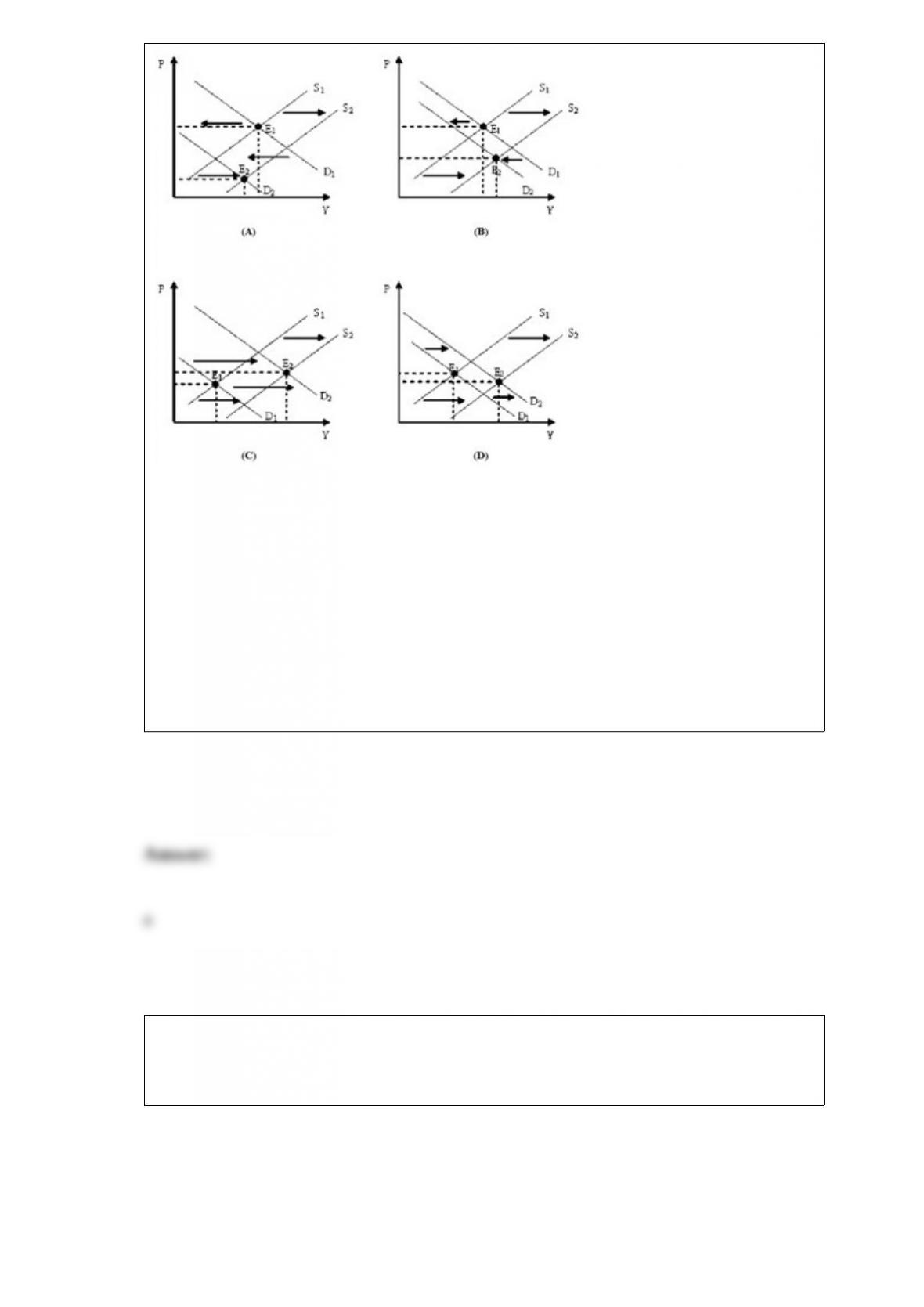
Which of the panels in Figure 10-7 shows an economic recession caused by primarily
by a change aggregate demand?
a. Panel (A)
b. Panel (B)
c. Panel (C)
d. Panel (D)
Figure 17-7
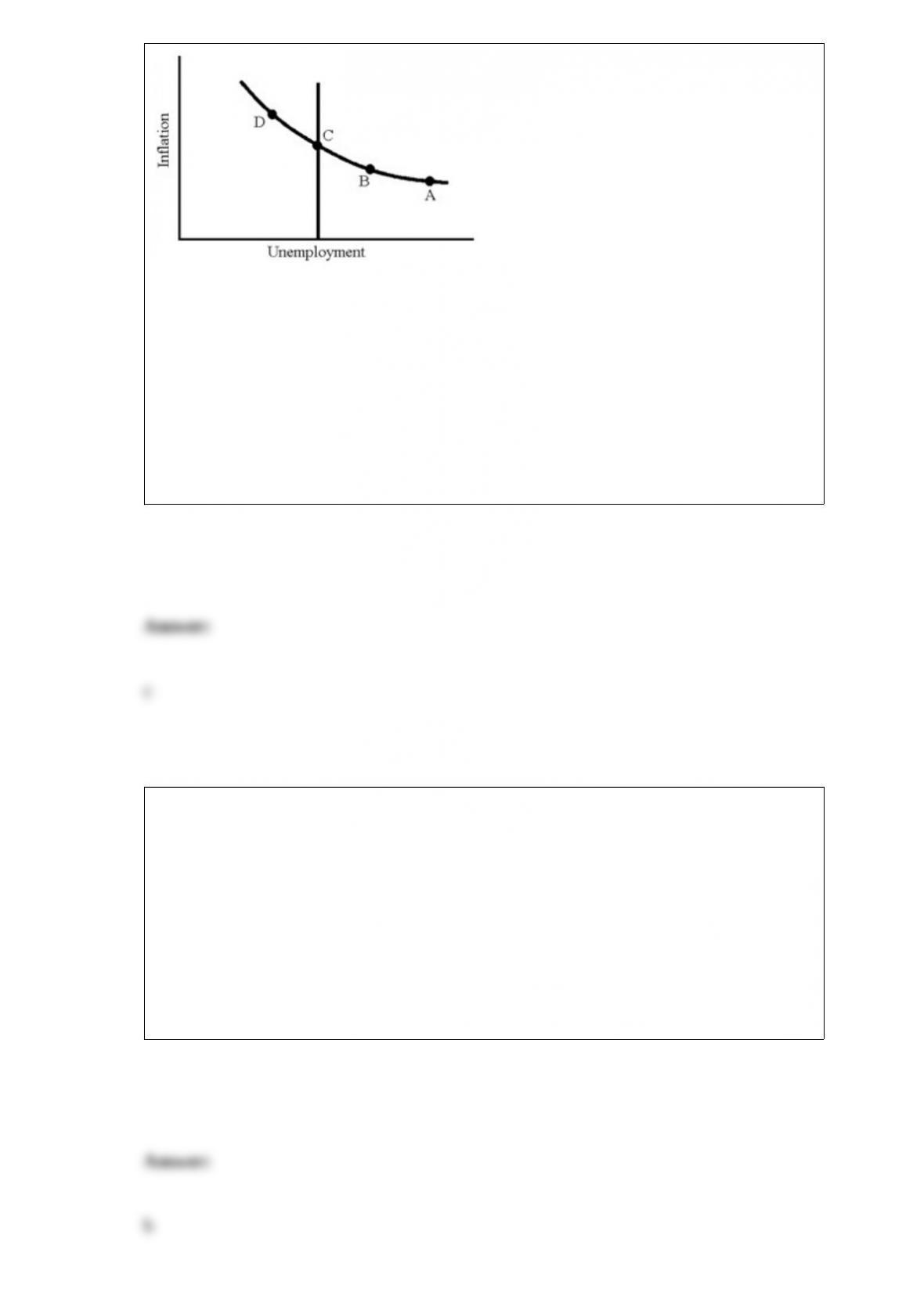
In Figure 17-7, the only sustainable long-run equilibrium position is at point
a. A.
b. B.
c. C.
d. D.
If you fall short of a certain minimum standard of living, you are poor; once you pass
this standard, you are no longer poor. This refers to the ____ definition of poverty.
a. average
b. absolute
c. relative
d. threshold

The net national debt is smaller than the gross national debt because
a. some debt is held by foreigners.
b. some debt is held by U.S. citizens.
c. some debt is held by government agencies.
d. the government does not have to pay all of the debt.
It is true that the distribution process carried out by the price system
a. accomplishes the task more efficiently than central planners would.
b. favors the rich.
c. is superior to other rationing mechanisms because it is able to pay attention to
individual consumer preferences.
d. All of the above are true.
In a floating exchange market, the exchange rate for pesos and yen will not change
when:
a. the yen trades at a rate below the equilibrium level

b. the peso trades at a rate above the equilibrium level
c. the currencies trade at the equilibrium exchange rate
d. it will change in all of these situations