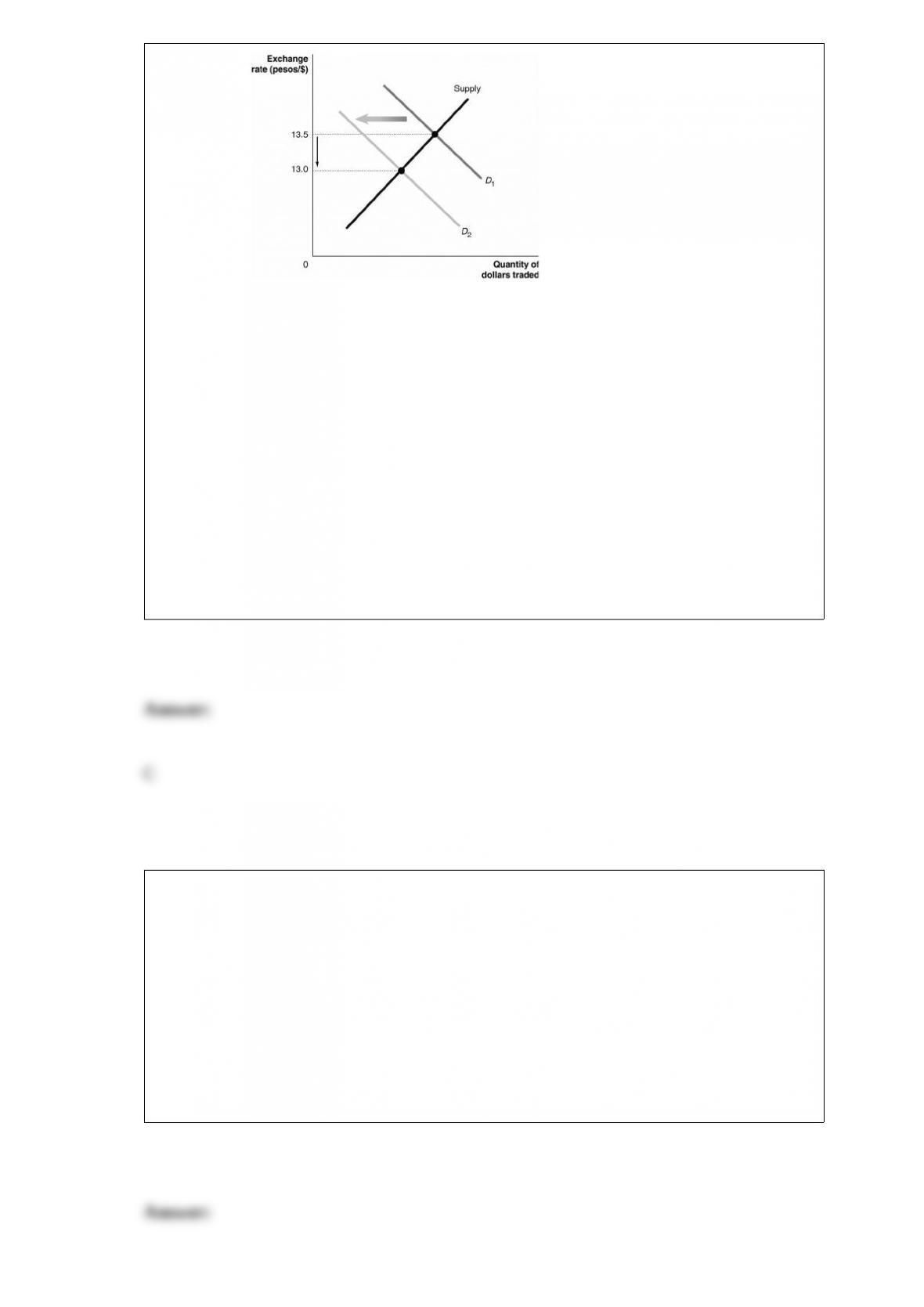
Figure 19-6
Which of the following would cause the change depicted in the figure above?
A) Lack of investment in infrastructure causes Mexican productivity to fall relative to
American productivity.
B) A possibility of diseased poultry in Mexico causes U.S. consumers to decrease their
preferences for Mexican-raised chickens relative to U.S.-raised chickens.
C) A new trade agreement with Mexico results in the United States removing all tariffs
on sugar imported from Mexico.
D) An expansionary monetary policy in Mexico causes an increase in the price level of
Mexican goods relative to U.S. goods.
If the government implements a price ceiling on insulin, this will
A) increase the price consumers will pay for insulin.
B) decrease the quantity of insulin the manufacturers will be willing to supply.
C) have to be set above the market equilibrium price to be effective.
D) encourage manufacturers to produce and sell more of insulin to increase their
profits.
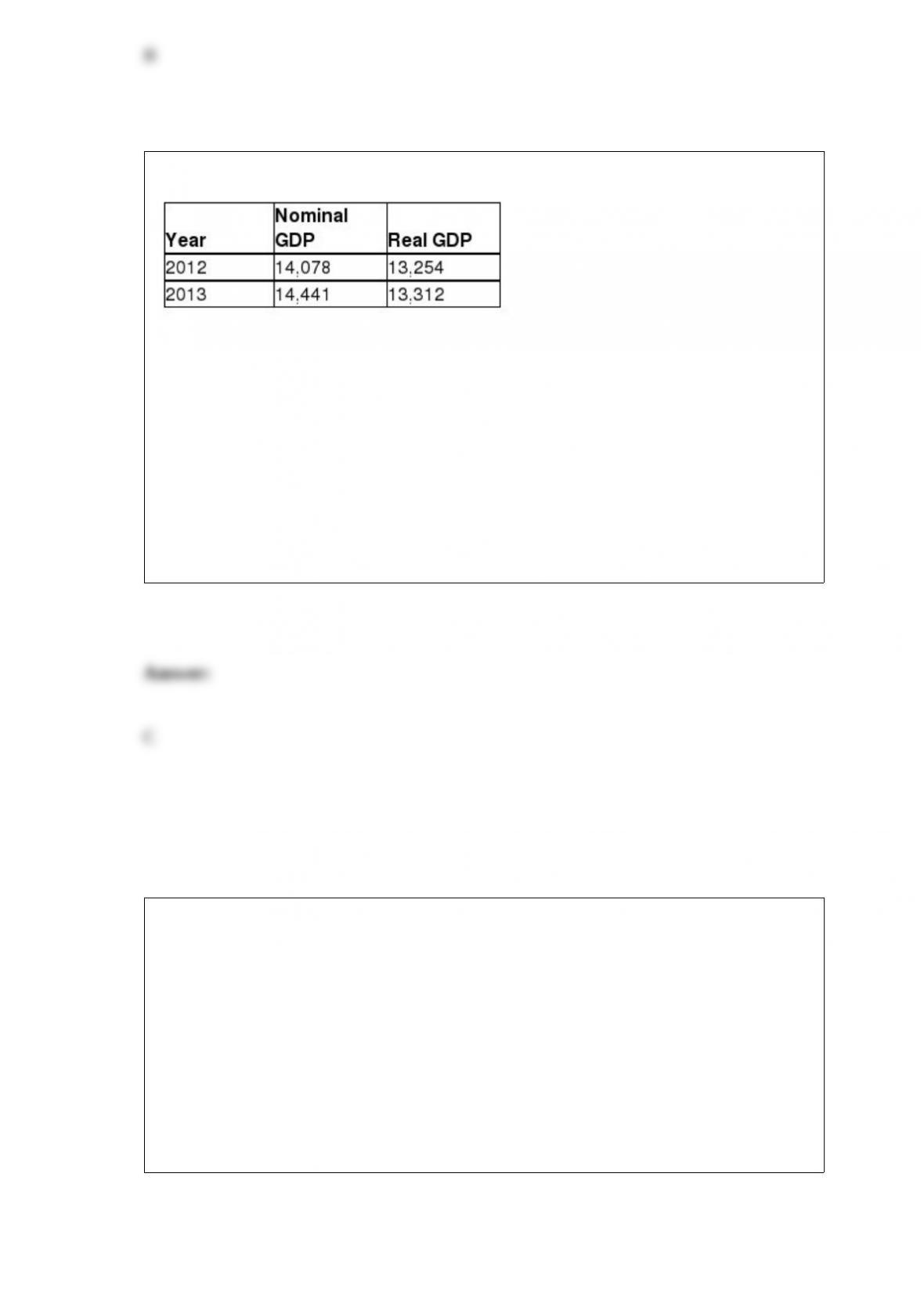
Table 19-14
Consider the following data on nominal GDP and real GDP (values are in billions of
dollars): The GDP deflator for 2013 equals
A) 92.2.
B) 102.6.
C) 108.5.
D) 109.1.
Economists Robert Jensen and Nolan Miller reasoned that to be a Giffen good, with an
income effect larger than its substitution effect, a good must be ________ and make up
a ________ portion of a consumer’s budget.
A) a normal good; very small
B) an inferior good; very small
C) a normal good; very large
D) an inferior good; very large
Refer to Figure 13-4. What is the area that represents the loss made by the firm?
A) the area P0adP3
B) the area P1bcP2
C) the area P0acP2
D) the area P2cdP3
If total variable cost exceeds total revenue at all output levels, a perfectly competitive
firm
A) should produce in the short run.
B) is making short-run profits.
C) should shut down in the short run.
D) has covered its fixed cost.
The production possibilities frontier model shows that
A) if consumers decide to buy more of a product, its price will increase.
B) a market economy is more efficient in producing goods and services than is a
centrally planned economy.
C) economic growth can only be achieved by free market economies.
D) if all resources are fully and efficiently utilized, more of one good can be produced
only by producing less of another good.
Minimum efficient scale is defined as the level of output at which
A) all economies of scale are exhausted.
B) diminishing returns affect average total cost.
C) the firm’s long-run average total cost starts falling.
D) the maximum output is produced.
Which of the following statements is true?
A) Japan is more dependent on foreign trade than is the United States.
B) Imports and exports account for over one-half of the GDP of Belgium.
C) France is the leading exporting country, accounting for 10 percent of total world
exports.
D) Because the cost of labor used on farms is so high, the United States exports very
little of its wheat, rice and corn crops.
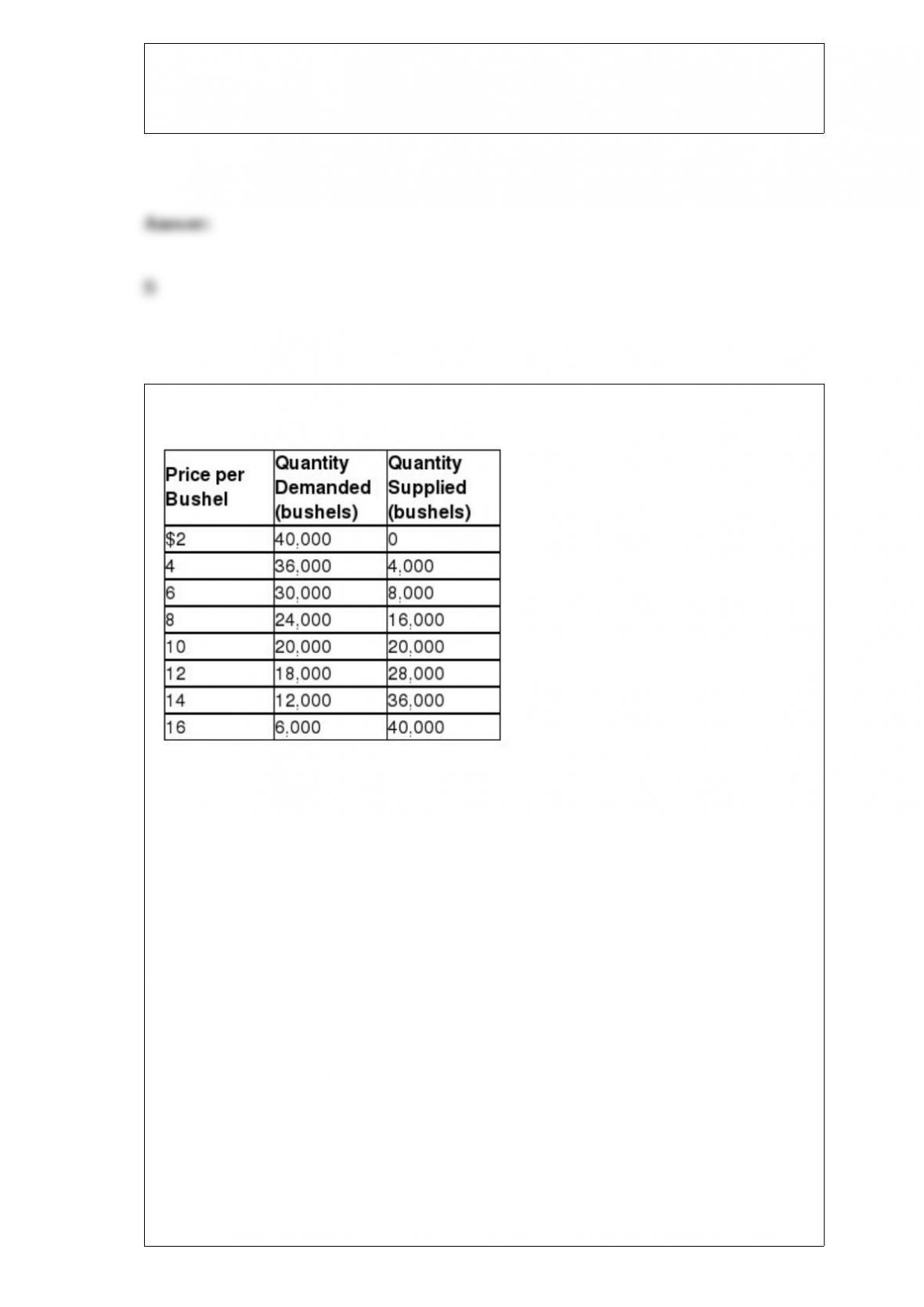
Table 3-6
The table contains information about the sorghum market. Use the table to answer the
following questions. a. What are the equilibrium price and quantity of sorghum?
b. Suppose the prevailing price is $6 per bushel. Is there a shortage or a surplus in the
market?
c. What is the quantity of the shortage or surplus?
d. How many bushels will be sold if the market price is $6 per bushel?
e. If the market price is $6 per bushel, what must happen to restore equilibrium in the
market?
f. At what price will suppliers be able to sell 36,000 bushels of sorghum?
g. Suppose the market price is $14 per bushel. Is there a shortage or a surplus in the
market?
h. What is the quantity of the shortage or surplus?
i. How many bushels will be sold if the market price is $14 per bushel?
j. If the market price is $14 per bushel, what must happen to restore equilibrium in the
market?
Actual investment spending does not include
A) spending on consumer durable goods.
B) spending on new capital equipment.
C) spending on new houses.
D) changes in inventories.

Why doesn’t the Fed have both a money supply target and an interest rate target?
A) Short-term interest rates do not respond to changes in the money supply, which the
Fed can control.
B) The Fed does not control money demand.
C) The Fed cannot offset the impact of changes in cash management by the public or
changes in lending policies of commercial banks on the money supply.
D) Only the level of interest rates matters when we consider rates of growth in real
GDP, employment, and rates of price inflation.
A narrow definition of monopoly is that a firm is a monopoly if it can ignore
A) government antitrust laws.
B) the pricing decisions of its suppliers.
C) the pricing decisions of firms that produce complementary products.
D) the actions of all other firms.
When prices are rising, which of the following will be true?
A) The real interest rate will be lower than the nominal interest rate.
B) The real interest rate will be negative.
C) The real interest rate will be higher than the nominal interest rate.
D) The nominal interest rate will be negative.