
Anything of value owned by a person or a firm is
A) an asset.
B) a liability.
C) wealth.
D) owner’s yield.
Which of the following is true for a monopolist?
A) Being the only seller in the market, the monopolist faces a perfectly inelastic
demand curve.
B) Being the only seller in the market, the monopolist faces a perfectly elastic demand
curve.
C) Being the only seller in the market, the monopolist faces the market demand curve.
D) Being the only seller in the market, the monopolist faces a downward sloping
demand curve that lies below the marginal revenue curve.
Wage differences can be explained by all of the following except
A) compensating differentials.

B) differences in marginal revenue products.
C) economic discrimination.
D) comparable worth.
A change in all of the following variables will change the market demand for a product
except
A) the price of the product.
B) population and demographics.
C) income.
D) tastes.
A firm that successfully differentiates its product or lowers its average cost of
production creates
A) value for its customers.
B) entry barriers into its market.
C) a perfectly inelastic demand curve for its product.
D) economies of scale.
Economic efficiency in a free market occurs when
A) consumer surplus is maximized.
B) producer surplus is maximized.
C) the sum of consumer surplus and producer surplus is maximized.
D) price is as low as possible.
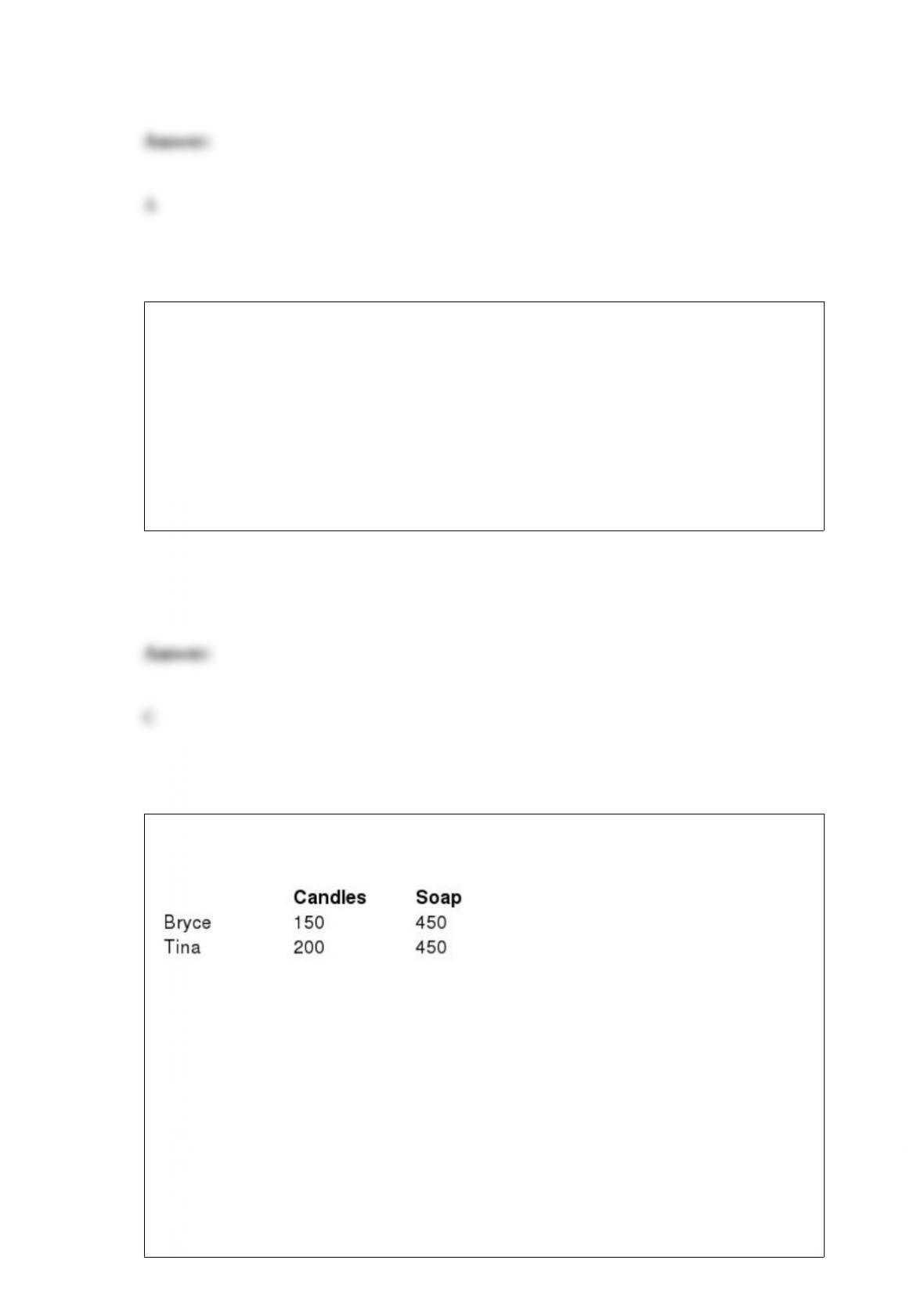
Table 9-3
Bryce and Tina are artisans who produce homemade candles and soap. Table 9-3 lists
the number of candles and bars of soap Bryce and Tina can each produce in one month.
Refer to Table 9-3. Select the statement that accurately interprets the data in the table.
A) Bryce has a greater opportunity cost than Tina for making candles.
B) Bryce’s opportunity cost for making candles is less than Tina’s.
C) Tina has a greater opportunity cost than Bryce for making candles.
D) Bryce’s opportunity cost for making candles and making soap are both greater than

Tina’s.
On an isoquant/isocost graph, the least cost input combination of producing a given
output is
A) any point on the isoquant curve.
B) any point on the isocost curve.
C) given by the tangency between the isoquant curve and the isocost line.
D) one of the intercept values on the graph.
According to Steven Cheung: “Pollination contracts usually include stipulations
regarding the number and strength of …[bee] colonies, the rental fee per hive, the time
of delivery…the protection of bees from pesticides, and the strategic placing of hives.”
Cheung cites this as evidence that
A) the high costs of writing and enforcing complicated written agreements between
owners of beehives and apple orchards prevents economic efficiency from being
achieved in these markets.
B) government intervention is not always necessary to bring about an economically
efficient number of apple trees and beehives.
C) government regulation of contracts between owners of beehives and apple orchards
is necessary to bring about an economically efficient number of apple trees and
beehives.
D) the beekeeping and apple growing businesses have become more complicated and
costly over time due to the legal costs involved.
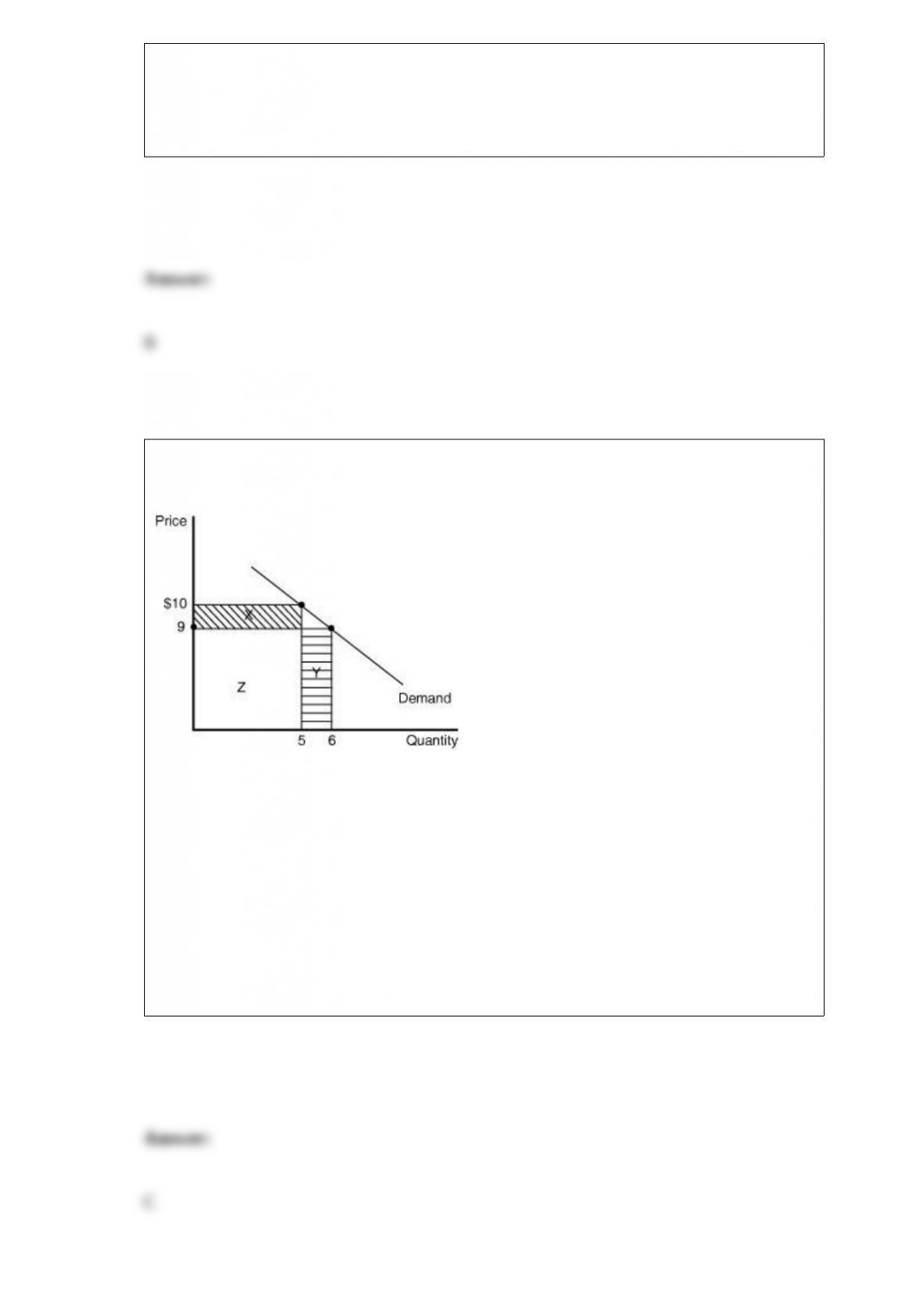
Figure 13-3
Refer to Figure 13-3. The marginal revenue from one additional unit sold is the sum of
the gain in revenue from selling the additional unit and the loss in revenue from having
to charge a lower price to sell the additional unit. Based on the diagram in the figure,
A) X represents the gain (price effect) and Y the loss (output effect).
B) X + Z represents the loss (output effect) and Y the gain (price effect).
C) Y represents the gain (output effect) and X the loss (price effect).
D) X represents the loss (price effect) and Y + Z the gain (output effect).
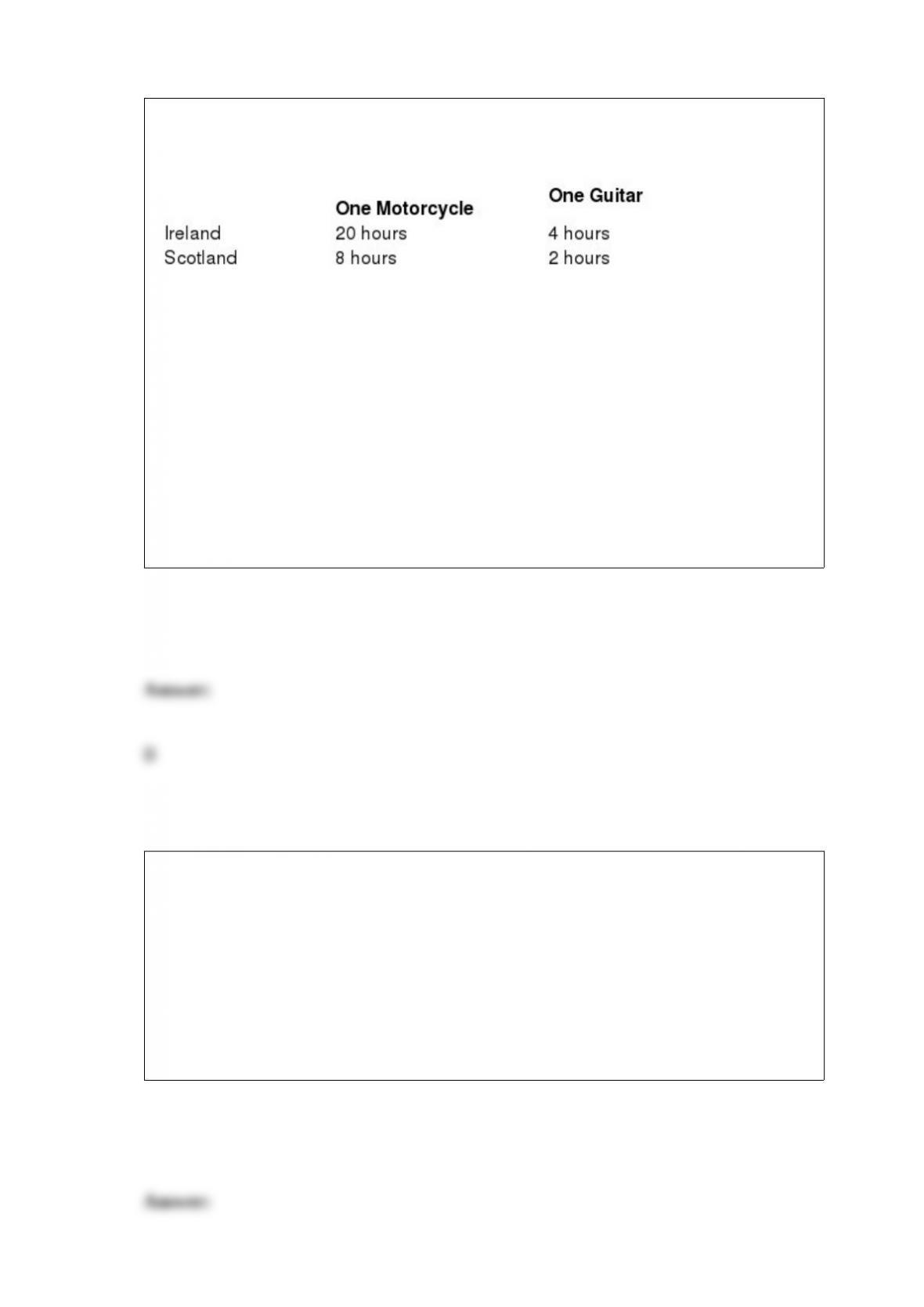
Table 2-11
Table 2-11 shows the number of labor hours required to produce a motorcycle and a
guitar in Ireland and Scotland.
Refer to Table 2-11. What is Ireland’s opportunity cost of producing one motorcycle?
A) 0.2 guitar
B) 5 guitars
C) 8 guitars
D) 32 guitars
Yield management is the practice of
A) determining production functions to minimize production costs.
B) forecasting competitors’ responses to price changes.
C) using buyer data to rapidly adjust prices.
D) using information technology to find the best interest rate.
In the United States, the average person mostly patronizes firms that operate in
A) perfectly competitive markets.
B) monopolistically competitive markets.
C) oligopoly markets.
D) monopoly markets.
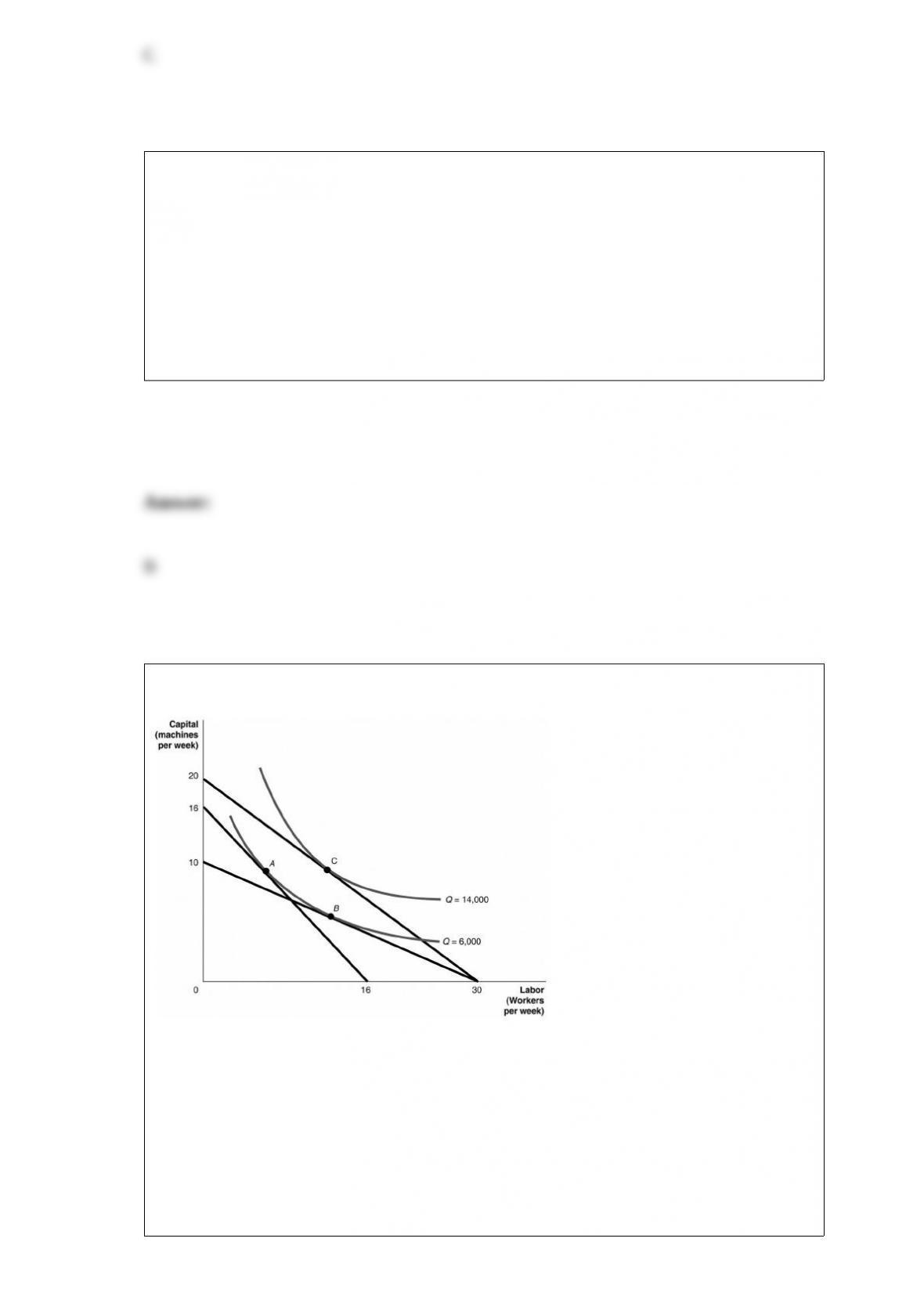
Use the following graph to answer the following questions.
a. If the wage rate and the rental price of machines are both $50 and total cost is $800,
is the cost-minimizing point A, B, or C?
b. If the wage rate is $40, the rental price of equipment is $120, and total cost is $1,200,
is the cost-minimizing point A, B, or C?
c. If the wage rate is $60, the rental price of equipment is $90, and total cost is $1,800,
is the cost-minimizing point A, B, or C?
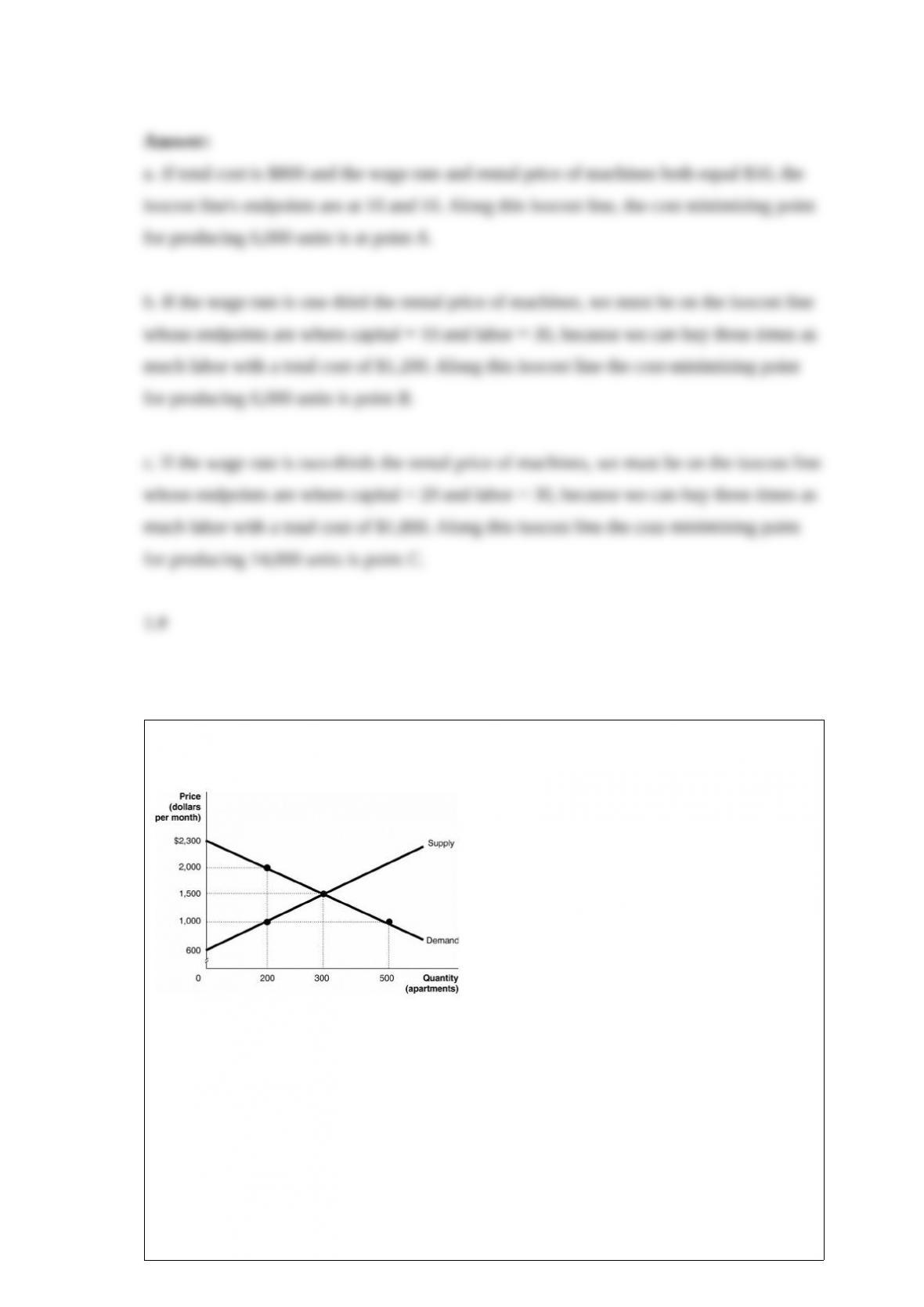
Figure 4-5
Figure 4-5 shows the market for apartments in Springfield. Recently, the government
imposed a rent ceiling of $1,000 per month.
Refer to Figure 4-5. What is the value of the portion of producer surplus transferred to
consumers as a result of the rent ceiling?
A) $40,000
B) $100,000
C) $125,000
D) $140,000
Economic discrimination takes place when an employer
A) pays workers the lowest wage possible.
B) pays workers different wages on the basis of some arbitrary characteristics of
workers that are irrelevant to the job performed.
C) pays lower wages to workers who are not as productive as other workers.
D) pays workers compensating wage differentials.
Table 12-4
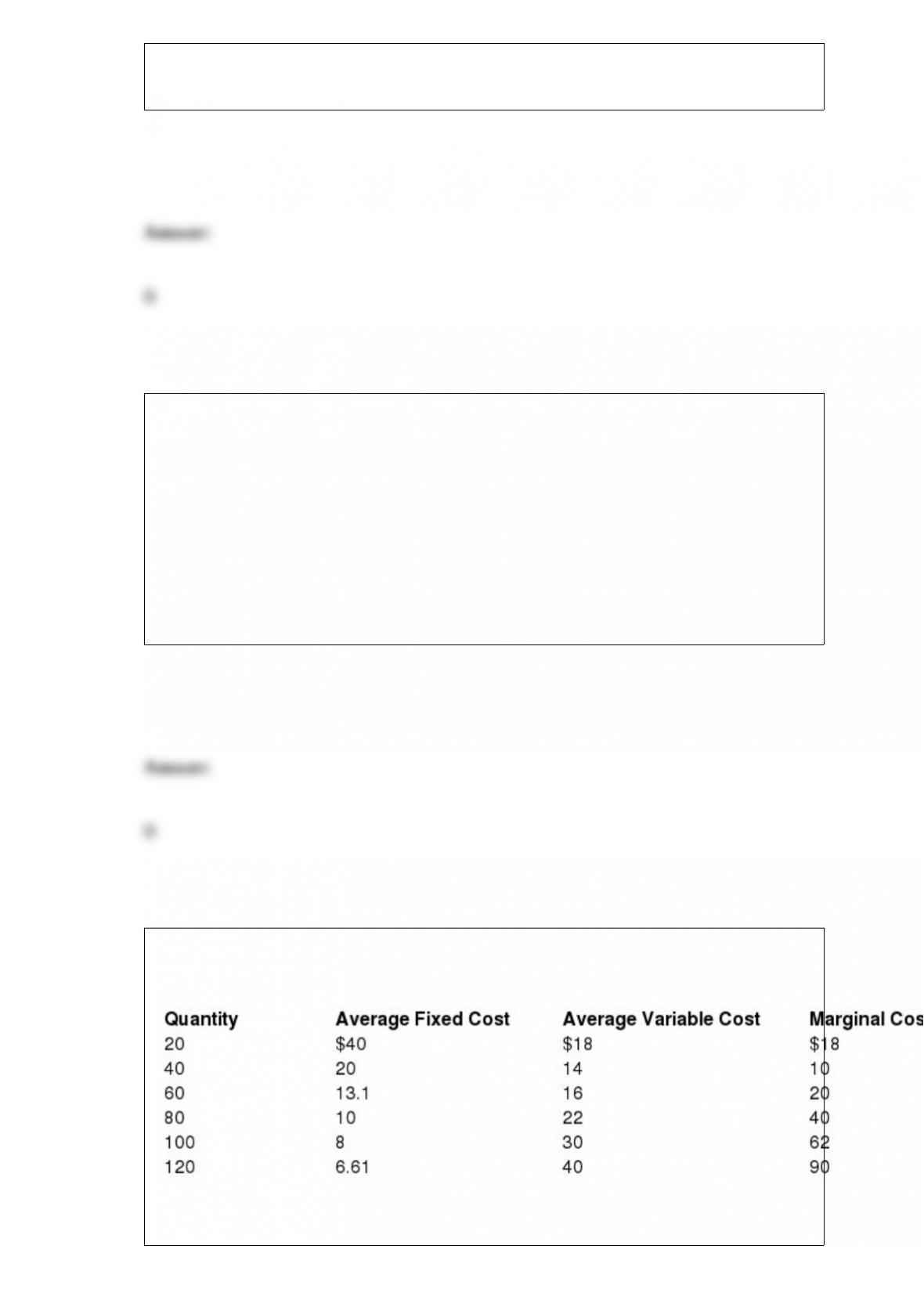
Table 12-4 shows the short-run cost data of a perfectly competitive firm. Assume that

output can only be increased in batches of 20 units.
Refer to Table 12-4. If the market price is $45, the firm
A) earn a profit of $3,600.
B) will suffer a loss of $200.
C) will break even.
D) will earn profit of $1,040.
Because consumers who have insurance provided by their employers usually only pay a
deductible for a visit to the doctor’s office
A) employers have more incentive to allow employees time off for doctor visits.
B) doctors have less incentive to control their costs.
C) insurance companies have more incentive to approve medical procedures for their
policy holders.
D) consumers have less incentive to visit the doctor’s office on a more frequent basis.
Which of the following is nota reason why government officials are willing to impose
entry barriers?
A) to raise revenue

B) to encourage innovation which may improve the standard of living in the long run
C) to increase economic efficiency
D) to promote an equitable distribution of income
Consider the following methods of pollution reduction:
a. the government sets a target for maximum emissions
b. the government mandates the installation of specific pollution abatement equipment
c. the government imposes a per unit tax on the good that creates pollution
d. the government gives firms a tax rebate for every unit of pollution abated
Which of the above is an example of a command and control approach to reducing
pollution?
A) a only
B) b only
C) a and b only
D) a, b, and d only
E) a, b, c, and d
In the United States in 2012, the percentage of people without any form of health
insurance was about
A) 16%.
B) 29%.
C) 64%.
D) 83%.
Figure 15-18
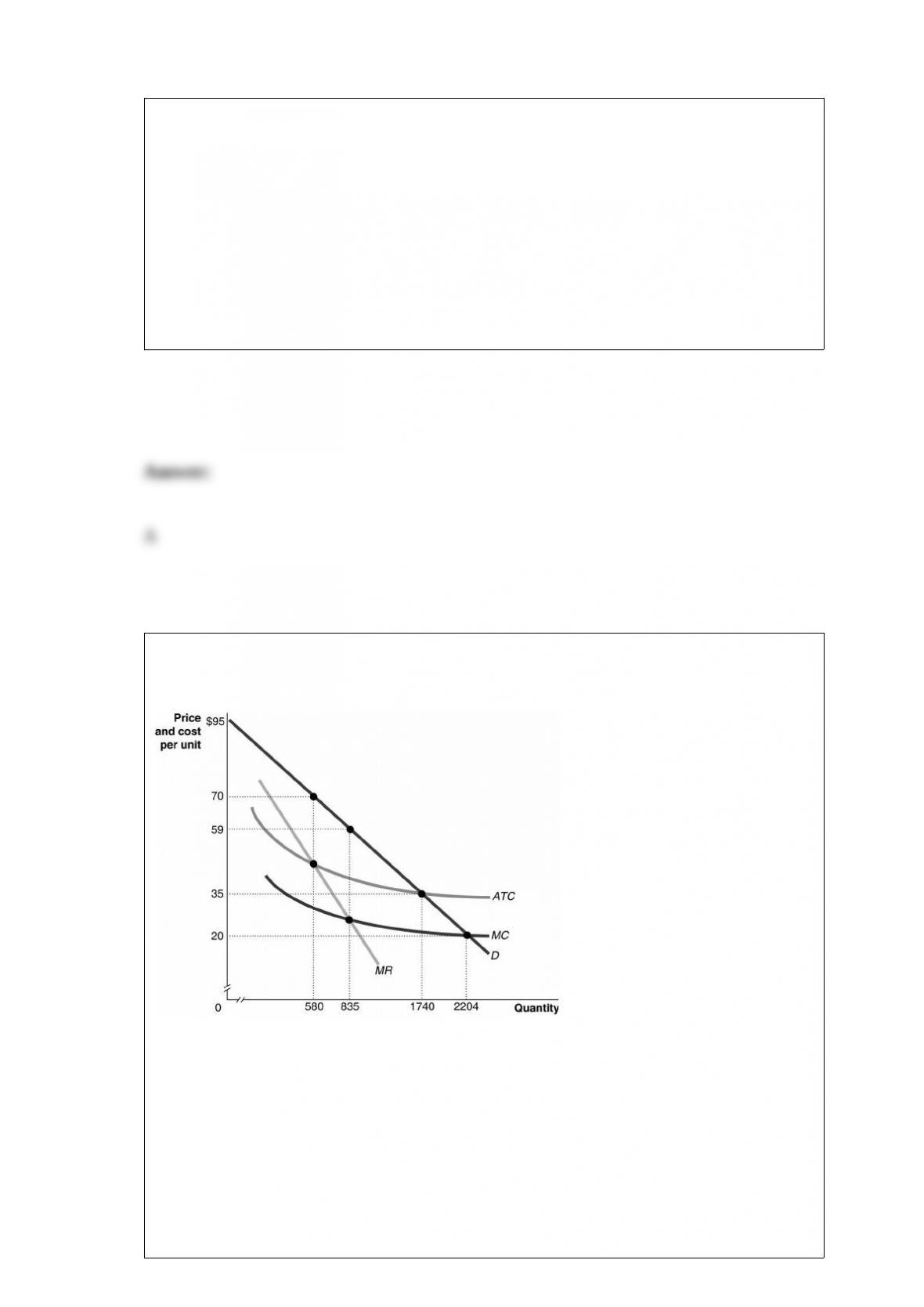
Refer to Figure 15-18 to answer the following questions.
a. What quantity will this monopoly produce and what price will it charge?
b. Suppose the monopoly is regulated. If the regulatory agency wants to achieve
economic efficiency, what price should it require the monopoly to charge?
c. To achieve economic efficiency, what quantity will the regulated monopoly produce?
d. Will the regulated monopoly make a profit if it charges the price that will achieve
economic efficiency?
e. Suppose the government decides to regulate the monopoly by imposing a price
ceiling of $35. What quantity will the monopoly produce and what price will the
monopoly charge?
f. With the price ceiling of $35, what profit will the monopoly earn?
Figure 10-1
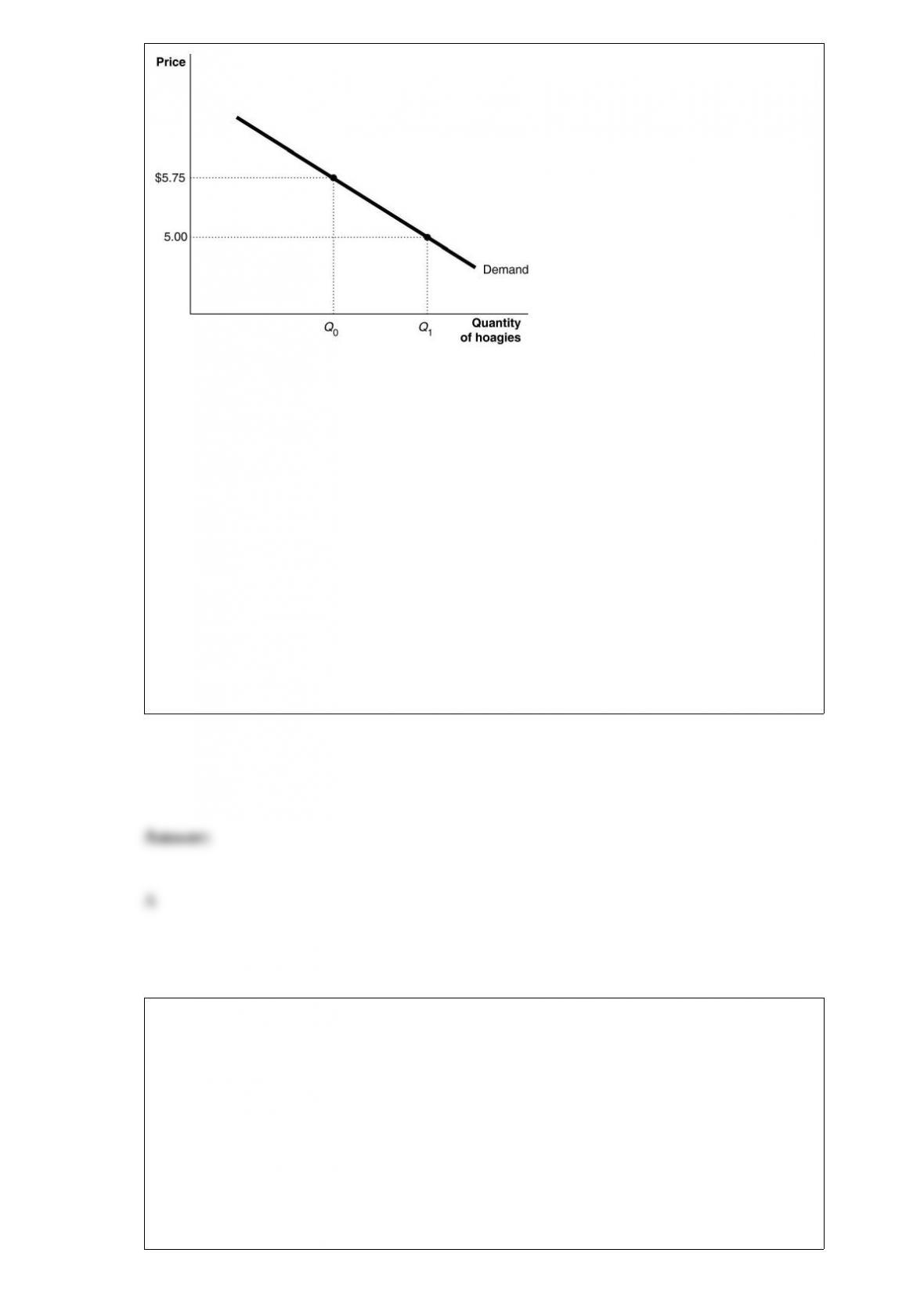
Refer to Figure 10-1. Which of the following statements is true?
A) Quantities Q0 and Q1 are the utility-maximizing quantities of hoagies at two
different prices of hoagies.
B) Quantities Q0 and Q1 may not necessarily be the utility-maximizing quantities of
hoagies at two different prices because we have no information on the consumer’s
budget or the price of other goods.
C) Quantity Q0 could be a utility-maximizing choice if the price is $5.75, but quantity
Q1 may not be because we have no information on the marginal utility per dollar when
price changes.
D) Quantities Q0 andQ1 are derived independently of the utility-maximizing model.
Assume that the tuna fishing industry is perfectly competitive. Which of the following
best characterizes the industry if, as demand for tuna increases, fishing boats have to go
farther into the ocean to harvest tuna?
A) a constant-cost industry
B) an increasing-cost industry
C) a decreasing-cost industry

D) a fixed-cost industry
In a study conducted by Marianne Bertrand and Sendhil Mullianthan, identical resumes
were sent in response to help wanted ads in newspapers, with half of the resumes
assigned an African-American-sounding name and half assigned a white-sounding
name. The study found that
A) employers were equally likely to interview workers with white-sounding names and
with African-American-sounding names.
B) employers were 50 percent less likely to interview workers with
African-American-sounding names.
C) employers were 50 percent less likely to interview workers with white-sounding
names.
D) no employers chose to interview workers with African-American-sounding names.
Basic supply and demand analysis indicates that having firms rather than the
government provide health insurance to workers
A) changes both the composition of the compensation that firms pay and its level.
B) changes the composition of the compensation that firms pay, but does not change its
level.
C) does not change the composition of the compensation that firms pay, but does

change its level.
D) changes neither the composition of the compensation that firms pay nor its level.
Which of the following would cause both the equilibrium price and equilibrium
quantity of potatoes (assume that potatoes are an inferior good) to decrease?
A) an increase in consumer income
B) a freeze that sharply reduces potato output
C) a decrease in consumer income
D) a technological advancement that results in a bumper crop of potatoes
The demand for all carbonated beverages is likely to be ________ the demand for Dr.
Pepper.
A) more elastic than
B) perfectly elastic compared to
C) less elastic than
D) perfectly inelastic compared to
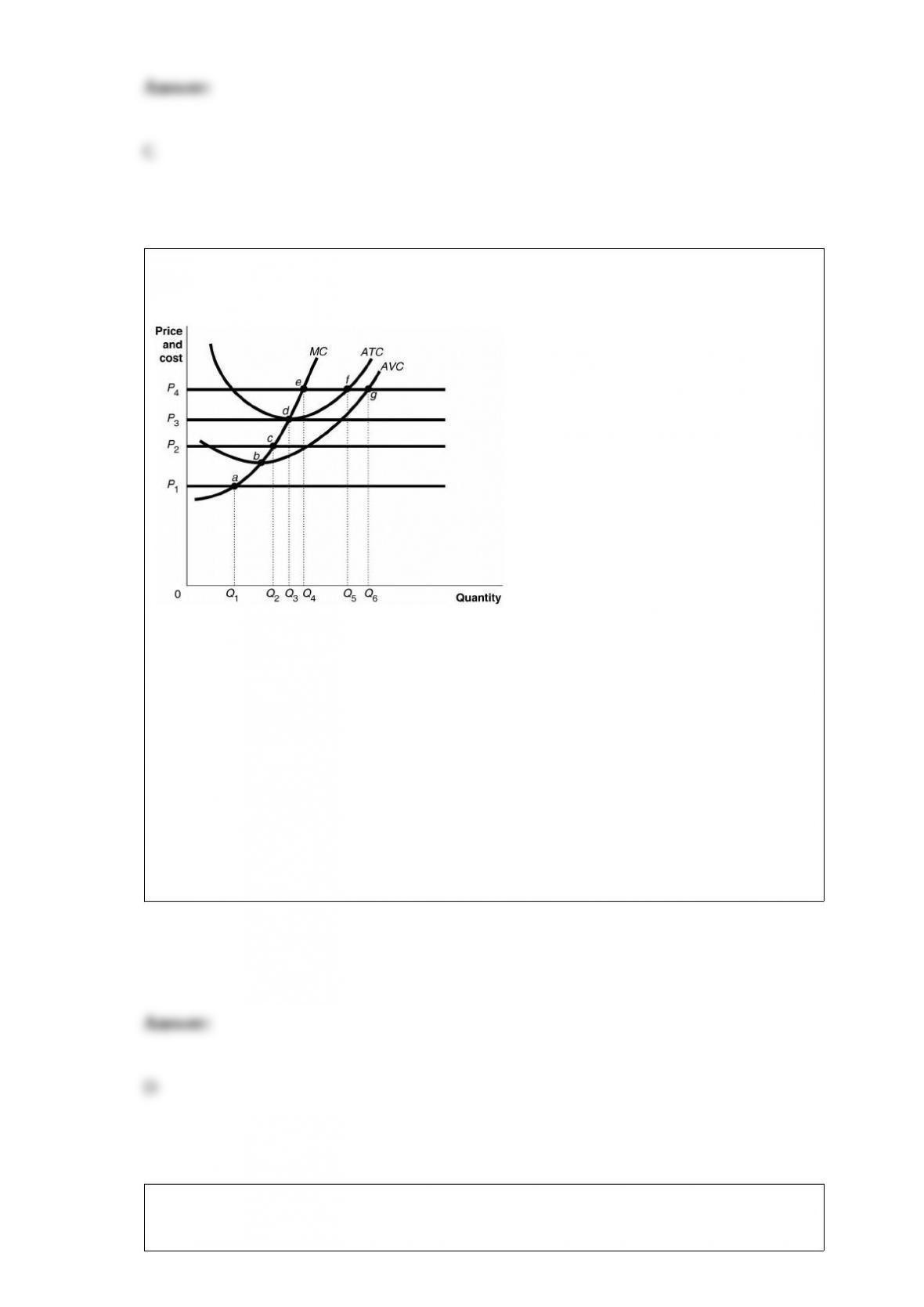
Figure 12-9
Figure 12-9 shows cost and demand curves facing a profit-maximizing, perfectly
competitive firm.
Refer to Figure 12-9. At priceP3, the firm would
A) lose an amount equal to its fixed cost.
B) lose an amount more than fixed cost.
C) lose an amount less than fixed cost.
D) break even.
When a monopolistically competitive firm cuts its price to increase its sales, it
experiences a loss in revenue due to the

A) substitution effect.
B) income effect.
C) price effect.
D) output effect.
Abercrombie & Fitch wants to raise $8 million to finance the construction of a new
store, and the company wishes to raise the funds through direct finance. Which of the
following methods could it use?
A) It could sell $8 million in bonds.
B) It could borrow $8 million from a bank.
C) It could issue $8 million in stocks.
D) It could choose either A or C.
Figure 5-1
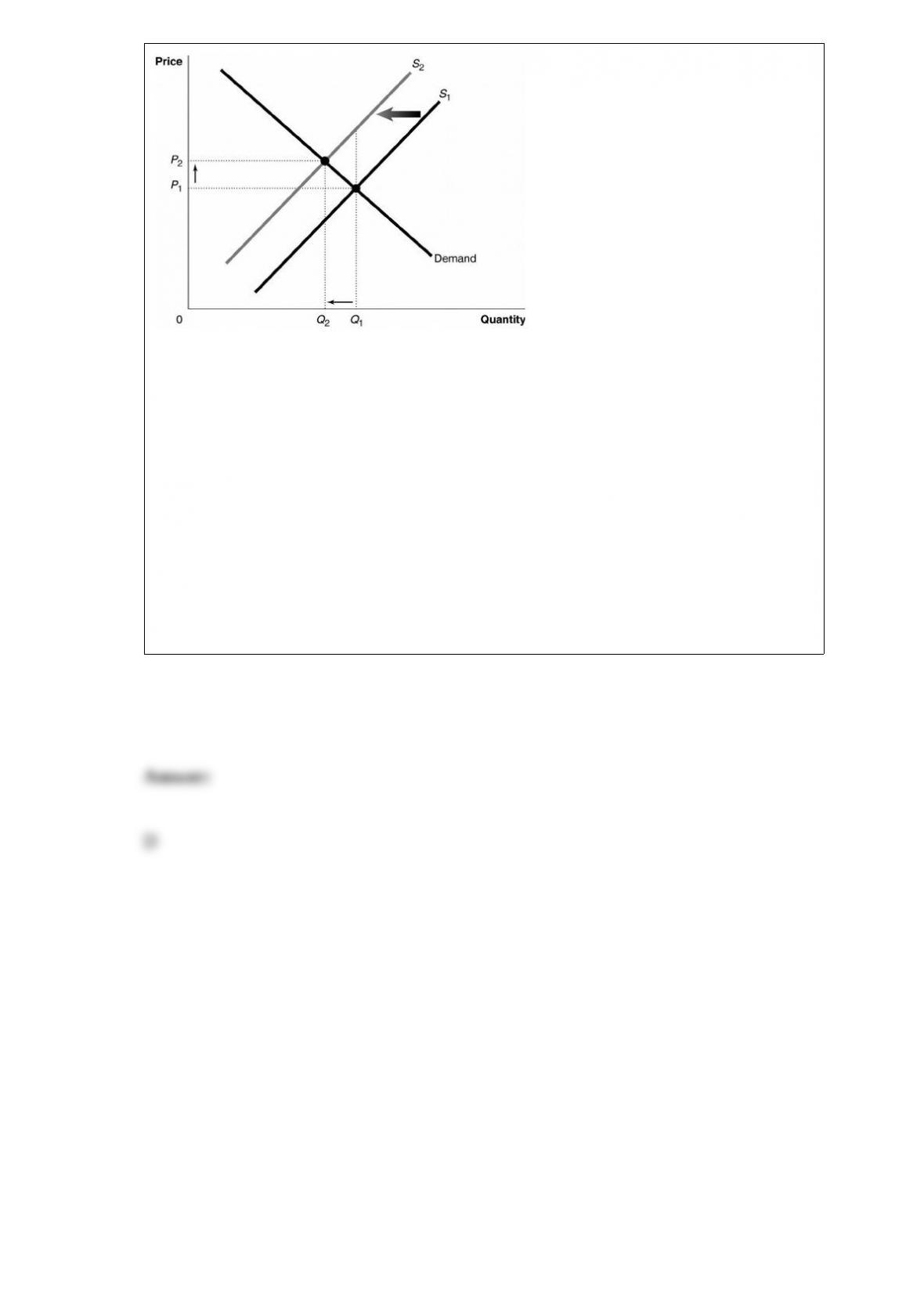
Figure 5-1 shows a market with an externality. The current market equilibrium output of
Q1 is not the economically efficient output. The economically efficient output is Q2.
Refer to Figure 5-1. If, because of an externality, the economically efficient output is
Q2 and not the current equilibrium output of Q1, what does S1 represent?
A) the market supply curve reflecting external cost
B) the market supply curve reflecting implicit cost
C) the market supply curve reflecting social cost
D) the market supply curve reflecting private cost